The incredible story of PK Nair, India’s most respected film archivist, has now been documented!

On the 3rd of May later this year, an anniversary of epic proportions will occur. For it was on that day in 1913, one hundred years ago, that “Raja Harishchandra”, the silent film produced and directed by Dadasaheb Phalke which is widely accepted as the first Indian full-length feature film, was released. In effect, the day marks the existence of one hundred years of Indian cinema. And what a glorious century it has been!

Of the many ways in which this anniversary is likely to be commemorated, we at TCRC are particularly excited about the release of Shivendra Singh Dungarpur’s National Award-winning documentary “Celluloid Man” on 3rd May 2013. The film showcases the life and work of legendary Indian archivist and founder of National Film Archive of India (NFAI), PK Nair.  Given below is an excerpt from the film:

The film is said to feature interviews with many leading film personalities including including Krzysztof Zanussi, Lester James Peries, Vidhu Vinod Chopra, Saeed Akhtar Mirza, Gulzar, Basu Chatterjee, Naseeruddin Shah, Kamal Haasan, Girish Kasaravalli, Jahnu Barua, Jaya Bachchan, Dilip Kumar, Saira Banu, Sitara Devi, Santosh Sivan, Rajkumar Hirani, Shyam Benegal, Mahesh Bhatt, Yash Chopra, Ramesh Sippy and Mrinal Sen, all of whom share their reflections on the influence of PK Nair on the films that they watched and loved. In the 2012 National Film Awards, “Celluloid Man” won accolades for Best Editing and Best Biographical/Historical Reconstruction.

PK Nair, now 80 years old, has meanwhile spoken about how the prints of films such as “Raja Harishchandra,” “Alam Ara,” etc are not available at all and has lamented the loss of many important films made before the 1950s (click here to read that whole story).

We at TCRC salute PK Nair, or Nair Saab as he is known, for his commitment to archiving the early days of Indian cinema. May his tribe only grow.

Film v/s Digital: Answers to the big question

We at TCRC recently chanced upon an interview with Senthil Kumar, the co-founder of Real Image Technologies & Qube Cinema, companies which are said to be among the best as far as cinema exhibition technology is concerned. In this interaction with blog Pulse72+, Senthil had an interesting response to a query where he is asked to give five reasons as to why someone should choose digital filmmaking over conventional filmmaking. Here’s what he had to say:

Senthil Kumar, co-founder of Real Image Technologies. Photo Courtesy: IndianTelevision.com

Anything digital will keep improving in quality over time while the price reduces so it’s usually a certainty that digital will triumph. In the case of shooting, the future was obvious because of the precedent set by still photography – for many years now, it’s been hard to see a film camera in use, let alone buy and process film negative! So a key plus for digital is the reduced cost of equipment – which is now economic enough that a production can buy the equipment just for a film rather than rent it. The second reason is the very low cost and reusable nature of hard drives in digital when compared to film stock – this allows for shooting difficult subjects like children and animals or even amateur actors where it’s often necessary to just keep the camera running in order to get the shot you want. Another reason is the lack of film grain and hence the randomness that makes compositing and other special effects harder on film-originated material. The fourth reason is the excellent low-light performance of digital cameras where just the light of a candle is sufficient when the scene calls for it. And finally, digital now has a very wide dynamic range, the range of light within a shot, from the darkest to the brightest part. This is especially because of the new High Dynamic Range (HDR) techniques available in some digital cinema cameras. There are more reasons to use digital cameras but these would be some of the top ones.”

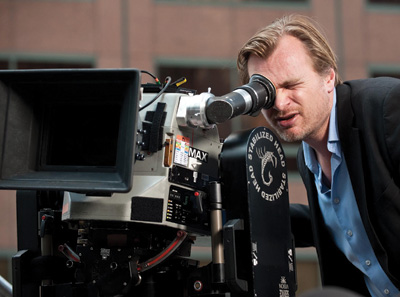
However, not everyone seems to share his enthusiasm for digital cinema. Director Christopher Nolan, best known for powerful films such as “Memento,” “The Dark Knight,” and “Inception,” has spoken about the advantages offered by film numerous time. We found his argument in an interview to the Directors Guild of America (DGA) Quarterly particularly compelling. Here’s what he had to say:

Director Christopher Nolan. Photo Courtesy: DGA Quarterly

For the last 10 years, I’ve felt increasing pressure to stop shooting film and start shooting video, but I’ve never understood why. It’s cheaper to work on film, it’s far better looking, it’s the technology that’s been known and understood for a hundred years, and it’s extremely reliable. I think, truthfully, it boils down to the economic interest of manufacturers and [a production] industry that makes more money through change rather than through maintaining the status quo. We save a lot of money shooting on film and projecting film and not doing digital intermediates. In fact, I’ve never done a digital intermediate. Photochemically, you can time film with a good timer in three or four passes, which takes about 12 to 14 hours as opposed to seven or eight weeks in a DI suite. That’s the way everyone was doing it 10 years ago, and I’ve just carried on making films in the way that works best and waiting until there’s a good reason to change. But I haven’t seen that reason yet.”

That said, Christopher Nolan, Steven Spielberg, etc are said to be amongst the few in Hollywood today who still prefer to shoot only on film. Digital filmmaking is clearly the dominant mode there. And the struggle here really seems to be a question of aesthetics and choice, with filmmakers like Nolan fighting for film to remain an option whose existence is threatened by the convenience that digital cinema claims to offer.

And as if to prove the importance of the ‘film v/s digital’ question, actor Keanu Reeves has produced a documentary called “Side By Side” on the same issue (see trailer below). We at TCRC loved what Martin Scorsese had to say and if we were asked for our take on the issue, that is exactly what we’d say.

Understanding Devdas

The story of Devdas has got to be one of the most popular tales to have been embraced by Indian cinema. There have been a number of versions in a variety of languages. Some movie versions have remained largely faithful to Sarat Chandra Chattopadhyay’s original novella, while others have added their own twists and turns, reinterpreting the original story to suit the demands of the time period in which they were set.

Dilip Kumar & Shahrukh Khan as Devdas. Photo Courtesy: IBN Live.

This week, we at TCRC bring you a couple of pieces of academic writing on Devdas. The first is “The Devdas Phenomenon” by Corey K Creekmur, who is the head of Film Studies at the University of Iowa. He writes about the three versions of Devdas in Hindi cinema and also, discusses the original book on which these interpretations were based (click here to read his paper).

The second is “Devdas: India’s Emasculated Hero, Sado-masochism and Colonialism” by Poonam Arora, who is a professor of English at the University of Michigan – Dearborn. She writes about how the “Devdas narrative discursively construct a prototypical colonial male subjectivity.” (click here to read her paper).

And here’s a clip from PC Barua’s “Devdas”. This was released in 1935.

Happy b’day, Charlie Chaplin!

Wear a shabby suit,
And a bowler hat.
Swing a cane,
And sport a toothbrush ‘stache.
Turn into Chaplin, 
for he was a comic genius.
He taught us how to laugh,
and made the business of comedy, serious.” 

Comedy king Charlie Chaplin was born this very day back in 1889. He may have passed away in 1977. But he lives on through his movies, which have spread joy and cheer while making us reflect on the vagaries of life.

One of the best tributes to Chaplin that we at TCRC are aware of is the permanent show titled “Charlie Chaplin – The Great Londoner” that has been set up for him at the London Film Museum (click image below to know more).

“Charlie Chaplin – The Great Londoner” | London Film Museum

Also, our favorite Chaplin film has got to be “The Kid.” Incidentally, The Kid has been preserved in the United States National Film Registry by the Library of Congress for being “culturally, historically, or aesthetically significant.”

Here’s wishing the comic genius a very happy b’day!

Missing PBS. Wishing Pran.

We at TCRC deeply mourn the demise of veteran playback singer PB Sreenivas. PBS’ lilting melodies, however, shall live on. Our favorite is “Kalangalil Aval Vasantham” from the 1961 Tamil film “Paava Mannippu,” which incidentally was the first South Indian film to win the National Award for the Second Best Feature Film.

At the same time, we at TCRC are glad to know that the Dadasaheb Phalke Award for Cinematic Excellence is being conferred on actor Pran this year and we extend our heartiest congratulations to one of Indian cinema’s finest villains. Given below is a compilation of some of Pran’s best moments on screen.


Alfred Hitchcock on editing

OpenCulture (click here to read their take on it) linked us to this seven-minute master class on editing by Alfred Hitchcock. Watch, learn & enjoy.

Satyajit Ray’s foreword in Gaston Roberge’s “Chitrabani: A Book on Film Appreciation”

Srinivas Krishnaswamy (a.k.a Srini), a cinephile and a friend of TCRC, brings us this rare foreword penned by auteur Satyajit Ray for a book titled “Chitrabani: A Book on Film Appreciation.” The book was authored by Fr. Gaston Roberge and was published for the first time in 1974. It has now gone out of print and on Srini’s request, Fr.Gaston Roberge has typed out Ray’s essay from his old copy of the book. We thank both of them for making this lovely essay available to us.

Chitra Bani, 1974

Foreword by Satyajit Ray, 26 January 1974

Gaston Roberge has written a film book which is aimed primarily at the Indian student of the cinema. Even ten years ago, a project like this would have made no sense. That it does so now is due to the enormous increase in interest in the cinema among the young people of the country, thanks largely to the spread of the film society movement. But this is not a phenomenon restricted to India alone. One has only to turn to the bibliography at the end of the book to realise what a vast amount of literature on the cinema is available to the enthusiast now. In my youth, when I set out in the pursuit of film, there were hardly a dozen worthwhile books on the subject in English.

For aesthetics, one turned to Arnheim, Spottiswoode, to Balasz and to Pudovkin. Eisensstein’s erudite essays didn’t see the light of the day until the late 40’s. For history, there was Rotha, there was Bardèche and Brasillach and, if one’s special interest lay in Hollywood, there was Lewis Jacobs. There were also a few odd collections of film criticisms – Agate’s, C. A. Lejeune’s, and a compilation by Alistair Cook called Garbo and the Nightwatchman. As for screenplays, one looked around in vain for them. The only film script in book form that I was able to track down was on René Clair’s first English language film, The Ghost Goes West.

The situation has, of course, changed drastically. Today is not unusual for even a modest pavement book stall in Calcutta or Bombay to display titles in the Cinema One series, or some of the admirable Lorrimer screenplays, or even a dog-eared old copy of Cahiers du cinema. And the amazing thing is that these books and magazines don’t stay in the stalls for long, but are picked up by young film buffs who are slowly building up their own private libraries.

Continue reading

The Archive | A film about the world’s largest music record collection

Paul Mawhinney was born and raised in Pittsburgh, PA. Over the years, he amassed what was one of the world’s largest music record collections.

Due to health issues and lack of support from the music industry, Paul was eventually forced to sell his collection.

This is the story of a man and his records.

We at TCRC salute Paul’s spirit.