NT Rama Rao with Malathi in “Pathalabhairavi” (Telugu, 1951)
For last week’s ‘Blast From the Past’ column in The Hindu, ML Narasimham wrote a lovely piece on the 1951 Telugu film “Pathalabhairavi” starring NT Rama Rao, SV Ranga Rao, Malathi and others. We particularly loved the anecdote featuring the then-Union Home Minister, C Rajagopalachari (click on the image to read the full story).
We at TCRC have, in our archives, various memorabilia from Telugu films that have been made over the years. We are currently in the process of digitizing those artifacts. So, do follow our blog for updates.
We at TCRC are always scouring the internet for interesting material on the origins of the regional cinemas of South India. And the internet never ceases to surprise us. Recently, we chanced upon CinemaofMalayalam.net, a website that had a separate page on JC Daniel, the man who wrote, directed and produced the first ever Malayalam feature film.
The movie, titled “Vigathakumaran,” was a silent film and was released in November 1928. In fact, the Kerala state government’s award for lifetime achievement in Malayalam cinema is called the JC Daniel Award, recognizing his efforts in starting up what is today one of India’s most interesting film industries. Interestingly, Daniel was a dentist who showed keen interest in martial arts. He is said to have been an expert at Kalarippayattu and is reported to have written a book about Indian martial arts in English before he ventured into cinema.
A still from “Vigathakumaran,” the first ever Malayalam feature film (released in 1928). Photo Courtesy: Wikimedia Commons
Given below is a Malayalam documentary on the life of the director JC Daniel.
There has also been quite a bit of controversy over when “Vigathakumaran” was released. While many acknowledge it to be 1928 (including those such as noted Malayalam film journalist Chelangatt Gopalakrishnan and Yves Thoraval, author of “The Cinemas of India”), a photocopied version of a handbill announcing the release of “Vigathakumaran” in 1930 by producers Travancore National Pictures has been circulating on the internet of late, an artifact whose source is yet to be confirmed. Blogger CineMatters has written a detailed post about the 1928 v/s 1930 controversy here for the blog Old Malayalam Cinema. However, there is no dispute over the fact that “Vigathakumaran” by JC Daniel was the first ever Malayalam feature film.
TCRC has, in its archives, memorabilia from various Malayalam films that have been released over the years. Seeing this page on JC Daniel compelled us to revisit some of the old material and we’re working on the digitization of the same. So, do revisit the TCRC blog for updates.
“Chandralekha”, a Tamil film directed by SS Vasan, was released by Gemini Studios in 1948. Starring MK Radha, TR Rajakumari, Ranjan and NS Krishnan, the film was made at a then-lavish budget of more than Rs.30 lakhs and was considered to be one of the most expensive films of that time. It was also one of the first Madras productions to become an all-India hit. It is said to have released in 609 screens worldwide. The drum-dance sequence featured here was one of the highlights of the movie, leading up to one of the longest sword-fighting sequences in Indian cinema.
We at TCRC are proud to to have, in our archive, memorabilia from films of that era.
Srinivas Krishnaswamy (a.k.a Srini), a cinephile and a friend of TCRC, brings us this rare foreword penned by auteur Satyajit Ray for a book titled “Chitrabani: A Book on Film Appreciation.” The book was authored by Fr. Gaston Roberge and was published for the first time in 1974. It has now gone out of print and on Srini’s request, Fr.Gaston Roberge has typed out Ray’s essay from his old copy of the book. We thank both of them for making this lovely essay available to us.
Chitra Bani, 1974
Foreword by Satyajit Ray, 26 January 1974
Gaston Roberge has written a film book which is aimed primarily at the Indian student of the cinema. Even ten years ago, a project like this would have made no sense. That it does so now is due to the enormous increase in interest in the cinema among the young people of the country, thanks largely to the spread of the film society movement. But this is not a phenomenon restricted to India alone. One has only to turn to the bibliography at the end of the book to realise what a vast amount of literature on the cinema is available to the enthusiast now. In my youth, when I set out in the pursuit of film, there were hardly a dozen worthwhile books on the subject in English.
For aesthetics, one turned to Arnheim, Spottiswoode, to Balasz and to Pudovkin. Eisensstein’s erudite essays didn’t see the light of the day until the late 40’s. For history, there was Rotha, there was Bardèche and Brasillach and, if one’s special interest lay in Hollywood, there was Lewis Jacobs. There were also a few odd collections of film criticisms – Agate’s, C. A. Lejeune’s, and a compilation by Alistair Cook called Garbo and the Nightwatchman. As for screenplays, one looked around in vain for them. The only film script in book form that I was able to track down was on René Clair’s first English language film, The Ghost Goes West.
The situation has, of course, changed drastically. Today is not unusual for even a modest pavement book stall in Calcutta or Bombay to display titles in the Cinema One series, or some of the admirable Lorrimer screenplays, or even a dog-eared old copy of Cahiers du cinema. And the amazing thing is that these books and magazines don’t stay in the stalls for long, but are picked up by young film buffs who are slowly building up their own private libraries.
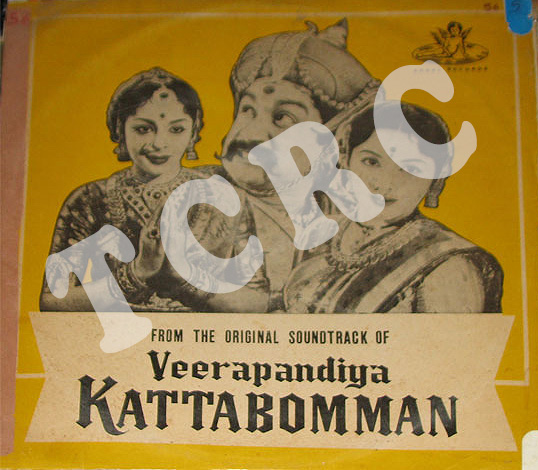
Mohan V Raman had written a warm tribute to writer “Sakthi” TK Krishnaswamy in The Hindu Metroplus yesterday, a piece that we at TCRC loved (click here to read the story).
The tribute resonated even more with us, given that our archives have an original LP of the “Veerapandiya Kattabomman” soundtrack (see image below).
In the late 1960s, the conductor of the Bangalore Transport Service (BTS) bus that plied on route No 10A from Srinagar to Majestic via City Market was a certain Shivaji Rao Gaikwad, a Kannada-speaking Maharashtrian. He was a stickler for rules. His dos and don’ts for commuters were simple: don’t board a running bus; always alight and board only at bus stops; don’t travel on the footboard; present exact change for tickets. One morning, he noticed a pig-tailed college girl jump into his moving bus, and snarled, “Ilee ree, ilee ree” (get off, get off). He had the driver stop the bus and made my aunt Vasanthi—the passenger—disembark.”
We at TCRC loved reading this lovely Open magazine story about superstar Rajnikanth (click on the image to read the full story).
Our archives have numerous rare images of Rajnikanth over the years and we are currently digitizing a number of those images. So, do watch this space for updates!



 The Cinema Resource Centre (TCRC)