The story of Lena Chettiar, the used-car dealer who turned into a film producer!

We at TCRC are always looking out for interesting trivia about yesteryear film personalities. Also, given that our search analytics told us that people were looking into the TCRC blog for information on one of Tamil cinema’s earliest superstars, actor-singer M K Thyagaraja Bhagavathar, we thought of putting together a separate post about him. We started looking for information about his 1934-released debut film “Pavalakodi.” But it was one of the producers of “Pavalakodi”, one Mr. Lena Chettiar, who ended up piquing our curiosity.

“Prabhavathi” (Tamil, 1942) was produced under the Krishna Pictures banner promoted by Lena Chettiar. Photo Courtesy: The Hindu.

Writing about the film “Prabhavathi” (Tamil, 1942) in The Hindu’s Blast From The Past column, Randor Guy profiles Lena Chettiar (click here to read the post about “Prabhavathi”):

S. M. Letchumanan Chettiar, popularly known as Lena Chettiar, was a powerful figure in the world of Tamil Cinema. A native of Chettinad, he was a ‘drama contractor’ in his early days, staging plays in various southern parts of the state by hiring freelancing actors and selling tickets for their plays. He also dealt in used cars and was the first man in this part of the world to print and circulate handbills about used cars in Tamil. Most of the Naattukottai Chettiars were wealthy, but did not know English. They found these handbills a novelty and encouraged Lena Chettiar.”

Randor Guy also reports that it was Lena Chettiar who convinced M K Thyagaraja Bhagavathar to not venture into production himself and stepped in to produce it for him:

M. K. Thyagaraja Bhagavathar’s (a top-ranking freelancing stage actor then) play with another stage actress S. D. Subbulakshmi, ‘Pavalakodi’, was a raving hit not only in the Tamil-speaking areas of South India but also in Ceylon. Bhagavathar was seriously planning to enter movies with Pavalakodi and Lena advised him against venturing into production on his own and convinced Bhagavathar to team up with him. With his rich pals, Lena produced Pavalakodi in 1934, which marked Bhagavathar’s film debut and proved to be a major hit.”

Lena Chettiar produced numerous films under various labels and eventually, started promoting the ‘Krishna Pictures’ banner in the early part of the 1940s under which he produced films in Tamil and Telugu for nearly 15 years. The last film that he produced, before the founding of Krishna Pictures, was “Krishnan Thoothu,” which was the Tamil debut of Telugu film star Kannamba. In his post about “Krishnan Thoothu,” Randor Guy mentions Lena again:

 He wielded enormous influence beyond the confines of the movie business in official and political circles. Soon after this film, he promoted his own unit, Krishna Pictures, in T. Nagar. His office on Thanikachalam Chetti Road (named after the noted Justice Party leader O.T. Chetti) was indeed a landmark of that area with its Krishna temple besides the building put up by Lena.”

Producers seldom get mentioned in serious writing about cinema. But in the early days of cinema in India, we at TCRC have noticed that often it was the producers who  moved mountains to fuel innovation and creativity. Lena Chettiar seems to be one such gentleman and we at TCRC are glad to bring back to public memory, stories of such film entrepreneurs.
Sir Richard Attenborough on working with Satyajit Ray in “Shatranj Ke Khilari”: Old DD Bangla interview

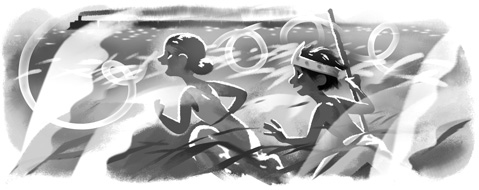
Today is master filmmaker Satyajit Ray’s 92nd birthday and Google’s paid a lovely tribute through a doodle based on his film “Pather Panchali.” For those who missed it, here’s what the doodle is all about:

Google doodle on the occasion of Satyajit Ray’s 92nd birthday (2nd May 2013).

We at TCRC also chanced upon a YouTube video of an old show on DD Bangla where Sir Richard Attenborough, director of “Gandhi,” talks about the experience of working with Ray on “Shatranj Ke Khilari.” The film, released in 1977, was based on Munshi Premchand’s short story of the same name and was narrated by  Amitabh Bachchan. The cast included actors such as Sanjeev Kumar, Saeed Jaffrey, Shabana Azmi, Farida Jalal, Amjad Khan, Richard Attenborough, Victor Banerjee, Farooq Shaikh and Tom Alter. Do look out for Sir Attenborough’s views on cinema as an art form and Ray’s soundbites!

RARE: Raj Kapoor’s “Mera Naam Joker” sweetbox made for Russia!

In 1970, the world witnessed the release of Raj Kapoor’s maganum opus “Mera Naam Joker,” a 255-minute spectacle about a clown who makes the everyone laugh, but cries within. This Chaplinesque saga was made over a period of six years and had Raj Kapoor investing large amounts of his personal fortune in order to complete the movie. However, it was a disaster at the box-office, causing great monetary loss to Raj Kapoor. In the years that followed, however, the film garnered critical acclaim and is considered to be a milestone in Hindi cinema, today.

It was distributed under the RK Films banner and the star cast included Raj Kapoor, Manoj Kumar, Simi Garewal, Dharmendra, Padmini, Rajendra Kumar, and Dara Singh. The music was scored by the duo Shankar Jaikishan. The film also marked the debut of Rishi Kapoor and was shot on location in India and Russia.

The Russian Embassy in India, in its post on Bollywood in Russia, states (click here to read the entire post):

In Mera Naam Joker (My Name is Joker, 1970) Raj Kapoor presented the prowess of Russian circus and ballet. The protagonist, Raju, falls in love with the visiting trapeze artist Marina, played by Kseniya Ryabinkina. Raju and Marina get close despite the language barrier. The brief affair ends with heartbreak as Marina returns home with her troupe. Ryabinkina’s role was reprised in Chintuji (2009) a movie based on the life of Raj Kapoor’s son and actor Rishi Kapoor. Marina returns to India after 40 years and visits the site where their circus had performed. She meets Raju’s son, a part which Rishi Kapoor had debuted with.

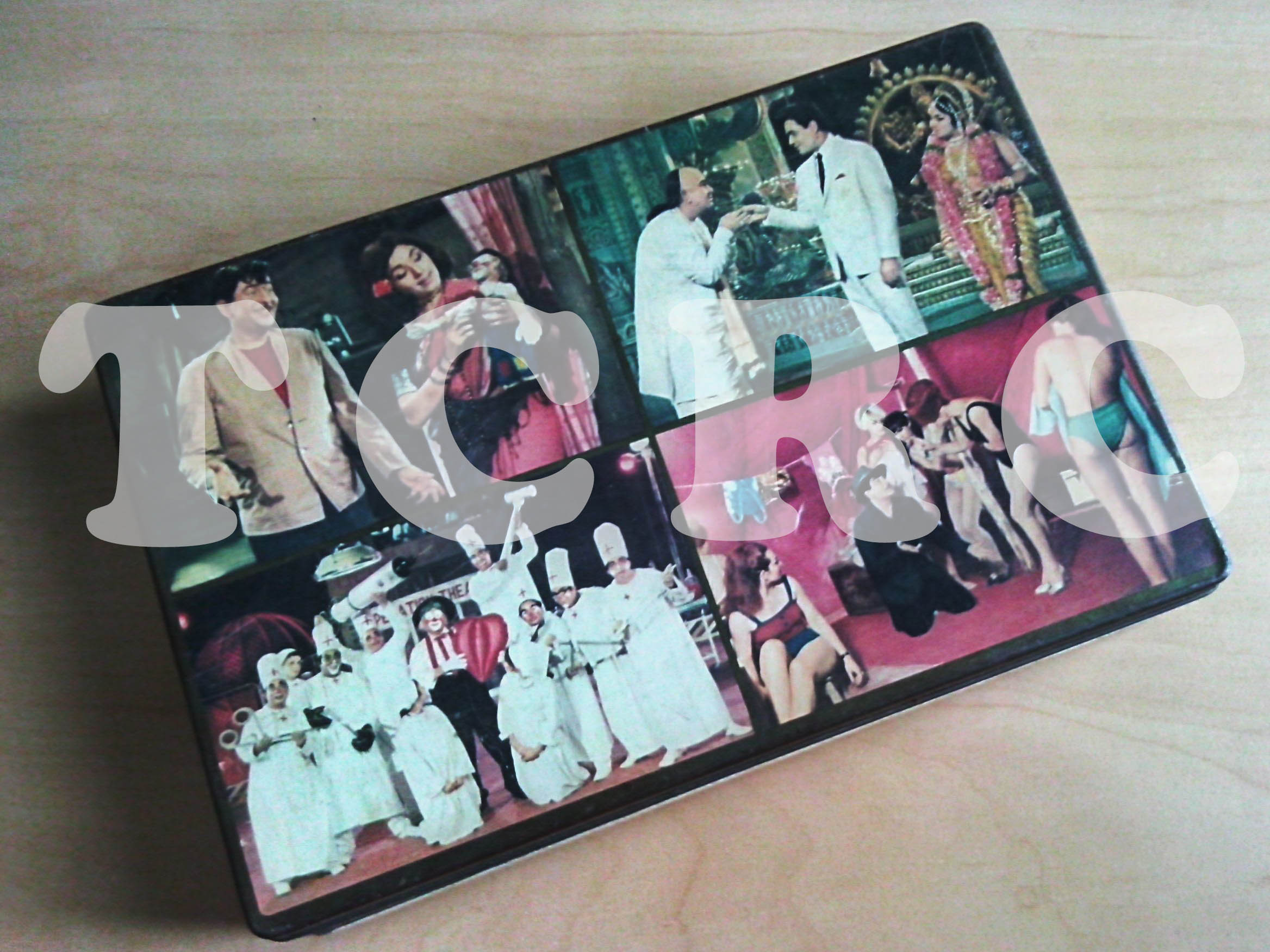
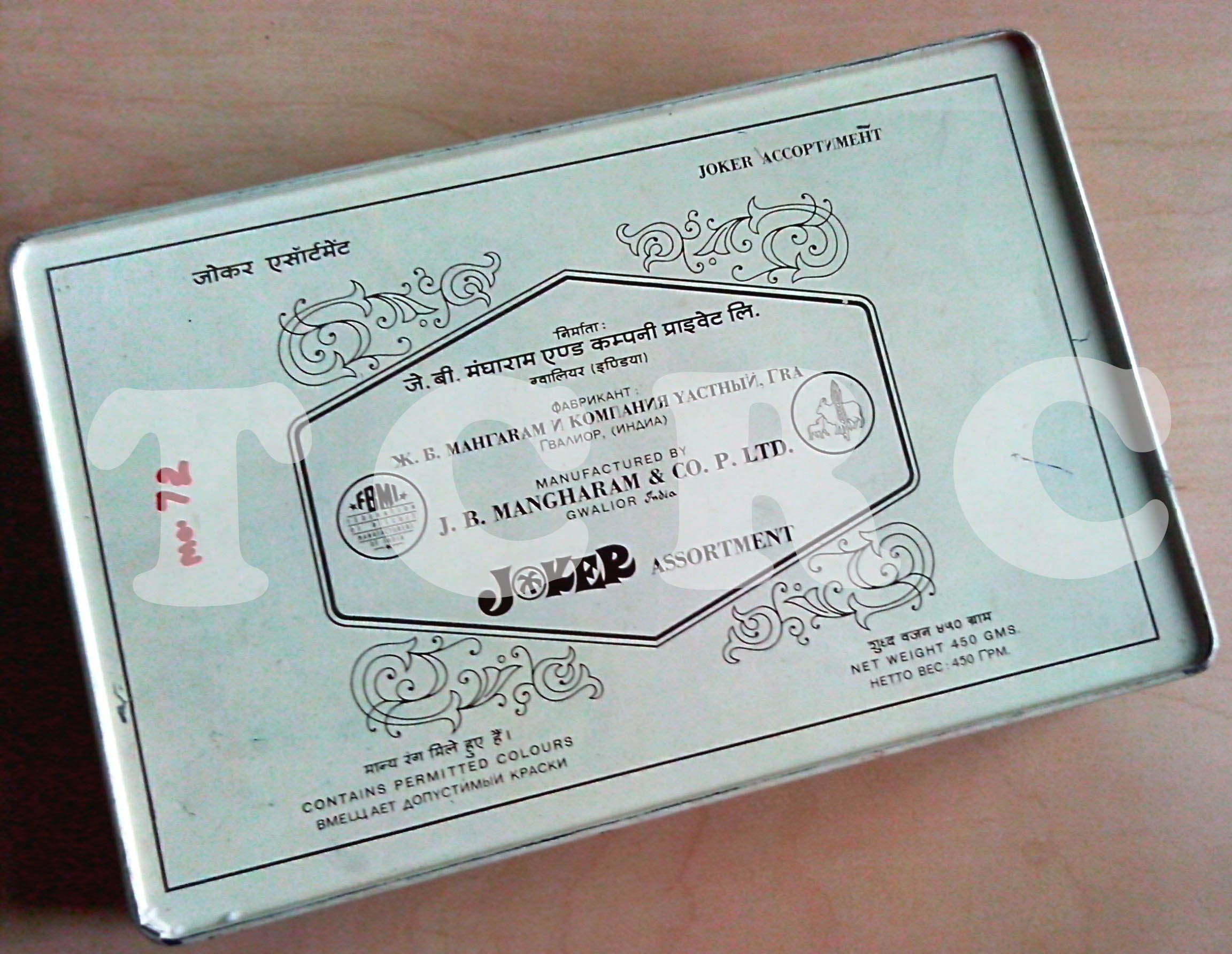
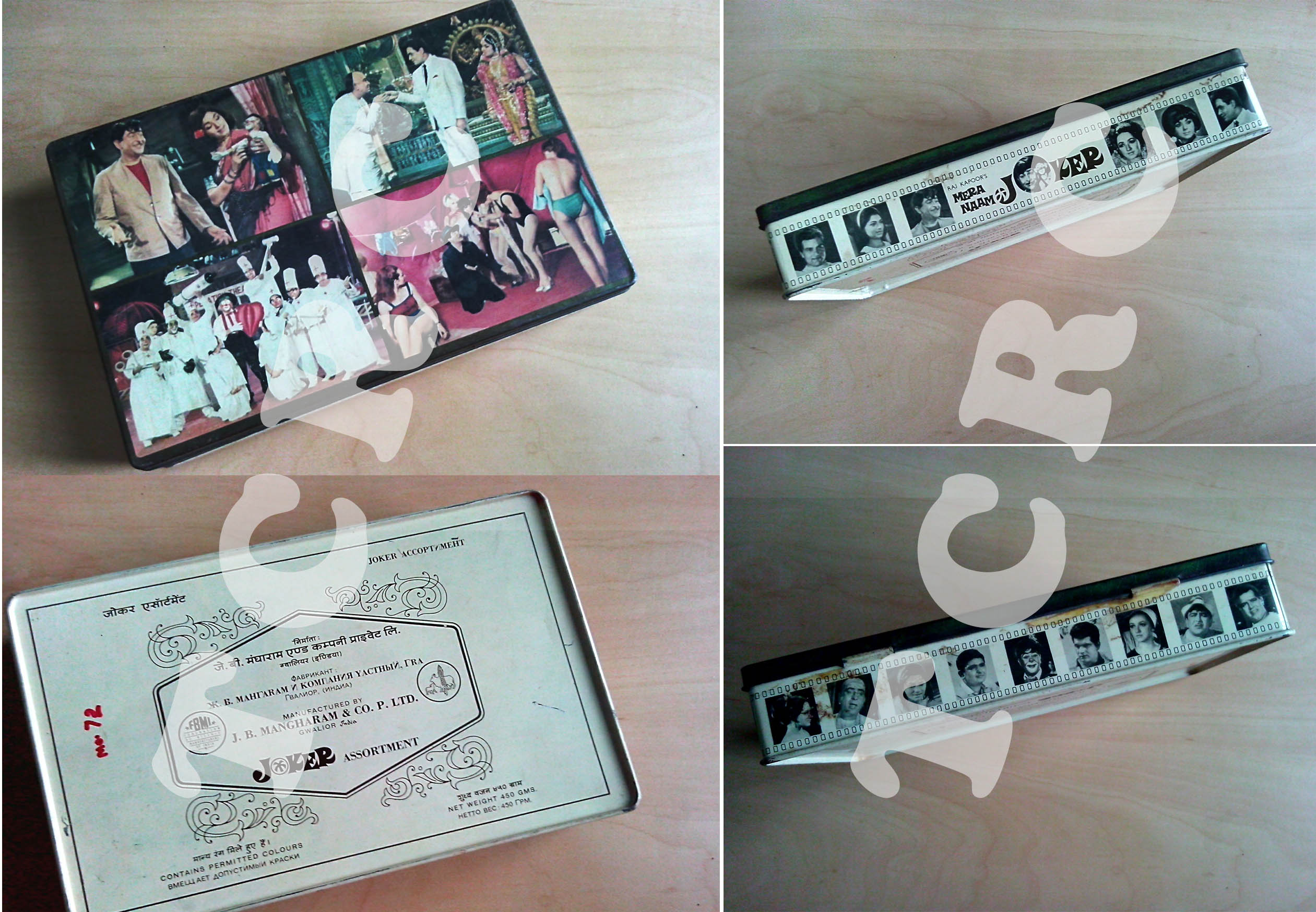
Today, we at TCRC bring to you a sweetbox made by JB Mangharam & Co in Gwalior for the Russian release of “Mera Naam Joker.” Notice the markings in Hindi, English and Russia. Called the “Joker Assortment,” the box is a favourite of ours at the archive here!

Sweets box made for Russia | "Mera Naam Joker" | Hindi | 1970

Sweets box made for Russia | “Mera Naam Joker” | Hindi | 1970

Sweets box made for Russia | "Mera Naam Joker" | Hindi | 1970

Sweets box made for Russia | “Mera Naam Joker” | Hindi | 1970

Sweets box made for Russia | "Mera Naam Joker" | Hindi | 1970

Sweets box made for Russia | “Mera Naam Joker” | Hindi | 1970

“Elphinstone Elphinstone Everywhere”: The story of Elphinstone Theatre in Madras, the first with a balcony!

The Indian Express carried a PTI (Press Trust of India) story yesterday about tent cinemas returning to Delhi as a part of the ongoing “100 years of cinema” celebrations. We found a couple of paragraphs at the end of the story rather interesting (click here to read the entire piece):

In India, among the pioneers of tent cinema, the most important name is that of J F Madan, a Parsi businessman who started ‘Elphinstone Bioscope Company’ in early 20th century in Calcutta (now Kolkata) and would do tent shows in the Maidan there. He later started the cinema halls by the name of ‘Elphinstone Picture Palaces’.

His ‘Elphinstone’ was also one of the few Indian companies, among other European production houses, which filmed the historic 1911 Delhi Durbar attended by King George V and Queen Mary.

His legend has survived today in the form of various ‘Elphinstone’ theatres spread across India.”

Now, we were aware that a New Elphinstone Theatre was operational up till sometime in the 1970s, off Mount Road. So, we did some searching and it turns out that there was indeed an Elphinstone in Madras as well. Manish Raj, writing for the Times of India, mentions the cinema hall in his piece of theatres in Madras of the yore (click here to read his entire story):

New Elphinstone Theatre in 1916 was inaugurated by the governor general of Madras and it was one of the first theatres in India to raise funds for the World War I through its shows. It housed the most unusual indoor sport — a boxing ring where amateurs sparred. When the film bubble burst, it later became Elphinstone Soda fountain, which sold beverages.

Given that there was a New Elphinstone, we realised that an Old Elphinstone had to be a part of this history. Historian S Muthiah, in his lovely piece titled “Cinema at Round Tana”, fills the gaps:

A New Elphinstone meant there had to be an old Elphinstone – and there was one, rooted in almost the beginnings of cinema-screening in Madras. The Elphinstone was located across Round Tana from the New Elphinstone on the site of Misquith Building, just west of the old Hindu building at the junction of Ellis Road and Wallajah Road. (Wallace) Misquith & Co., established in 1842 built itself a magnificent brick-exposed Indo-Saracenic building to house on the ground floor its showroom for musical instruments and, on the first floor, music salons which could be rented by the hour for anyone wanting to play any instrument.In time, Misquith’s’ became Musee Musicals and moved further down Mount Road, but in its heyday it housed the Lyric, a hall of entertainment that a man named Cohen established on the first floor when he took over Misquith’s in 1907.

In 1913, the Lyric began screening films, calling itself the Empire Cinema, but a fire in March 1914 closed it down. Later that year, J F Madan of Calcutta, owner of India’s biggest cinema chain at the time, took over the Empire and renamed it with that of his flagship, the Elphinstone. In 1915, Madan bought the Misquith Building and made the Elphinstone a permanent cinema theatre, the biggest and the first with a balcony in Madras.

Given that Dadasaheb Phalke’s “Raja Harishchandra,” the first feature length Indian film was released at around the same time that Empire Cinema was started (1913), we at TCRC were thrilled to find the various strands of our cinematic history crisscrossing. Unfortunately, we weren’t able to find a single image or photographs of the Elphinstone Theatre and this only served to remind us of the importance of archiving  images of our cinemas’ golden past. Interested in helping this sort of archival effort? Volunteer at TCRC!

India’s first indigenously-made feature film in colour: “Kisan Kanya” (Hindi, 1937)

In our post about Fatma Begum, India’s first woman film director, we had mentioned Ardeshir Irani as the father of Indian talkie films, as he was involved with the making of both “Alam Ara” (the first Indian talkie) and “Kalidas” (the first Tamil talkie), both of which were released in 1931. In fact, “Kalidas” was made on the sets of “Alam Ara” by Ardeshir Irani’s former assistant HM Reddy.

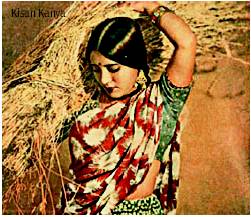
It turns out that Ardeshir Irani has been responsible for other landmarks as well in India’s cinematic history. His production company, Imperial Pictures, backed “Kisan Kanya”, India’s first indigenously-made feature film in colour. The movie, directed by Moti B Gidvani, was coloured using the Cinecolor process that was acquired from an American film by the producers Imperial Pictures. Given below is a still from the film:

"Kisan" | Hindi | 1937. Photo Courtesy: The Times of India

“Kisan Kanya” | Hindi | 1937. Photo Courtesy: The Times of India

The ‘indigenously-made’ tag comes into play thanks to other experiments with colour by pioneer V Shantaram, who co-founded the Prabhat Film Company. In 1933, he produced a Marathi film titled “Sairandhri,” which had some scenes shot in colour. But in the case of “Sairandhri,” the film was printed and processed in Germany, thereby allowing “Kisan Kanya” to be remembered as the first indigenously-made feature film in Hindi. “Kisan Kanya” is said to have had a run time of 137 minutes and its cast is reported to include actors such as Padmadevi, Jillo, Ghulam Mohammed, Nissar, Syed Ahmed, and Gani.

The story of Fatma Begum, India’s first woman film director

While pulling out playback singer Shamshad Begum’s version of Katiya Karoon, we at TCRC realised that she was one of the earliest female playback singers in the Hindi film industry. This set us off on a search for India’s first woman film director and led us to this interesting piece on Fatma Begum, written by Rohit Vats for IBN Live as a part of their “100 years of Indian cinema” series. Here’s an excerpt from that piece (click here to read the entire story):

Born in an Urdu speaking family, Fatma Begum was related to Nawab Sidi Ibrahim Muhammad Yakut Khan III. She was the mother of Zubeida, Sultana and Shehzadi, who were popular actors of the silent era. She started working in films in 1922 after getting trained in plays. Fatma worked with filmmakers like Ardeshir Irani and Nanubhai Desai before founding her own production company Fatma Films which was later rechristened as Victoria-Fatma Films. ‘Bulbul-E-Paristan’ that released in 1926, became the first Indian film to be directed by a female director. However, acting remained on her wish list and she continued to act till late 1930s.”

Ardeshir Irani, who Fatma worked with as an actor, incidentally is the father of Indian talkie films, having made both “Alam Ara” (in Hindi) and “Kalidas” (in Tamil, with songs in Telugu).

We also tried to find an image of Fatma Begum on the web. While we did come across few images, we couldn’t confirm the veracity of any of them. The Whistling Woods (a film school in Mumbai) blog, for instance,  features this picture:

Fatma Begum, India’s first woman film director.

Cineplot Enyclopedia, on the other hand, features this image:

Fatma Begum, India’s first woman film director.

Clearly different people, don’t you think? It is interesting (and worrisome) to note that the internet doesn’t  have a single undisputed image of the first woman director in one of the world’s largest film industries. On days like these, we at TCRC find renewed vigour in our attempt to archive cinema-related artifacts. Have you found other such examples with respect to information about the early days of cinema? Do share them with us by writing to tcrc.india[at]gmail[dot]com.

Shamshad Begum & The Original ‘Katiya Karoon’!

We at TCRC were deeply saddened to hear about the demise of Shamshad Begum, one of the earliest playback singers in the Hindi film industry. She was 94, only half a dozen years younger than Indian cinema itself (if we go by the release of “Raja Hairshchandra” as the beginning). Along the way, Shamshad Begum has given us some of the most evergreen melodies in Indian film music, including hits such as “Kabhi Aar Kabhi Paar” and “Kajra Mohabbatwala” for composer OP Nayyar, and “Mera Piya  Gaye Rangoon” for music director C Ramanchandra.

Shamshad Begum. Photo Courtesy: Hindustan Times

A Padma Bhushan awardee, Shamshad (which means “graceful” in Persian) Begum recorded her first song, a Punjabi number, in the 1930s. And it is another Punjabi number that we at TCRC are bringing to you today, as a tribute to this doyenne. In the 1963-released, black-and-white Punjabi movie “Pind Di Kurhi” directed by Baldev R Jhingan, Shamshad Begum had sung a version of “Katiya Karoon,” the folk number which was recently adapted in Imitiaz Ali’s “Rockstar” starring Ranbir Kapoor. While the new “Katiya Karoon” was composed by AR Rahman, the original version delivered by Shamshad Begum was composed by Hansraj Behl and was picturized on actress Nishi. Watch and enjoy!

Ray’s 21st Death Anniversary: Revisiting ABP’s “No Ads, Please!” Tribute & The Films That Ray Would’ve Liked To Make

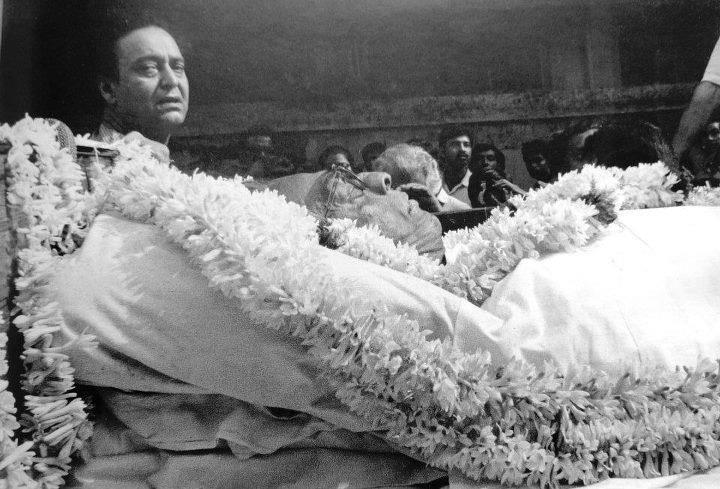
On 23rd April 1992, Satyajit Ray, one of India’s most celebrated personalities from the world of cinema, passed away in Calcutta. Twenty one years later, we at TCRC revisit some material on the illustrious life of the iconic Bengali filmmaker.

Satyajit Ray's funeral. Photo from the newspaper Anandabazar Patrika dated 24th April 1992.  Photography by Tarapada Bandopadhyay. Courtesy: Riddhi Goswami (found on the Facebook page "FeludaSeries"

Satyajit Ray’s funeral. Photo from the newspaper Anandabazar Patrika dated 24th April 1992. Photograph shot by Tarapada Bandopadhyay. Reproduction Courtesy: Riddhi Goswami (found on the Facebook page “FeludaSeries”)

The New York Times published a glowing obituary of Ray, the day after his demise (click here to read the entire obit).  The obituary, penned by Peter Flint, recounts how a three-member Oscar committee visited him at Belle Vue Hospital in Calcutta, a month before his death, to present him with the golden statuette for lifetime achievement in cinema. The presentation of the Oscar was filmed and his acceptance speech was screened two weeks later at the Oscars ceremony at the end of March that year.

The NYT obit also showcases a quote from Ray (given below), which beautifully captures how the auteur’s approach to mise-en-scene:

You had to find out yourself how to catch the hushed stillness of dusk in a Bengali village,” he said, “when the wind drops and turns the ponds into sheets of glass dappled by the leaves of the trees, and the smoke from ovens settles in wispy trails over the landscape, and the plaintive blows on conch shells from homes far and wide are joined by the chorus of crickets, which rises as the light falls, until all one sees are the stars in the sky, and the stars blink and swirl in the thickets.”

Interestingly, the Bengali newspaper Anandabazar Patrika didn’t carry a single advertisement on the day after Ray’s death as a mark of respect to the master filmmaker. Well, from where we see it, very few filmmakers today would even be considered worthy of such a tribute and fewer media outlets would be willing to pay such a tribute!

We also loved Dilip Basu’s biography of Ray for the Satyajit Ray Film and Study Center at the University of Southern California, Santa Cruz. Here’s an excerpt (click here to read the entire biography):

How he managed to make the film, pawning his rare music albums, his wife Bijoya’s jewelry and his mother, Suprabha’s networking in the Government circles in Calcutta, has now become a by-word in the annals of Indian film history. It also provides a paradigm on the “modes of production” in the kind of world cinema that stubbornly refuses to kowtow to commercial pressure. The paradigm required a perennial search for the elusive producer; an essential routine of most of Ray’s movie-making career. If he had access to funds for the kind of films he wanted to make on his fiercely independent and nonnegotiable artistic terms, the world would have seen more diversity and many more period pieces in Ray’s oeuvre: films based on ancient epics, the Mughals and the British Colonials. Instead, he limited himself to what was locally available and possible, refusing to stop or give in to commercial presuures. By 1992, the year he passed on, he had made forty films including shorts and documentaries. Some of these are all-time classics, great and near-great films. Unlike his illustrious contemporaries Antonioni, Bergman, Fellini and Kurosawa, for example he never made a film that can qualify as “bad” from the filmmaker’s standpoint.”

Dibakar Banerjee: Discovering “good” international cinema through a search for porn!

We at TCRC are always looking for fabulous written material on films and their makers, and it is during one such search that we found Jai Arjun Singh‘s absolutely delightful piece on Dibakar Banerjee, the director of films such as “Khosla Ka Ghosla,” “Oye Lucky Lucky Oye,” “Love, Sex Aur Dhokha” and “Shanghai.” All too often, we find directors giving interviews about their latest film and such interviews invariably end up including a couple of stock questions about the process of writing and making films. But Jai Arjun’s story for The Caravan magazine focuses entirely on Dibakar Banerjee – the man, his influences and his creative process. Discursive and detailed, the piece builds a fascinating, multi-dimensional picture of the filmmaker who has made some truly path-breaking yet commercially successful films. Sample this:

For the young Dibakar, “getting his hands dirty” meant being part of a street-smart lifestyle that was far removed from the cliché of the armchair intellectual. And that early life is inseparable from what he is today. Even “good” international cinema came into his personal orbit through what was an adolescent’s rite of passage: at age 17, he and four friends rented what they thought would be a porn film called Confessions of a Taxi Driver to watch in a darkened room in Jhandewalan—and ended up with Martin Scorsese’s Taxi Driver instead. “We closed the drapes, waited for the obligatory hardcore moment but nothing happened—and by the end, here were five guys from a typical Karol Bagh setting, riveted by what they were seeing.”

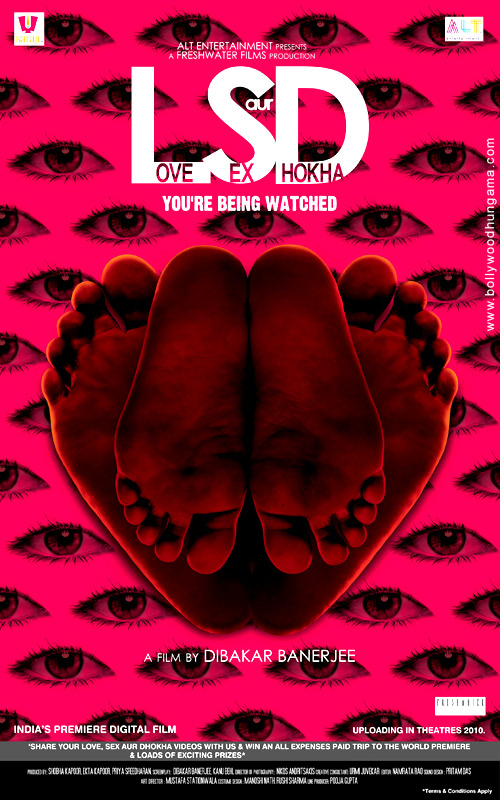
Love Sex Aur Dhokha (LSD)  |  Hindi  |  2010

Love Sex Aur Dhokha (LSD) | Hindi | 2010

Truth be told, this profile of Dibakar Banerjee is easily one of the best (and longest) pieces of writing about a filmmaker that we’ve come across in the recent past (click on the image above to read the full story). We at TCRC would like to doff our hats in salute to both filmmaker Dibakar Banerjee and writer Jai Arjun Singh.

The Changing Face of Film Distribution & The 50 Best Undistributed Films of 2012

The current model of distributing movies (i.e., the use of “release windows” to ensure that films don’t eat into each others’ businesses and the staggering of the release of material across cinema, TV, home video, etc) is repeatedly dissed as archaic and incongruent to present day trends where people live their lives, shuffling from one screen to another. Chris Jones, who runs the London Screenwriters’ Festival, has an interesting blog post about the same topic, in which he lists down the key problems plaguing film distribution today:

1.    The high impact life of your film is 14 days, max. Any buzz you create, any momentum you build, is now created on a global scale. Social media does not know boundaries – posters, trailers, interviews, articles – all go global in a moment, and ideally viral. I believe that you can only get REAL buzz for your project for a few weeks… After those two weeks, internet dies back considerably.

2.    It follows then that you need to get your movie out as quickly as possible, and in as many territories as you can, and finally on all devices (TV, web, phone etc.). Ideally this would happen on the same day too.

3.    If we create buzz and then fail to deliver an easy way for people to legally watch our films, we are simply begging people to rip and upload our films to share. I don’t believe these people think of themselves as pirates. This isn’t about money, it’s about us promising something amazing and then failing to deliver a way to watch the film legally and easily.

4.    No single platform, aside from iTunes, seems to work well as yet. And iTunes being Apple owned, is housed a ridiculous walled garden.

5.    Forget theatres, they are operating in a different century.

As a film maker, all this means that I will get very little back from current distribution methods and my film will get seen mostly via illegal downloads.”

Given that film distribution is a complicated quagmire, some great films don’t end up getting distributed at all. For instance, late last year, the Film Society of Lincoln Center’s blog FilmComment had put together a list of the 50 best undistributed movies in 2012. The list (click here to see the entire list) features movies from across the world and is an eye-opener in many ways.

“Gebo and the Shadow” | Manoel de Oliveira | Portugal/France

We at TCRC are huge fans of anything cinema and it’s always a joy to see the internet ensuring that we hear of such little-known (or distributed) gems. Follow this space, for we intend to showcase many more of these undiscovered beauties!