Dibakar Banerjee: Discovering “good” international cinema through a search for porn!

We at TCRC are always looking for fabulous written material on films and their makers, and it is during one such search that we found Jai Arjun Singh‘s absolutely delightful piece on Dibakar Banerjee, the director of films such as “Khosla Ka Ghosla,” “Oye Lucky Lucky Oye,” “Love, Sex Aur Dhokha” and “Shanghai.” All too often, we find directors giving interviews about their latest film and such interviews invariably end up including a couple of stock questions about the process of writing and making films. But Jai Arjun’s story for The Caravan magazine focuses entirely on Dibakar Banerjee – the man, his influences and his creative process. Discursive and detailed, the piece builds a fascinating, multi-dimensional picture of the filmmaker who has made some truly path-breaking yet commercially successful films. Sample this:

For the young Dibakar, “getting his hands dirty” meant being part of a street-smart lifestyle that was far removed from the cliché of the armchair intellectual. And that early life is inseparable from what he is today. Even “good” international cinema came into his personal orbit through what was an adolescent’s rite of passage: at age 17, he and four friends rented what they thought would be a porn film called Confessions of a Taxi Driver to watch in a darkened room in Jhandewalan—and ended up with Martin Scorsese’s Taxi Driver instead. “We closed the drapes, waited for the obligatory hardcore moment but nothing happened—and by the end, here were five guys from a typical Karol Bagh setting, riveted by what they were seeing.”

Love Sex Aur Dhokha (LSD)  |  Hindi  |  2010

Love Sex Aur Dhokha (LSD) | Hindi | 2010

Truth be told, this profile of Dibakar Banerjee is easily one of the best (and longest) pieces of writing about a filmmaker that we’ve come across in the recent past (click on the image above to read the full story). We at TCRC would like to doff our hats in salute to both filmmaker Dibakar Banerjee and writer Jai Arjun Singh.
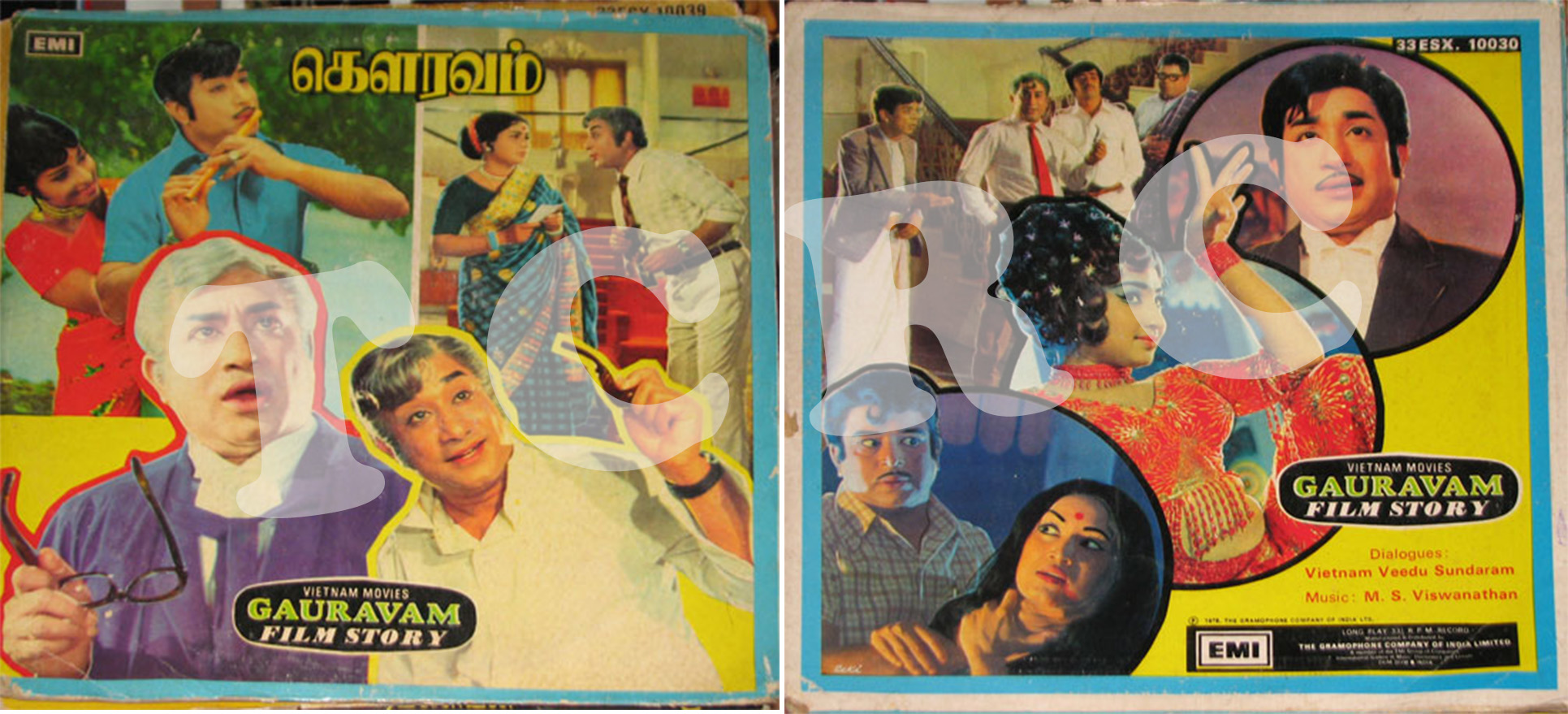
RARE: Original LP of Sivaji Ganesan’s “Gauravam” (1973), in which he plays a character called Rajnikanth!

This week, we bring from you yet another gem from the TCRC archives. Given that the Prakash Raj-produced, Radha Mohan-directed “Gouravam” has just released, we thought it would be fun to revisit the original “Gauravam” starring Sivaji Ganesan, Nagesh and ‘Major’ Sundarrajan, which was released in 1973. Interestingly, in the old “Gauravam,” Sivaji plays the role of Rajnikanth, a senior lawyer. When seen against that fact that superstar Rajnikanth’s original name is Shivaji (Shivaji Rao Gaikwad), the nomenclature system seems to come fulls circle! Given below is the photograph of the original LP set of Sivaji Ganesan’s “Gauravam”:

"Gauravam"  |  LP Record  |  Tamil  |  1973

“Gauravam” | LP Record | Tamil | 1973

“Gauravam” was directed by ‘Vietnam Veedu’ Sundaram and the music was scored by MS Vishwanathan. “Vietnam Veedu” was Sundaram’s first  stage play for Sivaji Ganesan’s theatre company Sivaji Nataka Mandram. The play was staged for the first time in 1965 and was a massive hit. It was later turned into a movie as well.

The Changing Face of Film Distribution & The 50 Best Undistributed Films of 2012

The current model of distributing movies (i.e., the use of “release windows” to ensure that films don’t eat into each others’ businesses and the staggering of the release of material across cinema, TV, home video, etc) is repeatedly dissed as archaic and incongruent to present day trends where people live their lives, shuffling from one screen to another. Chris Jones, who runs the London Screenwriters’ Festival, has an interesting blog post about the same topic, in which he lists down the key problems plaguing film distribution today:

1.    The high impact life of your film is 14 days, max. Any buzz you create, any momentum you build, is now created on a global scale. Social media does not know boundaries – posters, trailers, interviews, articles – all go global in a moment, and ideally viral. I believe that you can only get REAL buzz for your project for a few weeks… After those two weeks, internet dies back considerably.

2.    It follows then that you need to get your movie out as quickly as possible, and in as many territories as you can, and finally on all devices (TV, web, phone etc.). Ideally this would happen on the same day too.

3.    If we create buzz and then fail to deliver an easy way for people to legally watch our films, we are simply begging people to rip and upload our films to share. I don’t believe these people think of themselves as pirates. This isn’t about money, it’s about us promising something amazing and then failing to deliver a way to watch the film legally and easily.

4.    No single platform, aside from iTunes, seems to work well as yet. And iTunes being Apple owned, is housed a ridiculous walled garden.

5.    Forget theatres, they are operating in a different century.

As a film maker, all this means that I will get very little back from current distribution methods and my film will get seen mostly via illegal downloads.”

Given that film distribution is a complicated quagmire, some great films don’t end up getting distributed at all. For instance, late last year, the Film Society of Lincoln Center’s blog FilmComment had put together a list of the 50 best undistributed movies in 2012. The list (click here to see the entire list) features movies from across the world and is an eye-opener in many ways.

“Gebo and the Shadow” | Manoel de Oliveira | Portugal/France

We at TCRC are huge fans of anything cinema and it’s always a joy to see the internet ensuring that we hear of such little-known (or distributed) gems. Follow this space, for we intend to showcase many more of these undiscovered beauties!


The incredible story of PK Nair, India’s most respected film archivist, has now been documented!

On the 3rd of May later this year, an anniversary of epic proportions will occur. For it was on that day in 1913, one hundred years ago, that “Raja Harishchandra”, the silent film produced and directed by Dadasaheb Phalke which is widely accepted as the first Indian full-length feature film, was released. In effect, the day marks the existence of one hundred years of Indian cinema. And what a glorious century it has been!

Of the many ways in which this anniversary is likely to be commemorated, we at TCRC are particularly excited about the release of Shivendra Singh Dungarpur’s National Award-winning documentary “Celluloid Man” on 3rd May 2013. The film showcases the life and work of legendary Indian archivist and founder of National Film Archive of India (NFAI), PK Nair.  Given below is an excerpt from the film:

The film is said to feature interviews with many leading film personalities including including Krzysztof Zanussi, Lester James Peries, Vidhu Vinod Chopra, Saeed Akhtar Mirza, Gulzar, Basu Chatterjee, Naseeruddin Shah, Kamal Haasan, Girish Kasaravalli, Jahnu Barua, Jaya Bachchan, Dilip Kumar, Saira Banu, Sitara Devi, Santosh Sivan, Rajkumar Hirani, Shyam Benegal, Mahesh Bhatt, Yash Chopra, Ramesh Sippy and Mrinal Sen, all of whom share their reflections on the influence of PK Nair on the films that they watched and loved. In the 2012 National Film Awards, “Celluloid Man” won accolades for Best Editing and Best Biographical/Historical Reconstruction.

PK Nair, now 80 years old, has meanwhile spoken about how the prints of films such as “Raja Harishchandra,” “Alam Ara,” etc are not available at all and has lamented the loss of many important films made before the 1950s (click here to read that whole story).

We at TCRC salute PK Nair, or Nair Saab as he is known, for his commitment to archiving the early days of Indian cinema. May his tribe only grow.

Understanding Devdas

The story of Devdas has got to be one of the most popular tales to have been embraced by Indian cinema. There have been a number of versions in a variety of languages. Some movie versions have remained largely faithful to Sarat Chandra Chattopadhyay’s original novella, while others have added their own twists and turns, reinterpreting the original story to suit the demands of the time period in which they were set.

Dilip Kumar & Shahrukh Khan as Devdas. Photo Courtesy: IBN Live.

This week, we at TCRC bring you a couple of pieces of academic writing on Devdas. The first is “The Devdas Phenomenon” by Corey K Creekmur, who is the head of Film Studies at the University of Iowa. He writes about the three versions of Devdas in Hindi cinema and also, discusses the original book on which these interpretations were based (click here to read his paper).

The second is “Devdas: India’s Emasculated Hero, Sado-masochism and Colonialism” by Poonam Arora, who is a professor of English at the University of Michigan – Dearborn. She writes about how the “Devdas narrative discursively construct a prototypical colonial male subjectivity.” (click here to read her paper).

And here’s a clip from PC Barua’s “Devdas”. This was released in 1935.

The Archive | A film about the world’s largest music record collection

Paul Mawhinney was born and raised in Pittsburgh, PA. Over the years, he amassed what was one of the world’s largest music record collections.

Due to health issues and lack of support from the music industry, Paul was eventually forced to sell his collection.

This is the story of a man and his records.

We at TCRC salute Paul’s spirit.