I DIRECTORS: THE CAPTAINS — MASTERS AND COMMANDERS WITH AN IMPACT TO LAST THE AGES
2. The 1930s— Part 12(2)
(2)T.R. Raghunath
While last episode we talked about Raja Chandrasekhar this episode is about his younger brother T.R. Raghunath alias Thimatchipuram Rajagopal Raghunath whowas born on 16 July 1912.
Few of the films that T.R. Raghunath worked as a film maker/Technician during 1930 to early 1940:
1935: GNANASOUNDARI (Assistant Director)
1936: DHARA SASANGAM (Sound Recordist)
1936: KIZHATTU MAAPPILLAI (Short Film)(Director)
1939: JOTHI (Director)
1942: Thamizhariyum Perumal
Raghunath graduated from Madras University but moved to his better interest, Film making. He started his film career as a sound recordist later went on to become a director. He worked under his elder brother initially before moving on to do films independently.
He worked as an Assistant director in Gnanasoundari and as a sound recordist in Dharasasangam. Both were directed by the pioneer A. Narayanan, often referred as the Father of south Indian Film business who started the south India’s first talkie studio Srinivasa Cinetone
Raghunath directed independently for first time through a short film Kizhattu Maappillai. Kizhattu Maappillai was shown along with Usha Kalyanam directed by another forgotten revolutionary film maker K. Subramanian who introduced many talents to the Tamil Film Industry
An advertisement of MURUGAN TALKIE FILM COMPANY mentioning KIZHATTU MAAPPILLAI
From the magazine ANANDA VIKATAN DEEPAVALI MALAR 1939
PC: From the archives of TCRC
In 1939 he directed the film Jothi also titled Sri Jyothi Ramalinga Swamigal. The film was about the life of saint Ramalinga Swamigal of Vadalur. Script was written by Pammal Sambandam Mudaliar, he along with Shankardas Swamigal pioneered the early years of Tamil theatre. His elder brother Raja Chandrasekhar supervised the film making and guided in the screenplay process as well.
Madurai Mariyappa Swamigal wrote the lyrics and scored music for songs. The songs became popular and were released in Odeon records owned by another pioneer, A.V. Meyyappan. The film went on to become one of the major hits of those days and ran in cinema halls for 18 weeks.
He made the film based on the Sanskrit poet Kalidas, Thamizh Ariyum Perumal. Story Screenplay and dialogues were written by Elangovan. Produced by RM. Ramanathan Chettiar, at Newtone Studios in which he was an investor. The film had M.G. Ramachandran alias MGR in the lead role who went on to become one of the biggest stars of those times and later Chief Minister of Tamil Nadu. M. R. Santhanalakshmi as female lead played dual role in the film.
An advertisement of THAMIZH ARIYUM PERUMAL
From the magazine KALKI DEEPAVALI MALAR 1942
PC: From the archives of TCRC
Thamizh Ariyum Perumal had 22 songs. All were written by Udumalai Narayana Kavi. The music was credited in the name of Saraswathi Stores owned by A.V. Meyyappan. The film was distributed by Thyagaraja Films Limited owned by M.K. Thyagaraja Bhagavathar. Inspite of having lot of positive factors the film failed at box office.
T.R. Raghunath had a wonderful career directing more than 30 films with most of them being successful. After directing MGR in minor roles during 1940s he directed him again as a leading star in Raja Desingu and Vikramadithan. He was later appointed as President of Madras division of FDI (Film Division of India)
[To be continued] We’ll be back next week with more hidden treasure from the history of Tamil cinema. Stay tuned!
About the Author:
V.V. Prasad is a Electronics and Communication Engineer based from Chennai. He is currently involved in the role of a Researcher and Archivist in THE CINEMA RESCOURCE CENTRE. He takes care of the non film materials like Photographs, Magazines, Lobby Cards, Song books etc of the archives. Cataloguing them and digitizing them are part of his current work. His interests and passion lie on the research of Cinema particularly South Indian Cinema.
I DIRECTORS: THE CAPTAINS — MASTERS AND COMMANDERS WITH AN IMPACT TO LAST THE AGES
2. The 1930s— Part 12(1)
Raja Chandrasekhar and T.R. Raghunath
This episode we are going to talk about the 2 forgotten pioneers, siblings Raja Chandrasekhar and T.R. Raghunath. The first part of this episode will be about the elder one Raja Chandrasekhar
(1)Raja Chandrasekhar
Raja Chandrasekhar was one of the early film makers of Tamil Cinema. He was born in Trichy and studied Textile Engineering in Bombay before his interest shifted towards Cinema.
Few of the films made by Raja Chandrasekhar during 1930 – 1940:
1936: CHANDRAMOHANA
1936: RAJA DESINGU
1937: BHAKTHA THULASIDAS
1938: DAKSHA YAGNAM
1939: MAYA MACHINDRA
Raja Chandrasekar started his film career byjoining as assistant to Fatma Begam, the first female director of India in 1929. He later joined General Pictures Corporation. His first film as a director was the silent film Mohini Rukhmangatha. He is believed to have made around 12 silent films after that. One of them being Pandava Nirvahan in 1930 which was the most popular of all. His first talkie film was Chandramohana released in the year 1936.
In 1936 he made another film Raja Desingu, Produced by Rajeswari talkies. The film was initially advertised as Desingu Rajan before release. The film was shown along with a dance presentation of the dance icon Rukmini Devi Arundale, the founder of Kalakshetra, an academy for dance and music
An advertisement of RAJA DESINGU
From the magazine ANANDA VIKATAN DEEPAVALI MALAR 1935
PC: From the archives of TCRC
Bhaktha Thulasidas directed by Raja Chandrasekhar released on September 9 1937. It had then popular star M.K. Radha in lead role along with K.S.Prabha Devi and Comedy duos N.S.Krishnan and T.A.Madhuram.
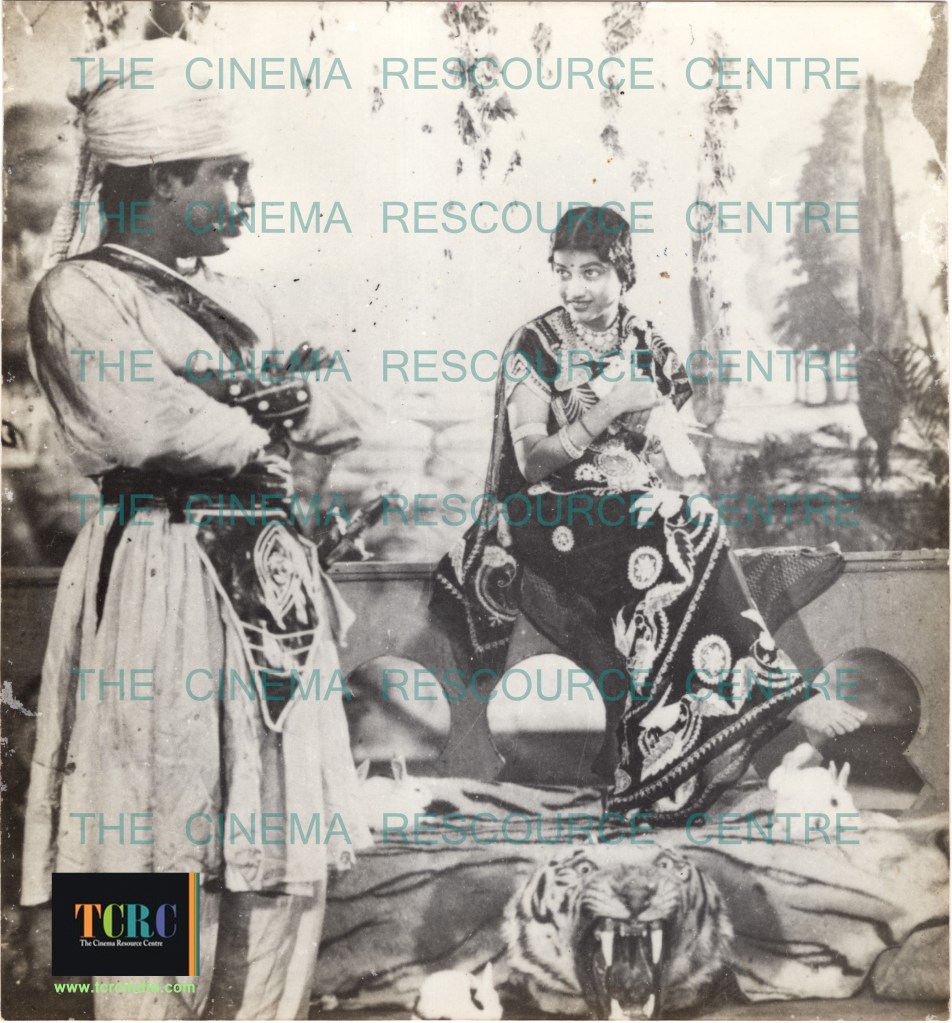
A still from the Film BHAKTHA THULASIDAS
PC: From the archives of TCRC
Bhaktha Thulasidas had 19 songs composed by Jayarama Iyer known as Fiddle Jayarama Iyer (Not to be mistaken with famous carnatic muscian Lalgudi Jayaraman)
One of the songs sung by the lead actor M.K.Radha written by Mayavaram Thyagaraja Mudaliyar , “Rama Ellam Neeye“ was quite popular then.
Another important film in Raja Chandrasekhar’s career was Maya Machindra released in the year 1939. The film again had M.K.Radha in titular role. M.R. Krishnamoorthy, younger brother of the famous carnatic singer Mahrajapuram Vishwanatha Iyer played an important role in the film. M.B. Radha Bhai was the female lead while N.S. Krishnan and his wife T.A. Madhuram filled the comedy part of the film. They sang few comic songs too. M.G. Ramachandran(MGR), who went on to become one of the most popular Tamil film stars and later as Tamilnadu Chief Ministerplayed a minor role in the film as well. The film also had the star cast of some popular actors like M.G. Chakrapani, P.G. Venkatesan, K.S. Sankara Iyer, T.M. Pattammal, Saroja Ratnavali, Ramalakshmi, L. Chandrika, K. Soundaram, Sundari, K.S. Velayudham and V. Nataraj
A still from the Film MAYA MACHINDRA
PC: From the archives of TCRC
Maya Machindra was based on the story of life of Machindranath, believed to be incarnation of Lord Shiva. The first film based on this story was made in Hindi and Marathi of same name by Legendary filmmaker actor V. Shantharam.
Raja Chandrasekhar was believed to be the favorite director of the then Superstar M.K. Thyagaraja Bhagavathar with whom he made a few popular hit films like Ashok Kumar. Later he had to go through downfall in his career. MGR in his directorial venture Nadodi Mannan (1958) took his assistance and credited him as the Technical Advisor.
His brother T.R. Raghunath too became a successful filmmaker. We will talk about him in our next edition
[To be continued] We’ll be back in next edition with more hidden treasure from the history of Tamil cinema. Stay tuned!
About the Author:
V.V. Prasad is a Electronics and Communication Engineer based from Chennai. He is currently involved in the role of a Researcher and Archivist in THE CINEMA RESCOURCE CENTRE. He takes care of the non film materials like Photographs, Magazines, Lobby Cards, Song books etc of the archives. Cataloguing them and digitizing them are part of his current work. His interests and passion lie on the research of Cinema particularly South Indian Cinema.
It isn’t uncommon, especially in Indian Cinema, to see other forms of art, like music, modified to supplement film. When initially dance performances, short plays, and boxing matches were added in between to make films more attractive, these turned into modern dance numbers and fight sequences incorporated into the story as films evolved. Traditional art forms were altered with changing media and the advent of new forms of media in the early 20th century, first with silent films and later with talkies. Performance mediums like music and dance now had the opportunity to be displayed to a larger audience, and films had the chance to use existing art forms to aid their storytelling. Taking music and film’s evolution together, they formed a new genre of film songs and later opened up playback singing, which involves recording audio tracks of one person singing and substituting it for the actor’s voice, as a new profession.
Sound first came to Tamil cinema as the four-reeler(the length of a film was indicated by the number of reels long it was), which consisted of sequences of semi-classical songs and dances. With sound came music, and Papanasam Sivan is said to be the maestro who made film music popular in South India in the 1930s.
Working Still from the Film Naveena Sarangadhara Featuring S.D.Subbulakshmi Naveena Sarngadhara was directed by K.Subramaniam had the songs composed by Papanasam Sivan PC: From the archives of TCRC
The songs in most of the early talkies were songs adapted from drama companies for film, which brought singers to the cinema rather than actors who couldn’t sing. Since early film musicians were drawn from the stage, stage performers clearly brought an influence, but most classical compositions had to adapt for the screen. To make films socially acceptable to the upper classes, they looked for a change through the use of Carnatic music to make it a more “respectable” medium. Since the advent of talkies, the world of cinema was seen as vulgar to the extent that barely anyone wanted to be associated with the industry. Sambur Vadagarai Subbaiah Bhagavathar was the first from the classical music scene to enter cinema along with Mahajapuram Viswanatha Iyer in Nandanur in the 30s. However, the film didn’t do well despite having two Carnatic music personalities when the negative caught fire and the filmmakers were accused by an insurer of sabotage. The star-singing era stretched from the 1930s into the 40s, when actors had to be able to sing as well as act, and the songs were recorded with an overhead mic while orchestras played behind the mic; at the same time, the ‘Tamizh Isai’ movement was born which contended that musicians from Tamil Nadu were only to sing in Tamil and not Telugu. The movement had ties to the Dravidian Self-Respect movement as well.
Working Still from the Film KAMBAR (also called KALVIYIN VETTRI) A film that S. V. S. Bhagavathar acted and sung in PC: From the archives of TCRC
During the 1940s, cinema-centred music culture was created from the emergence of film songs. The songs were shorter and had influences from multiple music genres, and only the features of a raga that made it identifiable as such were maintained. For a while, since Tamil talkies were made in studios in Calcutta, the influence of Western music that had seeped into Calcutta started affecting Tamil and Telugu films as well. The resulting South Indian film songs were a blend of traditional Carnatic and Hindustani music, Folk music, and Western pop. With music being mass-produced in South India for films and making it more accessible, the new genre of film music threatened traditional hierarchies. It marginalised the standing of Carnatic music and musical drama that had so far maintained a position at the top of the “hierarchy” of music in society.
Working Still from the Film Nandhakumar, Featuring T.P. RAJALAKSHMI and T.R.Mahalingam from the magazine Cine Art Review 1937
A.V. Meyyappan, who was accredited to introducing playback singing, has also been attributed to bringing about dubbing in different languages and shooting on-location. Playback singing in South India started with Meyyappan’s decision to replace the voice of the actress who played Devaki voice in Nanda Kumar, which he found lacking, with Lalitha Venkataraman’s voice. By the end of the 1940s, playback singing had become common. Playback singers have been given considerable importance and recognition in Indian Films considering the contrasting amount of discourse in Hollywood from the fact that Christopher Plummer’s original vocals were cut from ‘The Sound of Music’ to more recently (in the 21st Century) when Zac Efron’s vocals in ‘High School Musical’ were replaced. Indian Playback singing has widely been given its due, and playback singers are openly credited for their work. With new technology in music production, some producers are using tech instead of the “traditional” method of recording and producing music and though this has received some backlash, as change usually does, it opened up film music to incorporate new genres and attract new audiences. Despite this use of technology, traditional methods are still an irreplaceable part of South Indian film music seeing that they are still used in conjunction by highly-regarded Music Directors like A.R. Rahman, Ilayaraja, and Santhosh Narayanan. To this day, playback continues to be prevalent in South Indian Film Industries, with singers like K.S. Chithra, K.J. Yesudas, S.P. Balasubramanyam, S. Janaki, and countless others, the sheer number of which should indicate the importance of this profession in South Indian Cinema. However, there has been a new trend of actors doing their vocals more recently with actors like Dhanush, Kamal Haasan, Shruti Haasan, and Nithya Menen.
About the Author: Sarayu Sankriti Kaushik:
Sarayu is an undergraduate student currently interning at TCRC. Having always been interested in all forms of art, she is currently pursuing a B.A. degree in Literature and Arts.
Film as a medium had an influence on the public on a scale that no other performance-based medium had, especially in terms of informing and influencing the public on social reform and politics. In addition, cinema in India has always catered to the masses, becoming a key factor in propaganda. Though initially silent films in South India didn’t participate in political activism, small references and undertones of political situations were present in films even as something as small as an imprisoned protagonist wearing a Gandhi cap in a scene. Over time, the topics covered in films have been influenced by the social and political situation of the time and place that they were made in. The influence wasn’t just direct in terms of the settings of the film drawing from reality, but also subtly through the effect on trade and travel, affecting what filmmakers were exposed to and therefore affecting the aesthetics and opinions that the films carried.
At the beginning of World War 1, most funds went towards funding war efforts and the British army, so the financing for films ran low, in addition, though there was a demand for Indian mythological films in the West, orders for prints couldn’t be met due to the impact of the war on trade between India as a British colony and Britain and the import of raw films. Apart from the war, the Spanish flu had taken a large toll on the Indian population considering a third of the Spanish Flu deaths worldwide in 1918 and 1919 were in India alone. Filmmakers in India were not entirely deterred though, with Dadasaheb Phalke releasing 23 films between 1913 and 1918 by initially mortgaging his insurance policies and later getting several loans, and even travelling to England during the war to screen some of his films there. The first studio in Madras, the India Film Company, was established in 1916 and the first Tamil silent film, ‘Keechaka Vadham’ was released amid the First World War.
After World War 1, Indian filmmakers’ attraction to German cinema led to several of them travelling to train at the UFA Studios, resulting in an adoption of the aesthetics and the type of content covered. At the level of marketing films on the other hand, in retaliation to US films being offered at lower prices, Britain had enforced the ‘Cinematograph Films Act’, having found their productions lacking in comparison to the US studio’s marketing tactics, making it a legal obligation to show a minimum quota of British films for 10 years from 1928. Since British films were any films made by British companies or British-controlled companies (made by studios in the British Empire authored by a British subject), Indian Films benefitted. Despite their rivalry in the market, what both Hollywood and British films had in common were their propaganda films. Especially Imperial propaganda films portrayed India as a primitive society and an “oriental fantasy” while pushing the idea of white supremacy and of the British as rulers. But this wasn’t without backlash and causing agitation, with the National Congress calling for the boycott of ‘Gunga Dun’, an American film, in provinces where it hadn’t already been banned before release. This led to Britain’s official advisory to Hollywood and British filmmakers to avoid several topics that would incite backlash. Drama artists brought political activism to cinema produced by Indian filmmakers as well with the arrival of talkies. ‘Kalidas’, the first Tamil talkie, though a mythological film, had a calling for civil disobedience and a song praising Gandhi. Political films soon became a key part of propaganda when they started moving away from using mythological allegories and became “politically conscious”.
Working Still from the Film KALIDAS, Featuring T.P. RAJALAKSHMI and VENKATESAN
PC: From the archives of TCRC
As all forms of art do, film drew from reality, and with films focussing on more current issues, they moved away from becoming more overtly political. The Japanese invasion of Burma and the Indian exodus from Burma was one such event, influencing films like ‘Maana Samrakshanam’ and, ‘Burma Rani’ (which was banned after independence for its negative portrayal of the Japanese and Burmese). With World War 2’s start, the British went as far as to mandate the use of the War as a setting, ensuring every studio produced one film highlighting the efforts of the British for every three films they made. “War films became the flavour of the day,” says P.V. Gopalakrishnan in his ‘Nitrate Saga’. The British government discouraged local film production to promote “Empire films” (movies made in England) ultimately to promote the commercial interests of British Film Companies.
An advertisement of BURMA RANI
From the magazine PESUM PADAM PONGAL MALAR 1945
PC: From the archives of TCRC
After the British government recognised the role of films in political propaganda and with tensions rising in the country, they attempted to tighten censorship, particularly around communist ideas, labour, Hindu-Muslim relations, and other such socio-political issues in an attempt to quell any spread of nationalist ideology. This led to extremely non-controversial entertainment and escapist cinema. From 1942 to 1943, with people fleeing from Madras City due to fear of Japanese invasion. Gemini Studios and The Film Chamber temporarily moved out of the city after the Japanese bombing of Madras in October 1943. Production of films took a significant hit, but never stopped, using the reality of life in the South during the war as topics in films. With Independence from British colonisation, the topic of films shifted to patriotism and freedom. The effect of Partition on South Indian film wasn’t direct since unlike North India, the exodus from India didn’t include filmmakers and actors from this industry. However, with the migration of Muslims who owned large parcels of land in Kodambakkam, South Indian filmmakers acquired the land and turned the area into a hub for filmmaking in South India, and still houses many Tamil film studios to this day.
About the Author: Sarayu Sankriti Kaushik: Sarayu is an undergraduate student currently interning at TCRC. Having always been interested in all forms of art, she is currently pursuing a B.A. degree in Literature and Arts.
I DIRECTORS: THE CAPTAINS — MASTERS AND COMMANDERS WITH AN IMPACT TO LAST THE AGES
2. The 1930s
11) C.V. Raman and S. Soundarrajan
C.V. Raman
This episode we are going to talk about a personality who sowed the seeds for early studios in Chennai. He is none other than forgotten C.V. Raman, cousin of another forgotten pioneer A. Narayanan.
Raman whose name always use to be appeared as C. V. Raman, B.A. LLB was the founder of the studio on the banks of the Adyar River (named LalithaCinetone) in Madras, which changed many hands and names before it finally became ‘Sathya Studio’. Now the college is being run there in the name of `Janaki-MGR Arts and Science College’
Few of the films made by C.V. Raman during 1930 – 1940:
1935: ATHIROOPA AMARAVATHI
1935: SIRUTHONDA NAYANAR
1937: LAKSHMI or HARIJANA PENN
1938: TENALI RAMAN
1939: ANANDHA ASHRAMAM
1940: HARIHARA MAYA or BIKSHADANAR
1940: VIKRAMA URVASHI or URVASIYIN KADHAL
ATHIROOPA AMARAVATHI was Raman’s first directorial talkie venture which is believed to have done a decent business then. The film was produced by SundaramTalkies of Coimbatore and filmed in it’s studio SundaramStudios, Madras (LalithaCinetone initially) which changed hands and got different names as mentioned above. Comedy sequences of Ezhumalai and Komaali Sambandhan where the highlight of the film which played major part in the success of the film.
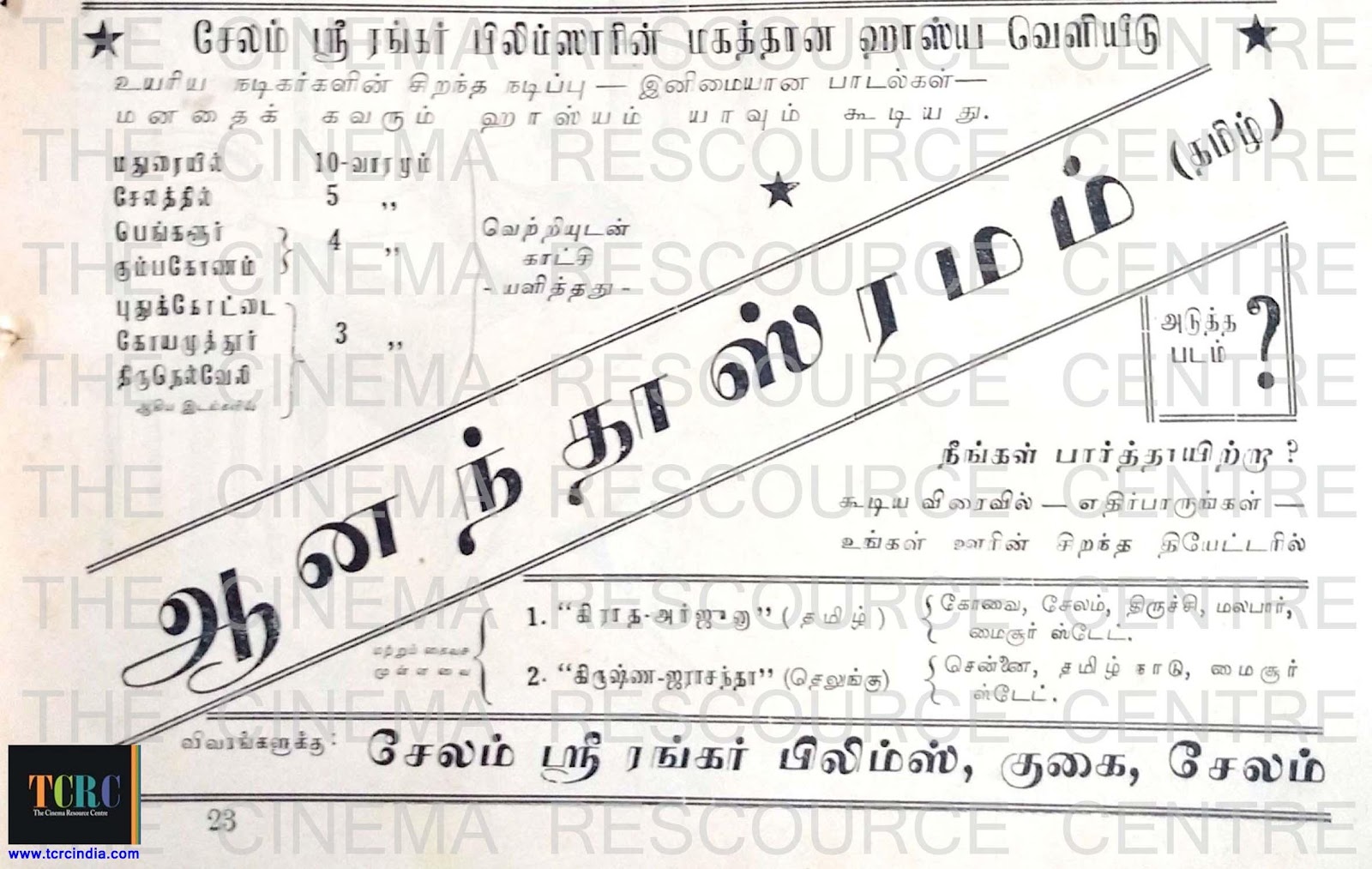
Raman not acheiving much success with Subsequent films SIRUTHONDA NAYANAR in 1935, HARIJANA PENN in 1937 and TENALI RAMAN in 1938 made a film in 1939 with the name ANANDHA ASHRAMAM under the production of Salem Sri Rangar Films, Salem. The film released on 30th July of the year 1939. Backed by good performances of lead artists, good music and humour became a decent box office hit.
An advertisement of ANANDHA ASHRAMAM
From the magazine ANANDA VIKATAN DEEPAVALI MALAR 1939
PC: From the archives of TCRC
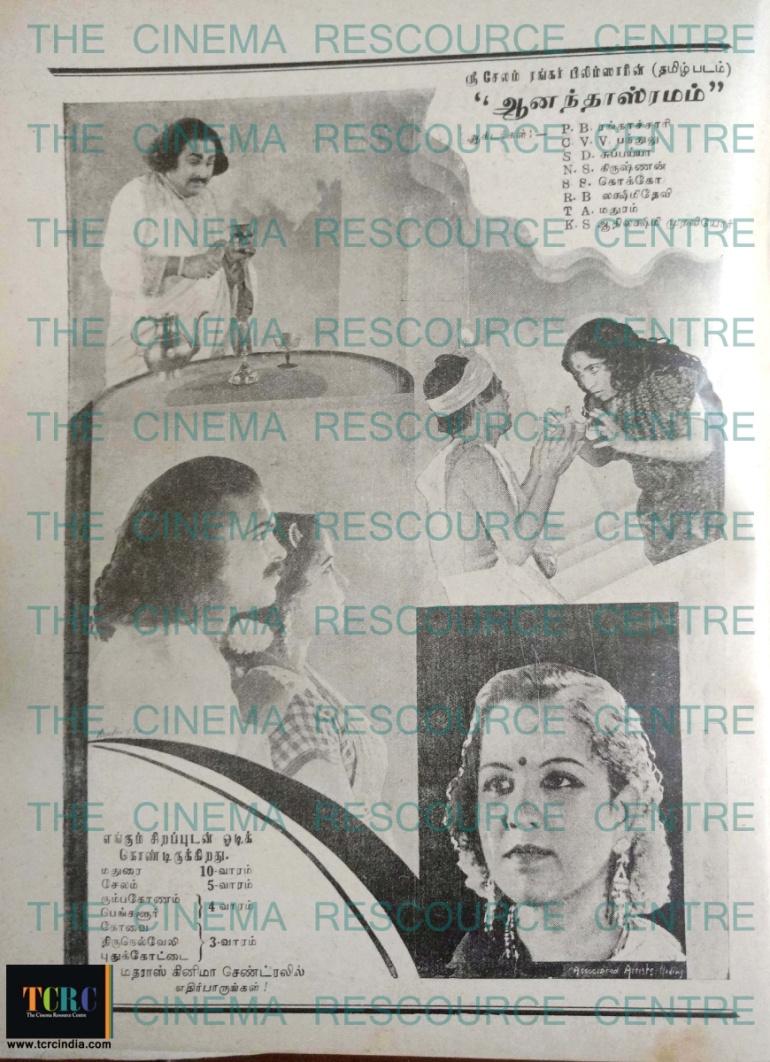
ANANDHA ASHRAMAM had T.B. Rangachari, C.V.V. Panthulu, R.B. Lakshmidevi, S.N. Subbaiah along with Comedy duo N.S. Krishnan and T.A. Madhuram.
The song sung by S.N. Subbaiah in the film was a hit during the film’s release
R.B. Lakshmidevi the lead actress of the film was introduced by Raman during his stint in Silent era. She was also cast in his Cousin A.Narayanan’s directorial venture SRINIVASA KALYANAM in 1934 which incidentally was the first talkie to be made entirely in Madras. She acted in several Tamil films as stunt woman produced in Mumbai studios. She was one of the early personalities to stay at the famous Lloyds road in Chennai (Then Madras) where TKS brothers, M.G.R etc stayed in their primitive years.
An advertisement of ANANDHA ASHRAMAM
From the magazine ANANDA VIKATAN DEEPAVALI MALAR 1939
PC: From the archives of TCRC
S. Soundarrajan
Srinivasa Soundararaja Ayyangar alias S. Soundararajan was yet another forgotten pioneer who was born in Kottacheri, Tamilnadu. Though he was in to a successful brassware business along with his father his interest grew in Cinema after his association with film maker and Srinivasa Cinetone founder A.Narayanan. He extending his financial support for film making.
This association led Soundarajan to an astonishing career in Film Industry as a director, producer, distributor etc. He also was the owner of first processing laboratory in south India and wore many more hats in his illustrious career.
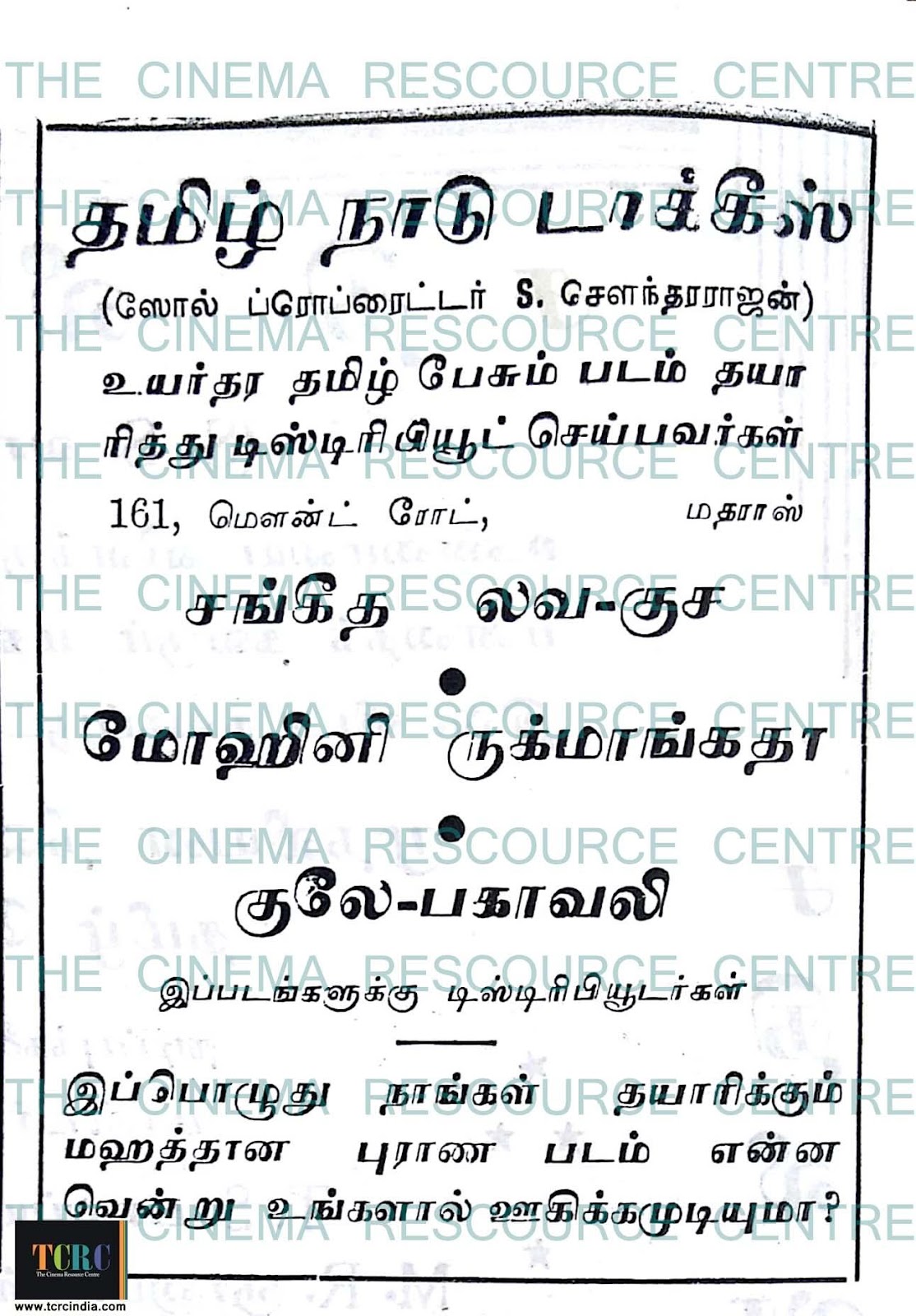
With his friend Alagappa Chettiar as partner, he promoted Tamil Nadu Talkies (TNT) in the year 1933 which soon occupied pride of place in South Indian cinema.
He made his debut as a director with SANGEETHA LAVA KUSA produced by his own TNT. The film is said to have more than 60 songs (as Per Film Historian Randor Guy) hence the prefix Sangeetha(meaning music in English) was used for Lava Kusa
An advertisement of Tamilnadu Talkies showcasing films
SANGEETHA LAVA-KUSA
MOHINI RUGMANGADA
GULEPAKAVALI
From the magazine ANANDA VIKATAN DEEPAVALI MALAR 1935
PC: From the archives of TCRC
Few of the films made by S. Soundararajan during 1930 – 1940:
1934: SANGEETHA LAVA KUSA
1935: GULEPAKAVALI
1935: MOHINI RUKMANGADHA
1936: SRIMATH MAHABHARATHAM
1937: MISS SUNDARI
1940: THIRUMANGAI AAZHWAR
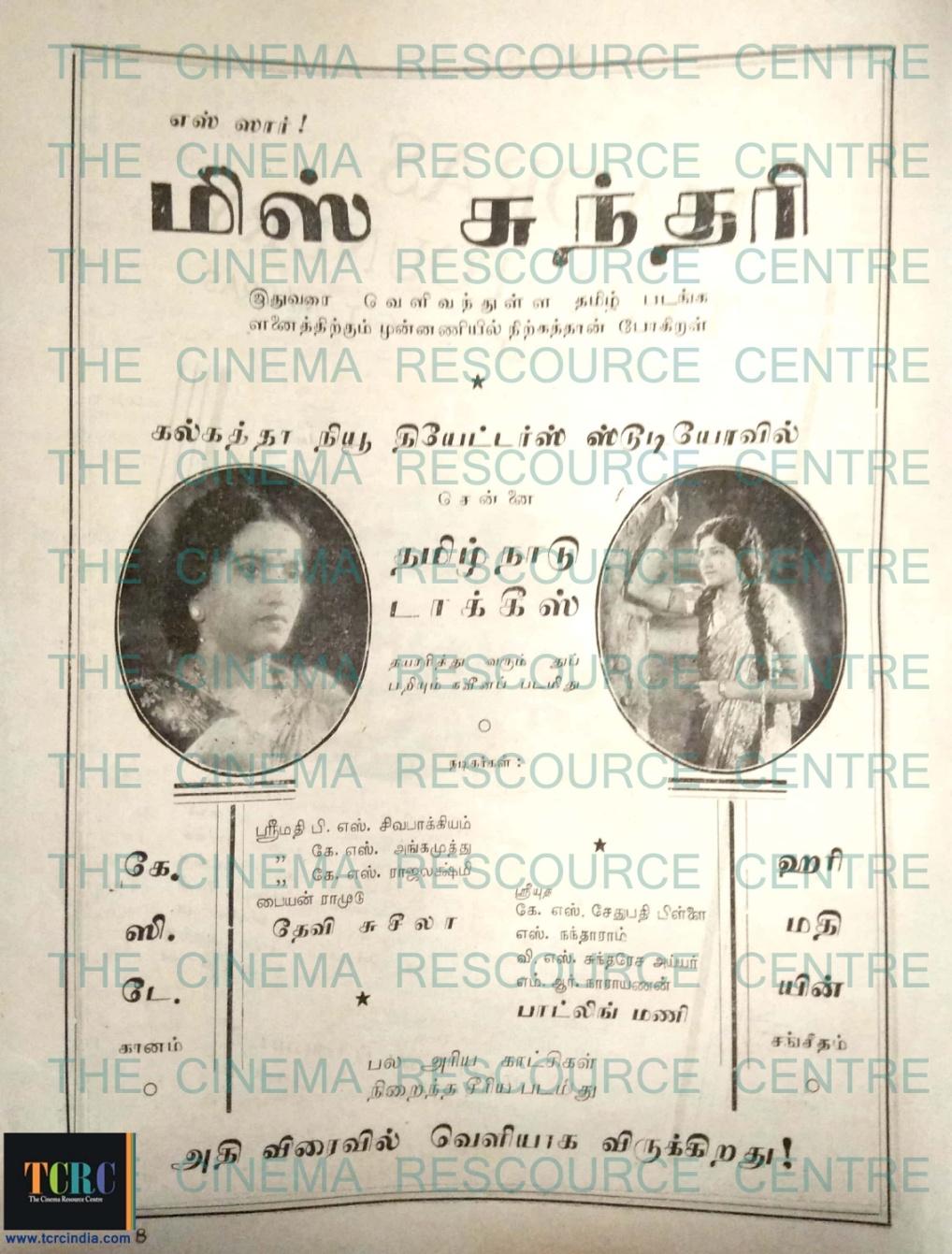
Soundarajan was invloved a lot in colour experiments for his films initially. He tried hand tinting method in his film MOHINI RUGMANGADA in 1935. Later in MISS SUNDARI that released in the year 1937 he continued with his experiments and printed in sepia.
MISS SUNDARI star cast included Bottling Mani, B.S. Sivabhagyam, V.S. Sundaresa Iyer, Sushila Devi, M.R. Narayanan, K.S. Angamuthu, K.S. Sethupathi Pillai and K.S. Rajalashmi
An advertisement of MISS SUNDARI
From the magazine ANANDA VIKATAN DEEPAVALI MALAR 1936
PC: From the archives of TCRC
Soundarrajan was also instrumental in bringing the talents and develop careers of many film personalities like Vasundhara Devi, Krishnakumari, Rama Shankar, Gummadi Venkateshwara Rao and the multifaceted legend S. Balachander
[To be continued] We’ll be back next week with more hidden treasure from the history of Tamil cinema. Stay tuned!
About the Author:
V.V. Prasad is a Electronics and Communication Engineer based from Chennai. He is currently involved in the role of a Researcher and Archivist in THE CINEMA RESCOURCE CENTRE. He takes care of the non film materials like Photographs, Magazines, Lobby Cards, Song books etc of the archives. Cataloguing them and digitizing them are part of his current work. His interests and passion lie on the research of Cinema particularly South Indian Cinema.
I DIRECTORS: THE CAPTAINS – MASTERS AND COMMANDERS WITH AN IMPACT TO LAST THE AGES
10) M.L. Tandon and Michael Omalov
In this episode, we are going to talk about two classmates of Ellis R. Dungan at the University of Southern California: M.L. Tandon and Michael Omalov.
M.L. Tandon
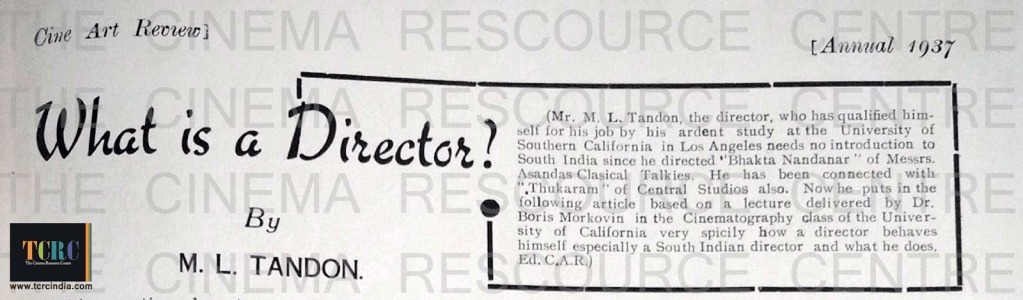
M.L. Tandon, also known as Mani Lal Tandon, was one of the first Indians to study film making in the US. He attended the renowned University of Southern California (USC) in Los Angeles, where he made student films and became the first Indian to work in Hollywood. After returning to India, he became a successful filmmaker in the early years of Tamil and Telugu cinema.
Cut out from an Article by M.L.Tandon
From the magazine CINE ART REVIEW 1937
PC: From the archives of TCRC
Some of the films made by M.L. Tandon during the period of 1930-1940 include:
1934: BAMA VIJAYAM
1935: DUMBACHARI
1935: BHAKTHA NANDHANAR
1938: TUKKARAM (Telugu)
1938: YAYATHI
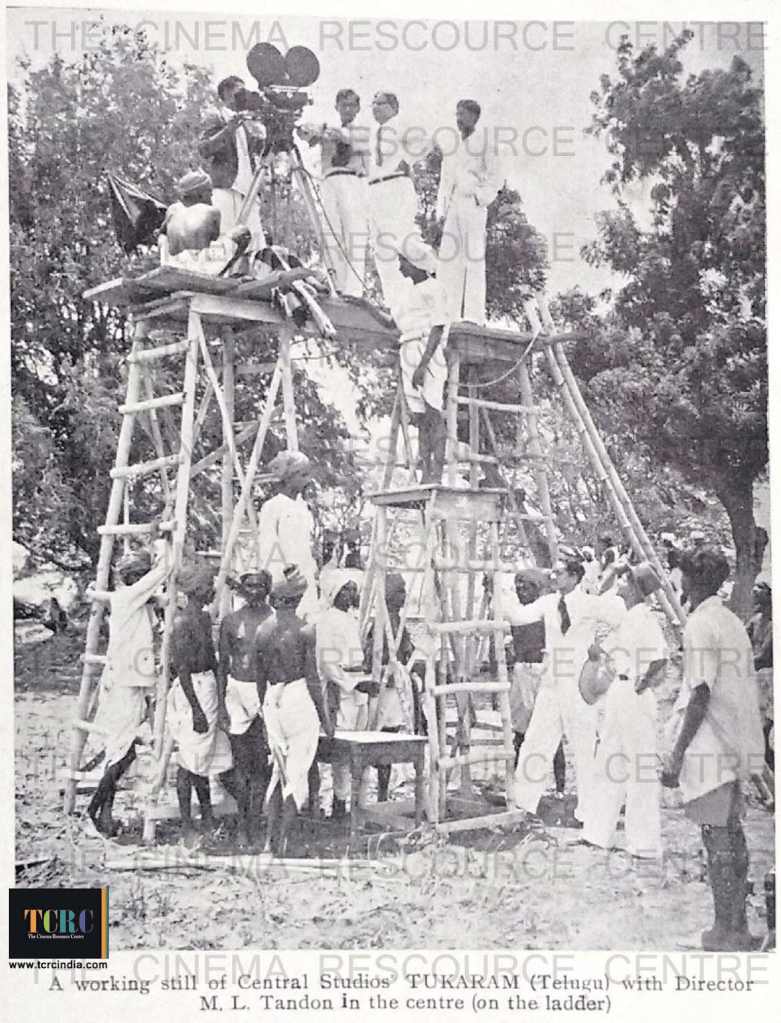
While studying at USC, two of Tandon’s classmates were Michael Omalov and the celebrated American Tamil filmmaker Ellis R. Dungan. When Tandon returned to India, he brought both of them with him and played a vital role in shaping their careers here. One of them became a cameraman/director, while the other went on to become an iconic filmmaker.
A still featuring M.L.Tandon with his crew during TUKARAM (TELUGU) shooting
From the magazine CINE ART REVIEW 1937
PC: From the archives of TCRC
While the Tamil version of TUKARAM was directed by B.N. Rao, Tandon directed the Telugu version with the thespian C.S.R. Anjaneyulu, also known as Chilakalapudi Seeta Rama Anjaneyulu, in the titular role. CSR, who acted in many films during the 1930s, was a big star and is believed to have acted in more than 175 films.
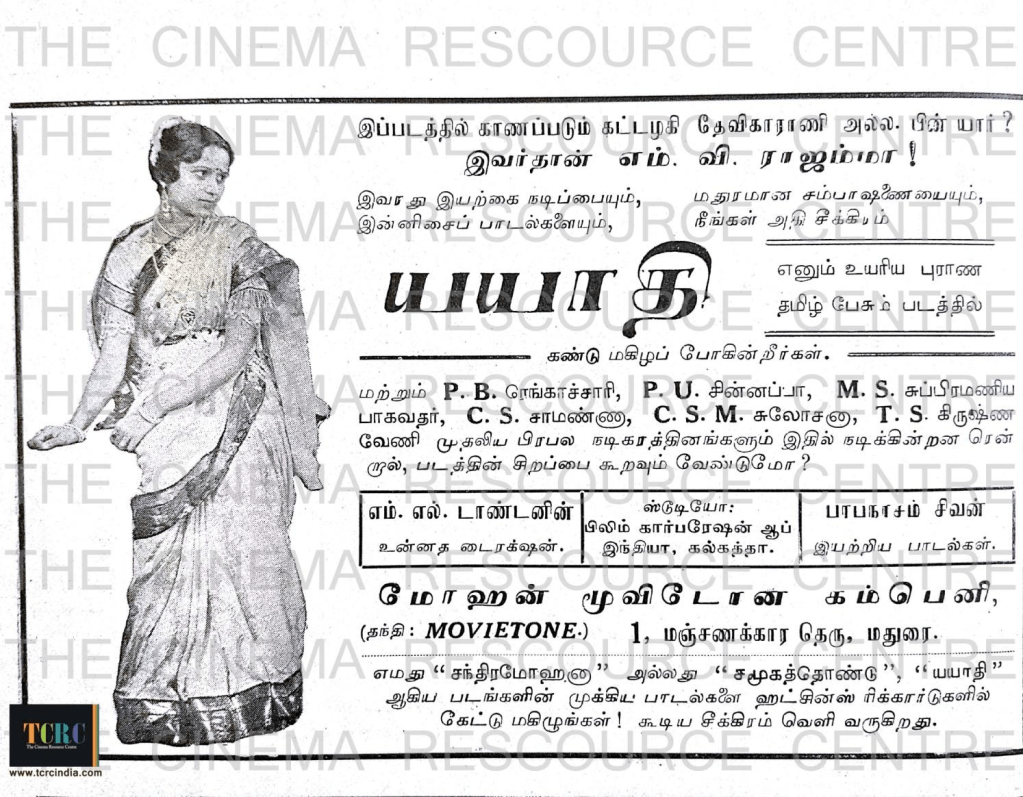
YAYATHI, directed by Tandon, had one of the early superstars of the Tamil film industry, P.U. Chinnappa, in the lead role, with M.V. Rajamma playing the female lead. It was one of the early films of Chinnappa, who had worked in BOYS DRAMA COMPANY before joining films.
An advertisement of YAYATHI highlighting M.V. Rajamma
From the magazine DINAMANI VARUSHA MALAR 1938
PC: From the archives of TCRC
YAYATHI was a mythological film based on the story of a princess named Devayani and a prince named Yayathi who fall in love and marry. The film portrays how they overcome curses and Yayathi regains his crown. The multifaceted Serukalathur Sama wrote the dialogues, while Papanasam Sivan handled the lyrics and music composition for the 25 songs in the film. Although the film was not a big hit, it is still remembered by film historians and enthusiasts for the daunting performance of Chinnappa and Tandon’s direction.
M.L. Tandon made some memorable movies in the 1930s before making films for Modern Theatres in the late 40s. Though he was one of the leading filmmakers in the Telugu and Tamil film industry of yesteryears, he, too, is sadly amongst the forgotten pioneers of the industry.
Michael Omalov
Omalov was believed to be an exceptional cinematographer, and according to historian Randor Guy, he even operated the camera for one of Tandon’s student films, OVAL PORTRAIT in 1933 during his USC days. Although he came to India along with his friends Dungan and Tandon with the aspiration to flourish in the Indian film industry, he returned after directing his only film here, NAVA YUVAN.
Released in 1937, NAVA YUVAN was a story about an educated Indian youth who gets attracted to Western culture and forgets the deeply rooted Indian traditions. The film shows how he realizes the greatness of his homeland after his experiences in London. The film also had an alternate title, GEETHA SAARAM.
A still from the Film NAVA YUVAN featuring V.V.Sadagopan
PC: From the archives of TCRC
NAVA YUVAN eventually became the first Tamil movie to be filmed abroad. The film was shot in London and even made headlines in the local newspapers. The famous Carnatic musician V.V. Sadagopan made his acting debut in the lead role. However, during the shooting of the film in London, Omalov disappeared and never returned to India. He later became the Head of the Photography Department at Ford Motors in Detroit. [To be continued] We’ll be back next week with more hidden treasure from the history of Tamil cinema. Stay tuned!
About the Author:
V.V. Prasad is a Electronics and Communication Engineer based from Chennai. He is currently involved in the role of a Researcher and Archivist in THE CINEMA RESCOURCE CENTRE. He takes care of the non film materials like Photographs, Magazines, Lobby Cards, Song books etc of the archives. Cataloguing them and digitizing them are part of his current work. His interests and passion lie on the research of Cinema particularly South Indian Cinema.
I DIRECTORS: THE CAPTAINS – MASTERS AND COMMANDERS WITH AN IMPACT TO LAST THE AGES
9) R. Venkaiah and R. Prakash
This week, we will be discussing the father-son duo who played a significant role in the development of cinema in this part of the country.
R. Venkaiah
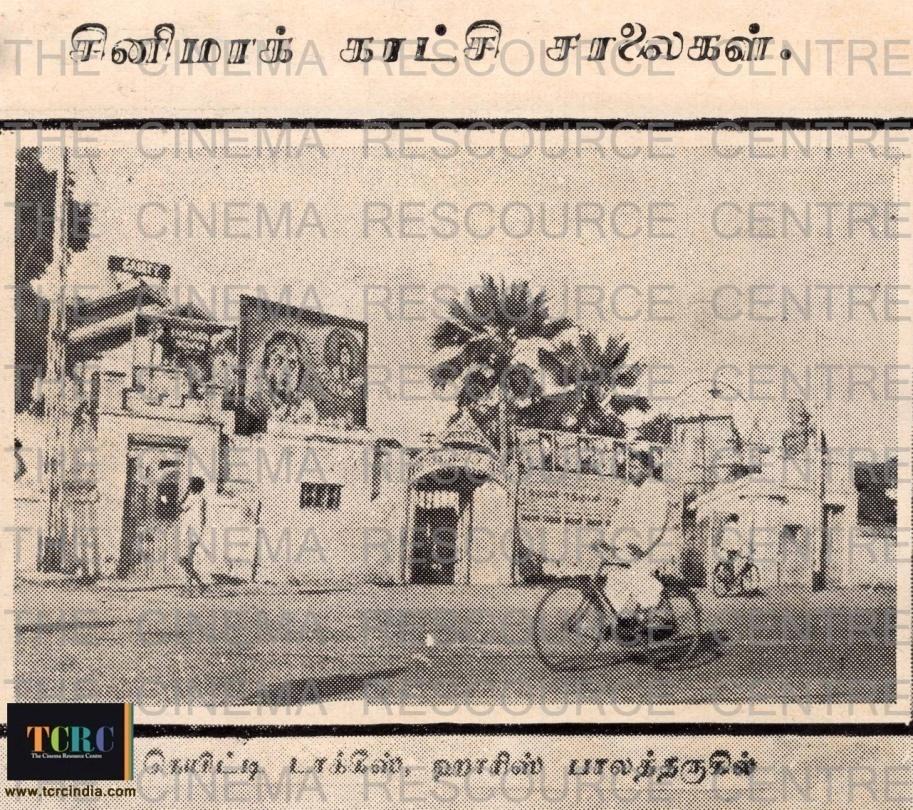
Raghupathy Venkaiah was born in Machilipatnam, Andhra Pradesh in 1869, into a family of men who served in the Indian (British) Army. His interest in photography led him to open a photo studio on Mount Road. After achieving resounding success with this business, he began exhibiting films, which also proved to be very profitable for him. He earned even more by extending his shows to all parts of India, as well as Burma and Ceylon. Upon returning home, his aspirations grew even higher, and he wanted to venture into permanent cinema houses. Thus, he built the first permanent cinema house in Madras City, called the Gaiety, in 1912. He then built two more cinema houses in Madras, the Crown and the Globe (which was later renamed Roxy), as well as one more in Madura, called the Imperial. Unfortunately, all of these cinema houses have since been shut down and turned into commercial or housing complexes.
A Photo of Cinema House Gaiety Mentioned as GaietyTalkies near HarrisBridge
From the magazine ANANDHA VIKATAN DEEPAVALI MALAR 1936
PC: From the archives of TCRC
R. Prakash
After achieving remarkable success with his cinema houses, Venkaiah wanted to move into picture production. Hence, his son Prakash was sent to Baker’s Motion Picture Studio in England.
Raghupathy Surya Prakash, born in 1901, was trained during his stay in England. He also acted in a couple of movies with the role of an Indian. He traveled to France and Germany to keenly observe the leading filmmakers there. After his return, along with his father, he launched Gajalakshmi Productions, and the maiden movie MEENAKSHI KALYANAM was born.
As per his father’s wish, Prakash started the ‘Star of the East’ studio in Purasawalkam, Madras. To avoid dust and simultaneously allow sunlight, a glass roof was erected, which became the reason for the studio to be known as the Glass Studio. The first film made in the studio was BHEESHMA PRATINGA in 1922. The late A. Narayanan, who was known as the father of the South Indian film industry, played the role of Lord Krishna in the film. BHEESHMA PRATINGA, also known as BHEESHMA VADHAM, was made with a budget of Rs.12,000 but earned Rs.60,000. It was written, photographed, produced, and directed by Prakash himself.
The following films were made in the Glass Studio:
NANDANAR (1923)
SAMUDRA MADANAM (1923)
GAJENDRA MOKSHAM (1924)
USHA SWAPNA (1924)
DRAUPADI BHAGYA (1924)
MAHATMA KABIRDAS (1925)
MACHAVATHARAM (1927)
Although Prakash was a skilled technician, he lacked business management skills which led to the closure of Star of the East.
However, with the help of family friend Motey Narayana Rao, he bounced back and established a new company, Guarantee Picture Corporation. He was given a large open land in Tondiarpet, Madras by another family friend, where he opened a new studio. He had an energetic young team comprising C. Pullaiah, Jiten Banerjee, C.V. Raman, A. Narayanan, P.V. Rao, and Y.V. Rao, who would later become great directors. It can be said that they learned their first lesson in the art of cinema from him. From this studio, DASAVATARAM (1929) and KOVALAN (1929) were made. However, due to poor planning and management, the Tondiarpet studio was also closed. A. Narayanan launched his own venture, General Pictures Corporation, and Prakash joined as a technician. Prakash made several films for Narayanan with reasonable success, including LEILA – THE STAR OF MINGRELIA, which proved to be a huge box office hit not only in India but also in neighboring countries like Burma and Ceylon.
When talkies started to emerge, Narayanan established Srinivasa Cinetone, the first talkie studio in South India, where Prakash continued his work. The first film of Srinivasa Cinetone was SRINIVASA KALYANAM directed by A. Narayanan, with Prakash handling the camera. The second film, DRAUPADI VASTRAPRAHARANAM, was directed jointly by Narayanan and Prakash.
R.S. Prakash directed several films during 1930-1940, including:
1935: THOOKU THOOKI
1936: INDRASABHA
1936: KRISHNANARADHI
1936: NALAIANI
1937: AANDAL THIRUKALYANAM
1937: RAJASEKARAN
1938: ANADHAI PENN
1939: SIRIKKAATHE
1940: KRISHNAN THOOTHU
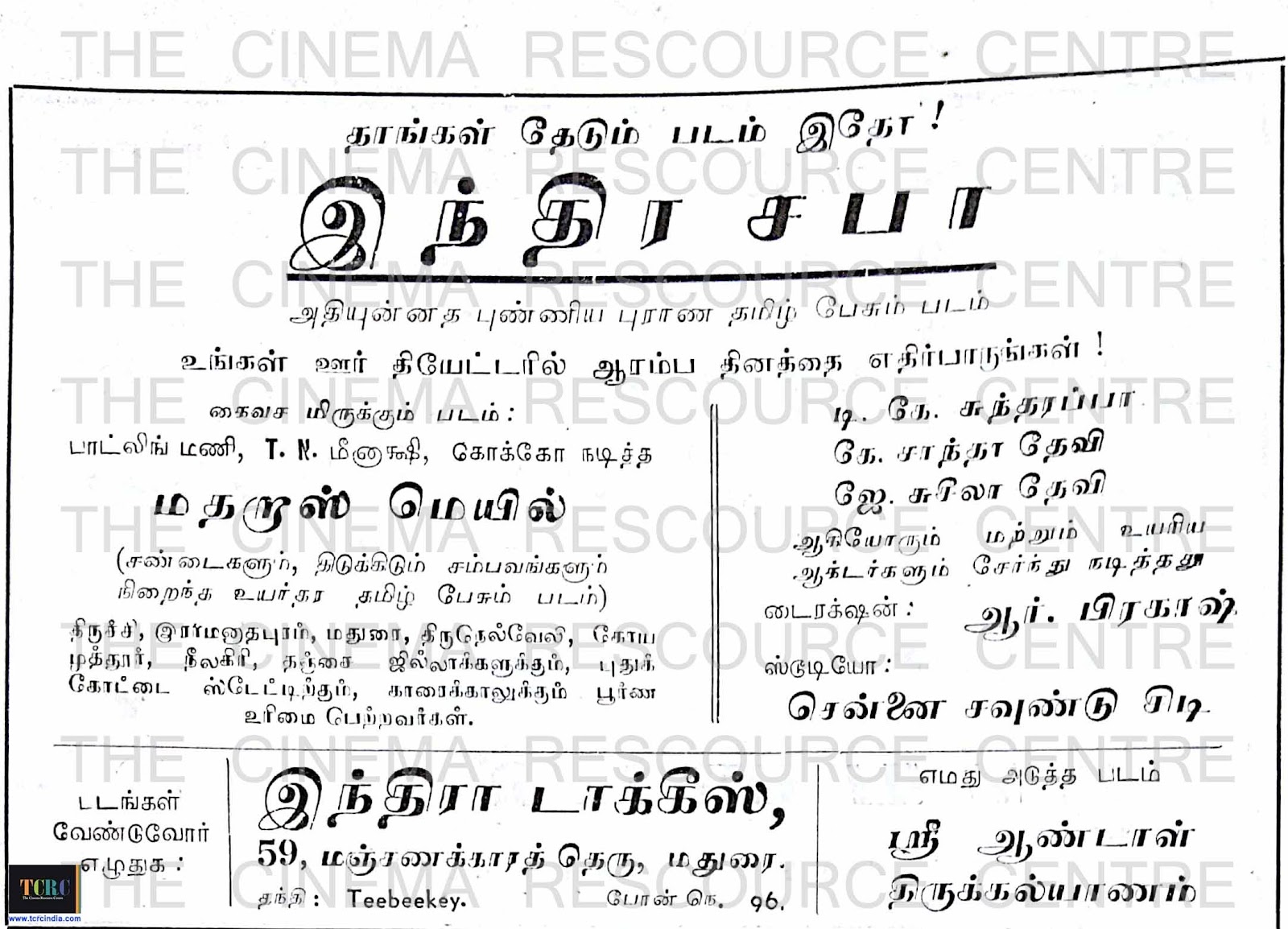
In 1936, Prakash directed INDRASABHA for Srinivasa Cinetone. The film was based on a Hindu mythology story about the romance between a prince and a fairy. The story was adapted into a Hindi film of the same name in 1932. Prakash’s Tamil adaptation for Sound City aka Srinivasa Cinetone starred T.K. Sundarappa, K. Shantha Devi, and Sushila Devi in the lead roles.
An advertisement of INDRA SABHA
From the magazine ANANDHA VIKATAN DEEPAVALI MALAR 1936
PC: From the archives of TCRC
In 1937, RAJASEKARAN was released and produced by Madurai Meenakshi Cinetone. This film directed by Prakash was notable for its music director Rajam Pushpavanam, who became the first female music director in the south and the third in India after Jaddanbai and Saraswathi Devi. She was only 19 years old when the film was released, making her the youngest woman music director in India at the time.
The film also marked the debut of the legendary actor Madras Rajagopala Radhakrishnan, popularly known as M.R. Radha. He earned the nickname Nadigavel at the peak of his career. His ideology was of Dravidianism and he used stages and films to promote atheism and social reforms.
A still from the Movie RAJASEKARAN Featuring M.R. Radha
PC: From the archives of TCRC
ANADHAI PENN is considered by many cinema pundits as R.S. Prakash’s best work. The film was based on a novel written by Vai. Mu. Kodhainayaki Ammal, commonly called Vai.Mu.Ko. She had written many successful novels, including topics like detective genres which were uncommon for female writers. She also single-handedly wrote, edited, and published a magazine by the name Jaganmohini, which was very popular at that time. Her most popular novel was ANADHAI PENN, which was adapted into a film with the same name.
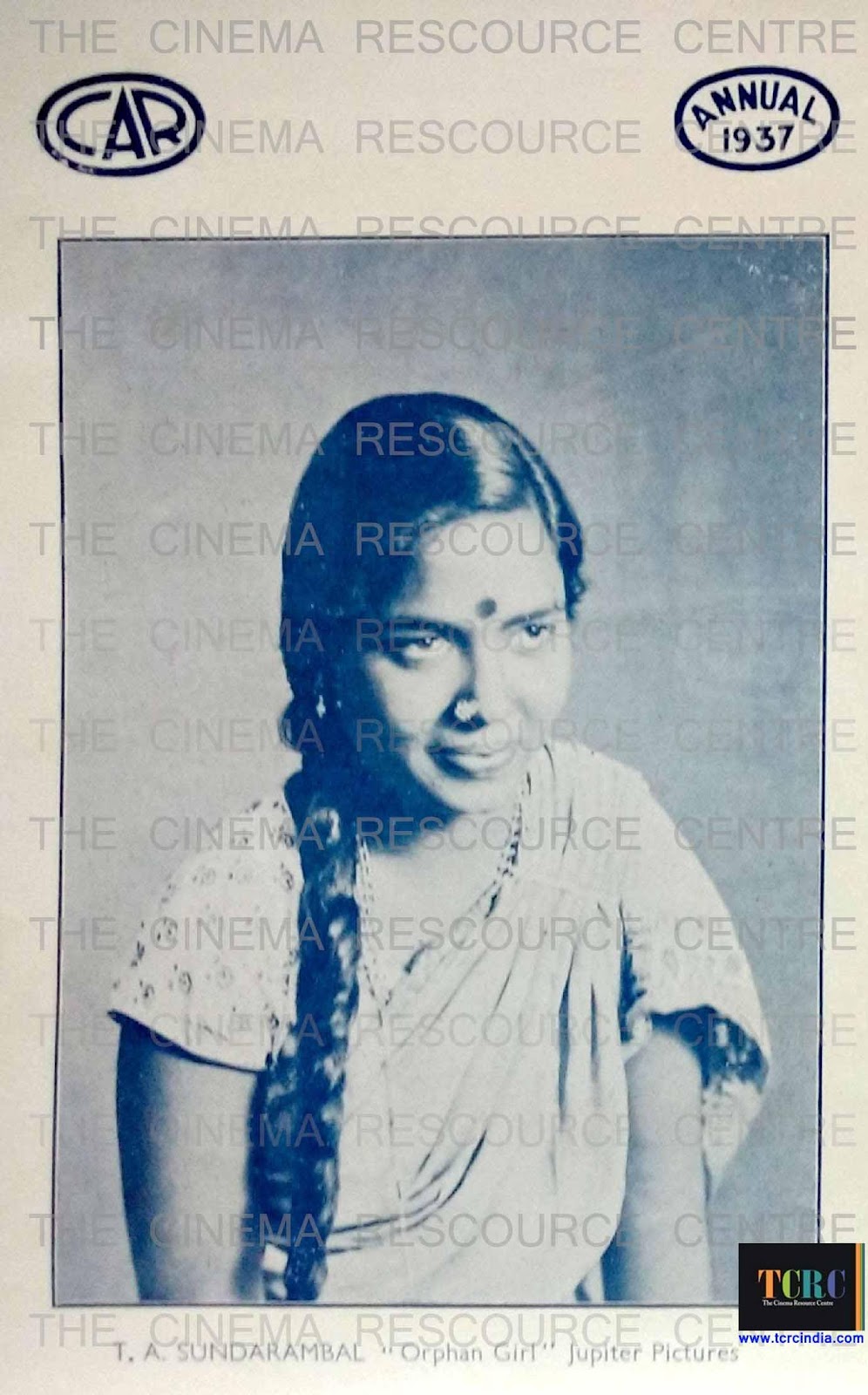
A still from the Film ANADHAIPENN featuring T.A.Sundarambal
From the magazine CINE ART REVIEW 1937
PC: From the archives of TCRC
Madras Kandaswami Radhakrishnan, also known as M.K. Radha, was selected as the lead actor along with T.A. Sundarambal. Radha was actually the choice of Vai.Ku.Mo, who was very particular about the decision, claiming that the story was written with Radha in mind. This was probably the first time in the country that a writer had chosen the leading hero for a movie.
ANADHAI PENN became a very important film in M.K. Radha’s career. The film was a big hit, and he became a style icon, with many fans dressing up and imitating his mannerisms from the film. Unfortunately, Sundarambal didn’t act much after this film and faded away. Interestingly, P.U. Chinnappa played the villain role as a budding actor, who later became a superstar, and another icon, Kothamangalam Subbu, acted in the movie in a comical role.
It’s unfortunate that R. Venkaiah is not given the recognition he truly deserves. He is one of the pioneers who contributed a lot to the city of Madras and is a forgotten figure, although the Andhra Government has instituted an award in his name called the Raghupathi Venkaiah Award For Excellence And Outstanding Contribution To Telugu Cinema. He and his son helped many people in a big way for the development of the film industry in South India. It would not be an exaggeration to say that this Father-Son duo’s contributions made the South Indian Film, particularly the Tamil Film, what it is today.
[To be continued] We’ll be back next week with more hidden treasure from the history of Tamil cinema. Stay tuned!
About the Author:
V.V. Prasad is a Electronics and Communication Engineer based from Chennai. He is currently involved in the role of a Researcher and Archivist in THE CINEMA RESCOURCE CENTRE. He takes care of the non film materials like Photographs, Magazines, Lobby Cards, Song books etc of the archives. Cataloguing them and digitizing them are part of his current work. His interests and passion lie on the research of Cinema particularly South Indian Cinema.
I DIRECTORS: THE CAPTAINS – MASTERS AND COMMANDERS WITH AN IMPACT TO LAST THE AGES
8) R. Padmanabhan
Rangasami Padmanabhan, also known as R. Padmanabhan, is one of the pioneers of Tamil Cinema. Sadly, few people remember or talk about him today, except for a few old-timers and film historians.
Padmanabhan was born in Sivaganga in 1895 into a middle-class family. His interest in cinema grew while he was in Colombo, where he began arranging exhibitions for an English distributor. Later, he moved to Madras and established his own firm, Oriental Film Services, which provided services such as bringing films from Bombay or Hollywood, arranging spares for film equipment, and assisting with miscellaneous film-related work. With the help of K.S. Venkatramani, who happened to be the father-in-law of the legendary filmmaker K. Subramanyam, Padmanabhan started the Madras-based Associated Film Studios. The production studio was the second-largest in South India at the time, followed only by General Pictures.
Padmanabhan made a name for himself in the silent era, and was responsible for launching the career of K. Subramaniyam, the lawyer turned filmmaker who began as a screenwriter for Padmanbhan but later became a revolutionary filmmaker with films such as SEVASADHANAM and THYAGABHOOMI.
Padmanabhan also brought another trendsetting filmmaker, Raja Sandow, to the forefront through the silent film ANADHAI PENN in 1929. This film marked the launch of Padmanabhan’s own Associated Film Studios, and it was quite successful upon its release in 1931. Unfortunately, it is now one of the many lost films from the silent era. Raja Sandow continued to work for Padmanabhan, and several silent films were made, through which K. Subramaniyam also received training.
When Tamil films began to talk — ie. feature sound — in 1931, Padmanabhan, who had made many silent films, began making talkies in both Tamil and Telugu. He established a production company, Oriental Film Services, in partnership with Ramalinga Mudaliar. Most of his films were shot at Pioneer Studios in Calcutta. His first talkie film as a director was DRAUPATHI VASTRAPAHARANAM, which was released in 1934. The film was produced in Calcutta by the Salem-based production company Angel Films.
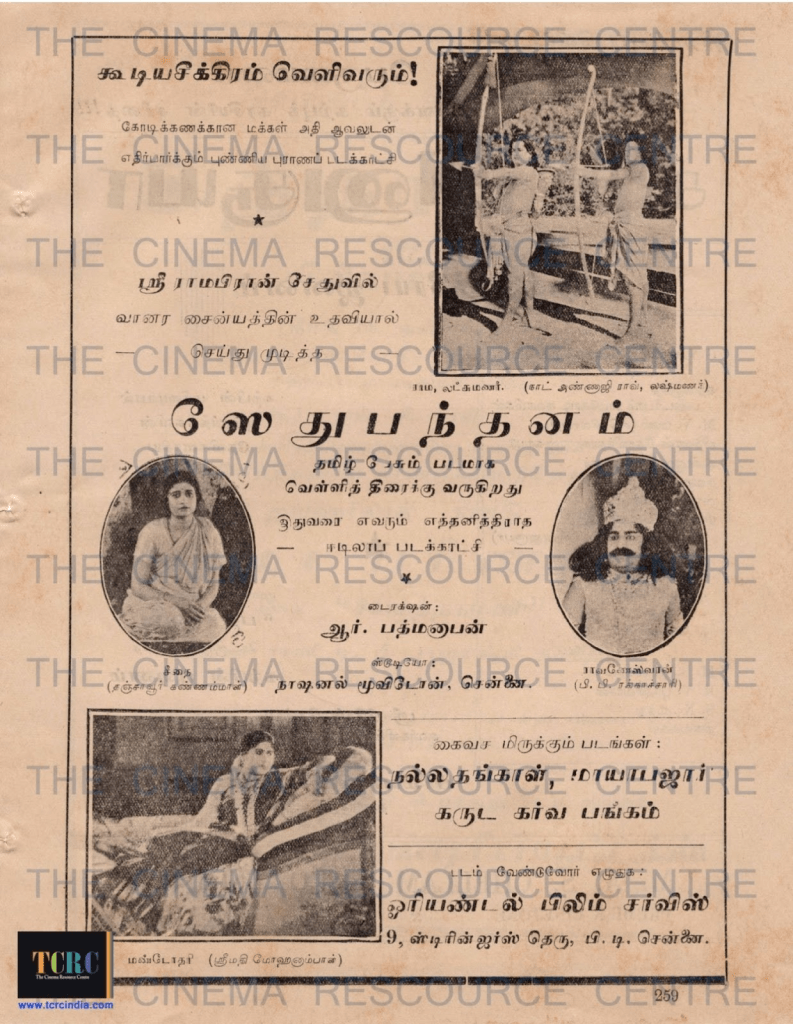
An advertisement of Oriental Film Services mentioning SETHU BANDHANAM, NALLATHANGAL,
MAYA BAZAAR and GARUDAGARVABHANGAM all 4 films directed by R. Padmanabhan
From the magazine ANANDHA VIKATAN DEEPAVALI MALAR 1936
PC: From the archives of TCRC
Following the release of DRAUPATHI VASTRAPAHARANAM, Padmanabhan had two more releases in 1935: NALLA THANGAL, and MAYA BAZAAR, also known as VATSALA KALYANAM.
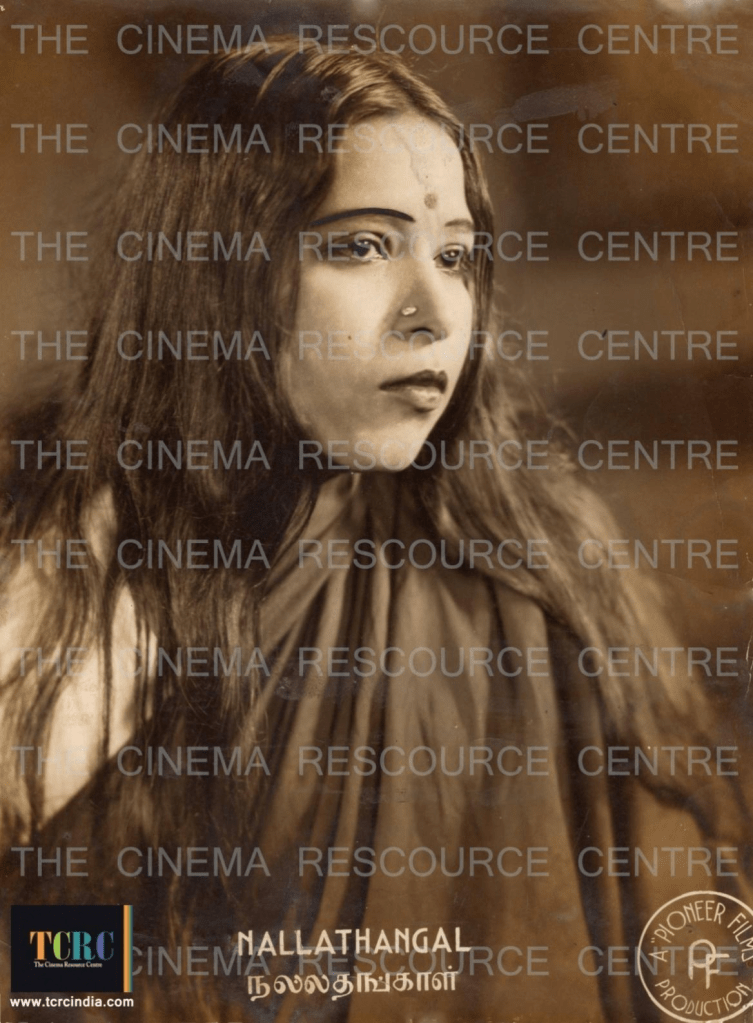
NALLA THANGAL is a story based on Hindu mythology about a mother of the same name who, along with her seven children, commits suicide by jumping into a well due to severe famine caused by barren lands, humiliation, and insults from society. Her brother, upon learning of this tragedy, also jumps into the well and takes his own life. After her death, Nalla Thangal becomes a village deity, and there are temples dedicated to her. Though many films have been made based on this story, R. Padmanabhan’s NALLA THANGAL, produced by Pioneer Films, was one of the first, along with P.V. Rao’s version, released in the same year under the same name, for Angel Films.
A still from the Movie NALLATHANGAL Featuring P.S.Rathnabhai
PC: From the archives of TCRC
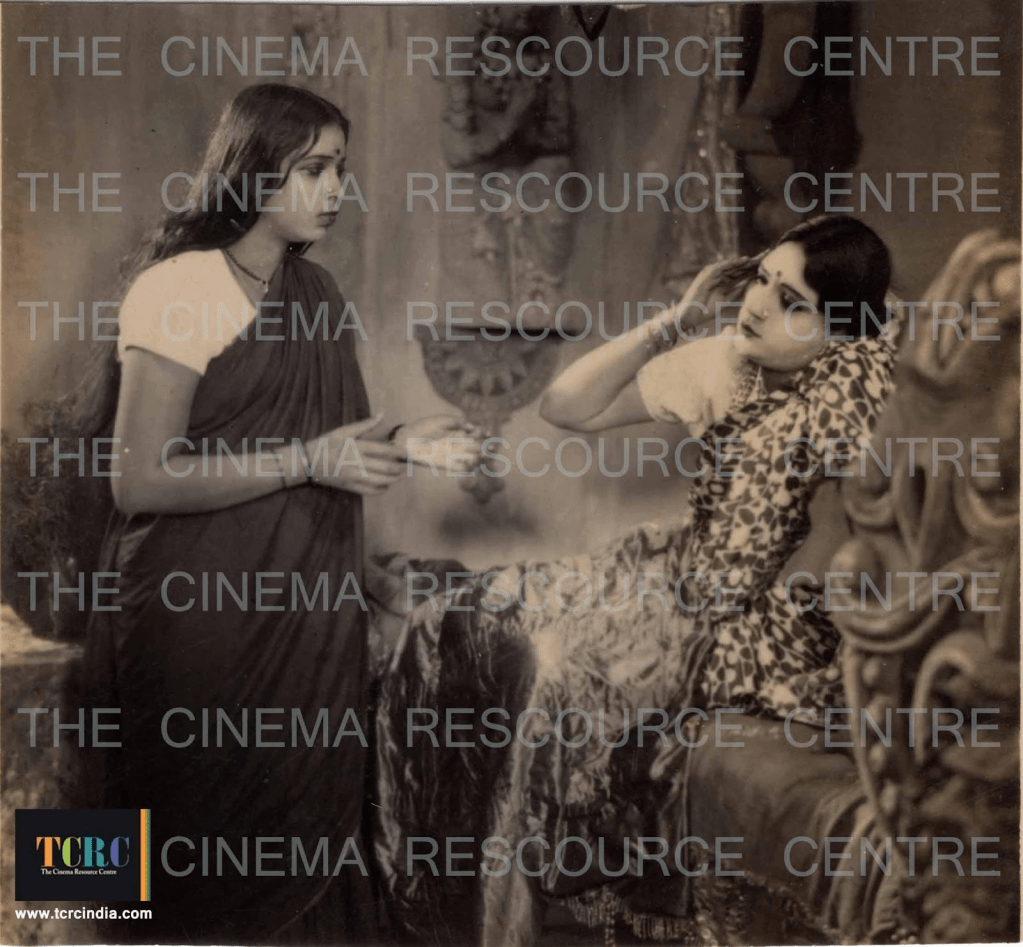
The film featured P.S. Rathanabhai in the titular role, with M.R. Krishnamurthy, M.S. Murugesan, and P.S. Saraswathibhai among the supporting cast. Rathanabhai and Saraswathibhai, who were siblings in real life and known as the Palayamkottai Sisters, often worked together as a team in many films. They were reportedly paid a combined fee of Rs. 25,000 for a 45-day shoot, with any extensions incurring additional payment.
A still from the Movie NALLATHANGAL Featuring P.S.Rathnabhai and P.S. Saraswathibhai
PC: From the archives of TCRC
R. Padmanabhan’s film, SETHU BHANDHANAM, ranks among the top in the most successful films chart of Padmanabhan. The film was based on the Hindu epic Ramayana, where Rama builds a bridge to Lanka with the help of his devotee Hanuman and his friends to fight Ravana and rescue his abducted wife Seetha. This bridge was called Sethu Bhandanam.
P.B. Rangachari, a famous star then, acted in the role of Ravanan, while Nott Annaji Rao essayed the character of Rama, and M.S. Mohanambal played Ravanan’s wife Mandothari. Alongside them, T.K. Kannammal acted in the role of Seetha. M.D. Parthasarathy acted in the much-applauded role of Hanuman, who later went on to become one of the most established Carnatic musicians in the country, and a film music composer to boot. His performance as Hanuman is considered a big plus towards the stupendous success of the movie. Padmanabhan later made a Telugu version of the film with the same name in 1946, which also turned out to be a profitable venture.
A still from the Movie SETHUBHANDHANAM Featuring P.B. Rangachari
PC: From the archives of TCRC
[To be continued] We’ll be back next week with more hidden treasure from the history of Tamil cinema. Stay tuned!
About the Author:
V.V. Prasad is a Electronics and Communication Engineer based from Chennai. He is currently involved in the role of a Researcher and Archivist in THE CINEMA RESCOURCE CENTRE. He takes care of the non film materials like Photographs, Magazines, Lobby Cards, Song books etc of the archives. Cataloguing them and digitizing them are part of his current work. His interests and passion lie on the research of Cinema particularly South Indian Cinema.
I DIRECTORS: THE CAPTAINS – MASTERS AND COMMANDERS WITH AN IMPACT TO LAST THE AGES
7) T.R. Sundaram
Tiruchengodu Ramalinga Sundaram was a profoundly important figure in pioneering the South Indian film industry. He was born on July 16th, 1907, in Tiruchengodu of Salem district, into a family of yarn merchants. After completing his schooling in Salem, he moved to Madras to study B.A. Once he finished his degree in Madras, his family, aspiring to modernise their business, urged him to pursue higher studies abroad. Consequently, he went to Leeds to obtain a BSc in textile technology, where he fell in love and married an English woman named Gladys. When he returned with his English wife, his family and relatives didn’t accept their relationship and refused him any role in their textile business. Sundaram was hardly shaken and chose to enter the film world. He eventually became one of the most successful personalities of the industry.
His film career started with a partnership with Salem-based Angel Films. He was actively involved in the production of movies such as DRAUPADI VASTRAPAHARANAM, which was released in the year 1934.
With the experience gained from his partnership with Angel Films, he decided to go solo and started his own venture called Modern Theatres. With 10 acres of land on the foothills of Yercaud (a hill station in Tamil Nadu), he built the studio that played significant role in the careers of many stalwarts of the industry. It was one of the biggest studios in South India built outside Chennai, in Salem. Modern Theatres was believed to have 250 employees. Some well-known names like S.V. Ranga Rao, Anjali Devi and M.R. Radha were introduced by Sundaram through Modern.
The first film that Sundaram produced at Modern Theatres was SATHI AHALYA in 1937, which he directed himself. This film was shot entirely in the Modern Theatres studio for the first time. Sri Lankan actress K. Thavamani Devi was cast in the lead role. Although she was born in Sri Lanka, she moved to Madras to pursue her career. Being trained in Carnatic music and Bharatanatyam, she was able to dance and sing in her own voice. Eventually, she earned the name Singalathu Kuyil. When Sundaram invited the press to announce his production launch and gave a photo carrying Thavamani Devi in a swimsuit, it raised eyebrows as it was considered too glamorous for that time. In fact, it was Devi who set the trend for glamour among heroines in Tamil films, which actresses like T.R. Rajakumari and Mathuri Devi followed.
The same year, he produced and directed one more film, PADMA JYOTHI. This second film from Modern Theatres had a very new feature in Tamil cinema, in fact, for the whole of India. It was the animation technique used in the title credits. When the heroine’s name Padma was shown, a cartoon face of a woman showing multiple expressions was used. It was incredible as animation was a completely unknown technique during that time. The film is said to have 25 songs, according to film historian Randor Guy. Though the film was only an average grosser, it is still remembered for the introduction of animation, a patriotic theme in cinema, and its music.
A still from the Movie PADMA JYOTHI produced and directed by T.R. Sundaram
PC: From the archives of TCRC
Some of the other films produced and/or directed by T.R. Sundaram during 1930-1940included:
1938: THAYUMANAVAR
1938: MAYA MAYAVAN
1938: MAYURATHVAJAN
1939: MANICKAVASAGAR
1939: SANTHANA DEVAN
1940: VIKRAMA URVASHI
1940: SATHI MAHANANTHA
1940: SATHYAVAANI
1940: UTHAMA PUTHIRAN
1940: HARIHARA MAYA
1940: SATHI MURALI
MANICKAVASAGAR, directed by T.R. Sundaram, was released in 1939. The film was jointly produced by two Salem-based companies, Sri krishna Films and Sundaram’s very own Modern Theatres. It was the third outing for M.M. Dhandapani Desigar as an actor and the second one with Sundaram after THAYUMANAVAR. M.S. Devasena played the female lead role again with the same combo of Sundaram and Desigar after Thayumanavar. Devasena and Desigar became life partners in real life as well later on in their lives.
A still from the Movie MANICKAVASAGAR featuring M.M.Dhandapani Desigar and others
PC: From the archives of TCRC
MANICKAVASAGAR was an eponymous biopic of the saint Manickavasagar. Desigar had his own fan following those days for his singing prowess and later became one of the legends in Carnatic music. He was one of the key personalities in the Tamil songs movement in classical music. His full-fledged concerts of the Thirukural are still applauded and celebrated greatly by music critics all over the country and the world. His music was loved by even people who didn’t have much knowledge of classical music. He earned the moniker of Isai Arasu, or The King of Music. He also received many felicitations like Isai Perarignar from the Tamil Isai Sangam and the Sangita Nataka Academy Award.
A still from the Movie MANICKAVASAGAR
PC: From the archives of TCRC
SANTHANADEVAN, produced by T.R. Sundaram and directed by S. Nottani, was a film based on Robin Hood. Nottani had been working with Modern Theatres for quite a while, including directing the first talkie in Malayalam, BALAN. The film featured a Muslim hero in Tamil cinema for the first time, G.M. Basheer. It took on the British government’s tax policies and indirectly criticised them through powerful dialogues and songs. However, to appease the British censors, the film used the character Madanan, the brother of a good and kindly king, as the person who mercilessly taxes people. The hero, Chandanadevan, sings with people to do service by looting the rich, landlords, and government servants to help the poor. The film also marked the debut of the legendary M.R. Radha as a villain. It was his second film as an actor after RAJASEKARAN.
A still from the Movie SANDHANADEVAN Featuring G.M.Basheer and P.Bhanumathi
PC: From the archives of TCRC
T.R. Sundaram was the founder of the legendary Modern Theatres, which at its peak had three film productions a year. After completing 98 films and while planning his 99th film he already had set his sight on the 100th film as a centenary celebration for his production unit. However unfortunately Sundaram fell victim to destiny and died at the age of 56 in 1963. By then Modern Theatres had produced 98 films of which 56 were directed by Sundaram himself. His son Rama Sundaram continued the legacy to fulfill his father’s dream, and Modern Theatres ended up producing 117 films before succumbing to the death of production studios in the country.
Sundaram is reverently remembered for the way he ran the studio with discipline and finesse, treating it like a factory with a rigid code of conduct. There was no bias or discrimination, and even a leading actor was made to stand for hours when he came late for work. The gates of the studio were locked on time, and no visitors were allowed. However, Sundaram paid everyone generously and promptly, which was quite rare during those times.
Sundaram achieved many milestones, such as producing Tamil cinema’s first colour film, ALIBABAVUM 40 THIRUDARGALUM, directing the first Malayalam talkie, BALAN, and producing the first-ever colour film in Malayalam, KANDAM BECHA KOTTU. He also conducted the first people’s poll in India through magazines for casting in his film MANONMANI and provided the film industry with many stalwarts, including P.U. Chinnappa, who became a superstar through Sundaram’s UTHAMA PUTHIRAN. His contributions are to be found in every history book that talks about Indian cinema. [To be continued] We’ll be back next week with more hidden treasure from the history of Tamil cinema. Stay tuned!
About the Author:
V.V. Prasad is a Electronics and Communication Engineer based from Chennai. He is currently involved in the role of a Researcher and Archivist in THE CINEMA RESCOURCE CENTRE. He takes care of the non film materials like Photographs, Magazines, Lobby Cards, Song books etc of the archives. Cataloguing them and digitizing them are part of his current work. His interests and passion lie on the research of Cinema particularly South Indian Cinema.
I DIRECTORS: THE CAPTAINS – MASTERS AND COMMANDERS WITH AN IMPACT TO LAST THE AGES
6) A. NARAYANAN
This week we are going to talk about someone who played an immensely important and pioneering role in the nascent stages of the Tamil film industry. This is none other than Sivagangai A. Narayanan— a man of many talents and wearer of many hats: actor, director, writer, producer, studio owner, and even film exhibitor.
A. Narayanan, born in January 1900 at Sivagangai,studied in the famed Presidency College, Chennai as an undergraduate student. After getting his degree, he worked as an insurance agent in a bank in Mumbai — then Bombay — before jumping headfirst in to the film industry. During this time, he worked for the K.D. Brothers, who were widely known and famed as Hollywood film distributors. In 1922, he joined Queens Cinema, in Calcutta, as a manager, and then moved to Chennai to manage Cinema Popular, aka the famed Star Talkies— its name once talkies took the industry by storm. After his many stints managing cinemas, he began his own venture — Exhibitor Film Services— in Chennai. Through this, he was distributing both foreign and Indian films, along with leasing cinema theatres in various towns across the state. No wonder, then, that he came to be known as the Father of South Indian Film Business.
In 1927, after dabbling in film distribution, he started his own film studio, General Pictures Corporation, Madras. It is believed that in 3 years — from 1927 to 1930 — he had produced over 20 films — and directed some as well! And all his films were distributed by his own business, Exhibitors Film Services. With its many branches at various places, from Bombay and Delhi to Rangoon and Singapore, he was able to release in a wide range of regions. The Bengal region, in India, on the other hand, had the Arora Film Corporation to distribute his films.
A few silent films that Narayanan produced during this prolific time include the following films. Unfortunately, all the films listed below are lost.
In 1928 he undertook a voyage to Hollywood, and carried with him a print of the silent film Anarkali. He returned to India having earned the distinction of being the first person to ever exhibit a fully produced Indian film in Hollywood. He visited various places of great importance while he was there, including the famed Universal Studios. While in the US, he learnt a lot of the mechanics of film making technology — to say nothing of his studio visits and meetings with various important people active in the industry at the time. During these interactions, he was heartily encouraged to shake things up in the Tamil film business when he gets back to India by the Hollywood counterparts. This inspired him in 1934 to start South India’s first talkie studio — which he, incidentally, named after his son — Srinivasa Cinetone aka Sound City.
In 1928, he produced a film in Chennai called MINGIRELIYA THARAGAI or LAILA, which was met with resounding success when it was screened simultaneously in Chennai at Wellington Cinemas, Super Cinemas in Bombay, and Cinema de Paris in Rangoon. This film broke records in its box office collections! Its budget, too, marked a historical moment in Tamil cinema. At a time when films were made with budgets of around Rs. 5000 or Rs. 6000 at most, MINGIRELIYA THARAGAI was made on an incredibly lush budget of Rs. 75,000. As it turned out, the only producer capable of pulling this remarkable feat at the time was Narayanan.
One of the significant milestones in his career was the establishment of his talkie studio, which was also South India’s first talkie studio, Srinivasa Cinetone or Sound City. Built in Poonamallee High Road in Chetpet, Chennai. this studio helped filmmakers based in the South make their films locally — rather than having to travel to places such as Calcutta, Bombay, Poona, or even Kolhapur to record sound. At Sound City, shootings took place in sunlight; for indoor shoots a tarpaulin cover was used. The first film produced here was Narayanan’s own film, SRINIVASA KALYANAM, both produced and directed by him. The film earned two important distinctions; one: it was the first Tamil talkie to be fully made in Chennai; two: his wife Meenakshi Narayanan became India’s first female sound recordist with this film. She also went on to handle the sound recording for four more films. The first woman in India to ever do sound recordings — and for five films, no less — is an astonishing fact that is oft forgotten and left out of history books, unfortunately.
Another interesting event during the film SRINIVASA KALYANAM involved the famous comedienne,Angamuthu,who came to shoot for her part in the film in a bullock cart. In fact, she hilariously maintained this throughout the production of the film.
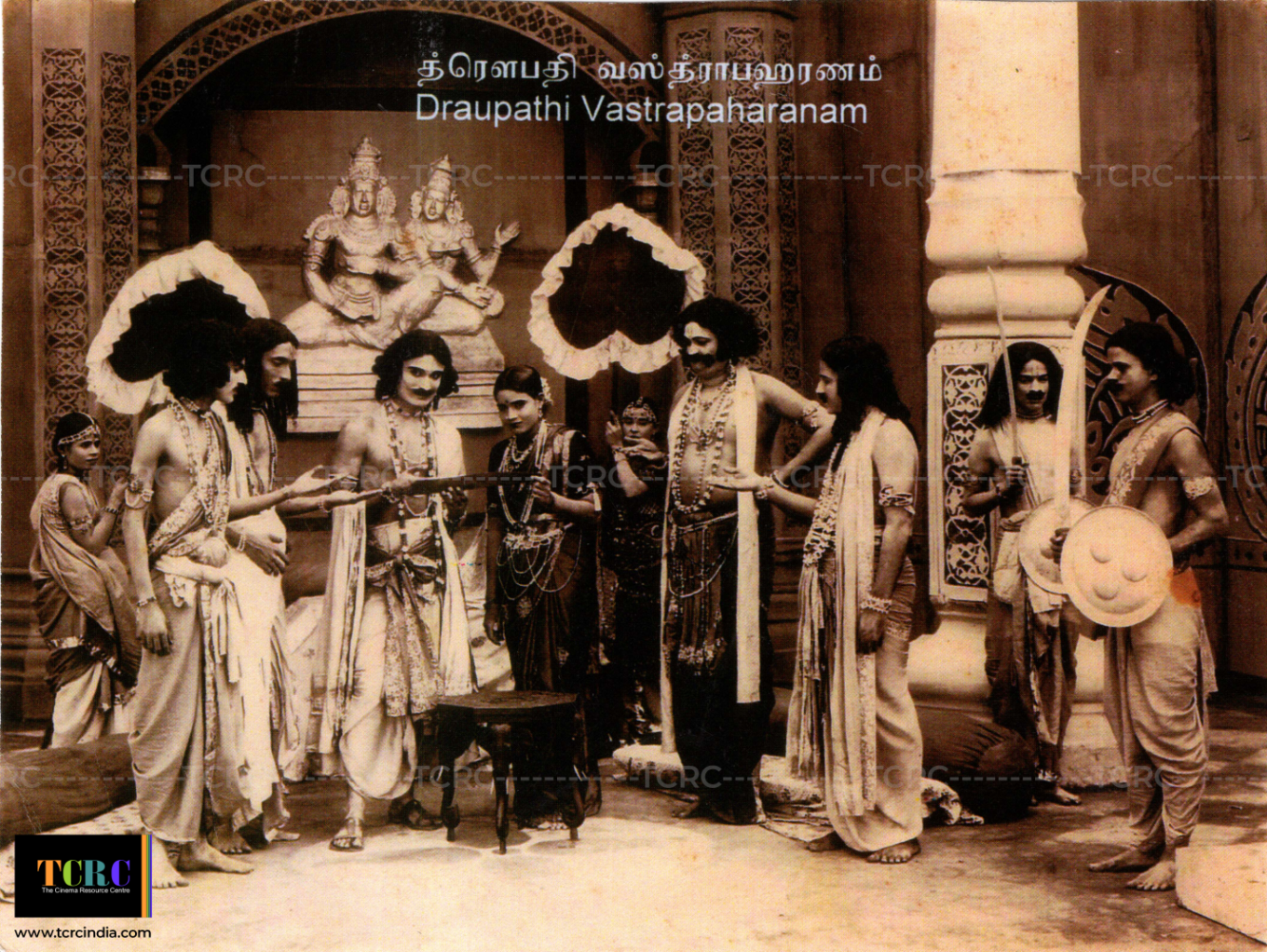
In the same year, one more film was produced at Srinivasa Cinetone: DRAUPADI VASTRAPRAHRANAM. Another film bearing the same name, in fact, was also released in the same year, 1934, under the aegis of Angel Films, directed by R. Padmanabhan and the production unit had another legend of Tamil cinema, T.R. Sundaram. (We have an upcoming post dedicated to his life and work — keep an eye out for it!) Both films did extremely well, commercially!
A still from the Movie DRAUPATHI VASTRAPAHARANAM made by R. Prakash and A. Narayanan
PC: From the archives of TCRC
Other films made by A. Narayanan included:
1935: GNANA SOUNDARI
1935: RAJAMBAL
1936: DHARA SASANGAM
1936: MEERA BAI
1936: MAHATMA KABEERDAS
1936: VISWAMITHRA
1937: KRISHNA THULABARAM
1937: VIKRAMA STRI SAHASM
1937: VIRADA PARVAM
1938: SRI RAMANUJAR
1938:THULASI BRINTHA
1938: VIPRANARAYANA
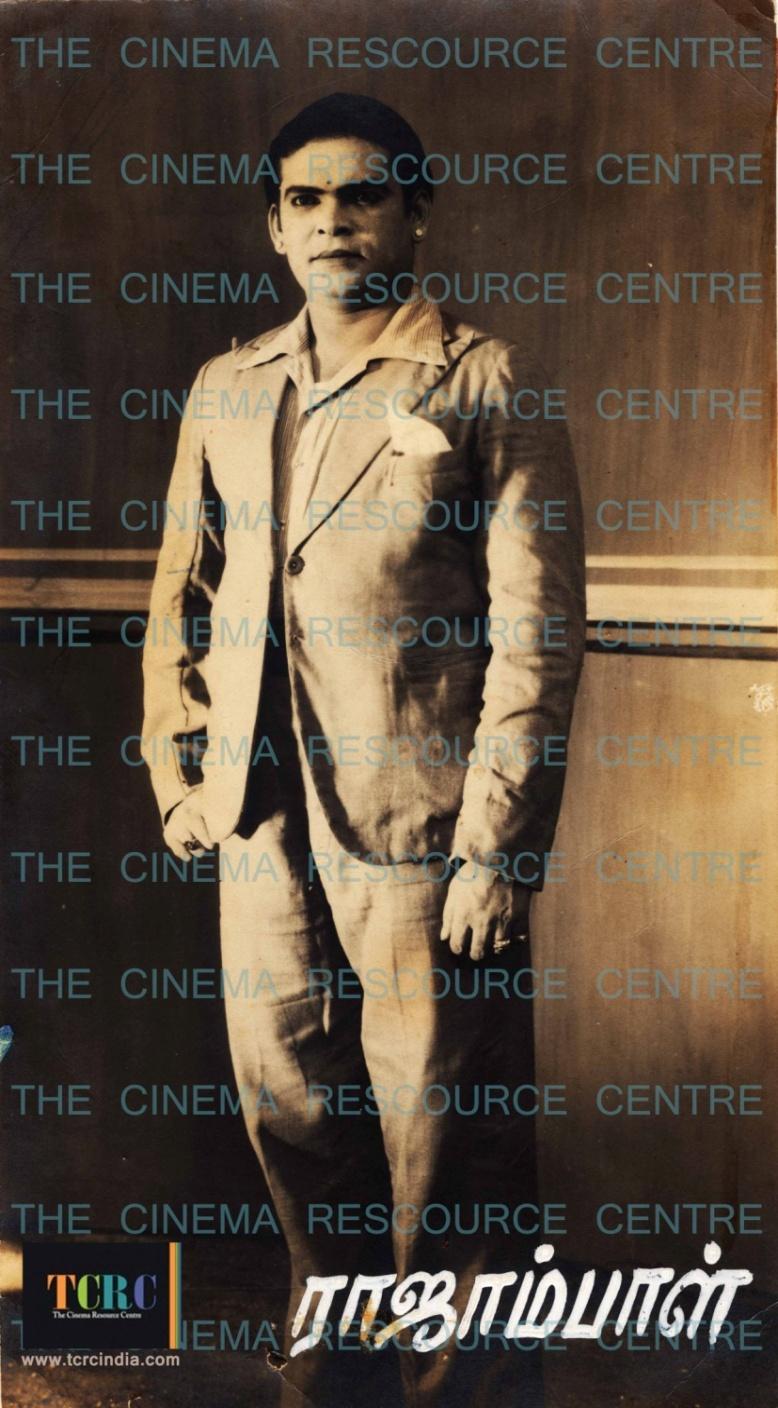
RAJAMBAL, released in 1935, was based on the novel written by J. R. Rangaraju, and this film marked the first time a film was made based on the book. Another film, based on the same novel, was made by R.M. Krishnasami in1951. This films is believed to be the first detective movie ever made in Tamil. The film garnered many raised eyebrows —from people in the world of law, in particular. The film, after all, was centered around a judicial officer who misuses his position and influencer for his own personal gain and selfish ends.
A still from the Movie RAJAMBAL
PC: From the archives of TCRC
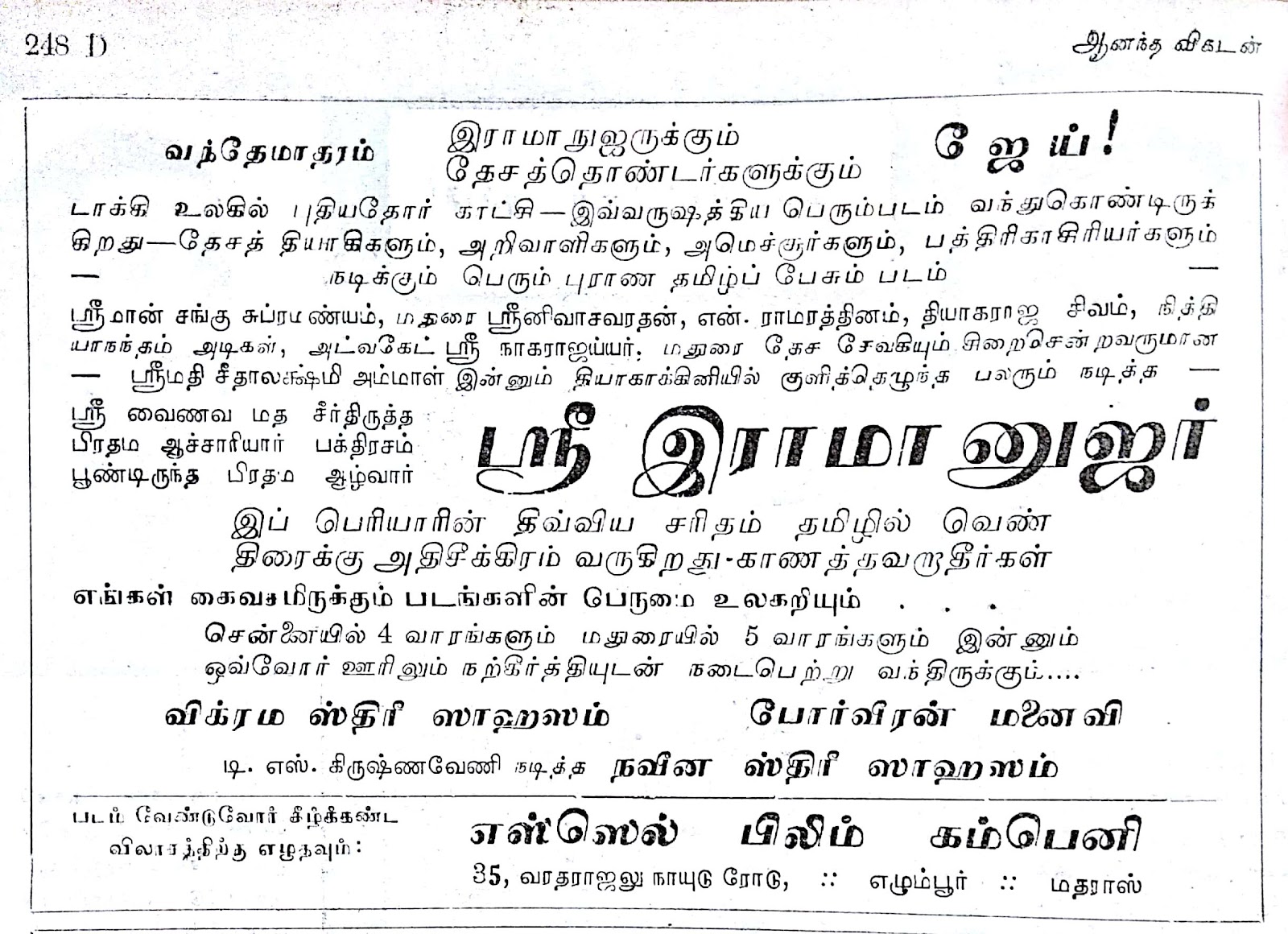
Yet another interesting movie that came out of Narayanan’s desk was VIKRAMA STRI SAHASAM in 1937. The film featured two plot lines in a single film, which was a relatively new notion in film at the time. It, incidentally, also had another title as well — perhaps to mirror the dual plots —NAVEENA STRI SAHASAM. See, for instance, this advertisement published in Anandha Vikatan, Deepavali Malar, 1937.
An advertisement for the Film SRI RAMANUJAR and VIKRAMA STRISAHASAM
From the magazine ANANDHA VIKATAN DEEPAVALI MALAR 1937
PC: From the archives of TCRC
Narayanan is a pretty important figure in the history of Tamil cinema, and his life and work in the industry features many stellar achievements:
He established the first talkie studio in the South of India.
He was the first person to Hollywood Studios and took the time to get an education in the nuances of film making business — commercially and technologically
His wife was India’s first female sound recordist — and recorded sound for five films at that.
He took film exhibitions to unprecedented levels with the establishment of his Film Exhibitor Services.
Unfortunately, he died very young, at the age of just 39. Many talents were nurtured by him: the likes of R. Prakash, Jithen Banargee, T.R. Raghunath and many others. It is rather tragic, all things considered, that one of the pioneers of not only Tamil cinema but all of south Indian cinema, could just as easily be placed very high indeed on a list of forgotten heroes as well.
[To be continued] We’ll be back next week with more hidden treasure from the history of Tamil cinema. Stay tuned!
About the Author:
V.V. Prasad is a Electronics and Communication Engineer based from Chennai. He is currently involved in the role of a Researcher and Archivist in THE CINEMA RESCOURCE CENTRE. He takes care of the non film materials like Photographs, Magazines, Lobby Cards, Song books etc of the archives. Cataloguing them and digitizing them are part of his current work. His interests and passion lie on the research of Cinema particularly South Indian Cinema.





 The Cinema Resource Centre (TCRC)