The Pioneers of Tamil Cinema

I DIRECTORS: THE CAPTAINS — MASTERS AND COMMANDERS WITH AN IMPACT TO LAST THE AGES 

2. The 1930s— Part 13(1)

(2) T.R. Raghunath

13)    Pioneers who travelled cross border (Directors from north)-1

In this part of the series we are going to talk about the forgotten pioneers who came from North India to direct Tamil Films. Few of them are: –

  1. Prafulla Ghosh
  2. K. Amarnath
  3. Bhalji Gopal Pendharkar and Babu Rao Pendharkar
  4. Fram Chetna
  5. Parshwanth Yeshwant Atlekar
  6. H.S. Mehta

We will talk about them in 4 Parts. First part is about Prafulla Ghosh and K. Amarnath

(1)     Prafulla Ghosh

Prafulla Ghosh was from Calcutta who made approximately 15 silent films there before he moved to Mumbai and then south. He was initially an accountant whose interest grew towards film making. He along with his friend Ahindra Choudhury decided to make a film around 1920. They visited various producers and later decided to build a studio of their own. This studio, Photo Play Syndicate, one of the foremost studios in Calcutta was built in southern fringes of the city at the east of Behala. They finalized Rs18000 budget for their maiden film titled Soul of the Slave which was lying unreleased for quite a while due to issue with the distribution house. Finally, the film released on August 14th, 1922. Though the film was appreciated it failed to break even due to lack of proper distribution. Amid the loses the friends parted ways and shone in their own new roles. Ghosh directed films in Hindi, Bengali and Tamil.

Few of the Tamil films that Prafulla Ghosh made during 1930s:

  • 1935: SUBADRA PARINAYAM
  • 1935: HARISCHANDRA
  • 1935: RATNAVALI
  • 1936: CHANDRAHASAN
  • 1936: VEERA ABHIMANYU

Ghosh directed 3 films in 1935 Subhadra Parinayam, Ratnavali and Harischandra.

Subhadra Parinayam was the mythological story of the love between Lord Krishna’s sister Subhadra with Arjuna and the hurdles they face before getting married. It was produced by one of the forefathers of Tamil film industry Vincent Samikkannu. The film had S.V. Subbaiah Bhagavathar and T.S. Velammal in lead role. The film was quite successful commercially. Bhagavathar was quite popular those days. The records that had his songs sold very well. In this film too he sang and acted which helped the film business a lot.

One of the songs that he acted and sung from this film was

Ratnavali directed by Ghosh released in the year 1935. It was based on the Sanskrit drama of same name written by Harsha. Harsha’s work was earlier adapted by Pammal Sambandha Mudaliar known as Founding Father of Tamil Theatre. His play with same name was received overwhelmingly which tempted AV Meyyappa Chettiar to make it as a film. His gramophone business with the name Saraswathi stores turned to Saraswathi talkies Productions under which the movie was produced. It was the second film for the banner after Alli Arjuna.
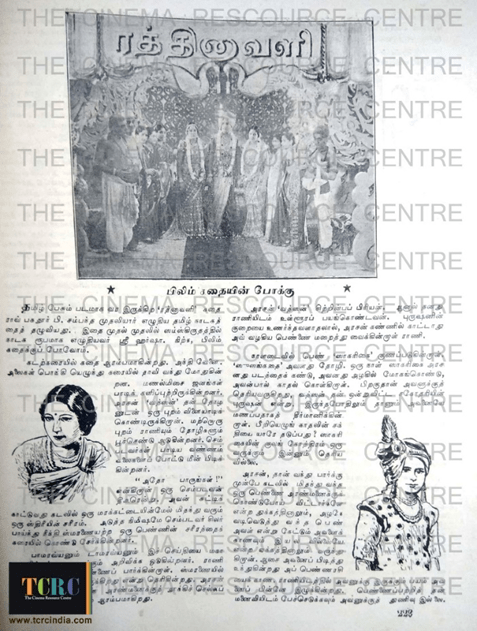
An article on RATNAVALI
From the magazine ANANDA VIKATAN DEEPAVALI MALAR 1935
PC: From the archives of TCRC

Ratnavali star cast was headed by Palayamkottai Sisters Ratna bai and Saraswathi bai with the former in titular role and the latter in a role of Vasvadhathai. They always used to act together in a film and were much in demand those days with their harmonious acting and singing skills. Male lead was by the then popular hero M.R. Krishnamoorthy, younger brother of legendary carnatic musician Maharaja Puram Vishwanatha Iyer. The same trio had earlier worked in the one of the most successful early tamil talkies Bama Vijayam

Harischandra, the 3rd Tamil film that talked after silent era was directed by Sarvottam Badami released in the year 1932. The film was also happened to be the first Tamil talkie to be made on the story of Raja Harischandra. Later many films were made based in the same story. Interestingly the first Indian film Raja Harischandra produced and directed by Dadasaheb Phalke was made on this storyline in 1913.  1935 version directed by Prafulla Ghosh was only the 2nd one in Tamil.  V.A. Chellappa acted in the titular role while T.P. Rajalakshmi known as Cinema Rani was the female lead. This was one more Ghosh film that was produced by Calcutta based Pioneer Films.

(2)     K. Amarnath

Gelaram Khetarpal Amarnath alias K. Amarnath was born on December 1, 1914 in Mianwali, Punjab (British India, now Pakistan). His childhood was spent in Mianwali and college years in Lahore.  His passion towards movies made him to move from Lahore to Calcutta, a movie hub in early 1930s. His interest was initially to become an actor. After struggling in Calcutta for a year he planned to move to Mumbai and try his luck there. With his towering physique and good looks, he initially wanted to become an actor but while working as junior artists in few films his interest grew towards film making. He started assisting directors like B.R. Patel and Dhirubhai Desai. He got his first break via Metro Movie tone in 1936. This first directorial venture of him was Matwali Jogan aka A Girl from Lahore. Though he got critical acclaim for the film his major breakthrough happened in Tamil film industry a year later in 1937 through Mohan Studios. All the first 5 films he directed for Mohan Studios were in Tamil.

The films directed by K. Amarnath in 1930s

  • 1937: DANGER SIGNAL
  • 1937: PAKKA ROWDY
  • 1937: MINNALKODI
  • 1938: BAGHYA LEELA
  • 1939: VEERA RAMANI

He directed 3 films in 1937. Danger Signal was his first one, followed by Pakka Rowdy then Minnal kodi. From Minnal kodi his association with K.T. Rukmini started and she went on to continue to be his lead actress in next 2 films Baghya Leela in 1938 and Veera Ramani in 1939.
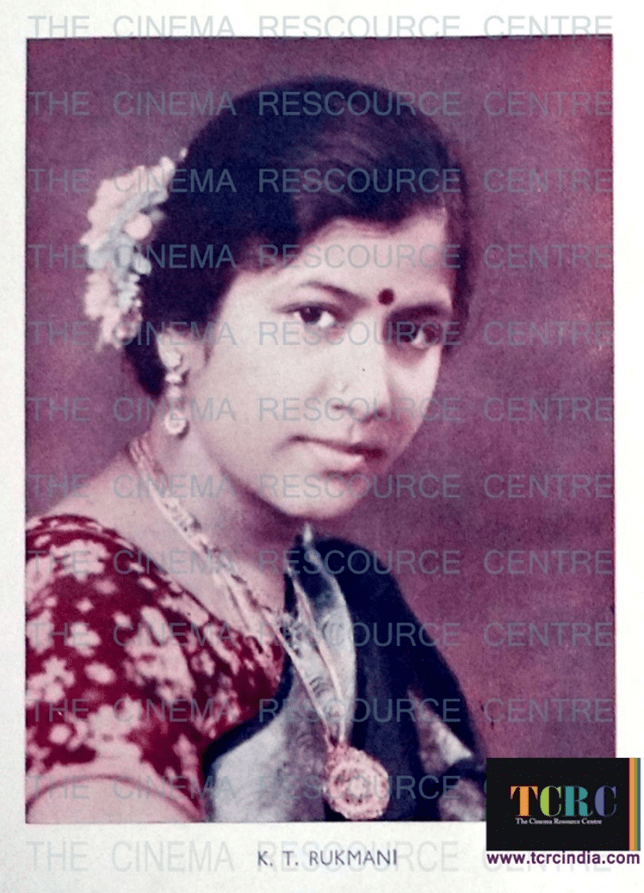
A still featuring K.T. Rukmini
From the magazine CINE ART REVIEW 1937
PC: From the archives of TCRC

K.T. Rukmini was the first action heroine of the Tamil Films. She was also known as stunt queen during those days. Though she was acting from silent movie era Amarnath’s Minnal kodi established her as a stunt heroine. She played the titular role. Adapting Robinhood concept of robing rich and helping poor the film turned out to be a major hit. The film supposedly had only 3 songs which was uncommon during those days. Srinivasa Rao played as love interest of Mohini/Minnal Kodi and S.S. koko as her servant. Other supporting roles were played by Gogia, Pasha, Subbulakshmi, Alamu, K. B. Rao and Usharani. The film made Rukmini a big star.

Under the Mohan Pictures banner Amarnath cast her again in next film Baghyaleela as well. Another stunt film.
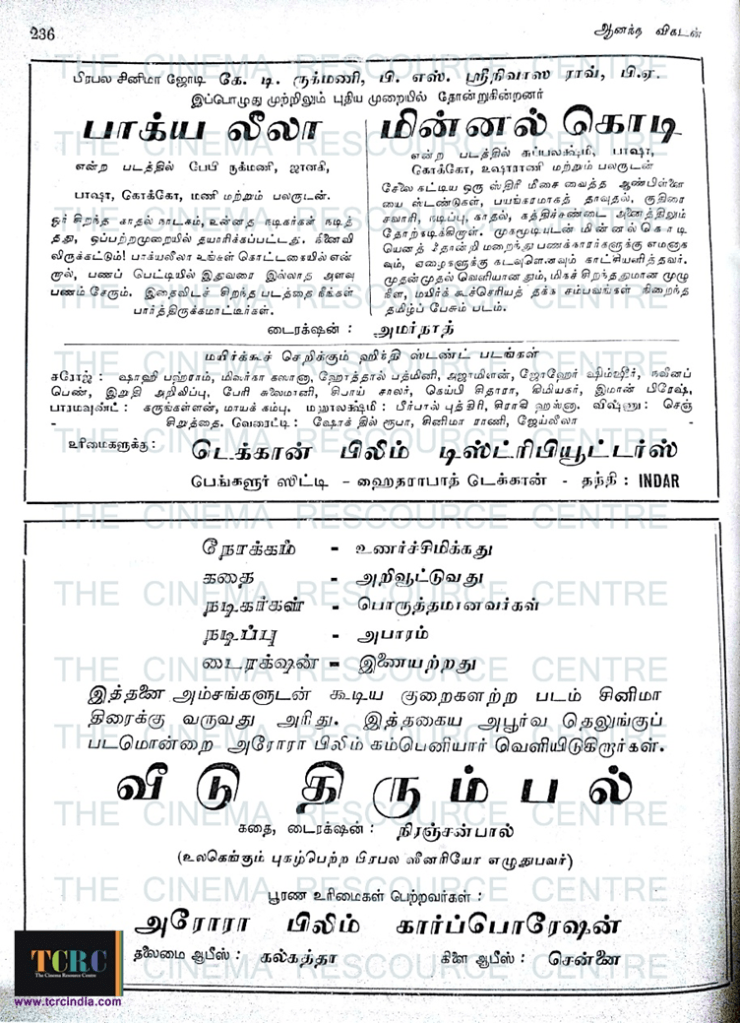
An advertisement of Deccan Film Distributor mentioning BAGHYALEELA and MINNALKODI
From the magazine ANANDA VIKATAN DEEPAVALI MALAR 1938
PC: From the archives of TCRC

In 1939 Amarnath worked with K.T. Rukmini for 3rd time. The film posters raised eyebrows of many as it had a heroine smoking or wearing short trousers which were uncommon for a society that was more conservative. The film had lot of stunt scenes and people loved it. Male lead was played by Srinivasa Rao. He was known as Stunt king so the film created lot of buzz with both stunt queen and stunt king.
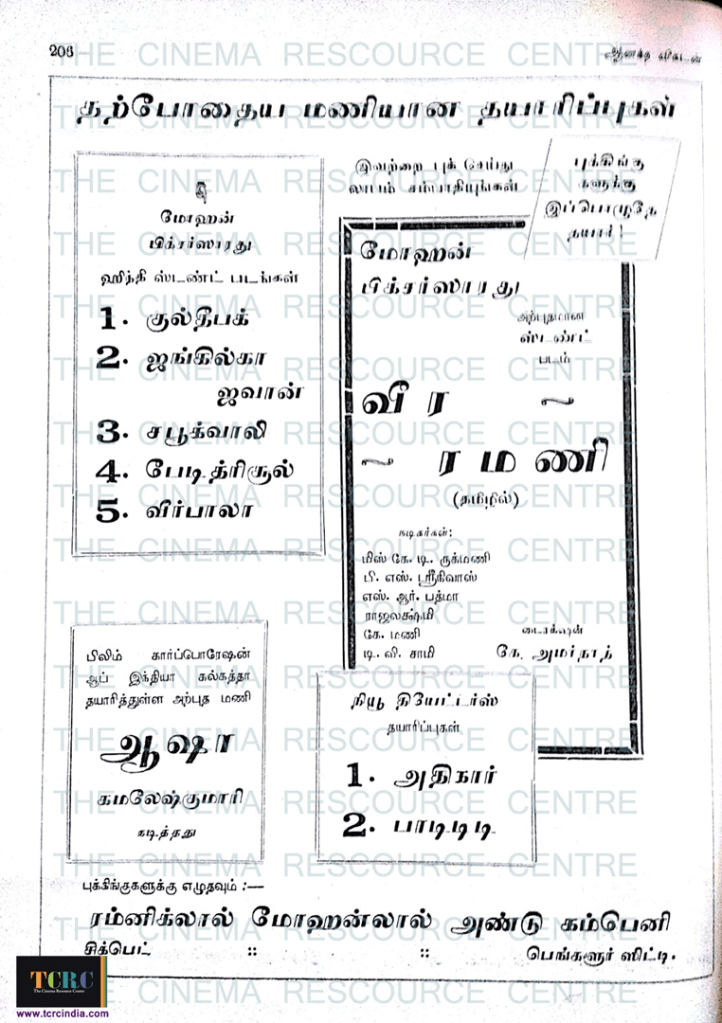
An advertisement of Ramniklal Film Corporation mentioning VEERA RAMANI
From the magazine ANANDA VIKATAN DEEPAVALI MALAR 1938
PC: From the archives of TCRC

Veera Ramani was quite successful mainly for its racy screenplay and stunt scenes. Amarnath after this film moved to Mumbai where he continued to make many successful Hindi films till early 70s. He passed at the age of 68 on May 14, 1983, leaving behind a legacy of his own.

[To be continued] We’ll be back next week with more hidden treasure from the history of Tamil cinema. Stay tuned!

About the Author:

V.V. Prasad is a Electronics and Communication Engineer based from Chennai. He is currently involved in the role of a Researcher and Archivist in THE CINEMA RESCOURCE CENTRE.
He takes care of the non film materials like Photographs, Magazines, Lobby Cards, Song books etc of the archives. Cataloguing them and digitizing them are part of his current work.
His interests and passion lie on the research of Cinema particularly South Indian Cinema.

The Pioneers of Tamil Cinema

I DIRECTORS: THE CAPTAINS — MASTERS AND COMMANDERS WITH AN IMPACT TO LAST THE AGES 

2. The 1930s— Part 12(2)

(2) T.R. Raghunath

While last episode we talked about Raja Chandrasekhar this episode is about his younger brother T.R. Raghunath alias Thimatchipuram Rajagopal Raghunath who was born on 16 July 1912. 

Few of the films that T.R. Raghunath worked as a film maker/Technician during 1930 to early 1940: 

  • 1935: GNANASOUNDARI (Assistant Director)
  • 1936: DHARA SASANGAM (Sound Recordist)
  • 1936: KIZHATTU MAAPPILLAI (Short Film)(Director)
  • 1939: JOTHI (Director)
  • 1942: Thamizhariyum Perumal

Raghunath graduated from Madras University but moved to his better interest, Film making. He started his film career as a sound recordist later went on to become a director. He worked under his elder brother initially before moving on to do films independently. 

He worked as an Assistant director in Gnanasoundari and as a sound recordist in Dharasasangam. Both were directed by the pioneer A. Narayanan, often referred as the Father of south Indian Film business who started the south India’s first talkie studio Srinivasa Cinetone 

 Raghunath directed independently for first time through a short film Kizhattu Maappillai.  Kizhattu Maappillai was shown along with Usha Kalyanam directed by another forgotten revolutionary film maker K. Subramanian who introduced many talents to the Tamil Film Industry 

Kizhattu Maappillai.jpg

An advertisement of MURUGAN TALKIE FILM COMPANY mentioning KIZHATTU MAAPPILLAI

From the magazine ANANDA VIKATAN DEEPAVALI MALAR 1939

PC: From the archives of TCRC

In 1939 he directed the film Jothi also titled Sri Jyothi Ramalinga Swamigal. The film was about the life of saint Ramalinga Swamigal of Vadalur. Script was written by Pammal Sambandam Mudaliar, he along with Shankardas Swamigal pioneered the early years of Tamil theatre. His elder brother Raja Chandrasekhar supervised the film making and guided in the screenplay process as well. 

Madurai Mariyappa Swamigal wrote the lyrics and scored music for songs. The songs became popular and were released in Odeon records owned by another pioneer, A.V. Meyyappan. The film went on to become one of the major hits of those days and ran in cinema halls for 18 weeks. 

He made the film based on the Sanskrit poet Kalidas, Thamizh Ariyum Perumal. Story Screenplay and dialogues were written by Elangovan. Produced by RM. Ramanathan Chettiar, at Newtone Studios in which he was an investor. The film had M.G. Ramachandran alias MGR in the lead role who went on to become one of the biggest stars of those times and later Chief Minister of Tamil Nadu. M. R. Santhanalakshmi as female lead played dual role in the film. 

An advertisement of THAMIZH ARIYUM PERUMAL

From the magazine KALKI DEEPAVALI MALAR 1942

PC: From the archives of TCRC

Thamizh Ariyum Perumal had 22 songs. All were written by Udumalai Narayana Kavi. The music was credited in the name of Saraswathi Stores owned by A.V. Meyyappan. The film was distributed by Thyagaraja Films Limited owned by M.K. Thyagaraja Bhagavathar. Inspite of having lot of positive factors the film failed at box office.

T.R. Raghunath had a wonderful career directing more than 30 films with most of them being successful. After directing MGR in minor roles during 1940s he directed him again as a leading star in Raja Desingu and Vikramadithan. He was later appointed as President of Madras division of FDI (Film Division of India)

[To be continued] We’ll be back next week with more hidden treasure from the history of Tamil cinema. Stay tuned! 

About the Author:

V.V. Prasad is a Electronics and Communication Engineer based from Chennai. He is currently involved in the role of a Researcher and Archivist in THE CINEMA RESCOURCE CENTRE.
He takes care of the non film materials like Photographs, Magazines, Lobby Cards, Song books etc of the archives. Cataloguing them and digitizing them are part of his current work.
His interests and passion lie on the research of Cinema particularly South Indian Cinema.
Filmy Ripples : Cinema Halls of old Madras – An Anthology (Part 2)

By P.V.Gopalakrishnan
The movies always began after ‘The News Reel’ of the Information & Broadcasting Ministry of the government.
Whenever a song sequence came in the movie the audience fled out to have a soda or smoke or to relieve themselves!
In the very few theatres that were air conditioned in those days, after the first reel was screened, the operator used to quietly switch off the a/c. In those times the word consumerism was unknown and none batted an eyelid at such practice!
On the metal backs of the seats you would find creative engravings by the ‘learned’ audience. In some seats the sponge was found scooped out by some disgruntled theatre goers. The washrooms had a mixed stink of phenyl and human fluids while their walls bore unsharable graffitis.
But the audience inside these halls, with high ceilings sporting sporadic ceiling fans, lived the movies with their favourite chocolate faced Heroes and buxom Heroines.
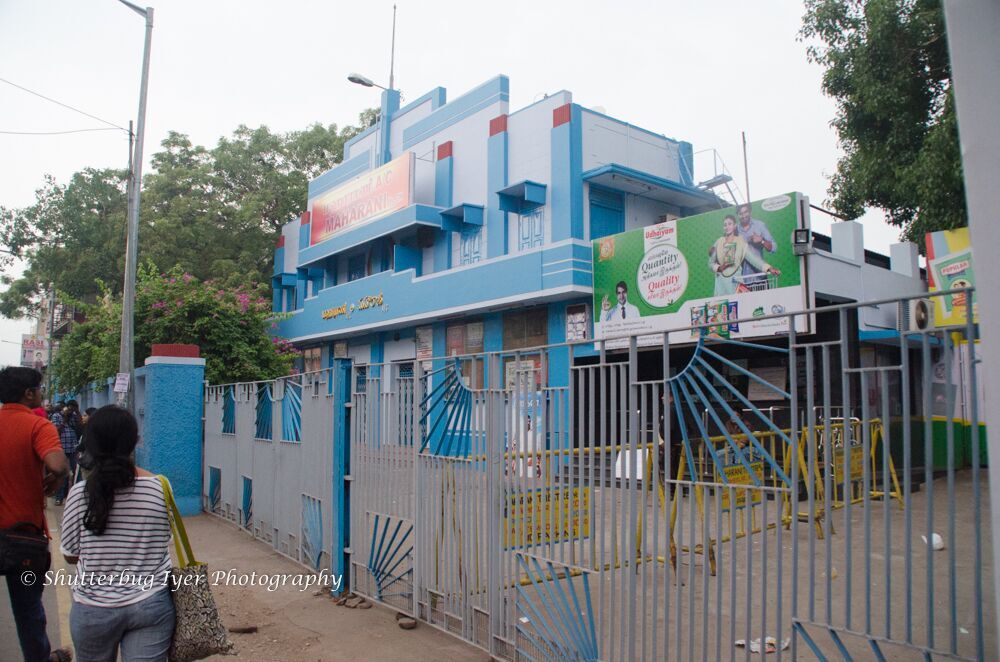
When Srinivasa Kalyanam was released in Maharani Theatre, in the front foyer a Tirupathi Balaji was installed. On the release of Marma Manithan, cycle rikshaw men were dressed like that character a la style Mr.X, as they distributed fliers about the movie.

maharani

Maharani still standing. PC: V.Harihara Subramanian, Feb 2017

One of the oldest theatres of Madras was Murugan Talkies. It was originally started in 1910 by one Murugesa Mudaliyar as Majestic Theatre where Tamil Plays happened.
This was later converted to a cinema hall. In 1931, Majestic’s name was changed to “Kinema Central” ,  where the first Indian talkie film “Alam Ara” was screened, with People coming by road and rail, packing food,  to watch the first talkie. This theatre also saw the screening of the first “Tamil-Telugu” Talkie ‘Kalidasa’. Classics like Meera, Shakunthala , Avvaiyaar , Uththama Puthiran, Sathi Leelavathi , Thyagabhoomi, Ambikapathy , Thiruneelakantar, Ashokkumar ran at  Kinema Central.The theatre’s name was changed as Murugan Talkies in 1942.This iconic cinema hall was pulled down a couple of years ago, after 80 years.

murugan-talkies

An unimpressive shopping complex stands in the place of Murugan Talkies.                          PC: V.Harihara Subramanian

Then the new air-conditioned cinemas such as Safire & Anand came right on Mount Road.
Safire was a pioneer featuring multiscreen complex. It had screens named Safire, Emerald & Blue Diamond. Its Blue Diamond cinema ran continuous shows, where one could buy a ticket and enter the theatre in the middle of a screening and continue to stay as long as one wanted, as the movie was screened non stop, back to back. Safire complex opened with the iconic 70MM movie ‘Cleopatra’, followed by Battle of the Bulge, Mutiny on the Bounty, South Pacific – all in mammoth 70MM. The Safire Complex also had the first ever Disco of Madras, named Nine Gems. It even had a restaurant serving Rajasthani culinary. When ever I pass by, these days, the bush grown compound where once Safire complex stood proudly on the Mount Road, I feel both melancholic & nostalgic.The Anand Theatre owned by an influential Congressman Umapathi had its mammoth electric screen raise before each movie projection started, revealing the silver screen, to the accompaniment of Spanish Gypsy tune, which, by the by, also inspired MSV to compose ‘Thulluvatho Ilamai’.


imgp2471

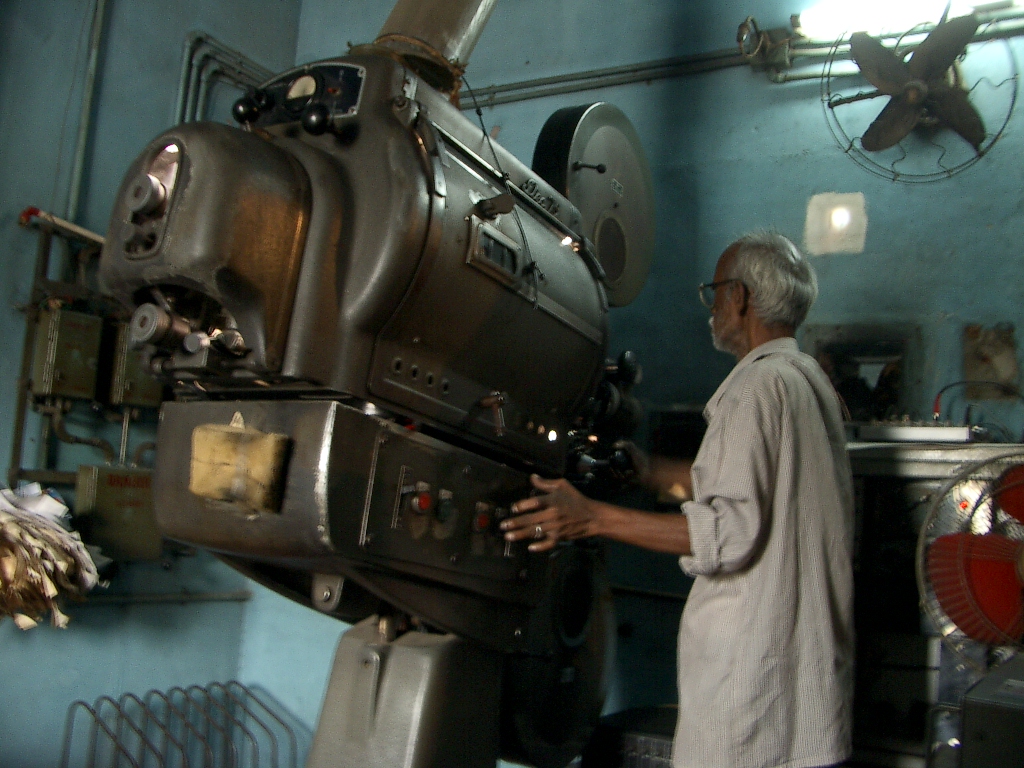
The projectionist with his projector at the erstwhile Anand theatre.                                            PC: Sruti Harihara Subramanian

Then came the Pilot Theatre in late sixties at Royapettah, started by Mr. Sanjeevi of Pilot Pen Company, with Cine Rama technology.

pilot-theater

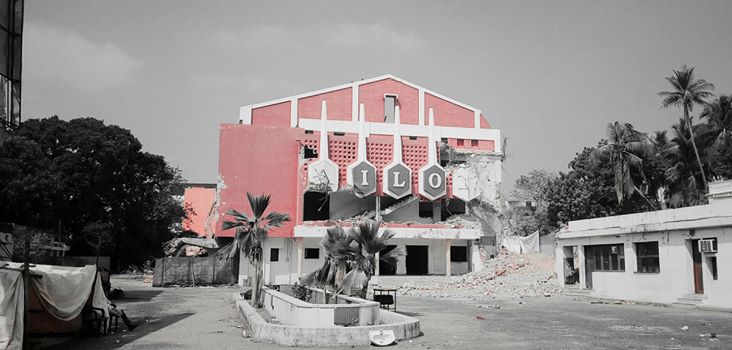
Pilot theatre in the process of being demolished on Feb 9th 2017 PC: Srinivasa Ramanujam

This is the anthology to the current generation of cinema halls, which are cartelised screens in corporate run set-ups, such as PVR & Inox, with plush seatings, comfy air-conditioning with snacks served at your seat, if you had pre booked them.
PVR which spearheaded multiplexes across India was a JV by the Indian film distributor Priya Exhibitors and Australian Media company Village Roadshow, from which first letters P-V-R, their multiplexes are known now.
Movies are an experience, indeed, whether in sixties or now.

Filmy Ripples : Cinema Halls of old Madras – An Anthology (Part 1)

TCRC is very happy to introduce our latest contributor Mr.P.V Gopalakrishnan who will be writing the series Filmy Ripples. The series promises to be very different from our earlier ones. Filmy Ripples hopes to share with you stories on Cinema over the last 60 years from the eyes of an avid Tamil film and music aficionado.  – Editor
At the outset, you may wonder why I chose to christen this new Blog with this Title. Well, I am going to share with you Film related subjects, which may be like ripples, forming waves of circles, even as you develop to visualise it in your minds through your own extended thoughts, whilst the ripple itself waning away to merge with the stillness of water!Having said that, we will dwell on the period things relating to films from the bygone era as I have seen, experienced, read about and so on!
In this very debut blog under this fancy title, lets time travel back to sixties and before, to see how people of Madras City saw movies.
In the past, a variety of venues let people witness cinemas. These included touring cinemas, thatched halls, single screen cinema theatres, Multiplex as the movies played there made people dance, clap, shed tears, as they watched the larger than life stars on the big screens, in awe!
The first film I ever watched as a child was in a thatched ‘cinema kottaai’ some where in a desolate village in Kerala, where I was born. (By the by, I am not a mallu!). And the movie was the Thespian Nagaiah starred ‘Chakradhari’ (1948). While Nagaiah played the protagonist Gora Kumbhar, Pushpavalli, mother of yesteryears’ Hindi siren Rekha acted as his wife.
 
Any new film release in these ‘kottais‘ were publicised by a bullock cart borne person throwing colourful hand notices around. Often such carts had huge cone speakers blaring cine music with intermittent vernacular announcements. Occasionally a drummer aboard the cart invited the attention of folks around.There used to be hand pushed carts with pneumatic wheels and slanting banners on either side, publicising the films.
I have experienced a tent cinema too in my younger days. I recollect, the film was  ‘Naya Daur’ (Hindi) starring Dilip Kumar & Vyjayanthimala. Typically tent cinemas had just a couple of rows of chairs in the rear of the ‘auditorium’ , with the forefront seating the cinema goers right on the mother earth. These guys stretched their legs and scribbled on the sandy surface with their fingers. The hall’s sides used to be thatchings spun of dried coconut leaves, with liberal holes through which anyone could have a peep show. The vendors used to crisscross hawking the likes of murukku & groundnuts.
Then there were these stand alone theatres, which have been since giving way to wedding halls, shopping arcades & car showrooms.
Paragon, Roxy, Sri Krishna, Prabhat, Broadway, Gaiety, Casino, Chithra, Brighton, Maharani, Thangam, Kamadhenu, Eros, Kapali, Rajakumari, Bharath, Ashok, Plaza, New Globe, Sayani, Star, Wellington, Odeon, Midland, Krishnaveni, Shanthi, New Elphinstone, Sun were all well known stand alone theatres of the old Madras.
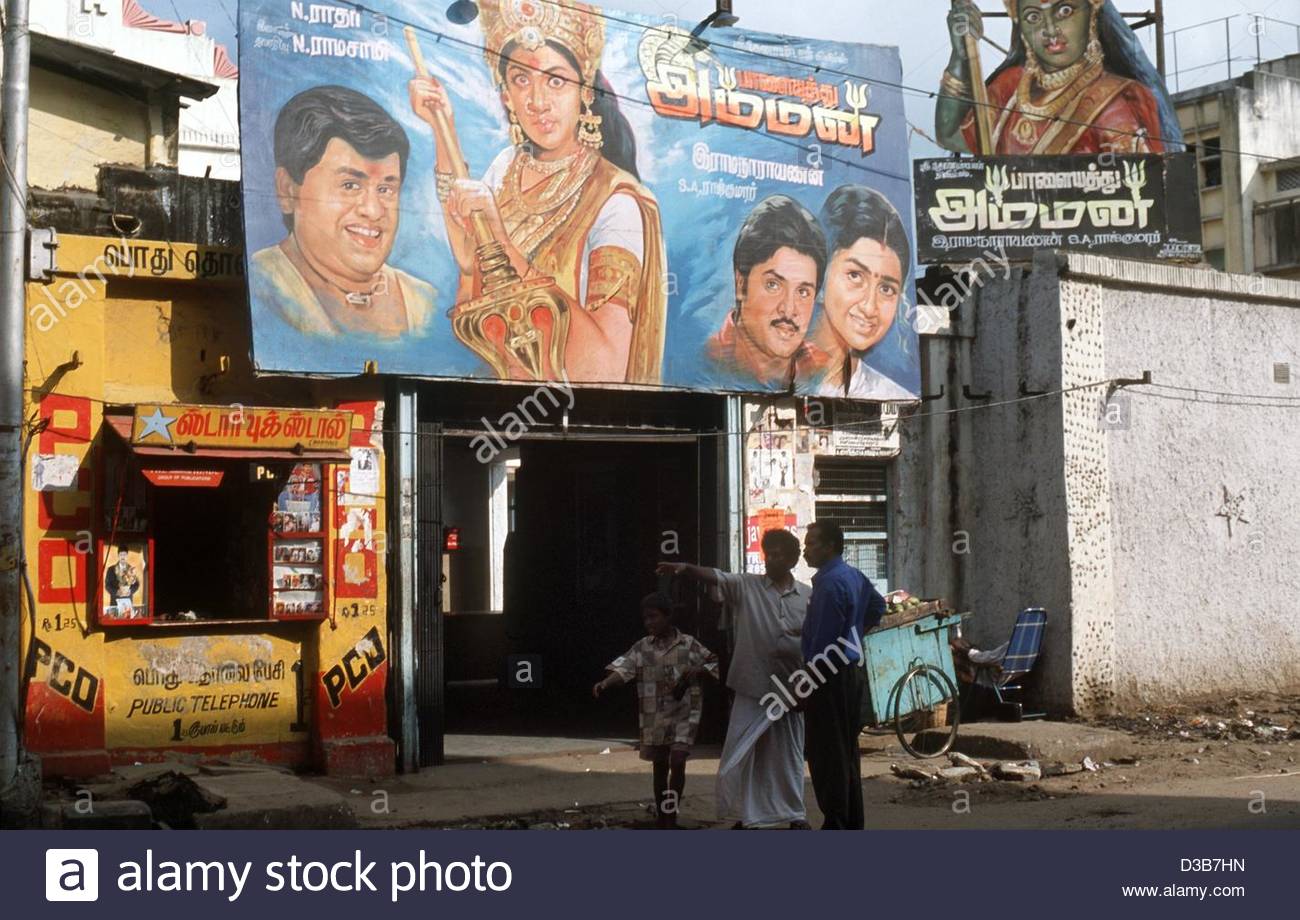
These theatres displayed on them huge banners & cutouts of the sequences from the movie being shown, drawn in bright colours, by renowned Banner Artistes such as Ayakan, Balu Brothers, G.H.Rao etc.

dpa-huge-cinema-posters-advertise-a-tamil-movie-in-a-street-in-chennai-d3b7hn

Star Theatre with a film’s banner at its entrance

Some of these halls used to be of very huge capacity, with those in balcony sporting an air about them.
The doorman, often in soiled lungis, at these cinemas used a vertically held torch to see your seat number and usher you in, sliding the blue curtains, at the door, that went to laundry ages ago!
Besides selling ‘soda, colour’, the vendors inside the hall used to hawk handy booklets, printed on poorest quality paper, containing the songs of the film. They used to print even the synopsis of the film being shown in such ‘paattu pusthakam‘ (song books), withholding as to how the film ended. ‘Matravai Velli thiraiyil‘(The rest on silverscreen)  was the last line, in print!

 Song Book of the Tamil film ‘Rambayin Kadal'(1956) PC: TCRC Archives
The lowest tickets were at four and three quarter Annas, before the advent of Naiya Paisa. The premium balcony seats costed a whopping Two and a half Rupees.
The tickets were issued out of a small window opening and there would be a winding high walled passage, that could choke you for lack of fresh air. As the tickets were often sold to black marketeers in bulk by the malicious counter staff, you could get tickets in grey market just about near the official counter! Booking tickets was a nightmare. After all, Bookmyshow was not around in those times!

(To be continued)

Poster boys

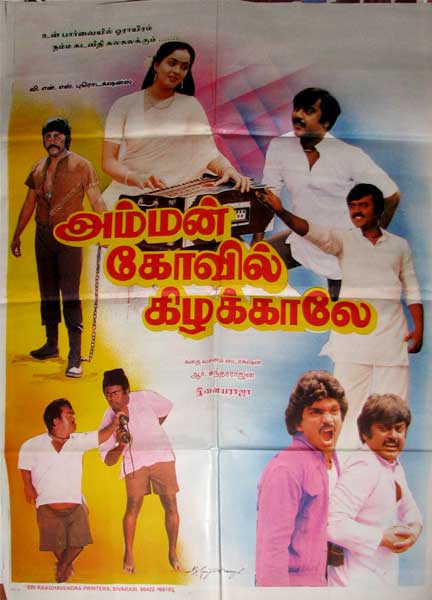
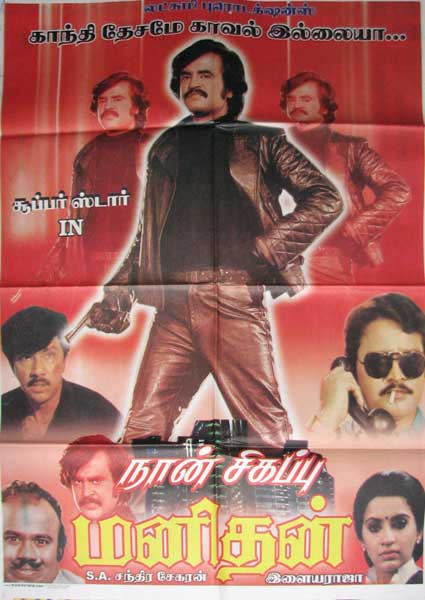
Posters are an integral part of any film’s promotion. The South Indian Film posters always stood out for its unique and interesting designs. Here is an article that was published in today’s Metro plus, a supplement of The Hindu  (Poster boys – The Hindu). The article talks about the men who work all night pasting these posters in our city walls.

While we are talking about posters here are images of posters from two famous tamil films taken from our archives.


Amman-Kovil-Kizhakkalae-1Naan-Sigapu-Manidhan-1