“Elphinstone Elphinstone Everywhere”: The story of Elphinstone Theatre in Madras, the first with a balcony!

The Indian Express carried a PTI (Press Trust of India) story yesterday about tent cinemas returning to Delhi as a part of the ongoing “100 years of cinema” celebrations. We found a couple of paragraphs at the end of the story rather interesting (click here to read the entire piece):

In India, among the pioneers of tent cinema, the most important name is that of J F Madan, a Parsi businessman who started ‘Elphinstone Bioscope Company’ in early 20th century in Calcutta (now Kolkata) and would do tent shows in the Maidan there. He later started the cinema halls by the name of ‘Elphinstone Picture Palaces’.

His ‘Elphinstone’ was also one of the few Indian companies, among other European production houses, which filmed the historic 1911 Delhi Durbar attended by King George V and Queen Mary.

His legend has survived today in the form of various ‘Elphinstone’ theatres spread across India.”

Now, we were aware that a New Elphinstone Theatre was operational up till sometime in the 1970s, off Mount Road. So, we did some searching and it turns out that there was indeed an Elphinstone in Madras as well. Manish Raj, writing for the Times of India, mentions the cinema hall in his piece of theatres in Madras of the yore (click here to read his entire story):

New Elphinstone Theatre in 1916 was inaugurated by the governor general of Madras and it was one of the first theatres in India to raise funds for the World War I through its shows. It housed the most unusual indoor sport — a boxing ring where amateurs sparred. When the film bubble burst, it later became Elphinstone Soda fountain, which sold beverages.

Given that there was a New Elphinstone, we realised that an Old Elphinstone had to be a part of this history. Historian S Muthiah, in his lovely piece titled “Cinema at Round Tana”, fills the gaps:

A New Elphinstone meant there had to be an old Elphinstone – and there was one, rooted in almost the beginnings of cinema-screening in Madras. The Elphinstone was located across Round Tana from the New Elphinstone on the site of Misquith Building, just west of the old Hindu building at the junction of Ellis Road and Wallajah Road. (Wallace) Misquith & Co., established in 1842 built itself a magnificent brick-exposed Indo-Saracenic building to house on the ground floor its showroom for musical instruments and, on the first floor, music salons which could be rented by the hour for anyone wanting to play any instrument.In time, Misquith’s’ became Musee Musicals and moved further down Mount Road, but in its heyday it housed the Lyric, a hall of entertainment that a man named Cohen established on the first floor when he took over Misquith’s in 1907.

In 1913, the Lyric began screening films, calling itself the Empire Cinema, but a fire in March 1914 closed it down. Later that year, J F Madan of Calcutta, owner of India’s biggest cinema chain at the time, took over the Empire and renamed it with that of his flagship, the Elphinstone. In 1915, Madan bought the Misquith Building and made the Elphinstone a permanent cinema theatre, the biggest and the first with a balcony in Madras.

Given that Dadasaheb Phalke’s “Raja Harishchandra,” the first feature length Indian film was released at around the same time that Empire Cinema was started (1913), we at TCRC were thrilled to find the various strands of our cinematic history crisscrossing. Unfortunately, we weren’t able to find a single image or photographs of the Elphinstone Theatre and this only served to remind us of the importance of archiving  images of our cinemas’ golden past. Interested in helping this sort of archival effort? Volunteer at TCRC!
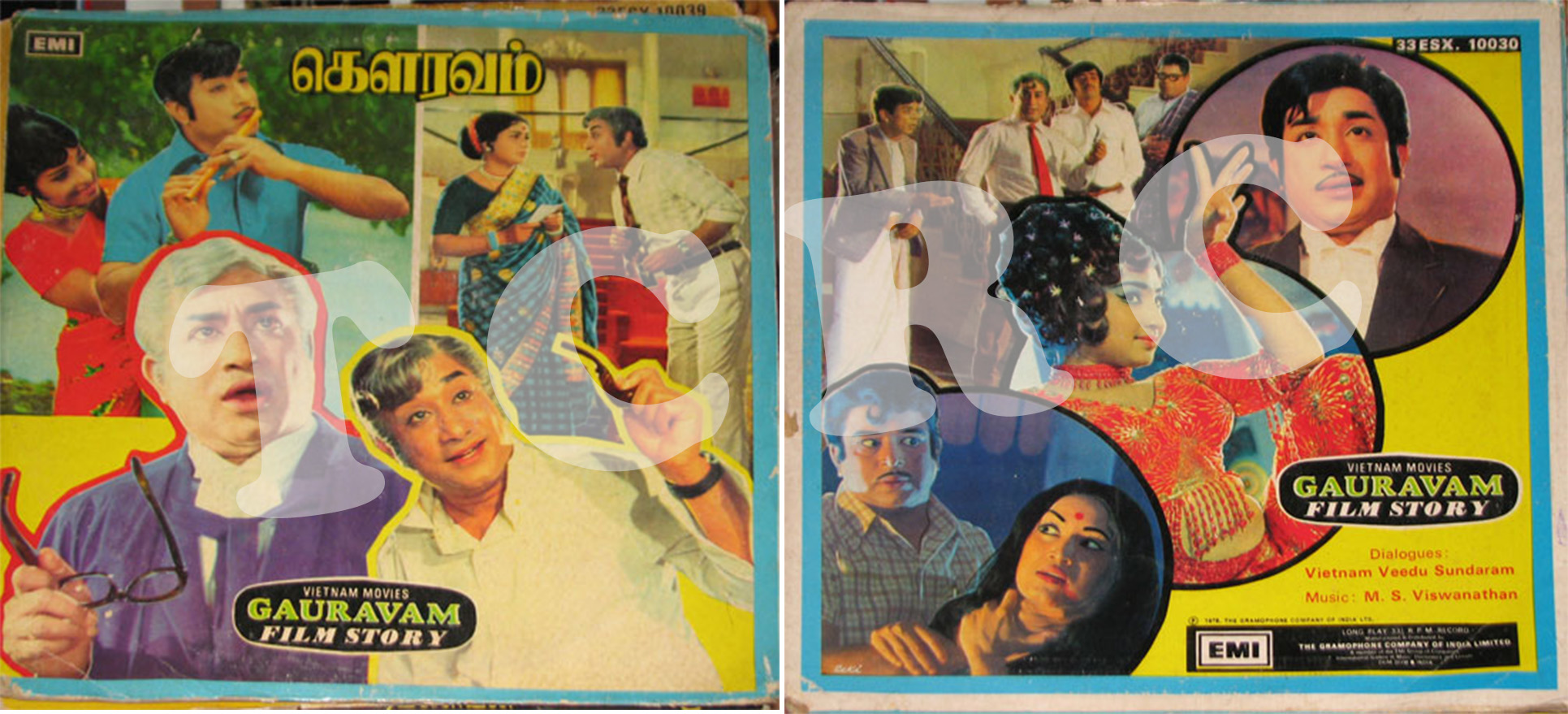
RARE: Original LP of Sivaji Ganesan’s “Gauravam” (1973), in which he plays a character called Rajnikanth!

This week, we bring from you yet another gem from the TCRC archives. Given that the Prakash Raj-produced, Radha Mohan-directed “Gouravam” has just released, we thought it would be fun to revisit the original “Gauravam” starring Sivaji Ganesan, Nagesh and ‘Major’ Sundarrajan, which was released in 1973. Interestingly, in the old “Gauravam,” Sivaji plays the role of Rajnikanth, a senior lawyer. When seen against that fact that superstar Rajnikanth’s original name is Shivaji (Shivaji Rao Gaikwad), the nomenclature system seems to come fulls circle! Given below is the photograph of the original LP set of Sivaji Ganesan’s “Gauravam”:

"Gauravam"  |  LP Record  |  Tamil  |  1973

“Gauravam” | LP Record | Tamil | 1973

“Gauravam” was directed by ‘Vietnam Veedu’ Sundaram and the music was scored by MS Vishwanathan. “Vietnam Veedu” was Sundaram’s first  stage play for Sivaji Ganesan’s theatre company Sivaji Nataka Mandram. The play was staged for the first time in 1965 and was a massive hit. It was later turned into a movie as well.

SS Vasan’s “Chandralekha” | The First Attempt To Get Nationwide Distribution

“Chandralekha”, a Tamil film directed by SS Vasan, was released by Gemini Studios in 1948. Starring MK Radha, TR Rajakumari, Ranjan and NS Krishnan, the film was made at a then-lavish budget of more than Rs.30 lakhs and was considered to be one of the most expensive films of that time. It was also one of the first Madras productions to become an all-India hit. It is said to have released in 609 screens worldwide. The drum-dance sequence featured here was one of the highlights of the movie, leading up to one of the longest sword-fighting sequences in Indian cinema.

We at TCRC are proud to to have, in our archive, memorabilia from films of that era.

The Superstar as a Conductor | A lovely Rajnikanth tale

In the late 1960s, the conductor of the Bangalore Transport Service (BTS) bus that plied on route No 10A from Srinagar to Majestic via City Market was a certain Shivaji Rao Gaikwad, a Kannada-speaking Maharashtrian. He was a stickler for rules. His dos and don’ts for commuters were simple: don’t board a running bus; always alight and board only at bus stops; don’t travel on the footboard; present exact change for tickets. One morning, he noticed a pig-tailed college girl jump into his moving bus, and snarled, “Ilee ree, ilee ree” (get off, get off). He had the driver stop the bus and made my aunt Vasanthi—the passenger—disembark.”

We at TCRC loved reading this lovely Open magazine story about superstar Rajnikanth (click on the image to read the full story).

Our archives have numerous rare images of Rajnikanth over the years and we are currently digitizing a number of those images. So, do watch this space for updates!

Incredible film posters from Poland!

Poster | “Apocalypse Now” in Polish

Andrew Lindstrom puts together a fantastic collection of 50 film posters from Poland for the blog WellMedicated (click on the image to see the entire list). Some of them are absolutely gorgeous.

Incidentally, The Cinema Resource Centre here in Chennai also houses a large number of posters and lobby cards of Hollywood films that have been released in India over the years. Want to drop in? Write to us at tcrcindia[at]gmail[dot]com.

“Thirumazhisai Aazhvaar”  |  Tamil  |  1948

The Hindu here in Chennai runs a column called ‘Blast From The Past’, where historian Randor Guy writes about one old Tamil film, every week.

This week, he wrote about “Thirumazhisai Aazhvaar”, a movie released in 1948 starring Carnatic musician Dhandapani Desikar (click on the picture to read the full story).

At TCRC, we have the song books of numerous films from the same era. Song books used to be released by film producers then, along with the records bearing the songs of the movie. These books are treasure troves for film aficionados and in some cases where the original film print has been destroyed, they serve as the only source of information about the film’s production process and the crew which worked on it. They typically contain lyrics of all the songs featured in the movie.