OpenCulture (click here to read their take on it) linked us to this seven-minute master class on editing by Alfred Hitchcock. Watch, learn & enjoy.

OpenCulture (click here to read their take on it) linked us to this seven-minute master class on editing by Alfred Hitchcock. Watch, learn & enjoy.
“Chandralekha”, a Tamil film directed by SS Vasan, was released by Gemini Studios in 1948. Starring MK Radha, TR Rajakumari, Ranjan and NS Krishnan, the film was made at a then-lavish budget of more than Rs.30 lakhs and was considered to be one of the most expensive films of that time. It was also one of the first Madras productions to become an all-India hit. It is said to have released in 609 screens worldwide. The drum-dance sequence featured here was one of the highlights of the movie, leading up to one of the longest sword-fighting sequences in Indian cinema.
We at TCRC are proud to to have, in our archive, memorabilia from films of that era.
Srinivas Krishnaswamy (a.k.a Srini), a cinephile and a friend of TCRC, brings us this rare foreword penned by auteur Satyajit Ray for a book titled “Chitrabani: A Book on Film Appreciation.” The book was authored by Fr. Gaston Roberge and was published for the first time in 1974. It has now gone out of print and on Srini’s request, Fr.Gaston Roberge has typed out Ray’s essay from his old copy of the book. We thank both of them for making this lovely essay available to us.
Chitra Bani, 1974
Foreword by Satyajit Ray, 26 January 1974
Gaston Roberge has written a film book which is aimed primarily at the Indian student of the cinema. Even ten years ago, a project like this would have made no sense. That it does so now is due to the enormous increase in interest in the cinema among the young people of the country, thanks largely to the spread of the film society movement. But this is not a phenomenon restricted to India alone. One has only to turn to the bibliography at the end of the book to realise what a vast amount of literature on the cinema is available to the enthusiast now. In my youth, when I set out in the pursuit of film, there were hardly a dozen worthwhile books on the subject in English.
For aesthetics, one turned to Arnheim, Spottiswoode, to Balasz and to Pudovkin. Eisensstein’s erudite essays didn’t see the light of the day until the late 40’s. For history, there was Rotha, there was Bardèche and Brasillach and, if one’s special interest lay in Hollywood, there was Lewis Jacobs. There were also a few odd collections of film criticisms – Agate’s, C. A. Lejeune’s, and a compilation by Alistair Cook called Garbo and the Nightwatchman. As for screenplays, one looked around in vain for them. The only film script in book form that I was able to track down was on René Clair’s first English language film, The Ghost Goes West.
The situation has, of course, changed drastically. Today is not unusual for even a modest pavement book stall in Calcutta or Bombay to display titles in the Cinema One series, or some of the admirable Lorrimer screenplays, or even a dog-eared old copy of Cahiers du cinema. And the amazing thing is that these books and magazines don’t stay in the stalls for long, but are picked up by young film buffs who are slowly building up their own private libraries.
Mohan V Raman had written a warm tribute to writer “Sakthi” TK Krishnaswamy in The Hindu Metroplus yesterday, a piece that we at TCRC loved (click here to read the story).
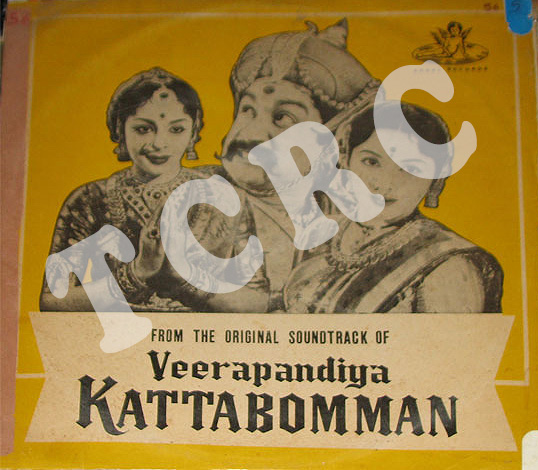
The tribute resonated even more with us, given that our archives have an original LP of the “Veerapandiya Kattabomman” soundtrack (see image below).

In the late 1960s, the conductor of the Bangalore Transport Service (BTS) bus that plied on route No 10A from Srinagar to Majestic via City Market was a certain Shivaji Rao Gaikwad, a Kannada-speaking Maharashtrian. He was a stickler for rules. His dos and don’ts for commuters were simple: don’t board a running bus; always alight and board only at bus stops; don’t travel on the footboard; present exact change for tickets. One morning, he noticed a pig-tailed college girl jump into his moving bus, and snarled, “Ilee ree, ilee ree” (get off, get off). He had the driver stop the bus and made my aunt Vasanthi—the passenger—disembark.”
We at TCRC loved reading this lovely Open magazine story about superstar Rajnikanth (click on the image to read the full story).
Our archives have numerous rare images of Rajnikanth over the years and we are currently digitizing a number of those images. So, do watch this space for updates!

Poster | “Apocalypse Now” in Polish
Andrew Lindstrom puts together a fantastic collection of 50 film posters from Poland for the blog WellMedicated (click on the image to see the entire list). Some of them are absolutely gorgeous.
Incidentally, The Cinema Resource Centre here in Chennai also houses a large number of posters and lobby cards of Hollywood films that have been released in India over the years. Want to drop in? Write to us at tcrcindia[at]gmail[dot]com.
“Unlike all the other art forms, film is able to seize and render the passage of time, to stop it, almost to possess it in infinity. I’d say that film is the sculpting of time.”
Andrei Tarkovsky (April 4, 1932 – December 29, 1986)
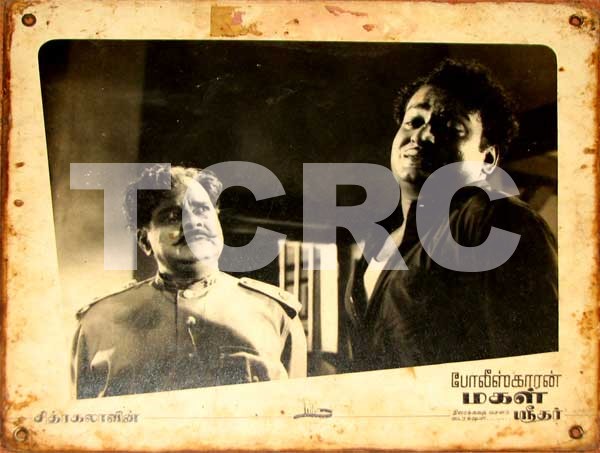
A ‘lobby card’ usually featured an image from the film that was being played at the theatre and was displayed in the glass-pane covered notice boards that characterized the lobbies of most single screen theatres in those days.
This is the lobby card of “Policekaaran Magal,” a successful Tamil film released in 1962.

 The Cinema Resource Centre (TCRC)