The Pioneers of Tamil Cinema

I DIRECTORS: THE CAPTAINS – MASTERS AND COMMANDERS WITH AN IMPACT TO LAST THE AGES

4a) THE RAOS – I

This week, we are going to talk about the Raos, a set of people who can truly be said to have ruled the Tamil film industry in the 1930s. These were Y. V. Rao, P. V. Rao, B. N. Rao and Sundar Rao Nadkarni – in some ways, the first royals of the Tamil industry.

4b) Y. V. RAO

Y. V. Rao alias Yaragudipati Varada Rao, born 30 May 1903, was rather prominent during his time as an extremely talented filmmaker; he does, however, seem to have been tragically largely forgotten today. A multifaceted mover in the industry, he donned many hats: as an editor, a director, an actor, a producer and even a screenwriter. His wife Kumari Rukmani, daughter Lakshmi, his granddaughter Aishwarya and even his mother-in-law, Nungambakkam Janaki, were all heavyweights in the industry as actors in their own right. His daughter, Lakshmi, and granddaughter, Aishwarya, are active in the industry to this day; Lakshmi, in fact, is well-known across languages and is National Award winning actress.

Y. V. Rao probably has the honour of bagging the most firsts in the South Indian film industries, collectively.  He made a number of multilingual films in Tamil, Kannada, Telugu, Konkani, and even Hindi, not to mention the plethora of silent movies in his filmography. He was the first to make motion pictures in so many languages; in fact, he holds an international record for this honour according to the film historian Randor Guy. His directorial venture SATI SULOCHANA was the first talkie ever made in the Kannada language. The battle scene in this film, shot using four cameras simultaneously, stayed with many viewers and was all the rage at the time of the film’s release. 

He was also the first filmmaker to ever make a film on the glittering world of cinema in his Telugu film VISWAMOHINI. At a time when most films were either mythological or based on social issues, VISHWAMOHINI was a pathbreaking film.  

Other notable works in the Tamil language by Y. V. Rao include: 

  • 1936: BHAMA PARINAYAM  
  • 1937: CHINTAMANI 
  • 1938: BHAKTA MEERA  
  • 1938: SWARNALATHA
  • 1941: SAVITHIRI

His film CHINTHAMANI, in particular, broke many box office records and catapulted its hero, M. K. Thyagarja Bhagavathar, to Superstar status. He, of course, went on to create a stunning legacy of his own. Ashwatama, the Kannada actress in the eponymous role, made her Tamil debut with this film. She, too, rose to dizzying heights with her acting and singing skills. However, she tragically succumbed to early death due to tuberculosis in 1939. The film itself ran for a year in single screen theatres – the first film to pull this feat off. It was not only a raging success in South Indian films, but went on to become one of the highest grossing films in India after its release. 
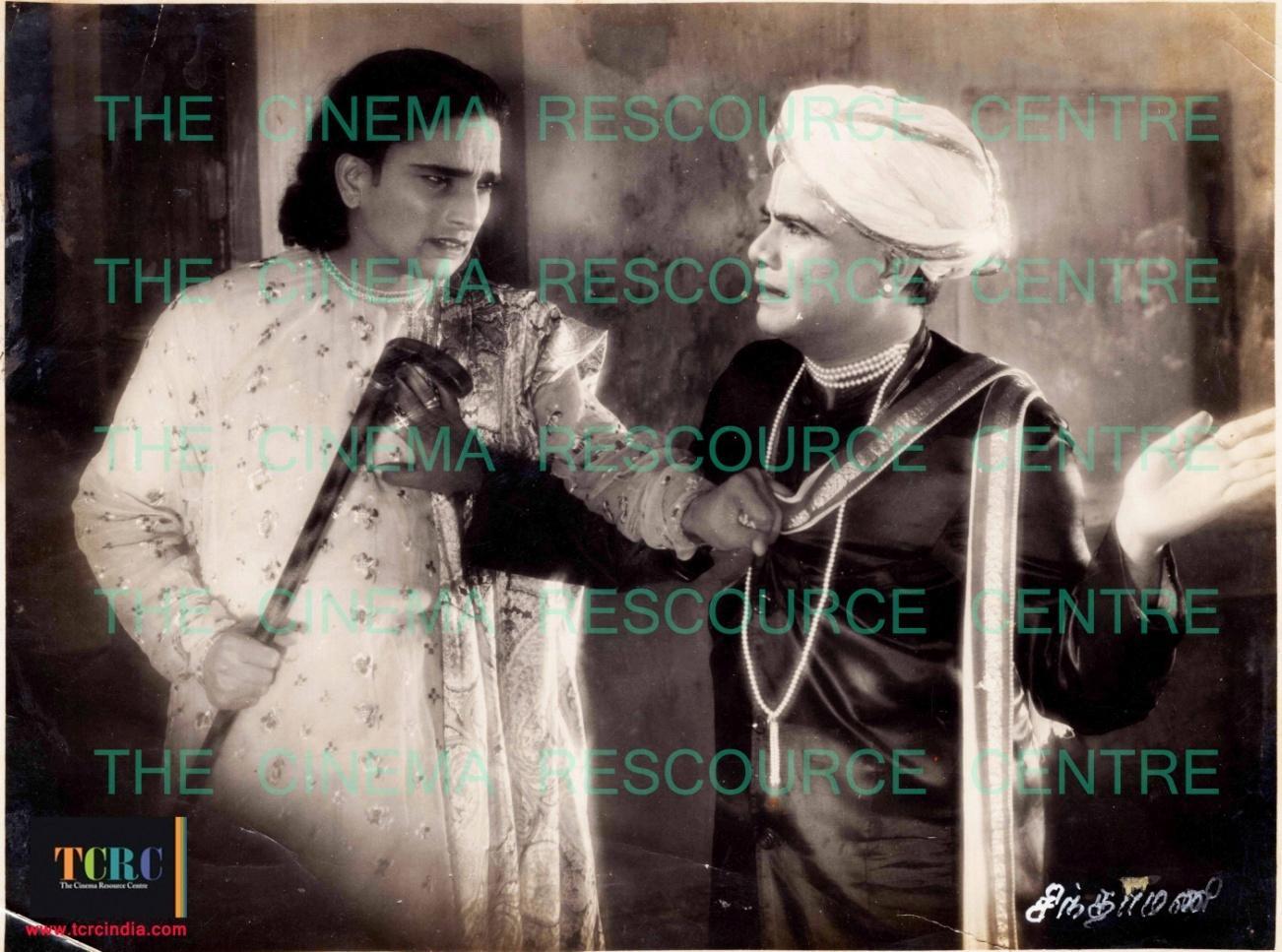
Chinthamani.jpg

Working Still from the Film CHINTHAMANI Featuring Y.V.RAO himself with L.NARAYANA RAO

PC: From the archives of TCRC

CHINTHAMANI, in later years, acquired a kind of cult status, and continues to be considered a historical event in South Indian cinema. Later, when Rao began producing films, he named his production company Chinthamani Pictures. The profit of this film as of such a magnitude that the distributors of the film, Royal Talkies, constructed a new cinema theatre in Madurai and named it after the film: Chinthamani Talkies.

With SWARNALATHA, Y. V. Rao bagged yet another first. This was the first film to be shot in one of the most famed studios of Chennai, Newtone Studios. 
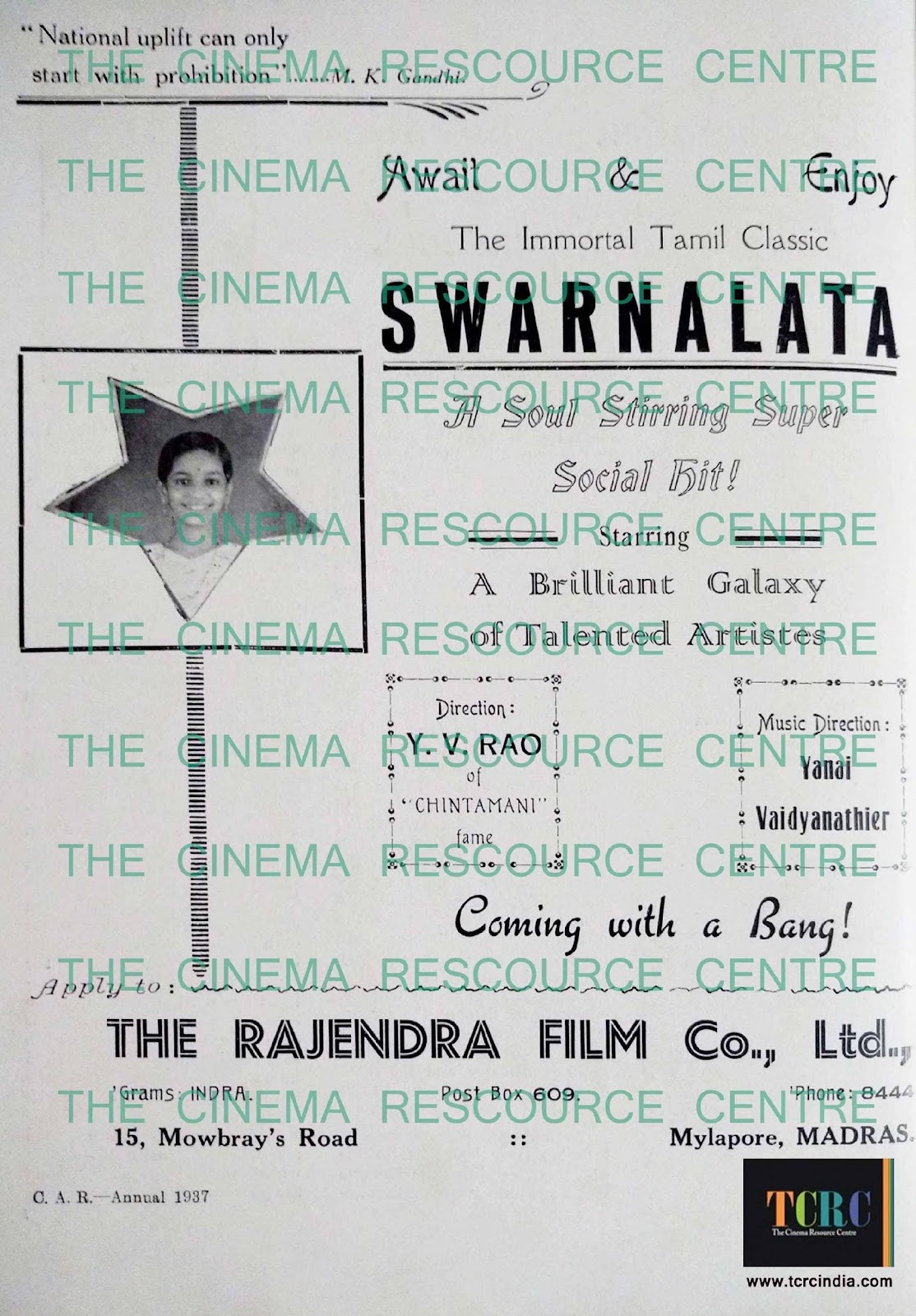
Swarnalatha.jpg

An advertisement for the Film SWARNALATHA

From the magazine CINE ART REVIEW 1937

PC: From the archives of TCRC

Although the movie itself wasn’t a raging success, commercially speaking, it did make a significant mark in the history of Tamil cinema – largely due to Y. V. Rao’s acting skills and careful direction, not to mention the distinction of being the first film to ever be shot at one of the busiest studios in the country during the period spanning 1940-1970. The studio was also was leased to the noted filmmaker A. Bhimsingh, who shot many of his films there. Later it was sold to Bharathiya Vidya Bhavan. This film grappled with many complex social issues such as alcoholism and unemployment. 

P.V.RAO

P. V. Rao was one of the foremost filmmakers in the South Indian film industry. His name is, perhaps a little oddly, often confused with the initials V. V. or T. V. However, according to compelling evidence available in publication, his name is stylised as P. V. See: the advertisement below, published in the year 1937. He directed many films in Tamil: VALLI, VALLI THIRUMANAM, SAKUNTHALA, SRI KRISHNALEELA, BHAKTHA DRUVAN, NALLA THANGAL, LEELAVATHI SULOCHANA, BALAMANI and DEVADAS

Interestingly during the shooting of BALAMANI (1937), it is said that the TKS brothers were unhappy with P. V. Rao’s discipline when it came to filmmaking. Unfortunately, as was anticipated, the film didn’t do well at the box office and was declared a flop rather swiftly. In startling move of creative revenge, the TKS brothers made a spoof of him, a character named V.P. Var – which cleverly reversed Rao’s name – in their next film, GUMASTHAVIN PENN. This film, curiously, was also directed by yet another Rao, B.N. Rao. This character, played by K.R. Ramasamy, was hilarious, and became quite popular and well loved! 

He also made the first of many DEVADAS films made in India – the first ever to me made in South India. It was released in 1937, where he himself played the lead role, opposite G. B. Rajayee.
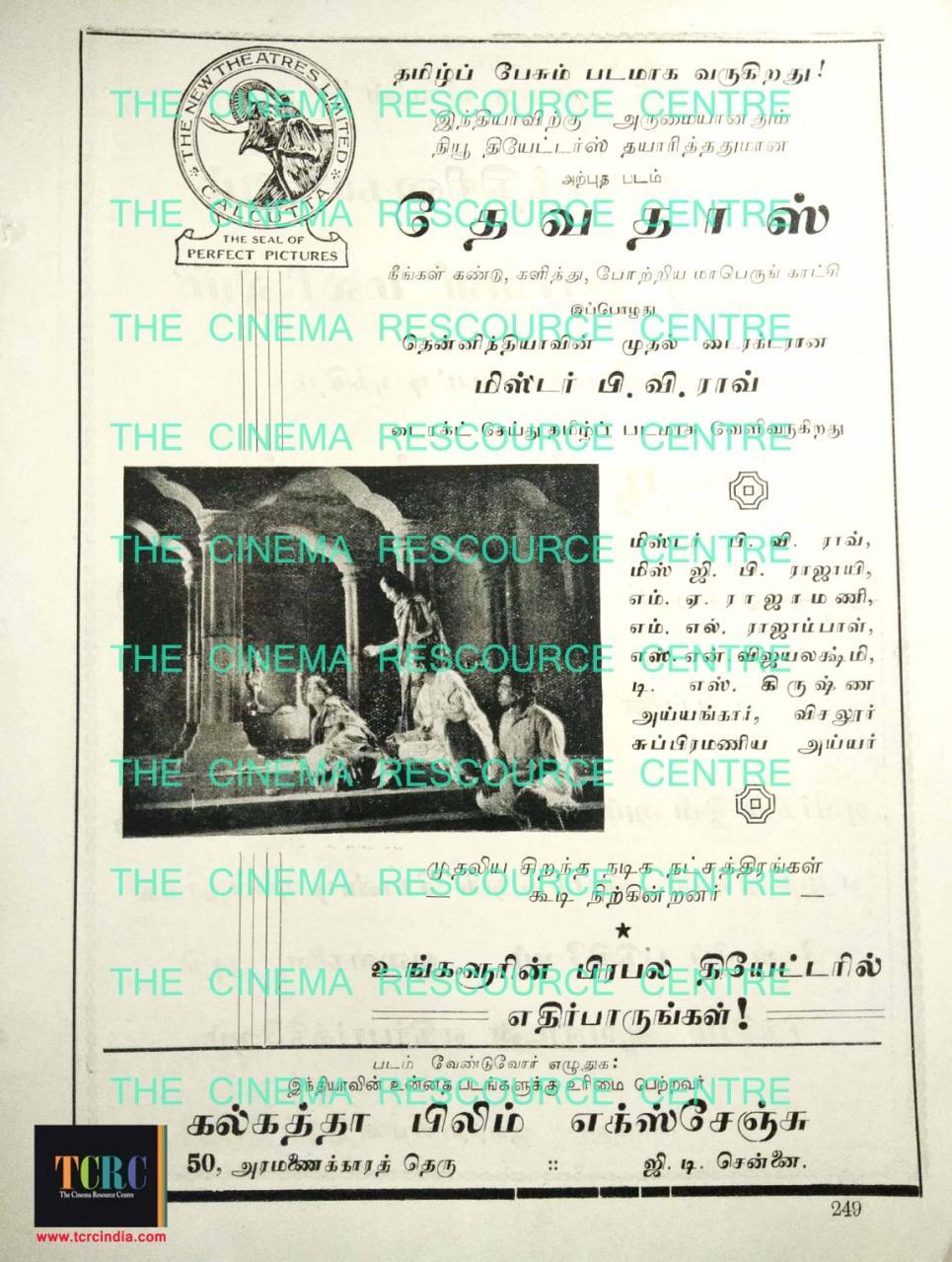
Devadas.jpg

An advertisement for the Film DEVADAS

From the magazine ANANDHA VIKATAN DEEPAVALI MALAR 1937

PC: From the archives of TCRC

[To be continued] Next week we will talk about two more Raos – who were each immensely influential in establishing the trends in Tamil cinema.

About the Author:

V.V. Prasad is a Electronics and Communication Engineer based from Chennai. He is currently involved in the role of a Researcher and Archivist in THE CINEMA RESCOURCE CENTRE.
He takes care of the non film materials like Photographs, Magazines, Lobby Cards, Song books etc of the archives. Cataloguing them and digitizing them are part of his current work.
His interests and passion lie on the research of Cinema particularly South Indian Cinema.
The Pioneers of Tamil Cinema

I DIRECTORS: THE CAPTAINS – MASTERS AND COMMANDERS WITH AN IMPACT TO LAST THE AGES

This week, we bring you yet another mover and shaker from the world of Tamil Cinema: Raja Sandow, a prominent filmmaker as well as a trendsetter — in every sense of the word!

3) RAJA SANDOW

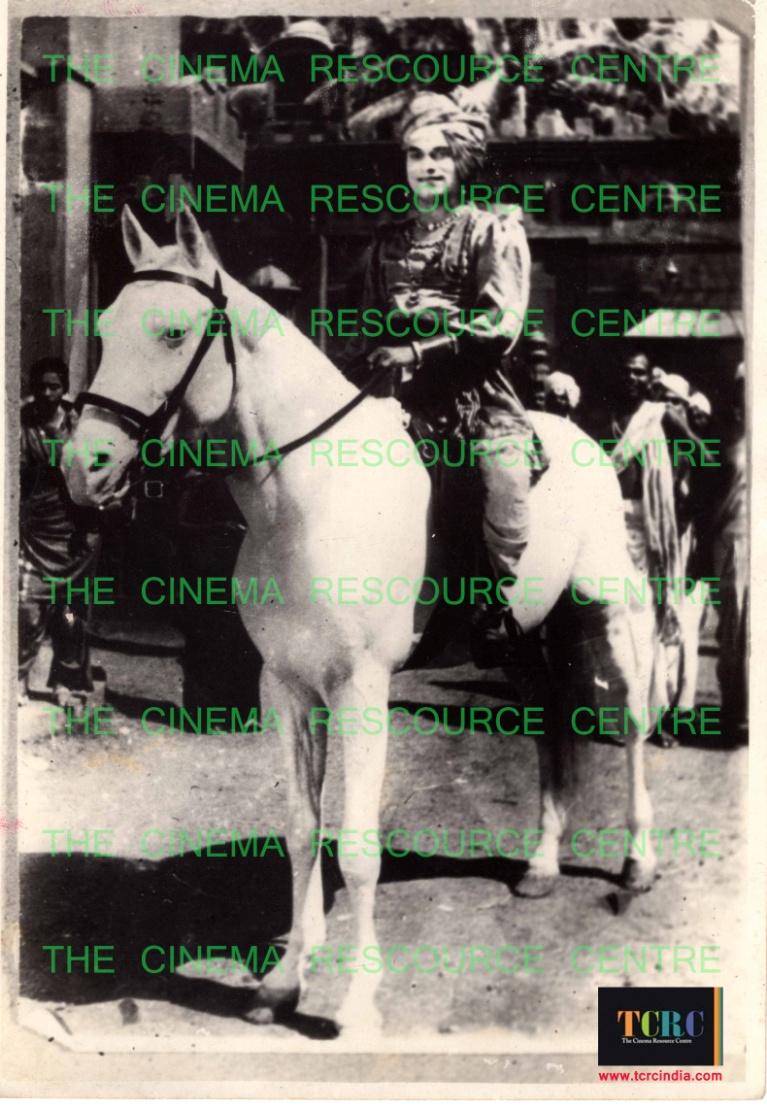
P.K. Nagalingam, better known as Raja Sandow to the world, was born in Pudukottai, Tamil Nadu in 1895. There’s an interesting story behind the origin of this new name: the story goes he acquired this unique moniker due to his impressively toned physique, built through his pastime of choice, bodybuilding and wrestling. Once he was satisfied with his bodybuilding, he opened a gym for the world — and a very successful one, at that. He went on to earn many accolades through his wrestling career, and was even featured in the Bombay Chronicle.

This popularity eventually paved his way into the glittering world of show business, and he began acting in silent films in the City of Dreams, Bombay. Right from his very first film, BHAKTHA BHODANA, he performed his own stunts. This attracted the attention of many filmmakers of the time, as a result of which he went on to act in more than seventy silent films.

Once he climbed to the very top of his acting career, Raja Sandow turned his attention behind the scenes, to the art of filmmaking. A keen observer, he had been watching and learning from the films he starred in from the very first one. When opportunity knocked on his door in the form the filmmaker R. Padmanabhan, who offered him a chance to make his own film in Madras, he jumped at it. And thus was made the film ANADHAI PENN in 1929. 

The films Raja Sandow made aimed to portray deep social messages, particular the terrible ways the poor, and women, were treated in society. His films NANDANAR and RAJESWARI, released  in the 1920s, were some such films that were truly remarkable for the times in which they were made.

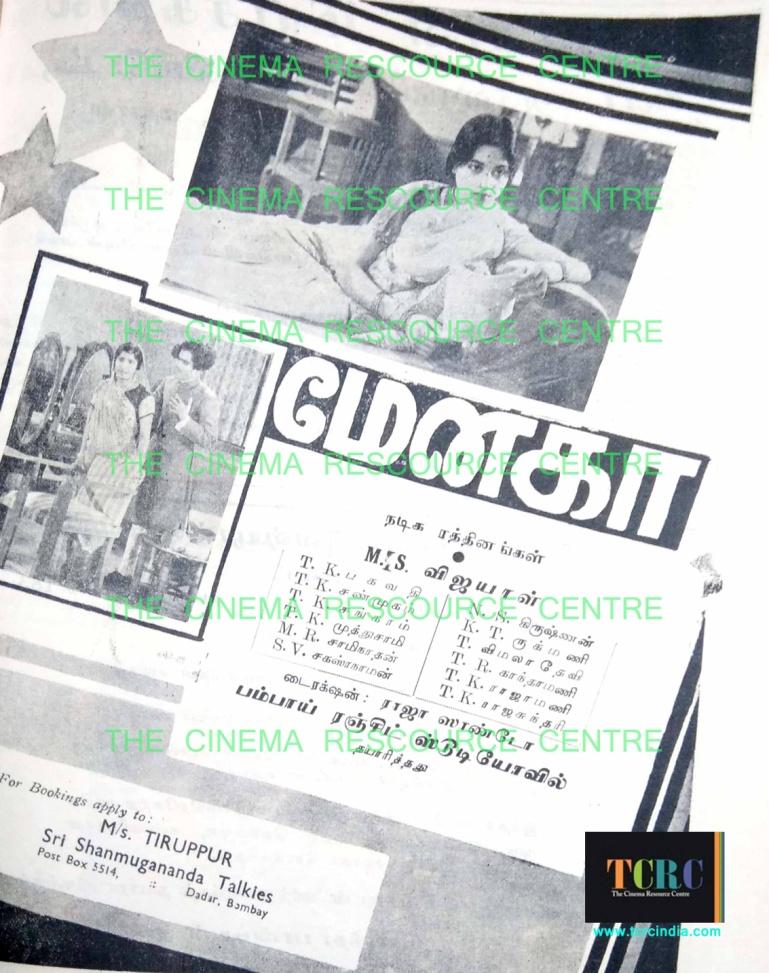
He was responsible for many firsts and beginnings in the Tamil film industry. In his MENAKA, for instance, the lead and actor and actress were pictured interacting very closely and even touching each other. This was revolutionary at a time when the norm was to place the hero and heroine at a two feet distance from each other at all times. He was, clearly, one of the first and foremost trendsetters of the Indian film industry as a whole.

Menaka.jpg

An advertisement for the Film MENAKA

From the magazine ANANDHA VIKATAN DEEPAVALI MALAR 1935

PC: From the archives of TCRC

MENAKA also marked the debut of the famous N.S. Krishnan, who went on to become one of the pioneers of comedy in Tamil films. It was also the first film appearance of the TKS Brothers, who were the foremost stars of the theatrical world at the time.

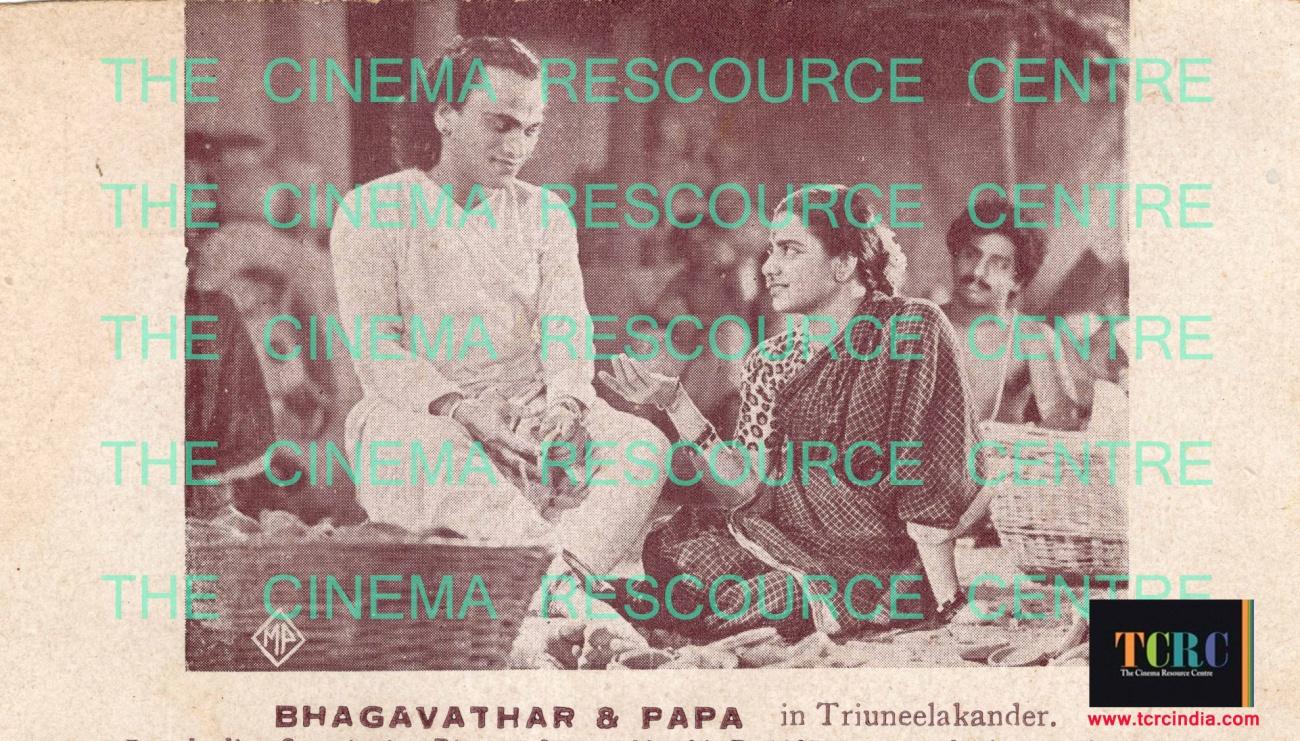
THIRUNEELAKANTAR, made in 1939, went on to become one of the biggest hits in the history of Tamil cinema. During its release period, shows were running in cinema halls even a year — 52 weeks — after the films initial release. This film, too, featured an extremely popular soundtrack by M.K. Thyagraja Bhagavathar. The songs were composed by Papanasam Sivan and became sensational runaway hits elevating the stardom of Thyagraja, known fondly as M.K.T. Songs from the movie such as Deena Karuna Karane Nataraja were all the rage. Songs from this film were catapulted to cult status, and remain both well-known and beloved by music lovers even today.

Thiruneelakandar.jpg

Working Still from the Film TIRUNEELAKANDER Featuring M.K.T and TIRUNELVELI PAPA

PC: From the archives of TCRC

The comedy duo N.S. Krishnan and T.A. Madhuram— who were, incidentally, husband and wife in reality too — were quite the comedic sensation; many flocked to the cinema to see their exceptional comedy.

Thiruneelakandar2.jpg

Working Still from the Film TIRUNEELAKANDER Featuring N.K.S and T.A. Madhuram

PC: From the archives of TCRC

In 1943, Raja Sandow tragically suffered a heart attack and died in Coimbatore on the 25th of November. His last film was SIVAKAVI, which he had, in fact, quit due to creative differences with the producer, S.M. Sriramulu Naidu. Naidu went on see the film to its conclusion himself.

Sivakavi2.jpg

Working Still from the Film SIVAKAVI Featuring M.K.T

PC: From the archives of TCRC

 [To be continued] We’ll be back next week with more hidden treasure from the history of Tamil cinema. Stay tuned! 

About the Author:

V.V. Prasad is a Electronics and Communication Engineer based from Chennai. He is currently involved in the role of a Researcher and Archivist in THE CINEMA RESCOURCE CENTRE.
He takes care of the non film materials like Photographs, Magazines, Lobby Cards, Song books etc of the archives. Cataloguing them and digitizing them are part of his current work.
His interests and passion lie on the research of Cinema particularly South Indian Cinema.

Filmy Ripples – N.S.Krishnan, the Legend

By P.V. Gopalakrishnan

It is generally said, however, a pathos scene is difficult to naturally enact, it is even more difficult to be successful as a comedian as timing & body language have to contribute to its success. Pure, vulgar-free comedy that stands out is a real tough job and all were not cut to deliver that.

In the very early talkie films, there was nothing like a separate comedian. It was only later, as part of the evolutionary process of cinema, comedians came into being in Indian films to provide a relief from the main story line, which, often, was heavy with emotions.

The early cinema (we are talking about pre-Nagesh period) had a bunch of good comedians such as T.S.Dorairaj, Kali N Rathinam, T.R.Ramachandran,

Sarangapani, ‘Friend’ Ramasami, A.Karunanidhi, Kakka Radhakrishnan, ‘Kuladeivam’ Rajagopal, A.Rama Rao, Chandrababu, Thangavelu, Muthulakshmi, T.A.Mathuram, & M.Saroja.

But the Monarch of the Tamil film comedians, undoubtedly, was N.S.Krishnan (NSK).

Tamil cine goers laughed their guts out at NSK’s thought provoking jokes. NSK has often been compared to the legendary comedian, Charlie Chaplin. But, while Chaplin scored with his slapstick comedy and body language, NSK relied more on his verbal humour, one-liners and subtle messages to the audience. His comedy, which also had its share of puns, was always wholesome at its best with no double entendre or misogyny involved.

As we cannot justifiably cover all the stalwart comedians who tickled our funny bones in a single Article, we hereby restrict our current write up to the Monarch of them all – N.S.Krishnan.

N.S.Krishnan was born as Nagerkovil Sudalamuthu Krishnan in 1908 in a poor family. His childhood years were spent selling snacks in a theatre in his hometown & working as a ball picker in a Tennis Club. His lack of formal education was amply made up by his native genius & curiosity.

Later, in his formative years he joined the celebrated drama company run by TKS Brothers. He was also proficient in a rural art form known as ‘Villu Paattu’.

Later he formed his own touring theatre group and traversed the length and breadth of erstwhile Madras Presidency with his plays, which always drew packed houses.

NSK’s entry into the celluloid world was through S.S.Vasan produced and Ellis Dungan directed film ‘Sathi Leelavathy’, where he was introduced as a comedian. Though this was his debut film, his second movie ‘Menaka’ got released before ‘Sathi Leelavathy’ could hit the screen. However ‘Menaka’ was adjudged the best movie of the year in 1935.

Menaka

An Advertisement of the Film MENAKA in the magazine ANANDHA VIKATAN DEEPAVALI MALAR 1935  PC: From the archives of TCRC

It was during the shooting of ‘Vasantha Sena’ (1936), directed by Raja Sandow, NSK ‘met’ co-star T. A. Mathuram and both fell in love. Their marriage was held in a simple manner, while the shooting schedule moved to Pune, with Raja Sandow presiding over the ‘wedding’. The couple got the honor of being the first real-life couple acting as couple of reel life too, between 1936 and 1957, when they did a whopping 122 films, as a pair!

Vasanthasena

An Advertisement of the Film VASANTHA SENA in the magazine ANANDHA VIKATAN DEEPAVALI MALAR 1936  PC: From the archives of TCRC

N S Krishnan, who popularly goes by his popular title, ‘Kalaivanar’, rose from humble beginnings as a ‘villu paatu’ artiste who became a master in the art of repartee. In tandem with his wife TA Mathuram, he regaled audiences, often stealing the spotlight from the lead stars. NSK was known to pen his comedy tracks himself and always ensured that he was never repetitive.  Noted lyricist Udumalai Narayana Kavi usually wrote the lyrics for Krishnan.

Untitled

In the early timeframe of his career, he worked with comedians like TS Durairaj, Pulimootai Ramaswamy, CS Pandian and Kali M Rathinam and later worked in most of the films of MK Thiagaraja Bhagavathar as Hero. Krishnan was also a gifted singer and his numbers in ‘Sivakavi’, ‘Raja Rani’ and ‘Manamagal’ became immensely popular.

He also produced the hit film ‘Nallathambi’, directed by C.N Annadurai. He directed films such as  ‘Panam’ and ‘Manamagal’ penned by Karunanidhi. SS Vasan’s magnum opus ‘Chandralekha’ too featured Krishnan in comedy tracks. There was a time in Tamil cinema when no film was complete without NSK!

He also shared screen space in many films of the leading heroes, MGR and Sivaji Ganesan, and despite the presence of these Titans always stood out with his comedy.

NSK went on to work as unparalleled comedian in as many as 150 films, MGR starred ‘Raja Desingu’ being the last one, released after his death.

On 8 November 1944, Lakshmikanthan the gossip columnist & Editor of ‘Indu Nesan’ was knifed by some unknown persons in Purasawalkam and was admitted to the General Hospital, Madras as an outpatient. But the next day, Lakshmikanthan was murdered mysteriously while still in the hospital. The police arrested eight persons as accused for the murder including M.K.Tyagaraja Bhagavathar and NSK. This came as a rude shock to their fans and the cine world.

After thirty long months of jail term they were acquitted for want of proof by the London Privy Council, thanks to the eminent lawyer V. L. Ethiraj who argued for them at Privy Council at London. (The same illustrious lawyer founded Ethiraj College for women).

Though N.S.Krishnan did manage to pick up the threads of his life again as an actor post his release from prison, things were not quite the same & he was financially drained and his fortunes plummeted rapidly.

When Krishnan was first sentenced to jail, Mathuram took a break from her acting career. Later she came out her self-imposed exile to generate revenues for financing her husband’s appeal to the Privy Council.

When NSK was in prison, T. A. Mathuram started a drama troupe called N. S. K Nataka Sabha, which staged plays written by and starring S.V.Sahasranamam. ‘Paithiyakaran’ (1947) was one of those plays. Later Mathuram converted the troupe into a film production company and made a film based on the play. While the film, being directed by Krishnan-Panju Duo,  was in production, Krishnan was acquitted released from prison. A new role was written for him in the film. NSK made fun of his stint in prison through the song jailukku poi vantha in which he described in prison life, his fellow inmates and the types of prisoners he met. MGR played a supporting role in the film.

In 1947, after his release from the prison, Nataraja Educational Society, Triplicane awarded him the title of ‘Kalaivanar’ to NSK through the ‘Father of Stage’, Pammal.K.Sambanda Mudaliyar. He is, to-date, known by this Title even without his name!

‘Manamagal’ (1951), produced & directed by NSK, saw the debut of Padmini as a lead actress. In this movie, A.Bhimsingh, who later became a big Director, was an Assistant Director to NSK. He also generously gifted his own expensive car to Baliah for his stellar performance in Manamagal.

MSV-TKR duo was formed as Music Directors by NSK for his Film ‘Panam’ (1952).

In his times, NSK was instrumental in bringing a number of leading Tamil stage and film personalities to the fore; he was also a Gandhian, patriot and philanthropist who became an active member of the Dravidian Movement. On the assassination of Gandhi, NSK raised a Memorial for the Father of the Nation at his own expense in the Municipal Park his hometown.

NSK was one of the founding fathers of South Indian Actors Association. He is reported to have even gifted his own land for its premises.

NSK passed away at his 49 on 30th August 1957, after bringing a lot of joy and cheer to his audience through his film roles.

Some of his well known films included Sathi Leelavathi, Ambikapathi, Madurai Veeran, Kala Megham, Uthama Puthiran, Sakunthalai, Arya Mala, Mangamma Sabatham, Harischandira, Haridas, Pavalakodi, Paithiyakkaran, Chandrakantha,  Chandralekha, NallaThambi, Managaiyarkkarasi, Rathnakumar, Vana Sundari, Panam, Amara Kavi, Kaveri, Dr. Savithri, Mudhal Thethi, Rangin Radha, Raja Rani, Manamagal & Raja Desingu.

Chandrakantha

An Advertisement of the Film CHANDRAKANTHA in the magazine ANANDHA VIKATAN DEEPAVALI MALAR 1936  PC: From the archives of TCRC

In his personal life, he had three wives, Nagammai, T.A.Mathuram & T.A.Vembammal (T.A.Mathuram’s sister).


NSK Interview

Stills from a short Interview of NSK in the magazine KALKI DEEPAVALI MALAR 1942 PC: From the archives of TCRC

The Tamil Nadu Government dedicated the Children’s Theatre on Wallaja Road, Madras as a memorial building in 1979, named it ‘Kalaivanar Kalai Arangam’  in his honour . His revered public statue adorns a major junction in T.Nagar in Chennai.

If NSK were to be alive today he would have been 108 years old!


Filmy Ripples : Film Directors of nascent stages of Tamil Screen

By P.V. Gopalakrishnan

A film’s narration is in the hands of its Director, besides its Editor & Cinematographer. While a Director’s role in filmmaking is second to none, he has to have teamwork with other functionaries.  The Directors are the professionals who see every sequence shot through the eyes of the ultimate cine goer. They are like the captains  of a ship and pilots of an aircraft.

These days, there is so much talent in the industry that we often witness the avtar of a new talent in film direction.

But think of the times when Cinema itself was in nascent stage & the Directors had the risk of experimenting with a pristine audience. In such a stage there were some outstanding Film Directors in Tamil Cinema who contributed to Tamil Cinema from its silent era, about whom we will talk here. We have excluded here the legend Ellis.R.Dungan, as we had covered in details about him earlier.

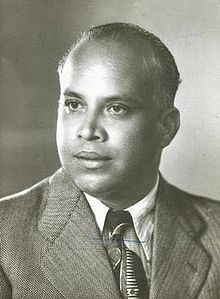
Sunder Rao Nadkarni

Sundar Rao Nadkarni, a Konkani from Mangalore, was an actor from Silent Film Era & later became an all rounder as editor, cinematographer, director and producer. He lived his formative years in Bombay which enabled him to delve deep into Marathi theatre and cinema. Thereon, Nadkarni moved to Coimbatore and finally Madras, where he settled down permanently. Inspired by the success of Sabapathy when AVM wanted to launch another comedy, he noted Nadkarni who went on to direct the Tamil Mega Hit film of AVM, En Manaivi (1942).

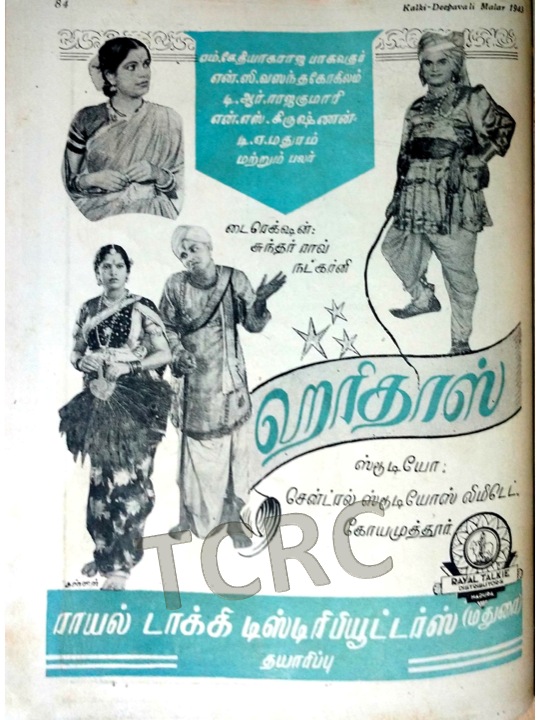
Following this success, Nadkarni also made other successful Tamil films. But his greatest hit was M.K.Thyagaraja Bhagavathar starred Haridas (1944), which set a record by becoming the first Tamil film to run for 110 weeks at the Broadway theatre in Madras.

Haridas

An ad for Haridas in Kalki Deepavali Malar 1943 PC: From the archives of TCRC

He directed all the top Tamil actors too during his active years, such as T. R. Rajakumari in Haridas (1944), Narsimha Bharathi in Krishna Vijayam (1950), and MGR and Savitri in Mahadevi (1957). (Nadkarni was the co-producer of ‘Mahadevi’).

Raja Sandow

unnamed

Raja Sandow PC: Unknown

K. Raja ‘Sandow’ (original name: P.K.Nagalingam) was one of the legendary film-makers right from the silent movie era. Besides, he was also a successful actor, producer and director.

According to Randor Guy, it was a sports enthusiast millionaire from Bombay, Omar Sobhani who took P.K.Nagalingam, for his athletic abilities, to Bombay, where he later met Director Patankar who gave him a break in ‘Baktha Bhodhana’ (1922), purely owing to his physique & good looks. Thus he started his film career. In fact, ‘Sandow’ in his name was appended for his physique, after the Hollywood strongman Eugen Sandow.

Between 1922 & 1943 Raja Sandow ruled the roost in silent  (such as ‘Veer Bhemsen’ (1923) & ‘The Telephone Girl’ (1926)) as well as talkie films in Tamil & Hindi. Later he took to film direction and even had scripted for talkies. The ‘Reformist’ Sandow brought many reforms to Tamil cinema & spearheaded making social themed movies with messages. He was also initially handling the Directorial part of the celebrated MKT movie, “Sivakavi” but was replaced by Sriramulu Naidu. A pioneer in the first generation of Indian film making, he also used to act in Tamil & Hindi till his sudden demise at his 48 in1943.

Y.V.Rao

2003082201400401

Y.V Rao PC: Unknown

Yaragudipati Varada Rao (born 1903) aka Y.V.Rao was a man of many parts that he was a filmmaker, actor and a film director. He was a visionary in his professional thinking & was a pioneer in making films in various Southern languages besides Hindi, right from silent movie era, when he started as an actor in silent films. Then he shifted to Madras in the 1920s & was cast as hero in many silent films like “Garuda Garva Bhangam”, “Gajendra Moksham” , and “Rose of Rajasthan”. Moving on, Y.V. Rao started his directorial debut with silent films, such as ‘Pandava Nirvana’ (1930), ‘Pandava Agnathavaas’ (1930) and ‘Hari Maya’ (1932).

Rao was at the pinnacle when he directed Tamil film, ‘Chintamani’ (1937) with MKT as its hero. The film created box-office records and proved to be a turning point in the annals of Tamil cinema and also in the life and career of Thyagaraja Bhagavathar.

Y.V.Rao married Actress Kumari Rukmini, through which they had a daughter, who would later come to be recognized as Actress Lakshmi.

Acharya

G. Raghavachari was a successful Madras High Court lawyer who was also active in the early Tamil Cinema writing and directing, without identifying himself for his work, as in those times cinema was a taboo in many minds, leaving Raghavachari to be anonymous in the movies he worked, including the popular film ‘Rishyasringar’ directed by him.

It was in 1943 at the insistence of movie mogul S. S. Vasan his name appeared as “Acharya” in the credit titles in Gemini’s ‘Mangamma Sabatham’.

During his days he was the most knowledgeable in South Indian Cinema and was involved in productions such as ‘Chandralekha’ (1948) & ‘Apoorva Sahotharargal’ (1949). As per Randor Guy, it was Raghavachari who directed the famous drum dance sequence in Chandralekha, using multiple cameras to film the sequence, though he walked out of the film in mid way.

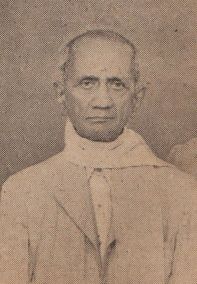
T.R. Sundaram

T._R._Sundaram

T.R.Sundaram PC: Unknown

T.R.Sundaram (born 1907) was from a wealthy family & was a graduate from Leeds University. He was married to a Britisher, Gladys while in UK.
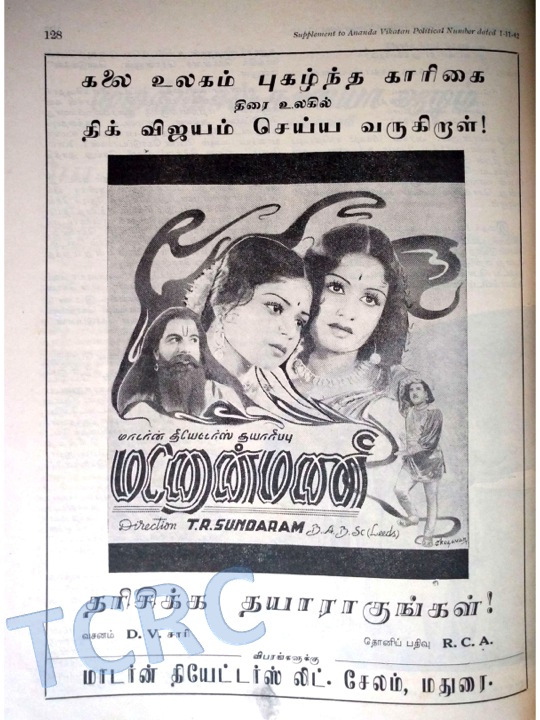
Sundaram entered Tamil films in the early 1930s & was involved in film production in partnership. Later he promoted his own company “Modern Theatres” in Salem. He became a successful studio owner & directed “Sati Ahalya’ (1937). Some of the films made by Modern Theatres included ‘Arundathi’ (1943), ‘ Sulochana’ (1947), ‘Utthama Puthiran’ (1940), Manonmani’ (1942), ‘Aayiram Thalaivangi Apoorva Chintamani’ (1947), ‘Adithan Kanavu’ (1948), ‘Digambara Samiyar’ (1950), ‘Manthiri Kumari’ (1950), ‘Ponmudi’ (1950), ‘Valayaapathi’ (1952), ‘Sarvadhikari’ (1951), ‘Alibabavum Narpathu Thirudargalum’ (1956), and ‘Pasa Valai’ (1956). T.R.Sundaram was a great & strict disciplinarian at work.

Manonmani

An ad of Manonmani in Ananda Vikatan Deepavali Malar 1942 PC: From the archives of TCRC

TRS gave breaks to many like M Karunanidhi & Kannadasan who became legends.Almost all the top stars have acted for Sundaram except the legend M. K. Thyagaraja Bhagavathar. Even the American filmmaker Ellis R. Dungan worked for him, directing ‘Manthiri Kumari,’ and ‘Ponmudi.’

Modern Theatres, one of the most successful film entities, has produced nearly two hundred movies in various languages. Out of this studio came out the first Malayalam movie, ‘Balan’. Besides, the first Tamil film in Gevacolor, ‘Alibabavum Narpathu Thirudargalum’ was also from Modern Theatres.

T.R. Sundaram who passed away in 1963.

K.Subramanyam

Subrahmanyam, a lawyer by profession, decided to go into movie making and founded in 1937 the Motion Pictures Producer Combines Studio where later Gemini Studios stood. He was a founding veteran of Tamil Film Industry & one of the founders of Nadigar Sangam in 1952.

He started his film career working on silent films directed by Raja Sandow. He started Meenakshi Cinetone, debuting his Directorial career with film Pavalakkodi, in which M. K. Thyagaraja Bhagavathar too debuted as an actor.

His remarkable movie was Balayogini, dealing with many social issues of the times. In 1938, he made Sevasadanam, advocating  woman’s empowerment, Bhakta Cheta, on the subject of untouchability and  “Mana Samrakshanam’, a war effort film. His best-known work was Kalki Krishnamurthy written nationalistic film Thyagaboomi, which got banned by the British government, for its explicit National flavor.

As to his personal life, he first married Meenakshi and later Actress S.D.Subbulakshmi. Through these two wed locks, he had children such as S. V. Ramanan, Dr Padma Subramanyam & Abaswaram Ramji, amongst others. His grandson S.Raghuram became a legendary dance choreographer in Indian film industry.

When Subramanyam’s studio was gutted in a major fire, the property came up for auction through a court order. At this juncture, Subrahmanyam persuaded S.S.Vasan to bid for it and enter film production. This is how Vasan’s Gemini Studios came into being.

Sriramulu Naidu

Sriramulu Naidu (born 1910 at Trichy) was another illustrious figure in the development of South Indian cinema. He was a great film personality who promoted as many as three motion picture studios in Coimbatore. In his younger days he was managing his railway retired father’s  bakery in Coimbatore. It was the early thirties when Tamil films were made only in far off Calcutta, Bombay or Kolhapur as till around 1934 the South did not have facilities for movie making. When Premier Cinetone Studio opened in Coimbatore, Sreeramulu Naidu joined the Studio & got trained in several aspects of film msking. Later he co founded the famed Central Studios in Coimbatore, where ‘Tukaram’ was made in Tamil 1938, in which the famous Carnatic Musician Musiri Subramanya Iyer debuted I Cinema. In 1941 Sreeramulu Naidu at Central Studios made ‘Aryamala’. In this movie, Naidu introduced M.S.Sarojini as the heroine. (Later he married her too). In this film Naidu learnt he Art of film making from the other capable co-technicians. When a Madras-based Narayana Iyengar promoted Pakshiraja Films at Coimbatore, Sreeramulu Naidu joined him as his agent and eventually became its Partner. But he quit that and founded the legendary Pakshiraja Studios at Coimbatore, where once Kandhan Studios stood.

Naidu’s second film ‘Sivakavi’ (1943) with MKT in the lead was also a grand success. Raja Sandow initially directed this film but since he fell out with Naidu, the latter took over its direction.

SIvakavi

Song book of Sivakavi. PC: From the archives of TCRC

The other noted films under his direction included Pavalakodi, Kalyaniyin kanavan, Kanchana, Malaikallan & Maragatham ‘Malaikallan’ (1954) was made in various languages including Hindi. In Tamil version the pair was MGR- Bhanumathi & in Hindi the pair was Dilip Kumar-Meena Kumari.

If there was a Hall of Fame for the Film Industry in India, like it is in Hollywood, all the above illustrious as well as industrious men would have surely found their coveted places therein. The current Tamil Film Industry owe a lot to these relentless pioneers.


Filmy Ripples : Tamil Cinema’s evolution from Theatre (Part 2)

By P V Gopalakrishnan

Pammal Sambanda Mudaliar, a qualified lawyer, founded Suguna Vilas Sabha, which is located even today next to the erstwhile Plaza Theatre near Cosmopolitan Club on Mount Road, Chennai. He wrote a hundred plays & staged them there. The title of Kamal Hassan’s film, “Pammal K. Sambandam” was his expression of tribute to this ‘Father of Tamil theatre’.

Pammal_Sambandha_Mudaliar

Pammal Sambanda Mudaliar PC: unknown

Sati Sulochana, Vedala Ulagam, Ratnavali, Manohara and Sabapathi, are some of the hundred and odd plays he wrote. The above mentioned plays were also made into successful films.  Old Madras luminaries such as S. Satyamurthy, R. K. Shanmukam Chettiar, V. V. Srinivasa Ayyangar, C. P. Ramaswamy Aiyar, V. G. Gopalaratnam and M. Kandaswamy Mudaliar (the father of the famed actor M. K. Radha) have acted in his plays. The British Govt., honored Pammal Sambanda Mudaliar with coveted Rao Bahadur Title, later the Government of India honored him with a Padma Shri Title in 1963.

Kandaswamy Mudaliar was a well known Tamil dramatist and stage actor. When Pammal Sambandham Mudaliar founded the famous ‘Suguna Vilas Sabha’. He became a member of it and took active part in the running of the Sabha. Besides writing plays, he supported his guru Sambandha Mudaliar in the theatre activities of the Sabha.

S.G.Kittappa, trained in music and acting by Sankaradas Swamigal, was a Tamil classical singer and stage actor who was active in the pre-cinema days.

K.B. Sundarambal as a small girl was discovered while singing and begging for alms on trains by F. G. Natesa Iyer, a Railway official, who was also a stage actor, talent – scout and play producer. He introduced her to Tamil theatre. Soon her stage plays such as “Valli Thirumanam”, “Pavalakodi”, “Harishchandra” became great hits during those days

While on a tour of Ceylon she met singer-stage actor S.G. Kittappa to whom she got married and started acting in stage musical plays as pair. KBS and SGK acted in dramas like Thookku Thookki, Nandanaar, Dasavatharam & Aandaal staged by the Kannaiya Nadaga Company. Their fans showered silver coins on stage when they acted. The couple became cult figures. They also took active part in the Indian Freedom Movement. But Kittappa eventually died very young in 1933 at the age of 27 due to which, at this juncture, his young widow K.B.Sundarambal went into isolation.

When the owners of a Sindhi business house, Chellarams, wanted to produce ‘Baktha Nandanar’ they approached KBS who initially resisted the offer. Subsequently, she debuted in that very film in 1935, in the role of Nandanar, for which she was paid a whopping lakh of Rupees. the renowned Carnatic Vidwan Maharajapuram Viswanatha Iyer (father of late Maharajapuram Santhanam) too acted in the very film ‘Baktha Nandanar’ (not to confuse with the subsequently made ‘Nandanar’ featuring M.M.Dandapani Desikar). Having debuted in this film, KBS acted & sang in many movies, notable of which were Gemini’s ‘Avvaiyar’, A.P.Nagarajan directed “Thiruvilaiyadal”, Poompukar, Kandan Karunai & Karaikal Ammaiyar.

PU. Chinnappa, was a popular singer movie actor in Tamil screen from 1930s. At a tender age of 8, Chinnappa joined in Meenalokshani Vidvabala Sabha, run by one Palaniyapillai, under the tutelage of Sankaradas Swamigal. At that time T.K.S brothers were acting in this popular drama company at that time. From there P.U.Chinnappa joined Madurai Original Boys Company for a salary of Rs.15 with a 3 year contract. Chinnappa was very prolific in singing too. When Chinnappa acted as hero, M.G.Ramachandran, P.G.Venkatesan, Ponnusamy and Alagesan were acting as a female lead with him. Kali N Rathinam and M. G. Chakrapaniwere acting in supporting roles.

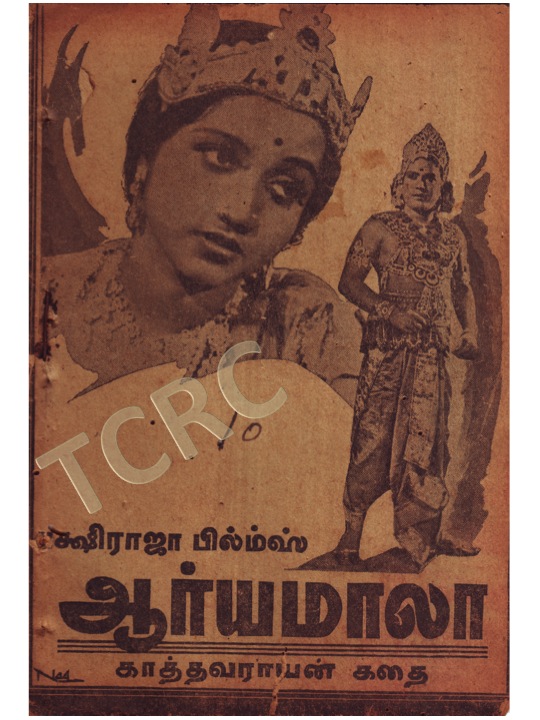
Chinnappa debuted in the movie Chandrakanta (1936) & continued his career in films like Punjab Kesari, Raja Mohan, Anadhai Penn, Yayathi and Mathruboomi. But the movie Uthama Puthiran was a block buster, catapulting the career of Chinnappa. His movies such as Aryamala & Kannaki made him a box office hero. Several other movies of him like Dhayalan, Dharmaveeran, Pruthivirajan and Manonmani too ran very successfully.

Aryamala

Song book of Aryamala PC: From the archives of TCRC

Manonmani.jpg

An ad of Manonmani in Ananda Vikatan Deepavali Malar 1942 PC: From the archives of TCRC

It was during this time, the professional competition between M.K. Thyagaraja Bhagavathar and Chinnappa became intense. Vanasundari, Ratnakumar and Sudarshan were the movies that Chinnappa acted last. He passed away in his late thirties in 1951.

One F.G.Natesa Iyer through his Rasika Ranjana Sabha, an amateur theatre group, introduced M.K.Thyagaraja Bhagavathar to Stage when MKT was in his pre-teen years. He also took professional training in Carnatic music. MKT teamed with S.D.Subbulakshmi toured even Ceylon & Burma to stage their dramas successfully.

MKT debuted in ‘Pavalakodi’ (1934), produced by Lena Chettiyar & directed by K.Subramanyam, in the music score of Papanasam Sivan.

Pavalakodi

Inside the pages of Pavalakodi song book. PC: From the archives of TCRC

In all, he acted in 14 movies in his life most of which were record breakers. Thiruneelakandar, Ambikapathi, Chintamani were among the highly successful Tamil films. His film Haridas, released (1944) ran continuously for three years at Broadway Theatre, Madras. The super hit film ‘Chintamani’ (1937) lodged MKT firmly in Super Star status. During the period of World War II, MKT staged his plays & gave concerts to collect funds for Red Cross Society.

He was very popular in classical concert circuits when very many doyens ruled the roost in that field.

After ‘Haridas’ was released, MKT emerged as an unequalled singer-actor & in this pinnacle of his career he had to undergo a jail term of three years, along with N.S.Krishnan, though he had been booked for many more films by that time for which he had collected even signing amounts. When he was released from the jail by the higher court in London after three years of jail term, MKT started seeing decline. His own production ‘Rajamukthi’ also bombed. He passed away at his 49 in the year 1959.

Haridas

An ad for the film Haridas in Kalki Deepavali Malar 1943  PC: From the archives of TCRC

NS. Krishnan (NSK), the highly acclaimed ace comedian of Tamil Screen of forties & fifties, started his career too on stage. He joined The Original Boys Company in the year 1924, while he was very young. A year later in 1925 NSK joined the Drama Company, ‘Sri Bala Shanmukhanandha Sabha of TKS Brothers where he debuted in a play titled “Savithri”. Subsequently, he worked in various other dramas and donned a variety of roles.

His debut into cinema was through the film ‘Sathi Leelavathy’, produced by Gemini S. S. Vasan, as a comedian. However his debut film was released only in 1936, a year later than his second movie ‘Menaka’ (1935), in which TKS Brothers & K.T.Rukmini acted.  ‘Menaka’, based on a play by TKS Brothers, was shot on a schedule of three months at Ranjit Studios, Bombay. Menaka was the first film to use a Bharathiyar song in a movie. The producers were bold to do that despite there having been a ban on Bharathiyar’s works by the British Government.

Soon in his life he added T.A.Madhuram, a co artiste of par excellence, as his spouse, during the shooting schedule at Poona of the film ‘Vasantha Sena’, directed by Raja Sandow. The rest was history with this couple acting together in over 120 movies, as a pair, between 1936 and 1957.

NSK & Maduram were both singing actors. Towards the later part of his career he too was implicated in the Lakshmikantan murder case along with M.K.Thyagaraja Bhagavathar & had to undergo a prison term of thirty months.

N.S.Krishnan produced & directed the movie “Panam” (1952), after his release from jail term, in which he paired music directors Viswanathan & Ramanoorthy first time. Though Ramamoorthy was senior to Viswanathan, NSK decided to have Viswanathan’s name first due to phonetic reasons. And it stayed so!

He passed away in 1957 & few of his films were released much after his demise.

                                                                                                                                                           (to be continued)