
The Cinema Resource Centre would like to wish one of India’s finest cinematographers, Mr. P.C.Sreeram a very Happy Birthday. Here are some of songs that he has picturised over the years.

The Cinema Resource Centre would like to wish one of India’s finest cinematographers, Mr. P.C.Sreeram a very Happy Birthday. Here are some of songs that he has picturised over the years.
In May 1989, Kamal Hassan’s “Aboorva Sagodharargal,” which featured the actor in the roles of a police officer, a mechanic and a dwarf clown, was released amidst much fanfare. Directed by Singeetham Srinivasa Rao and produced by Kamal Hassan himself, the film’s cast included Gouthami, Srividya, Delhi Ganesh, Jaishankar, Nassar, Nagesh, Janakaraj and many others. The film was a blockbuster hit and is said to have completed a 200-day run at the box office, a record run in Tamil cinema then (the record was broken six years later by superstar Rajnikanth’s “Baasha”). The film’s screenplay was penned by Kamal Hassan and the dialogues were written by Crazy Mohan. “Aboorva Sagodharargal” was Crazy Mohan’s debut film as dialogue writer.
The musical score of “Aboorva Sagodharargal” was composed by Ilaiyaraaja and its songs went on to become cult classics, with tracks such as “Raaja Kaiya Vecha” receiving airplay on radio and TV channels even today. And today, we bring to you from the TCRC archives the cover of the original LP record of the film:
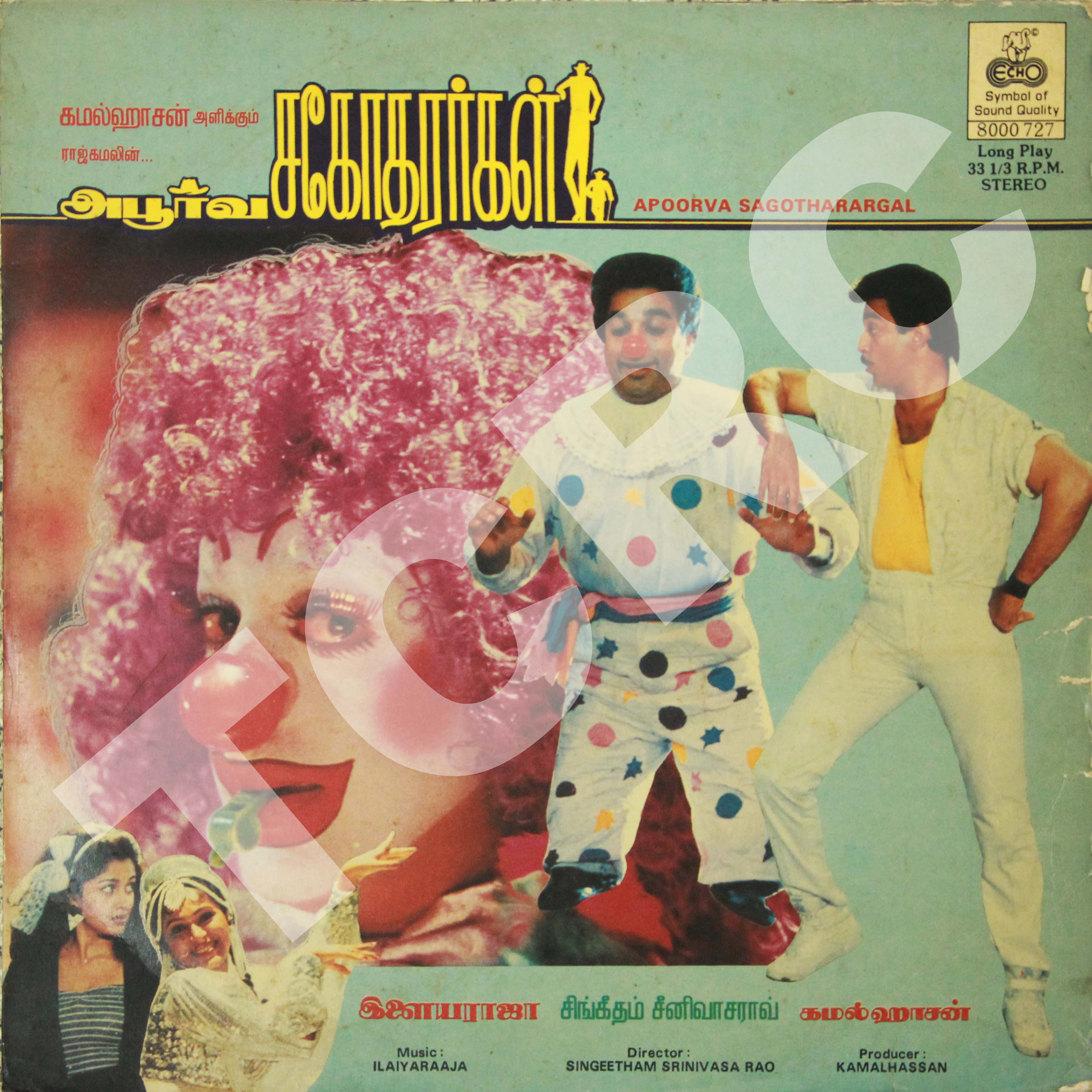
“Aboorva Sagodharargal” | LP record cover (front) | Tamil | 1989
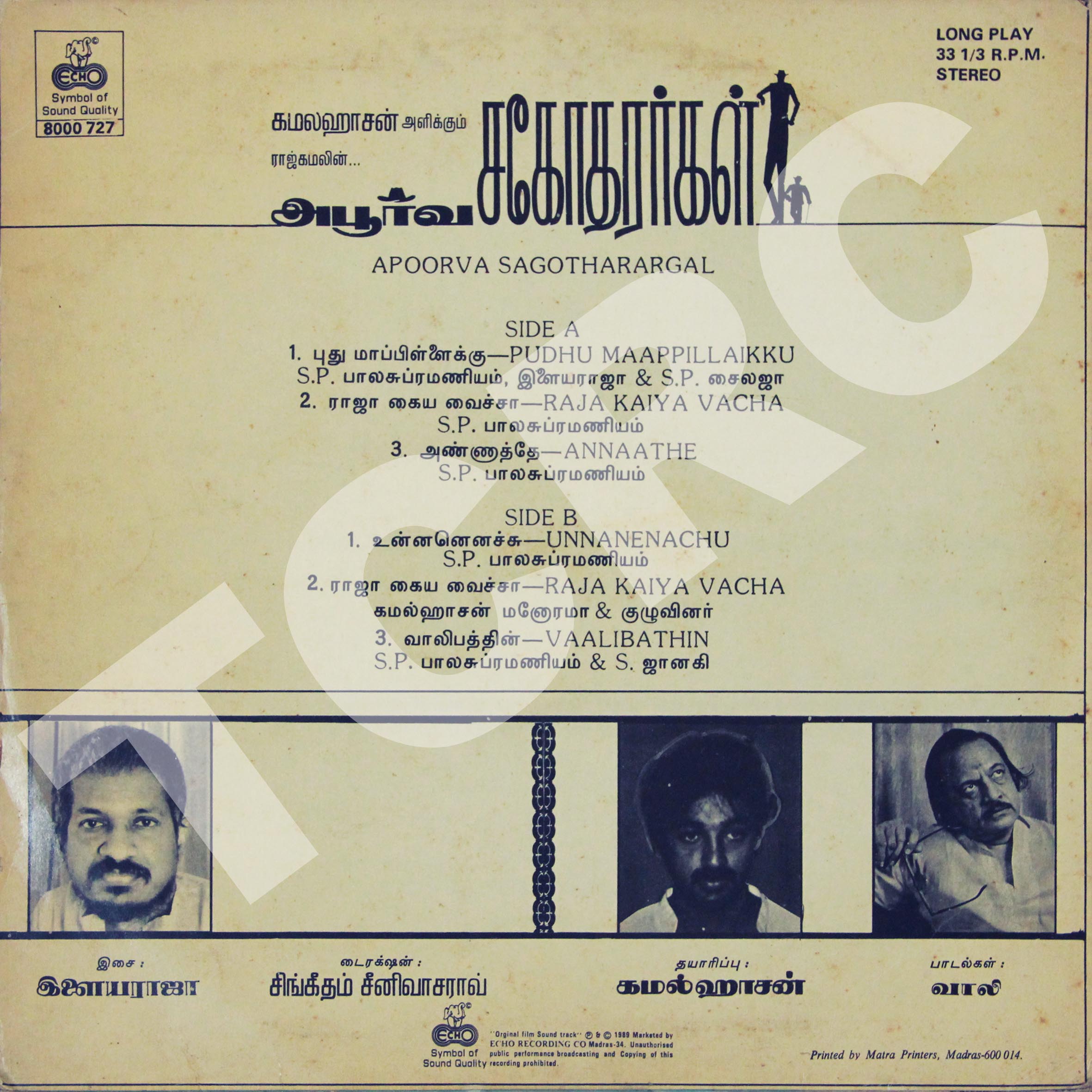
“Aboorva Sagodharargal” | LP record cover (back) | Tamil | 1989
The film was dubbed into Telugu as “Vichithra Sodarulu” and into Hindi as “Appu Raja,” a year later. Both the dubbed versions enjoyed a successful run at the box office, with Kamal receiving unanimous praise for his portrayal of the dwarf clown Appu. In the movie, the episode where Appu falls in love with the daughter of the circus owner (the daughter played by Rupini and the father played by Mouli) is said to be a tribute to Charlie Chaplin’s “The Circus,” which was a silent film released in 1928. In “Aboorva Sagodharargal,” Appu goes through a Chaplinesque heartbreak in romance that is very similar to what transpires in “The Circus.”
The title “Aboorva Sagodharargal” itself is a hat tip to SS Vasan’s 1949-released feature film of the same name. That “Aboorva Sagodharargal” featured actors MK Radha and Bhanumathi in titular roles and was produced in Tamil, Telugu and Hindi simultaneously. Directed by Acharya and written by Kothamangalam Subbu, the old “Aboorva Sagodharargal” was an adaptation of the novella “The Corsican Brothers” by Alexander Dumas. The idea of brothers coming together to avenge the death of their father is the common thread running between both the old and the new “Aboorva Sagodharargal.”
The ‘100 years of Indian cinema’ celebrations that are currently underway in various parts of India and also, the world, seem to be generating a lot of great content about the forerunners of Indian cinema. One such remarkable story is the Open magazine’s piece on Dadasaheb Phalke, in which Paresh Mokashi, the director of the award-winning Marathi film “Harishchandrachi Factory” based on the making of the first Indian film “Raja Harishchandra,” talks about the adventures of Phalke, the filmmaker, to Madhavankutty Pillai.
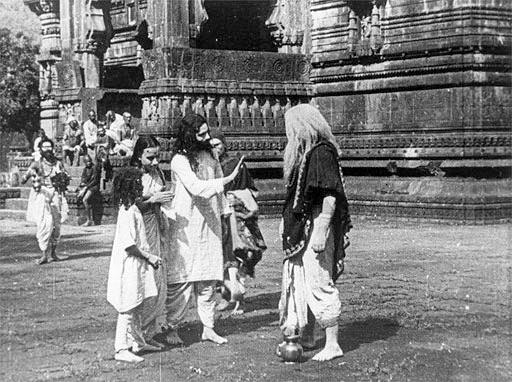
A still from “Raja Harishchandra” (1913). Photo Courtesy: Cineplot.com
Phalke’s struggles, in many ways, seem to epitomize the hardships that are faced by anyone who is involved in a pioneering attempt. Check out this nugget narrated by Mokashi:
Phalke needed money to start the film and, as usual, he had nothing. To impress financiers he thought of novel tricks. He put a seed in a pot and filmed it for a couple of seconds every day over a period of 30-40 days. He made a film of that seed growing into a plant and showed it to people to impress on them the power of the new medium. There was no other way he could make people understand. Films, cinema—these are modern words. They were not at his disposal. Indians were only theatre-goers then.”
And apparently, Phalke was also a master at film promotion, much before the term was even coined:
After the movie released, the response to it was lukewarm for the first two or three days. Phalke then started introducing novel marketing techniques. He came out with funny descriptions of the film, announcing in crowded market places that it is a mile long strip of 58,000 little pictures put together. He offered prizes to ticket buyers. The audience started coming in and the movie went on to make money. He not only recovered the film’s costs, but made profits after paying his creditors. With the money, he made two more films, back to back. In one-and-a-half years, he completed three films—Raja Harishchandra (1913), Mohini Bhasmasur (1913) and Satyavan Savitri (1914).”
Mokashi also mentions the contribution of Saraswati Phalke, Dadasaheb’s wife, who shared his enthusiasm for cinema:
Even today, every first time filmmaker is a Phalke. He goes through the same difficulties—a shortage of funds, and making others believe in you to bring them on board. There is also the struggle within you, a creative struggle—will I be able to pull it off? What fascinates me most about the entire story is his wife’s contribution. We don’t know much about Saraswati Phalke, but she was a key element throughout the venture. In fact, Phalke even made a film on the making of Raja Harishchandra. I suspect that it was his wife who shot it, because in one frame of the making we can see the cameraman shooting the film. Saraswati was the only other person in the unit who knew how to wield a camera.”
He also talks about the difficulties faced by Phalke in finding woman actors and also, the bizarre issues that came along with experimenting with a new medium like cinema:
When he couldn’t convince his wife and no other woman was available, Phalke went scouting in red light areas to get a prostitute for the role. Most refused because they considered acting less reputable than their profession. One sex worker agreed and accompanied him home but a regular client of hers came and took her away. Finally, he had to go with a waiter after spotting him in a tea shop.
He asked the men who were playing women in the movie to clean, wash, cook and do all the things that a woman did. It was method acting much before the term was coined. The movie was shot between six to eight months. He built sets first and completed those portions. He then went outdoors to Wangni, on the outskirts of Mumbai, where there is a dense jungle and a river flowing—scenery important for the story. The cast, who had gone before Phalke, was arrested after the police mistook the actors for dacoits due to their costumes.”
We at TCRC salute the pioneering spirit of Dadasaheb Phalke, the man who is often referred to as the father of Indian cinema.
Also, if you haven’t watched Paresh Mokashi’s “Harishchandrachi Factory” (2009) yet, here’s a link to the trailer:
The ‘100 years of Indian cinema’ celebrations that are happening across the country is something that we at TCRC wholly welcome, notwithstanding the fact that a vast majority of them seem to interpret it as ‘100 years of Hindi cinema.’ Thankfully, there are voices out there calling for balance and recognition of the other film industries in the country as well. And among such calls, we found Salil Tripathi’s piece for Mint most refreshing.
He starts off by speaking about the influence of our epics, the Mahabharata and the Ramayana, on our cinema:
Indian cinema has always been utterly reliant on the power of a narrative, and which narrative has greater richness than the Mahabharata? After all for Ved Vyas it is said, “Vyasochishtam jagat sarvam,” or whatever you find said in the universe, Vyas has said it before. It is that easy familiarity with the story—or what the critic Ashish Rajadhyaksha called the power of the epic, in his biography of Ritwik Ghatak—that makes Indian cinema so accessible to so many, in a country divided by everything—language, class, caste and faith—but united by the fascination for a good story.”
And then, he makes the argument that we’ve been parroting all along:
I love Hindi films too, but you don’t honour a national phenomenon by glorifying only one-fifth of it.”
Salil’s roundup of noteworthy cinema from the South of the Vindhyas was particularly interesting:
Moving south, there is so much to admire in Kannada cinema: two of U.R. Ananthamurthy works stand out. Girish Kasaravalli’s Ghatashraddha (1977) is about the outcasting of a pregnant widow. In Pattabhi Rama Reddy’s Samskara (1970), Girish Karnad’s Praneshacharya is a flawed progressive Brahmin who tries to do right, but succumbs to passion and is consumed by guilt. Karnad’s own Ondanondu Kaladalli (1978) was inspired by Akira Kurosawa’s samurai films.
Further south, in Adoor Gopalakrishnan’s Elippathayam (1981), the rat trap becomes the metaphor of the patriarchy of a closed society. His earlier film, Swayamvaram (1970), told the story of a young couple marrying against their parents’ wishes, moving to another town to start their life, and the inevitability of tragedy befalling them, and the determination of the young woman to cast her own lonely furrow. Another great film was G. Aravindan’s Oridathu (1986), which showed the transformation of a village’s life, and its people’s relationships, with the arrival of electricity. And the sheer melody of K. Vishwanath’s Telugu classic Shankarabharanam (1979).”
It’s not everyday that one finds a mention of G Aravindhan in a feature-style story about Indian cinema. Hailing from Kottayam in Kerala, Aravindhan was a cartoonist who later became a filmmaker. His debut film “Uttarayanam” was released in 1974 and won the National Award for the Best Feature Film on the 25th Anniversary of India’s Independence. Said to be be one of his finest films, “Uttarayanam” was set against the Independence movement and spoke of the opportunism and hypocrisy that existed during the time. The film is considered to have a played a key role in shaping the parallel cinema movement in Kerala.
Given below is Shaji Karun’s documentary on Aravindhan. Shaji is a National Award-winning filmmaker who used to be Aravindhan’s cinematographer. Shaji’s debut film “Piravi” (1988) won the Caméra d’Or – Mention d’honneur at the 1989 Cannes Film Festival and his 1994 film “Swaham” was the last competitive entry from India to be selected at the Cannes Film Festival.
Today, we bring to you a clip from “L’inde Fantôme” (Phantom India), a documentary film made by Academy Award-winning French filmmaker Louis Malle. This is an excerpt from “Choses Vues A Madras,” which was the second episode of the documentary. Focusing on the Madras film industry in the late 1960s, the excerpt features footage shot on the sets of the 1968-released, classic Tamil film “Thillaanaa Mohanambal,” starring Sivaji Ganesan, Padmini, Balaiah, Manorama and others. Directed by AP Nagarajan and written by Kothamangalam Subbu, the film and its songs continue to be remembered even today.
What we found most interesting was the commentary in French (you can turn on the English subtitles by clicking on the “Captions” button in the bottom bar on the YouTube video). The commentator, at one point, refers to Sivaji Ganesan as the “Indian Belmondo.” “Belmondo” here is a reference to Jean Paul Belmondo, the French actor who was a prominent face in the New Wave films that were made in France in the 1960s. He continues to be remembered for his portrayal of the character Michel Poiccard in Jean Luc Godard’s extremely influential film “Breathless” (“À bout de souffle” in French). “Breathless” was a path-breaking film that inspired many filmmakers through its brilliant use of the jump cut. So, while the comparison to Belmondo is flattering, it’s important to remember that Sivaji Ganesan had made his mark with “Parasakthi” in 1952, a good eight years before Belmondo broke out with “Breathless” (1960).
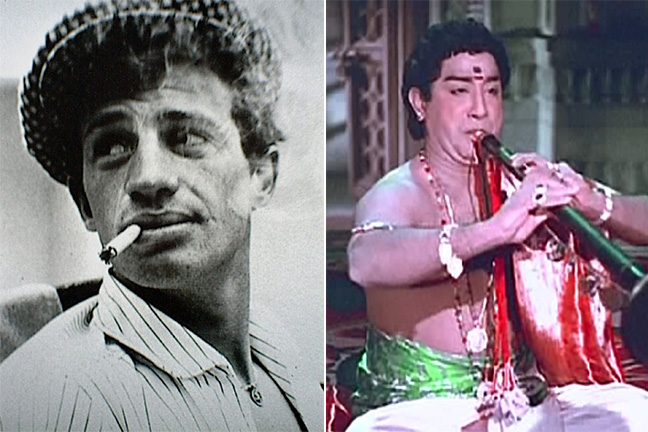
Jean Paul Belmondo in “Breathless” | Sivaji Ganesan in “Thillaanaa Mohanambal”
Do watch the clip and let us know about your thoughts on Louis Malle’s commentary and his take on Indian films. You can leave a comment or write to us at tcrc.india[at]gmail[dot]com.
Today is master filmmaker Satyajit Ray’s 92nd birthday and Google’s paid a lovely tribute through a doodle based on his film “Pather Panchali.” For those who missed it, here’s what the doodle is all about:
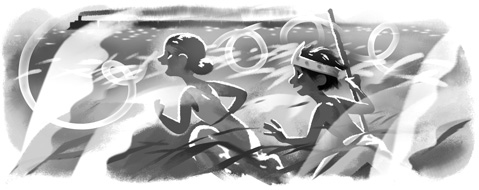
Google doodle on the occasion of Satyajit Ray’s 92nd birthday (2nd May 2013).
We at TCRC also chanced upon a YouTube video of an old show on DD Bangla where Sir Richard Attenborough, director of “Gandhi,” talks about the experience of working with Ray on “Shatranj Ke Khilari.” The film, released in 1977, was based on Munshi Premchand’s short story of the same name and was narrated by Amitabh Bachchan. The cast included actors such as Sanjeev Kumar, Saeed Jaffrey, Shabana Azmi, Farida Jalal, Amjad Khan, Richard Attenborough, Victor Banerjee, Farooq Shaikh and Tom Alter. Do look out for Sir Attenborough’s views on cinema as an art form and Ray’s soundbites!
Maverick filmmaker Quentin Tarantino’s films have always evoked extreme reactions and his latest film “Django Unchained” hasn’t been any different. Critics have mostly been underwhelmed by his take on slavery in the Deep South in “Django Unchained” and fans across the world are already curious about Tarantino’s next venture.
While talking to the French publication Les InRocks, the filmmaker indicated that his next film after “Django Unchained” would be a ‘small’ film in the vein of “Jackie Brown.” So, what exactly is “Jackie Brown” all about?

Quentin Tarantino’s “Jackie Brown” | English | 1997. Photo Courtesy: Internet Movie Poster Awards
This lesser-known Tarantino cult classic was released in 1997, three years after Tarantino’s insanely-popular breakout movie “Pulp Fiction.” Starring Pam Grier, Samuel Jackson, Robert Forster, Robert De Niro, Bridget Fonda, Michael Keaton and Chris Tucker, “Jackie Brown” was an adaptation of Elmore Leonard’s novel “Rum Punch.” It is said to be a tribute to the Blaxploitation films of the 1970s. Blaxploitation refers to the sub-genre of the broader category of exploitation films, which were characterized by funk and soul music soundtracks with the lead protagonists invariably being black.
In article titled “The One Time Quentin Tarantino Got Blaxploitation Masculinity Right” for The Atlantic (click here to read the entire story), Noah Berlatsky delineates why “Jackie Brown” works:
Jackie Brown, then, is not just a tribute to blaxploitation, but a critique of it—which means it’s also a critique of all those mainstream gendered assumptions and fantasies which informed blaxploitation in the first place. From previews and reviews, it seems unlikely that Django Unchained, whatever its other virtues, will manage to be bracing in quite the same way. But then, there aren’t many folks, of any gender, as cool, as smart, or as exhilarating as Jackie Brown.”
And here’s the trailer of the film.
We at TCRC are big fans for this lesser-known Tarantino film and we’d love to hear your thoughts about it. So, do write in!
While pulling out playback singer Shamshad Begum’s version of Katiya Karoon, we at TCRC realised that she was one of the earliest female playback singers in the Hindi film industry. This set us off on a search for India’s first woman film director and led us to this interesting piece on Fatma Begum, written by Rohit Vats for IBN Live as a part of their “100 years of Indian cinema” series. Here’s an excerpt from that piece (click here to read the entire story):
Born in an Urdu speaking family, Fatma Begum was related to Nawab Sidi Ibrahim Muhammad Yakut Khan III. She was the mother of Zubeida, Sultana and Shehzadi, who were popular actors of the silent era. She started working in films in 1922 after getting trained in plays. Fatma worked with filmmakers like Ardeshir Irani and Nanubhai Desai before founding her own production company Fatma Films which was later rechristened as Victoria-Fatma Films. ‘Bulbul-E-Paristan’ that released in 1926, became the first Indian film to be directed by a female director. However, acting remained on her wish list and she continued to act till late 1930s.”
Ardeshir Irani, who Fatma worked with as an actor, incidentally is the father of Indian talkie films, having made both “Alam Ara” (in Hindi) and “Kalidas” (in Tamil, with songs in Telugu).
We also tried to find an image of Fatma Begum on the web. While we did come across few images, we couldn’t confirm the veracity of any of them. The Whistling Woods (a film school in Mumbai) blog, for instance, features this picture:

Fatma Begum, India’s first woman film director.
Cineplot Enyclopedia, on the other hand, features this image:

Fatma Begum, India’s first woman film director.
Clearly different people, don’t you think? It is interesting (and worrisome) to note that the internet doesn’t have a single undisputed image of the first woman director in one of the world’s largest film industries. On days like these, we at TCRC find renewed vigour in our attempt to archive cinema-related artifacts. Have you found other such examples with respect to information about the early days of cinema? Do share them with us by writing to tcrc.india[at]gmail[dot]com.
We at TCRC were deeply saddened to hear about the demise of Shamshad Begum, one of the earliest playback singers in the Hindi film industry. She was 94, only half a dozen years younger than Indian cinema itself (if we go by the release of “Raja Hairshchandra” as the beginning). Along the way, Shamshad Begum has given us some of the most evergreen melodies in Indian film music, including hits such as “Kabhi Aar Kabhi Paar” and “Kajra Mohabbatwala” for composer OP Nayyar, and “Mera Piya Gaye Rangoon” for music director C Ramanchandra.

Shamshad Begum. Photo Courtesy: Hindustan Times
A Padma Bhushan awardee, Shamshad (which means “graceful” in Persian) Begum recorded her first song, a Punjabi number, in the 1930s. And it is another Punjabi number that we at TCRC are bringing to you today, as a tribute to this doyenne. In the 1963-released, black-and-white Punjabi movie “Pind Di Kurhi” directed by Baldev R Jhingan, Shamshad Begum had sung a version of “Katiya Karoon,” the folk number which was recently adapted in Imitiaz Ali’s “Rockstar” starring Ranbir Kapoor. While the new “Katiya Karoon” was composed by AR Rahman, the original version delivered by Shamshad Begum was composed by Hansraj Behl and was picturized on actress Nishi. Watch and enjoy!
The Kochi edition of The Hindu recently carried an interesting piece on “Asuravithu”, a Malayalam film that was released in 1968, in their Blast From The Past column (click here to read that story). “Asuravithu” featured Prem Nazir and Sharada, and was directed by A Vincent. The film was scripted by the famous Malayalam author MT Vasudevan Nair, a Jnanapith awardee for his overall contribution to Malayalam literature. Interestingly, MT Vasudevan Nair has also won four National Awards for Best Screenplay, which continues to be the most by anyone for that category. The film “Asuravithu” is based on his novel of the same name.
“Asuravithu” is set in an Indian village in the 1960s and revolves around the life of Govindankutty, played by Prem Nazir, the youngest son of a proud Nair tharavadu (joint family). Prem Nazir is considered to be one of the all-time superstars of Malayalam cinema and the breadth of his filmography is astonishing. He is said to have played the lead protagonist in over 600 films. He has acted with over 80 heroines and acted in 107 movies with just one heroine (Sheela). He is a recipient of both Padma Bhushan and Padma Shri awards.
The film also had some lovely folk melodies tuned by K Raghavan, of which our favourite is the song “Kunnathoru Kaavundu.” Do check it out!
 The Cinema Resource Centre (TCRC)