The Madras Film Industry in the 1960s: On the sets of “Thillaanaa Mohanambal” in a French documentary!

Today, we bring to you a clip from “L’inde Fantôme” (Phantom India), a documentary film made by Academy Award-winning French filmmaker Louis Malle. This is an excerpt from “Choses Vues A Madras,” which was the second episode of the documentary. Focusing on the Madras film industry in the late 1960s, the excerpt features footage shot on the sets of the 1968-released, classic Tamil film “Thillaanaa Mohanambal,” starring Sivaji Ganesan, Padmini, Balaiah, Manorama and others. Directed by AP Nagarajan and written by Kothamangalam Subbu, the film and its songs continue to be remembered even today.

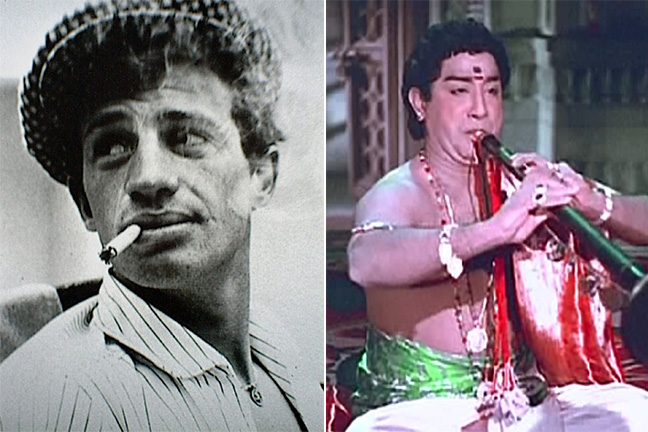
What we found most interesting was the commentary in French (you can turn on the English subtitles by clicking on the “Captions” button in the bottom bar on the YouTube video). The commentator, at one point, refers to Sivaji Ganesan as the “Indian Belmondo.” “Belmondo” here is a reference to Jean Paul Belmondo, the French actor who was a prominent face in the New Wave films that were made in France in the 1960s. He continues to be remembered for his portrayal of the character Michel Poiccard in Jean Luc Godard’s extremely influential film “Breathless” (“À bout de souffle” in French). “Breathless” was a path-breaking film that inspired many filmmakers through its brilliant use of the jump cut. So, while the comparison to Belmondo is flattering, it’s important to remember that Sivaji Ganesan had made his mark with “Parasakthi” in 1952, a good eight years before Belmondo broke out with “Breathless” (1960).

Jean Paul Belmondo in "Breathless" | Sivaji Ganesan in "Thillaanaa Mohanambal"

Jean Paul Belmondo in “Breathless”   |    Sivaji Ganesan in “Thillaanaa Mohanambal”

Do watch the clip and let us know about your thoughts on Louis Malle’s commentary and his take on Indian films. You can leave a comment or write to us at tcrc.india[at]gmail[dot]com.

Sir Richard Attenborough on working with Satyajit Ray in “Shatranj Ke Khilari”: Old DD Bangla interview

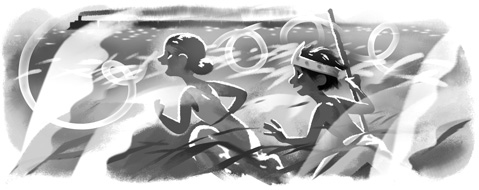
Today is master filmmaker Satyajit Ray’s 92nd birthday and Google’s paid a lovely tribute through a doodle based on his film “Pather Panchali.” For those who missed it, here’s what the doodle is all about:

Google doodle on the occasion of Satyajit Ray’s 92nd birthday (2nd May 2013).

We at TCRC also chanced upon a YouTube video of an old show on DD Bangla where Sir Richard Attenborough, director of “Gandhi,” talks about the experience of working with Ray on “Shatranj Ke Khilari.” The film, released in 1977, was based on Munshi Premchand’s short story of the same name and was narrated by  Amitabh Bachchan. The cast included actors such as Sanjeev Kumar, Saeed Jaffrey, Shabana Azmi, Farida Jalal, Amjad Khan, Richard Attenborough, Victor Banerjee, Farooq Shaikh and Tom Alter. Do look out for Sir Attenborough’s views on cinema as an art form and Ray’s soundbites!

“Elphinstone Elphinstone Everywhere”: The story of Elphinstone Theatre in Madras, the first with a balcony!

The Indian Express carried a PTI (Press Trust of India) story yesterday about tent cinemas returning to Delhi as a part of the ongoing “100 years of cinema” celebrations. We found a couple of paragraphs at the end of the story rather interesting (click here to read the entire piece):

In India, among the pioneers of tent cinema, the most important name is that of J F Madan, a Parsi businessman who started ‘Elphinstone Bioscope Company’ in early 20th century in Calcutta (now Kolkata) and would do tent shows in the Maidan there. He later started the cinema halls by the name of ‘Elphinstone Picture Palaces’.

His ‘Elphinstone’ was also one of the few Indian companies, among other European production houses, which filmed the historic 1911 Delhi Durbar attended by King George V and Queen Mary.

His legend has survived today in the form of various ‘Elphinstone’ theatres spread across India.”

Now, we were aware that a New Elphinstone Theatre was operational up till sometime in the 1970s, off Mount Road. So, we did some searching and it turns out that there was indeed an Elphinstone in Madras as well. Manish Raj, writing for the Times of India, mentions the cinema hall in his piece of theatres in Madras of the yore (click here to read his entire story):

New Elphinstone Theatre in 1916 was inaugurated by the governor general of Madras and it was one of the first theatres in India to raise funds for the World War I through its shows. It housed the most unusual indoor sport — a boxing ring where amateurs sparred. When the film bubble burst, it later became Elphinstone Soda fountain, which sold beverages.

Given that there was a New Elphinstone, we realised that an Old Elphinstone had to be a part of this history. Historian S Muthiah, in his lovely piece titled “Cinema at Round Tana”, fills the gaps:

A New Elphinstone meant there had to be an old Elphinstone – and there was one, rooted in almost the beginnings of cinema-screening in Madras. The Elphinstone was located across Round Tana from the New Elphinstone on the site of Misquith Building, just west of the old Hindu building at the junction of Ellis Road and Wallajah Road. (Wallace) Misquith & Co., established in 1842 built itself a magnificent brick-exposed Indo-Saracenic building to house on the ground floor its showroom for musical instruments and, on the first floor, music salons which could be rented by the hour for anyone wanting to play any instrument.In time, Misquith’s’ became Musee Musicals and moved further down Mount Road, but in its heyday it housed the Lyric, a hall of entertainment that a man named Cohen established on the first floor when he took over Misquith’s in 1907.

In 1913, the Lyric began screening films, calling itself the Empire Cinema, but a fire in March 1914 closed it down. Later that year, J F Madan of Calcutta, owner of India’s biggest cinema chain at the time, took over the Empire and renamed it with that of his flagship, the Elphinstone. In 1915, Madan bought the Misquith Building and made the Elphinstone a permanent cinema theatre, the biggest and the first with a balcony in Madras.

Given that Dadasaheb Phalke’s “Raja Harishchandra,” the first feature length Indian film was released at around the same time that Empire Cinema was started (1913), we at TCRC were thrilled to find the various strands of our cinematic history crisscrossing. Unfortunately, we weren’t able to find a single image or photographs of the Elphinstone Theatre and this only served to remind us of the importance of archiving  images of our cinemas’ golden past. Interested in helping this sort of archival effort? Volunteer at TCRC!

The story of Fatma Begum, India’s first woman film director

While pulling out playback singer Shamshad Begum’s version of Katiya Karoon, we at TCRC realised that she was one of the earliest female playback singers in the Hindi film industry. This set us off on a search for India’s first woman film director and led us to this interesting piece on Fatma Begum, written by Rohit Vats for IBN Live as a part of their “100 years of Indian cinema” series. Here’s an excerpt from that piece (click here to read the entire story):

Born in an Urdu speaking family, Fatma Begum was related to Nawab Sidi Ibrahim Muhammad Yakut Khan III. She was the mother of Zubeida, Sultana and Shehzadi, who were popular actors of the silent era. She started working in films in 1922 after getting trained in plays. Fatma worked with filmmakers like Ardeshir Irani and Nanubhai Desai before founding her own production company Fatma Films which was later rechristened as Victoria-Fatma Films. ‘Bulbul-E-Paristan’ that released in 1926, became the first Indian film to be directed by a female director. However, acting remained on her wish list and she continued to act till late 1930s.”

Ardeshir Irani, who Fatma worked with as an actor, incidentally is the father of Indian talkie films, having made both “Alam Ara” (in Hindi) and “Kalidas” (in Tamil, with songs in Telugu).

We also tried to find an image of Fatma Begum on the web. While we did come across few images, we couldn’t confirm the veracity of any of them. The Whistling Woods (a film school in Mumbai) blog, for instance,  features this picture:

Fatma Begum, India’s first woman film director.

Cineplot Enyclopedia, on the other hand, features this image:

Fatma Begum, India’s first woman film director.

Clearly different people, don’t you think? It is interesting (and worrisome) to note that the internet doesn’t  have a single undisputed image of the first woman director in one of the world’s largest film industries. On days like these, we at TCRC find renewed vigour in our attempt to archive cinema-related artifacts. Have you found other such examples with respect to information about the early days of cinema? Do share them with us by writing to tcrc.india[at]gmail[dot]com.

RARE: Original LP record of Sivaji Ganesan’s “Thiruvarutselvar” (Tamil, 1967)

"Thiruvarutselvar"  |  LP Record - Front  |  Tamil  |  1967

“Thiruvarutselvar” | LP Record – Front | Tamil | 1967

"Thiruvarutselvar"  |  LP Record - Back  |  Tamil  |  1967

“Thiruvarutselvar” | LP Record – Back | Tamil | 1967

In our archives here at TCRC, we have the original LP records of numerous Indian films, right from the 50s to the 80s. Today, we share with you the photos of the LP record of “Thiruvarutselvar”, a Tamil film starring Sivaji Ganesan, Savitri, Muthuraman, KR Vijaya and others. It was released in 1967 and was directed by AP Nagarajan, the veteran filmmaker whose other hits include “Thiruvilayadal,” “Saraswathi Sabatham,” and “Thillana Mohanambal.” The music for “Thiruvarutselvar” was scored by KV Mahadevan and the lyrics were written by Kannadasan. Even today, one remembers P Susheela’s mellifluous rendition of “Mannavan Vanthanadi,” one of the most popular songs of the album.

In an interview with Mohan V Raman for The Hindu in April 2012, CN Paramasivan, the son of director AP Nagarajan had said that the overwhelming response to the re-release of “Karnan” was encouraging him to look into the restoration of some of his father’s films (click here to read that story). We at TCRC hope to see that happen.

Also, it must be mentioned here that the same team, i.e., actor Sivaji Ganesan, director AP Nagarajan and music director KV Mahadevan, came together for “Kandan Karunai,” which won KV Mahadevan the National Award for Best Music Direction in 1967, the same year in which “Thiruvarutselvar” was released. This was the first time that a National Award was constituted for the category of Music Direction. Since then, the most number of National Awards for Best Music Direction have been won by Ilaiyaraja and AR Rahman, i.e., 4 each.

Understanding Devdas

The story of Devdas has got to be one of the most popular tales to have been embraced by Indian cinema. There have been a number of versions in a variety of languages. Some movie versions have remained largely faithful to Sarat Chandra Chattopadhyay’s original novella, while others have added their own twists and turns, reinterpreting the original story to suit the demands of the time period in which they were set.

Dilip Kumar & Shahrukh Khan as Devdas. Photo Courtesy: IBN Live.

This week, we at TCRC bring you a couple of pieces of academic writing on Devdas. The first is “The Devdas Phenomenon” by Corey K Creekmur, who is the head of Film Studies at the University of Iowa. He writes about the three versions of Devdas in Hindi cinema and also, discusses the original book on which these interpretations were based (click here to read his paper).

The second is “Devdas: India’s Emasculated Hero, Sado-masochism and Colonialism” by Poonam Arora, who is a professor of English at the University of Michigan – Dearborn. She writes about how the “Devdas narrative discursively construct a prototypical colonial male subjectivity.” (click here to read her paper).

And here’s a clip from PC Barua’s “Devdas”. This was released in 1935.

JC Daniel: Father of Malayalam Cinema

We at TCRC are always scouring the internet for interesting material on the origins of the regional cinemas of South India. And the internet never ceases to surprise us. Recently, we chanced upon CinemaofMalayalam.net, a website that had a separate page on JC Daniel, the man who wrote, directed and produced the first ever Malayalam feature film.

The movie, titled “Vigathakumaran,” was a silent film and was released in November 1928. In fact, the Kerala state government’s award for lifetime achievement in Malayalam cinema is called the JC Daniel Award, recognizing his efforts in starting up what is today one of India’s most interesting film industries. Interestingly, Daniel was a dentist who showed keen interest in martial arts. He is said to have been an expert at Kalarippayattu and is reported to have written a book about Indian martial arts in English before he ventured into cinema.

English: A short note on Vigathakumaran

A still from “Vigathakumaran,” the first ever Malayalam feature film (released in 1928). Photo Courtesy: Wikimedia Commons

Given below is a Malayalam documentary on the life of the director JC Daniel.

There has also been quite a bit of controversy over when “Vigathakumaran” was released. While many acknowledge it to be 1928 (including those such as noted Malayalam film journalist Chelangatt Gopalakrishnan and Yves Thoraval, author of “The Cinemas of India”), a photocopied version of a handbill announcing the release of “Vigathakumaran” in 1930 by producers Travancore National Pictures has been circulating on the internet of late, an artifact whose source is yet to be confirmed. Blogger CineMatters has written a detailed post about the 1928 v/s 1930 controversy here for the blog Old Malayalam Cinema. However, there is no dispute over the fact that “Vigathakumaran” by JC Daniel was the first ever Malayalam feature film.

TCRC has, in its archives, memorabilia from various Malayalam films that have been released over the years. Seeing this page on JC Daniel compelled us to revisit some of the old material and we’re working on the digitization of the same. So, do revisit the TCRC blog for updates.