Scenes from Star Wars of fantastical creatures and robots across new worlds, monsters destroying cities, aliens and much more have always amazed us at the movie theaters. Here is an interesting link that shows photographs of the making of these movies and reveals some of the magic!
Be it Fine Art, Literature, Theater or Chiema, the priority given to South Indian cinema and its participants is the tiniest fragment of the limelight. The following is an article that talks about the very issue of the marginalization of the South Indian cinema industry and the inability to market themselves to a nation wide audience.
T M Soundarajan has been the voice of many great legends like M G Ramachandran and Sivaji Ganesan. He passed away on 25th May 2013 at the age of 90 in Chennai.
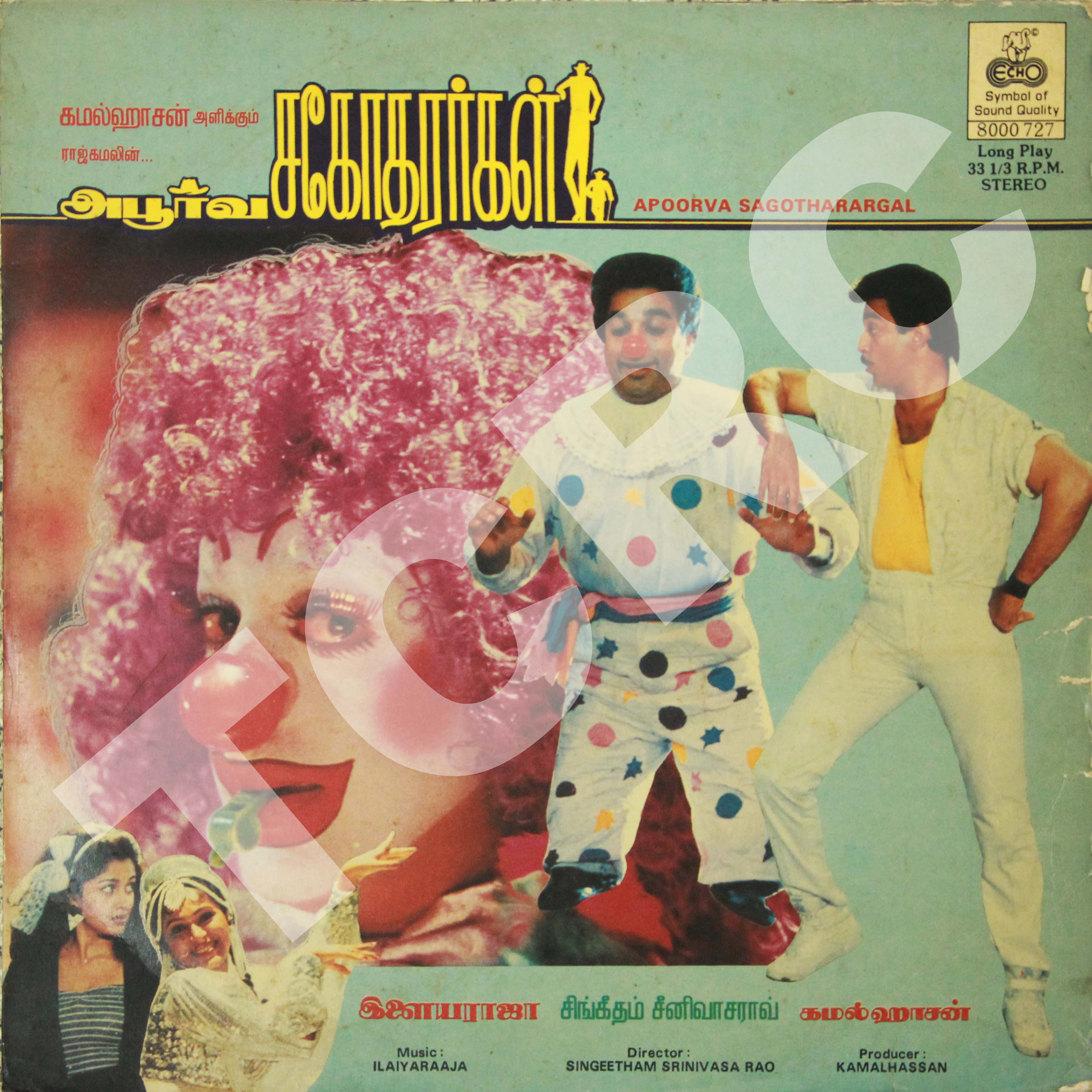
In May 1989, Kamal Hassan’s “Aboorva Sagodharargal,” which featured the actor in the roles of a police officer, a mechanic and a dwarf clown, was released amidst much fanfare. Directed by Singeetham Srinivasa Rao and produced by Kamal Hassan himself, the film’s cast included Gouthami, Srividya, Delhi Ganesh, Jaishankar, Nassar, Nagesh, Janakaraj and many others. The film was a blockbuster hit and is said to have completed a 200-day run at the box office, a record run in Tamil cinema then (the record was broken six years later by superstar Rajnikanth’s “Baasha”). The film’s screenplay was penned by Kamal Hassan and the dialogues were written by Crazy Mohan. “Aboorva Sagodharargal” was Crazy Mohan’s debut film as dialogue writer.
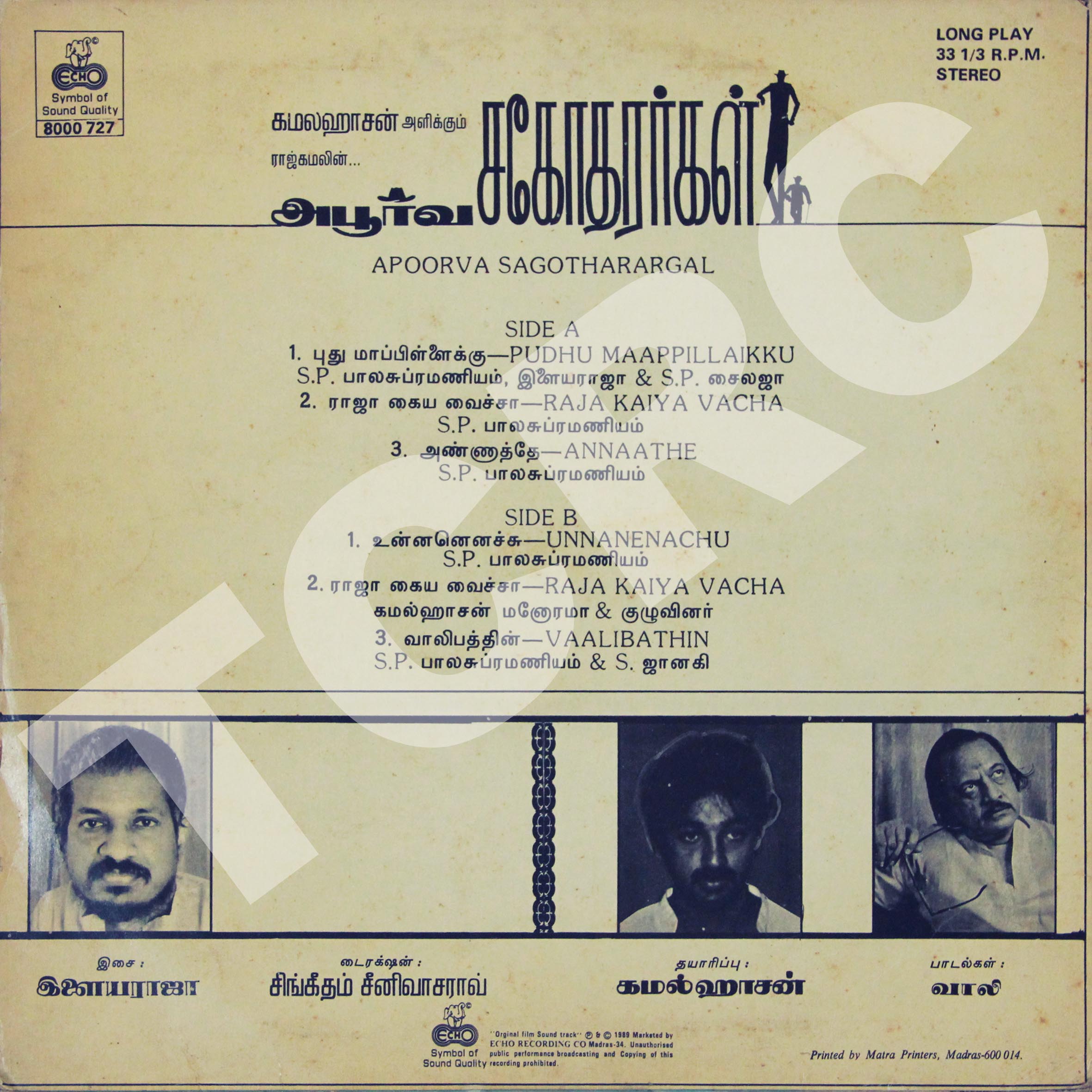
The musical score of “Aboorva Sagodharargal” was composed by Ilaiyaraaja and its songs went on to become cult classics, with tracks such as “Raaja Kaiya Vecha” receiving airplay on radio and TV channels even today. And today, we bring to you from the TCRC archives the cover of the original LP record of the film:
“Aboorva Sagodharargal” | LP record cover (front) | Tamil | 1989
“Aboorva Sagodharargal” | LP record cover (back) | Tamil | 1989
The film was dubbed into Telugu as “Vichithra Sodarulu” and into Hindi as “Appu Raja,” a year later. Both the dubbed versions enjoyed a successful run at the box office, with Kamal receiving unanimous praise for his portrayal of the dwarf clown Appu. In the movie, the episode where Appu falls in love with the daughter of the circus owner (the daughter played by Rupini and the father played by Mouli) is said to be a tribute to Charlie Chaplin’s “The Circus,” which was a silent film released in 1928. In “Aboorva Sagodharargal,” Appu goes through a Chaplinesque heartbreak in romance that is very similar to what transpires in “The Circus.”
The title “Aboorva Sagodharargal” itself is a hat tip to SS Vasan’s 1949-released feature film of the same name. That “Aboorva Sagodharargal” featured actors MK Radha and Bhanumathi in titular roles and was produced in Tamil, Telugu and Hindi simultaneously. Directed by Acharya and written by Kothamangalam Subbu, the old “Aboorva Sagodharargal” was an adaptation of the novella “The Corsican Brothers” by Alexander Dumas. The idea of brothers coming together to avenge the death of their father is the common thread running between both the old and the new “Aboorva Sagodharargal.”
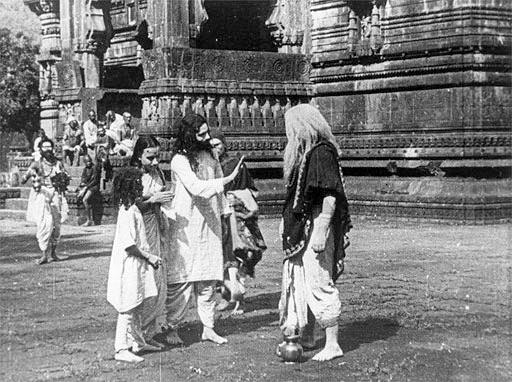
The ‘100 years of Indian cinema’ celebrations that are currently underway in various parts of India and also, the world, seem to be generating a lot of great content about the forerunners of Indian cinema. One such remarkable story is the Open magazine’s piece on Dadasaheb Phalke, in which Paresh Mokashi, the director of the award-winning Marathi film “Harishchandrachi Factory” based on the making of the first Indian film “Raja Harishchandra,” talks about the adventures of Phalke, the filmmaker, to Madhavankutty Pillai.
A still from “Raja Harishchandra” (1913). Photo Courtesy: Cineplot.com
Phalke’s struggles, in many ways, seem to epitomize the hardships that are faced by anyone who is involved in a pioneering attempt. Check out this nugget narrated by Mokashi:
Phalke needed money to start the film and, as usual, he had nothing. To impress financiers he thought of novel tricks. He put a seed in a pot and filmed it for a couple of seconds every day over a period of 30-40 days. He made a film of that seed growing into a plant and showed it to people to impress on them the power of the new medium. There was no other way he could make people understand. Films, cinema—these are modern words. They were not at his disposal. Indians were only theatre-goers then.”
And apparently, Phalke was also a master at film promotion, much before the term was even coined:
After the movie released, the response to it was lukewarm for the first two or three days. Phalke then started introducing novel marketing techniques. He came out with funny descriptions of the film, announcing in crowded market places that it is a mile long strip of 58,000 little pictures put together. He offered prizes to ticket buyers. The audience started coming in and the movie went on to make money. He not only recovered the film’s costs, but made profits after paying his creditors. With the money, he made two more films, back to back. In one-and-a-half years, he completed three films—Raja Harishchandra (1913), Mohini Bhasmasur (1913) and Satyavan Savitri (1914).”
Mokashi also mentions the contribution of Saraswati Phalke, Dadasaheb’s wife, who shared his enthusiasm for cinema:
Even today, every first time filmmaker is a Phalke. He goes through the same difficulties—a shortage of funds, and making others believe in you to bring them on board. There is also the struggle within you, a creative struggle—will I be able to pull it off? What fascinates me most about the entire story is his wife’s contribution. We don’t know much about Saraswati Phalke, but she was a key element throughout the venture. In fact, Phalke even made a film on the making of Raja Harishchandra. I suspect that it was his wife who shot it, because in one frame of the making we can see the cameraman shooting the film. Saraswati was the only other person in the unit who knew how to wield a camera.”
He also talks about the difficulties faced by Phalke in finding woman actors and also, the bizarre issues that came along with experimenting with a new medium like cinema:
When he couldn’t convince his wife and no other woman was available, Phalke went scouting in red light areas to get a prostitute for the role. Most refused because they considered acting less reputable than their profession. One sex worker agreed and accompanied him home but a regular client of hers came and took her away. Finally, he had to go with a waiter after spotting him in a tea shop.
He asked the men who were playing women in the movie to clean, wash, cook and do all the things that a woman did. It was method acting much before the term was coined. The movie was shot between six to eight months. He built sets first and completed those portions. He then went outdoors to Wangni, on the outskirts of Mumbai, where there is a dense jungle and a river flowing—scenery important for the story. The cast, who had gone before Phalke, was arrested after the police mistook the actors for dacoits due to their costumes.”
We at TCRC salute the pioneering spirit of Dadasaheb Phalke, the man who is often referred to as the father of Indian cinema.
Also, if you haven’t watched Paresh Mokashi’s “Harishchandrachi Factory” (2009) yet, here’s a link to the trailer:
The ‘100 years of Indian cinema’ celebrations that are happening across the country is something that we at TCRC wholly welcome, notwithstanding the fact that a vast majority of them seem to interpret it as ‘100 years of Hindi cinema.’ Thankfully, there are voices out there calling for balance and recognition of the other film industries in the country as well. And among such calls, we found Salil Tripathi’s piece for Mint most refreshing.
He starts off by speaking about the influence of our epics, the Mahabharata and the Ramayana, on our cinema:
Indian cinema has always been utterly reliant on the power of a narrative, and which narrative has greater richness than the Mahabharata? After all for Ved Vyas it is said, “Vyasochishtam jagat sarvam,” or whatever you find said in the universe, Vyas has said it before. It is that easy familiarity with the story—or what the critic Ashish Rajadhyaksha called the power of the epic, in his biography of Ritwik Ghatak—that makes Indian cinema so accessible to so many, in a country divided by everything—language, class, caste and faith—but united by the fascination for a good story.”
And then, he makes the argument that we’ve been parroting all along:
I love Hindi films too, but you don’t honour a national phenomenon by glorifying only one-fifth of it.”
Salil’s roundup of noteworthy cinema from the South of the Vindhyas was particularly interesting:
Moving south, there is so much to admire in Kannada cinema: two of U.R. Ananthamurthy works stand out. Girish Kasaravalli’s Ghatashraddha (1977) is about the outcasting of a pregnant widow. In Pattabhi Rama Reddy’s Samskara (1970), Girish Karnad’s Praneshacharya is a flawed progressive Brahmin who tries to do right, but succumbs to passion and is consumed by guilt. Karnad’s own Ondanondu Kaladalli (1978) was inspired by Akira Kurosawa’s samurai films.
Further south, in Adoor Gopalakrishnan’s Elippathayam (1981), the rat trap becomes the metaphor of the patriarchy of a closed society. His earlier film, Swayamvaram (1970), told the story of a young couple marrying against their parents’ wishes, moving to another town to start their life, and the inevitability of tragedy befalling them, and the determination of the young woman to cast her own lonely furrow. Another great film was G. Aravindan’s Oridathu (1986), which showed the transformation of a village’s life, and its people’s relationships, with the arrival of electricity. And the sheer melody of K. Vishwanath’s Telugu classic Shankarabharanam (1979).”
It’s not everyday that one finds a mention of G Aravindhan in a feature-style story about Indian cinema. Hailing from Kottayam in Kerala, Aravindhan was a cartoonist who later became a filmmaker. His debut film “Uttarayanam” was released in 1974 and won the National Award for the Best Feature Film on the 25th Anniversary of India’s Independence. Said to be be one of his finest films, “Uttarayanam” was set against the Independence movement and spoke of the opportunism and hypocrisy that existed during the time. The film is considered to have a played a key role in shaping the parallel cinema movement in Kerala.
Given below is Shaji Karun’s documentary on Aravindhan. Shaji is a National Award-winning filmmaker who used to be Aravindhan’s cinematographer. Shaji’s debut film “Piravi” (1988) won the Caméra d’Or – Mention d’honneur at the 1989 Cannes Film Festival and his 1994 film “Swaham” was the last competitive entry from India to be selected at the Cannes Film Festival.
The Forbes India magazine recently put out a list of the 25 greatest acting performances in Indian cinema, 8 of which are performances in Telugu, Kannada, Malayalam and Tamil films. Now, here at TCRC, we are always a little wary of lists such as these, fully aware that it’s incredibly hard to pick just 8 or 10 performances from over thousands of films made in the southern part of the country across the span of almost a century. But since this list is a part of their ‘100 Years of Indian Cinema’ set of features, we felt compelled to share this. Given below is an excerpt from the piece (click here to check out the entire list):
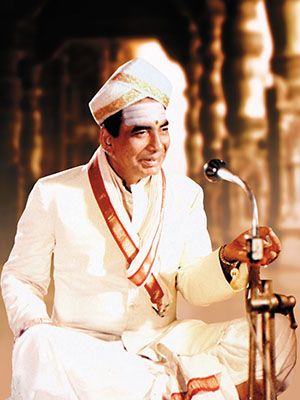
JV Somayajulu in Sankarabharanam (The Ornament of Shankara), 1980
JV Somayajulu, an IAS officer in his 50s, plays a Carnatic musician, misunderstood for supporting the daughter of a prostitute, ignored by a society where classical music is in decline, and is being overtaken by pop music. It was a surprise hit. It opened to empty seats, gathered speed and, today, enjoys a cult status. Somayajulu played his part with such dignity and intensity that you can’t listen to any of its hugely popular songs without imagining him performing them as his sadhana.
JV Somayajulu in “Sankarabharanam” (Telugu, 1980). Photo Courtesy: Forbes India.
“Sankarabharanam” turned out to be a cult film as far as Telugu cinema was concerned, after getting off to a slow start in the box office. Directed by K Vishwanath, the film is remembered for its music, scored by KV Mahadevan. The film was shot by cinematographer-turned-director Balu Mahendra, who later made “Moondram Pirai” with Kamal Hassan and Sridevi (“Sadma” in Hindi). The director of “Sankarabharanam,” K Vishwanath, went on to narrate yet another story revolving around an art form (classical dance) in “Saagara Sangamam” (“Salangai Oli” in Tamil). The film featured Kamal Hassan and Jayaprada in career-defining roles and like “Sankarabharanam,” it is said to be a musical success, with tunes composed by Ilaiyaraaja.
Today, we bring to you a clip from “L’inde Fantôme” (Phantom India), a documentary film made by Academy Award-winning French filmmaker Louis Malle. This is an excerpt from “Choses Vues A Madras,” which was the second episode of the documentary. Focusing on the Madras film industry in the late 1960s, the excerpt features footage shot on the sets of the 1968-released, classic Tamil film “Thillaanaa Mohanambal,” starring Sivaji Ganesan, Padmini, Balaiah, Manorama and others. Directed by AP Nagarajan and written by Kothamangalam Subbu, the film and its songs continue to be remembered even today.
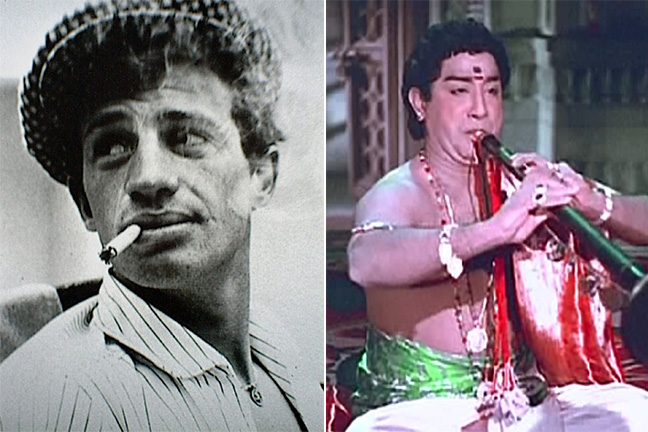
What we found most interesting was the commentary in French (you can turn on the English subtitles by clicking on the “Captions” button in the bottom bar on the YouTube video). The commentator, at one point, refers to Sivaji Ganesan as the “Indian Belmondo.” “Belmondo” here is a reference to Jean Paul Belmondo, the French actor who was a prominent face in the New Wave films that were made in France in the 1960s. He continues to be remembered for his portrayal of the character Michel Poiccard in Jean Luc Godard’s extremely influential film “Breathless” (“À bout de souffle” in French). “Breathless” was a path-breaking film that inspired many filmmakers through its brilliant use of the jump cut. So, while the comparison to Belmondo is flattering, it’s important to remember that Sivaji Ganesan had made his mark with “Parasakthi” in 1952, a good eight years before Belmondo broke out with “Breathless” (1960).
Jean Paul Belmondo in “Breathless” | Sivaji Ganesan in “Thillaanaa Mohanambal”
Do watch the clip and let us know about your thoughts on Louis Malle’s commentary and his take on Indian films. You can leave a comment or write to us at tcrc.india[at]gmail[dot]com.
We at TCRC are always looking out for interesting trivia about yesteryear film personalities. Also, given that our search analytics told us that people were looking into the TCRC blog for information on one of Tamil cinema’s earliest superstars, actor-singer M K Thyagaraja Bhagavathar, we thought of putting together a separate post about him. We started looking for information about his 1934-released debut film “Pavalakodi.” But it was one of the producers of “Pavalakodi”, one Mr. Lena Chettiar, who ended up piquing our curiosity.
“Prabhavathi” (Tamil, 1942) was produced under the Krishna Pictures banner promoted by Lena Chettiar. Photo Courtesy: The Hindu.
Writing about the film “Prabhavathi” (Tamil, 1942) in The Hindu’s Blast From The Past column, Randor Guy profiles Lena Chettiar (click here to read the post about “Prabhavathi”):
S. M. Letchumanan Chettiar, popularly known as Lena Chettiar, was a powerful figure in the world of Tamil Cinema. A native of Chettinad, he was a ‘drama contractor’ in his early days, staging plays in various southern parts of the state by hiring freelancing actors and selling tickets for their plays. He also dealt in used cars and was the first man in this part of the world to print and circulate handbills about used cars in Tamil. Most of the Naattukottai Chettiars were wealthy, but did not know English. They found these handbills a novelty and encouraged Lena Chettiar.”
Randor Guy also reports that it was Lena Chettiar who convinced M K Thyagaraja Bhagavathar to not venture into production himself and stepped in to produce it for him:
M. K. Thyagaraja Bhagavathar’s (a top-ranking freelancing stage actor then) play with another stage actress S. D. Subbulakshmi, ‘Pavalakodi’, was a raving hit not only in the Tamil-speaking areas of South India but also in Ceylon. Bhagavathar was seriously planning to enter movies with Pavalakodi and Lena advised him against venturing into production on his own and convinced Bhagavathar to team up with him. With his rich pals, Lena produced Pavalakodi in 1934, which marked Bhagavathar’s film debut and proved to be a major hit.”
Lena Chettiar produced numerous films under various labels and eventually, started promoting the ‘Krishna Pictures’ banner in the early part of the 1940s under which he produced films in Tamil and Telugu for nearly 15 years. The last film that he produced, before the founding of Krishna Pictures, was “Krishnan Thoothu,” which was the Tamil debut of Telugu film star Kannamba. In his post about “Krishnan Thoothu,” Randor Guy mentions Lena again:
He wielded enormous influence beyond the confines of the movie business in official and political circles. Soon after this film, he promoted his own unit, Krishna Pictures, in T. Nagar. His office on Thanikachalam Chetti Road (named after the noted Justice Party leader O.T. Chetti) was indeed a landmark of that area with its Krishna temple besides the building put up by Lena.”
Producers seldom get mentioned in serious writing about cinema. But in the early days of cinema in India, we at TCRC have noticed that often it was the producers who moved mountains to fuel innovation and creativity. Lena Chettiar seems to be one such gentleman and we at TCRC are glad to bring back to public memory, stories of such film entrepreneurs.
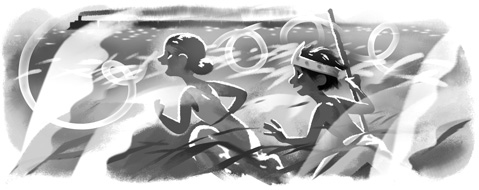
Today is master filmmaker Satyajit Ray’s 92nd birthday and Google’s paid a lovely tribute through a doodle based on his film “Pather Panchali.” For those who missed it, here’s what the doodle is all about:
Google doodle on the occasion of Satyajit Ray’s 92nd birthday (2nd May 2013).
We at TCRC also chanced upon a YouTube video of an old show on DD Bangla where Sir Richard Attenborough, director of “Gandhi,” talks about the experience of working with Ray on “Shatranj Ke Khilari.” The film, released in 1977, was based on Munshi Premchand’s short story of the same name and was narrated by Amitabh Bachchan. The cast included actors such as Sanjeev Kumar, Saeed Jaffrey, Shabana Azmi, Farida Jalal, Amjad Khan, Richard Attenborough, Victor Banerjee, Farooq Shaikh and Tom Alter. Do look out for Sir Attenborough’s views on cinema as an art form and Ray’s soundbites!



 The Cinema Resource Centre (TCRC)