Pattinapravesam : From Stage to Celluloid

By Karthik Bhatt

In this article of From Stage to Celluloid we look at the drama Patinapravesam which was later made into a film by K. Balachander.

The 1960s ushered in a new dawn on both Tamil stage and celluloid, with social themes gaining prominence. The 1970s and the 1980s were truly the heydays of this genre. MR Viswanathan, or Visu as he was popularly known was one of the most successful writer-directors of this era. His themes predominantly revolved around problems faced by the middle class families and most of them were commercial successes. Some of them are frequently re-aired on television channels to this day. His foray into cinema was through Tamil theatre and many of his creations on stage were made into films.

Visu’s first play in the official stage circuit was “Deviyar Iruvar”, written for Vani Kala Mandir in 1972. It was directed by AR Srinivasan (ARS) and had actress Sachu playing a key role. Visu was also associated as an actor with YG Parthasarathy’s UAA. Much later, he started his own troupe, Viswasanthi.

Kathadi Ramamurthy, who began his career on stage at the beginning of the social era remains one of Tamil stage’s most recognisable faces. Making his debut as one of the founding members of the legendary Viveka Fine Arts, he launched his own troupe, Stage Creations in 1965 with Shivaji Chaturvedi, TD Sundararajan and Bobby Raghunathan. Visu wrote four plays for Stage Creations and remarkably, all of them were remade as movies. This piece is about the most popular amongst them.

Visu’s first play for Stage Creations was Dowry Kalyana Vaibhogame (Dowry Kalyanam on celluloid), which as the name suggests dwelt upon the social evil of dowry. “The play was first written for V Gopalakrishnan, who did not take it up for some reason. Visu then narrated the script to me. I agreed to stage it, provided he directed the same”, says Kathadi Ramamurthy. It marked Visu’s debut as a director.

Dowry Kalyana Vaibhogame was followed by Pattinapravesam.  The play revolved around a family comprising five siblings (four brothers and a sister) and their aged mother who migrate to Madras from their village in search of a better living and their travails in the city. With their fortunes wildly fluctuating and problems hounding them, they finally decide to return to the village. It is interesting to note that the plot of the play bore a resemblance to Conquerors of the Golden City, an Italian movie.

The play was a remarkable success. “I remember K Balachander watched the play three or four times, each time bringing along a celluloid star. The biggest compliment I cherish was that he said that it was remarkable that the same level of performance was sustained every time he saw the play, which would have been possible only it was a movie”, says Kathadi Ramamurthy. The movie was directedby K.Balachander , produced by R Venkataraman for Premalaya Films and was released in 1976. Notable actors who played roles in the movie were Sarath Babu, Jai Ganesh and Sivachandran. “Three of us from the play took up roles in the movie”, continues Kathadi Ramamurthy.

Today the movie is best remembered for being the celluloid debut of one amongst the three, Delhi Ganesh, who reprised the role of the eldest brother from the play and the melodious “Vaa nilaa nilaa alla un vaalibam nilaa” set to tune by MS Viswanathan. The popular magazine Ananda Vikatan gave a rating of 52/100 for the movie, a more than average score given its reputation for being tough reviewers and a score of 60/100 to Delhi Ganesh (the highest amongst all actors).

After a hiatus of more than three decades, Visu made a comeback to Tamil stage with Konjam Yosinga Boss in 2014.

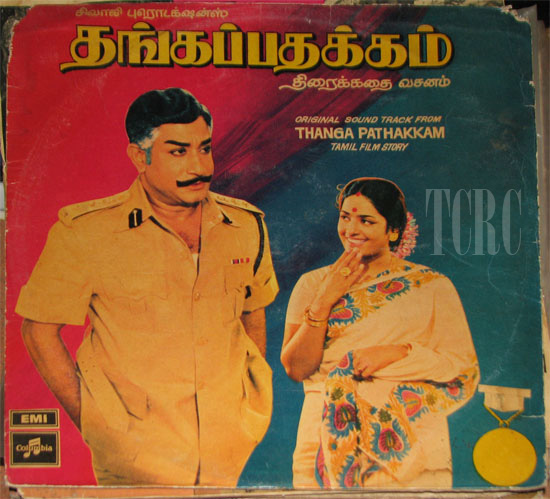
Below is the cover image of the song book of the film Pattinapravesam from our archives.

Pattina Pravesam

Mourning the loss of “Film News” Anandan

We at The Cinema Resource Centre mourn the loss of legendary archivist of Tamil Cinema “Film News” Anandan.

His journey in cinema started as a Photo film journalist and later became the first Public Relation Officer for Tamil Cinema.

A walking encyclopedia of Tamil cinema, Anandan’s recollection of  data about films releases, cast and crew was unmatched even until his final days.

In 1991, “Film news ” Anandan was conferred with the title Kalaimamani, the highest honor from the Tamil Nadu Government. He also received the ‘Honorary director’ title from The Cine Film Directors Association in 1989.
Tamil Cinema and Tamil Cinema History will greatly miss Mr. Anandan.
To know about him read here.

Thaneer Thaneer – From Stage to Celluloid

By Karthik Bhatt

Komal Swaminathan was one of Tamil stage’s most powerful contemporary playwrights. Born in 1935, he came to Madras in 1957 and joined the Seva Stage Kalvi Nilayam, the drama school that had been established by S.V.Sahasranamam. It was here that he learnt the various aspects of drama. He had a particular interest in writing scripts, having already written a few skits during his intermediate course at the Madura College.

Having completed the drama course Swaminathan joined Seva Stage as an apprentice to S.V.Sahasranamam, learning the production aspects of staging plays. He wrote his first play, “Puthiya Paathai” in 1960, which was staged by the Gujarati Young Men Association. Thus began a journey that saw the scaling of many heights in the course of the next three decades.

Swaminathan forayed into movies in 1963. He worked as an assistant and script writer to noted director K.S.Gopalakrishnan for the next seven years. This period saw him being associated with successful movies such as Karpagam, Pesum Deivam and Kai Kodutha Deivam. He started Stage Friends in 1971, a troupe primarily comprising of members from his mentor S.V.Sahasranamam’s Seva Stage. The troupe’s first play was Sannadhi Theru, which dealt with the stigma attached to lady artistes and the neglect drama troupes faced. The Kalki magazine review of the play termed it a first rate production, with special mention to Surya Prabha, the actress who played the lead role. The success of Sannadhi Theru was followed by several other productions such as Nawab Naarkaali (which was also later made into a movie), Yuddha Kandam and Chekku Maadugal. His best known and most celebrated play however is the subject of this piece, Thaneer Thaneer.

Thaneer Thaneer dealt with a topic that remains very contemporary, that of water scarcity. The story was set in a drought hit village which suffers as much from official apathy as it does from the failure of rains. With powerful dialogues which were well aimed barbs at the establishment, it was inevitable that it would raise eyebrows at some level. Sure enough, the hurdle came in the form of getting the clearance from the Police before staging the play.

The Madras Dramatic Performances Act, 1954 required that the Police Commissioner had to approve a script before it could be staged. This law had been brought about as a means of censorship to ensure that the popularity of the medium was not misused to propagate ideas that had the potential to create law and order problems. It was under this law that objections were being raised to Thaneer Thaneer. That the play apart from highlighting official apathy was also viewed as being sympathetic to an ideological movement, which probably raised a red flag leading to the withholding of permission. Hectic parleying ensued, with Cho Ramaswamy coming out in support of Komal Swaminathan. The permission came through about an hour before the inauguration on the 10th of October 1980 at the Mylapore Fine Arts Club auditorium.

The play was a stupendous success. The legendary director K.Balachander who watched the play was immediately taken in by the idea and wanted to make it into a movie. Komal Swaminathan agreed, with a request that the stage artistes be used in the film too. Balachander acceded to the request and artistes such as Raj Madan, Vaadhyar Raman acted in the movie too. It was produced by Kalakendra Movies. Certain changes were made to suit the commercial medium. Saritha, Rajesh and Radha Ravi played important roles in the movie, which was both a commercial success and a critically acclaimed one. K.Balachander won the award for the best screenplay and the movie won the Best Tamil Feature Film award at the National Film Awards for 1981.

More recently in 2012, the play was staged in English as Water by the Madras Players. Thaneer Thaneer was revived in 2013 through Stage Friends which made a comeback to stage thanks to the efforts of Komal Swaminathan’s daughter Ms.Lalitha Dharini.

(This author gratefully acknowledges the inputs given by Ms.Lalitha Dharini for this piece).


Thanga Padhakkam : From stage to celluloid

By Karthik Bhatt

Like all top artistes of his era, Sivaji Ganesan, inarguably the finest actor Tamil cinema has seen, came from a stage background. Bitten by the acting bug at an early age, Sivaji Ganesan joined Yadartham Ponnuswamy Pillai’s Madurai Sri Bala Gana Sabha, a well known Boys Company of the times. It marked the beginning of a long and cherished association with Tamil theatre, which he successfully managed to sustain even after he became a top star. That he continued to remain passionate about stage is illustrated by the fact that even at the height of his career, he continued to act in stage plays, with film shootings many a time scheduled to accommodate his stage commitments.

Starting off with the Streepart (Female role) at the Sri Bala Gana Sabha, Sivaji Ganesan’s repertoire expanded to a wide range of roles, all of which stood him in good stead when he made his foray into films. In his autobiography “Enathu Suyasarithai”, he poignantly recalls the struggles associated with life in a Boys Company, where they would often be confronted by poverty and other tough circumstances.

Parasakthi (1952) propelled him to stardom, after which there was no looking back for him as a film star. His passion for stage was however undiminished and he performed for troupes such as S.V.Sahasranamam’s Seva Stage. He started Sivaji Nataka Mandram in the mid-1950s to continue his passion for stage and also to provide opportunities to many actors who were trying to make it big in films and were languishing for roles. Managing the troupe was S.A.Kannan, a stage actor who was part of the Sakthi Nadaga Sabha that had just then wound up. Sivaji Nataka Manram over the course of the next couple of decades went on to produce several hits on stage which would also replicate the success on celluloid when they were remade. Famous plays included Veerapandiya Kattabomman, Vietnam Veedu, Needhiyin Nizhal, Pagal Nila, Kaalam Kanda Kavignan and Thanga Padhakkam, the subject of this piece. In his autobiography, Sivaji Ganesan says that the play, written by J.Mahendran (later of Mullum Malarum fame) was originally being staged by Senthamarai. He watched the play at the Raja Annamalai Mandram and highly impressed by it, asked Senthamarai for the rights to stage it under the Sivaji Nataka Mandram banner and also make it into a movie. Senthamarai agreed and Sivaji Nataka Mandram inaugurated the play in 1972.

The play, which revolved around an upright police officer, Superintendent of Police (S.P) Chowdhry was directed by S.A.Kannan and had Sivaji Ganesan playing the main role. Others in the cast were Sivakami (who played his wife, the role played by K.R.Vijaya in the film) and Rajapandian, who donned the role of his son Jagannathan (Srikanth playing the role in the film). The Kalki magazine review of the play makes special mention of a sequence where Sivaji Ganesan sings and dances merrily in the birthday party of his son, hailing it as a novel attempt. Reviewing Sivaji Ganesan’s performance, it says that calling his acting a majestic portrayal would be akin to saying sugar is sweet!

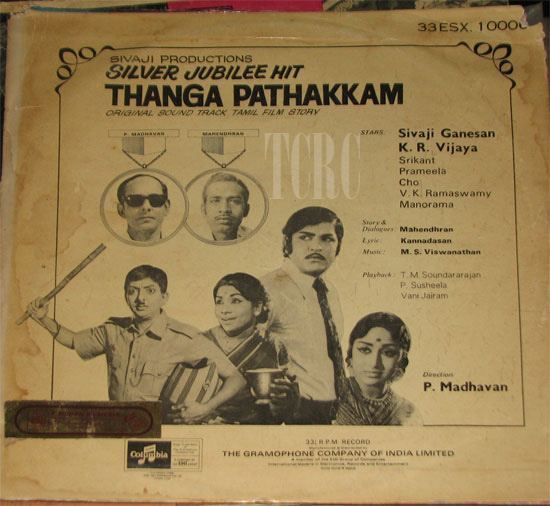
The play was made into a movie in 1974. P.Madhavan, who directed many hits (including some with Sivaji Ganesan) directed this movie, which was produced by Sivaji Ganesan’s daughter Shanti Narayanswamy for Sivaji Productions. The movie was a great success. The characterisation of the Superintendent of Police became a sort of a benchmark, with many a later movie referring to Chowdhry when mentioning a honest and upright officer! Below are the images of the LP from this film pulled out from our archive.

Thangapadakkam-1 WATERMARK Thangapadakkam-1A WATERMARK

Policekaran Magal: From stage to celluloid

By Karthik Bhatt

On 5th April 2013 TCRC shared its first post. It was the lobby card for the film Policekaran Magal. You can revisit the post here

Today as part of our ‘From Stage to Celluloid’ series we discuss more on this landmark film.

S.V.Sahasranamam was one of Tamil cinema’s most well-known character actors. Along with the likes of S.V.Ranga Rao and S.V.Subbiah, he was part of a select group of actors who were a constant presence in films between the 1950s and 1970s in the roles of a father, grandfather or elder brother.

Born in 1913, Sahasranamam joined T.K.Shanmugam’s Balashanmukhananda Sabha at an early age, giving up schooling to become an actor. His association with the troupe was a long one, lasting for more than two decades. It was an association that got him his first film opportunity, when a play of theirs, Menaka was made as a film in 1935. It was also in this troupe that he forged a lasting friendship with the legendary N.S.Krishnan.

Sahasranamam quit the Balashanmukhananda Sabha in 1936 on account of a misunderstanding with the managers. After stints as a manager with a couple of film houses, he joined N.S.Krishnan, by then a star, as a manager in his production house Ashoka Films. Film opportunities kept coming his way and he acted in a number of films through the 1940s. His passion for stage however remained undiminished. His dream of establishing his own troupe bore fruit in 1953, when he started Seva Stage.

Starting with Kangal, an adaptation of Rabindranath Tagore’s short story Vision, Seva Stage made a name for itself with its social themes and brilliant execution of the technical aspects. It was also to Sahasranamam’s credit that he managed to get noted writers such as T.Janakiraman, Ku.Alagiriswami and B.S.Ramiah to script successful and critically acclaimed plays such as Naalu Veli Nilam, President Panchatcharam, Vadivelu Vaathyaar and Policekaran Magal, which were later made into movies.

B.S.Ramiah, born in 1905 was an acclaimed journalist and writer best known in the literary circles for his association with Manikkodi, the magazine started by “Stalin” Srinivasan in 1933. He had made a name for himself as a short story writer. Sahasranamam approached Ramiah with a request to write a play for Seva Stage, thus marking the beginning of an association that would go on to produce great hits on stage.

Policekaran Magal was Ramiah’s fifth script for Seva Stage, after President Panchatcharam, Malliam Mangalam, Therotti Magan and the critically acclaimed Paanchali Sabatham . Revolving around a policeman and his family (most prominently the daughter), the play was a great success. Like other Seva Stage plays, this too did not lack in star value, with noted actors Muthuraman and V.Gopalakrishnan and actress S.N.Lakshmi playing important roles in the play. Muthuraman went on to play a role in the movie too, which was directed by C.V.Sridhar and came out in 1962. Vijayakumari played the role of the daughter in the movie, which was played on stage by Shanthini, a Seva Stage regular. J.P.Chandrababu and Manorama played the role of flower vendors, a crucial part of the plot. Sahasranamam reprised his stage role of the policeman on screen and even today, this movie is often spoken about as one of those movies which is impossible to remake thanks to the powerful portrayal by Sahasranamam.

The movie is also remembered today for its immortal melodies, most particularly Pon enben siru poo enben and Nilavukku en mel ennadi kovam.

Here are pictures of the film’s LP from our collection. The LP also carried the songs of another popular film of the time’ Sumai Thangi’.

policekaranmagal_sumaithangi Policekaranmagal_sumaithangi_back


Sabapathy: From stage to celluloid

By Karthik Bhatt

The next in our series from ‘stage to celluloid’ we discuss one of Tamil cinema’s earliest full length comedies, Sabapathy.

The film, which was released in 1941 was produced by A.V.Meiyappa Chettiar and directed by A.T.Krishnaswamy. The plot was based on Pammal Sambandha Mudaliar’s play by the same name.

In his autobiography Naadaga Medai Ninaivugal, Sambandha Mudaliar says that Sabapathy was the first farce that he wrote. The story, which revolved around a young, rich (and not so intelligent) zamindar and his foolish servant (both named Sabapathy) was first written in 1906. Sambandha Mudaliar writes that the inspiration for the servant was derived from observing the man Fridays of a few friends. In particular, he credits Narasimhan, the personal assistant of his close friend V.V.Srinivasa Iyengar, the noted lawyer for having served as the base to building the character! He also acknowledges the influence of Handy Andy, the famous book written by Samuel Lover where the character could do nothing right.

The story was written in eight parts, each of which was capable of being staged as a separate stage play. Pammal Sambandha Mudaliar himself played the role of the zamindar, while many of his troupe members donned the role of the servant. So popular was the play that it continued to be staged even after the movie had released and had become a huge success. Pammal Sambandha Mudaliar writes of an interesting incident in 1944, where he, aged 71 years at that time had to appear in the role of zamindar for a scene during a staging to raise funds for the Thondaimandala Thuluva Vellalar School on Mint Street.

The movie had T.R.Ramachandran and Kali N.Ratnam (both of them from stage backgrounds) playing the roles of the zamindar and the servant respectively. Having zeroed in on the choice of T.R.Ramachandran to play the role of zamindar, A.V.Meiyappa Chettiar brought him to Sambandha Mudaliar for his approval, which was given after a brief test of his capability to do justice to the role. Kali N.Ratnam was a well-known actor and vaadhyar who served with the Madurai Original Boys Company, earning the prefix of Kali thanks to his portrayal of the Goddess in a play about Kannagi. Amongst those who trained under him were P.U.Chinnappa and M.G.Ramachandran. The female lead was played by R.Padma (a Lux soap model!) while C.T.Rajakantham was paired opposite Kali N.Ratnam. The Kali N.Ratnam-Rajakantham partnership was a successful one and featured in several movies. C.T.Rajakantham was alive until the 1990s and even acted in the popular Marmadesam (Vidaadha Karuppu) serial.

The movie is a delight to watch even a good seven decades after its release thanks to the simple comedy and great characterisation of the actors.

Randor Guy’s article on the movie can be accessed here

Here is a popular 9 minute segment from the film.

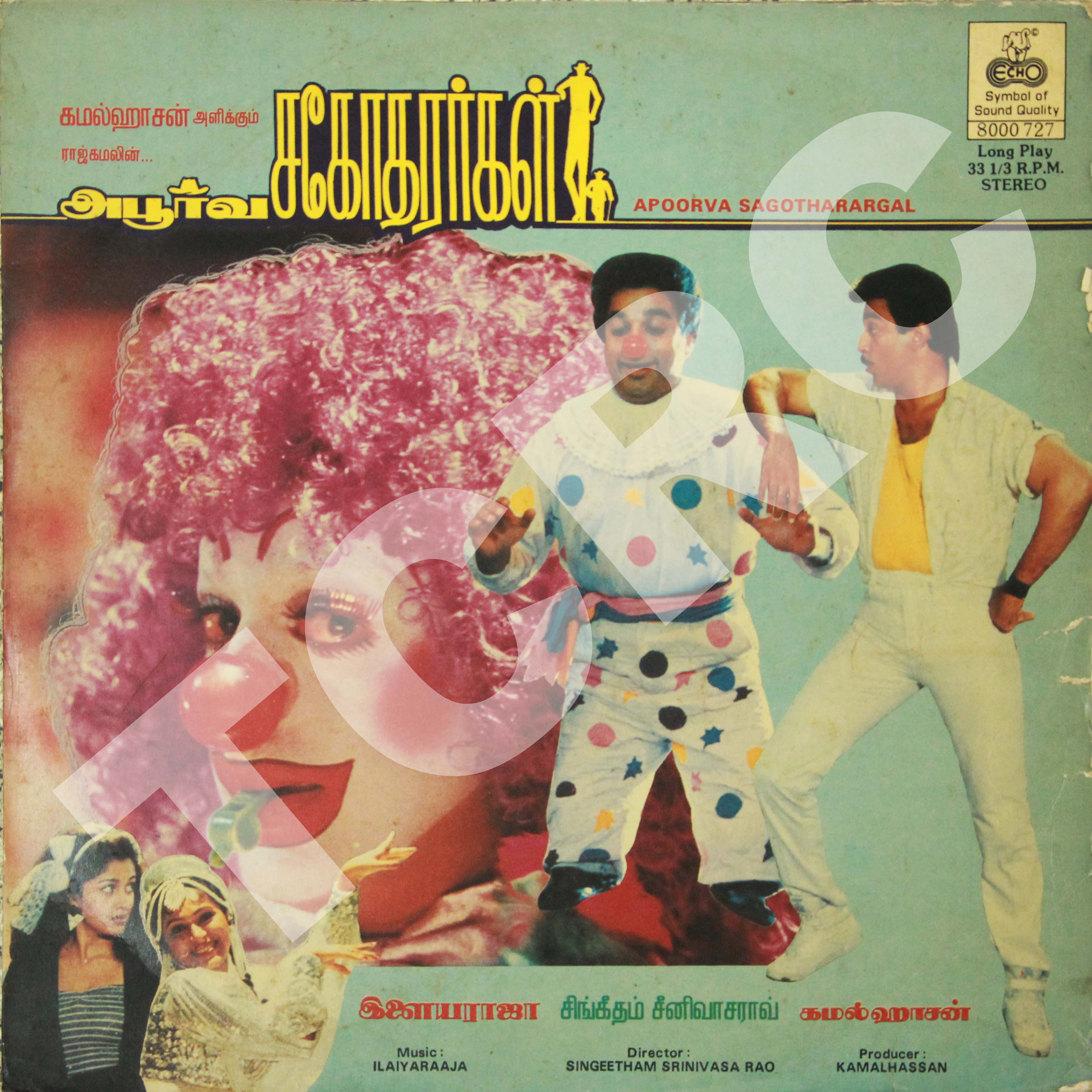
RARE: Original LP cover of Kamal Hassan’s “Aboorva Sagodharargal” (Tamil, 1989)

In May 1989, Kamal Hassan’s “Aboorva Sagodharargal,” which featured the actor in the roles of a police officer, a mechanic and a dwarf clown, was released amidst much fanfare. Directed by Singeetham Srinivasa Rao and produced by Kamal Hassan himself, the film’s cast included Gouthami, Srividya, Delhi Ganesh, Jaishankar, Nassar, Nagesh, Janakaraj and many others. The film was a blockbuster hit and is said to have completed a 200-day run at the box office, a record run in Tamil cinema then (the record was broken six years later by superstar Rajnikanth’s “Baasha”). The film’s screenplay was penned by Kamal Hassan and the dialogues were written by Crazy Mohan. “Aboorva Sagodharargal” was Crazy Mohan’s debut film as dialogue writer.

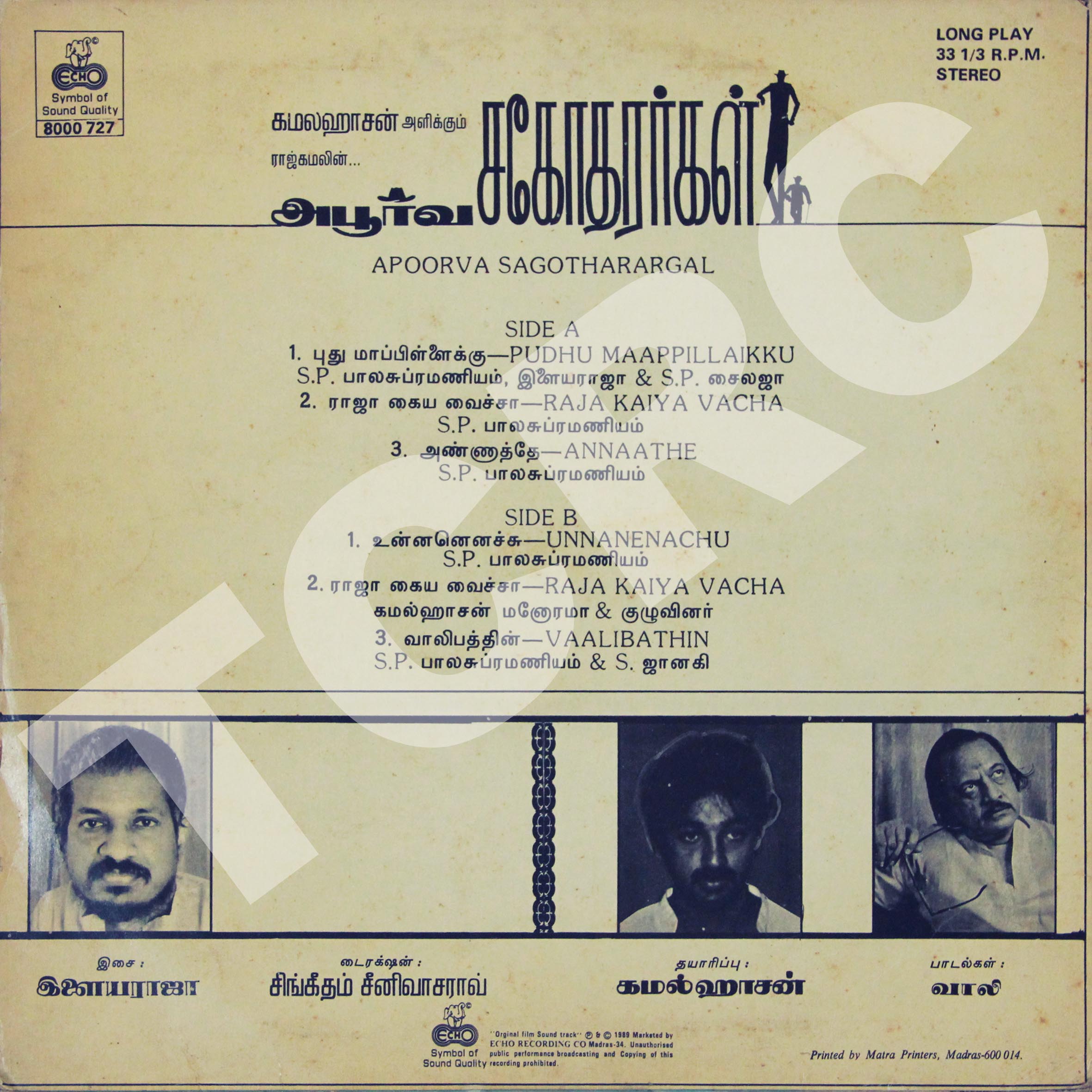
The musical score of “Aboorva Sagodharargal” was composed by Ilaiyaraaja and its songs went on to become cult classics, with tracks such as “Raaja Kaiya Vecha” receiving airplay on radio and TV channels even today. And today, we bring to you from the TCRC archives the cover of the original LP record of the film:

"Aboorva Sagodharargal" | LP record cover (front) | Tamil | 1989

“Aboorva Sagodharargal” | LP record cover (front) | Tamil | 1989

"Aboorva Sagodharargal" | LP record cover (back) | Tamil | 1989

“Aboorva Sagodharargal” | LP record cover (back) | Tamil | 1989

The film was dubbed into Telugu as “Vichithra Sodarulu” and into Hindi as “Appu Raja,” a year later. Both the dubbed versions enjoyed a successful run at the box office, with Kamal receiving unanimous praise for his portrayal of the dwarf clown Appu. In the movie, the episode where Appu falls in love with the daughter of the circus owner (the daughter played by Rupini and the father played by Mouli) is said to be a tribute to Charlie Chaplin’s “The Circus,” which was a silent film released in 1928. In “Aboorva Sagodharargal,” Appu goes through a Chaplinesque heartbreak in romance that is very similar to what transpires in “The Circus.”

The title “Aboorva Sagodharargal” itself is a hat tip to SS Vasan’s 1949-released feature film of the same name. That “Aboorva Sagodharargal” featured actors MK Radha and Bhanumathi in titular roles and was produced in Tamil, Telugu and Hindi simultaneously. Directed by Acharya and written by Kothamangalam Subbu, the old “Aboorva Sagodharargal” was an adaptation of the novella “The Corsican Brothers” by Alexander Dumas. The idea of brothers coming together to avenge the death of their father is the common thread running between both the old and the new “Aboorva Sagodharargal.”

The Extraordinary Adventures of Dadasaheb Phalke: The “Harishchandra” Story!

The ‘100 years of Indian cinema’ celebrations that are currently underway in various parts of India and also, the world, seem to be generating a lot of great content about the forerunners of Indian cinema. One such remarkable story is the Open magazine’s piece on Dadasaheb Phalke, in which Paresh Mokashi, the director of the award-winning Marathi film “Harishchandrachi Factory” based on the making of the first Indian film “Raja Harishchandra,” talks about the adventures of Phalke, the filmmaker, to Madhavankutty Pillai.

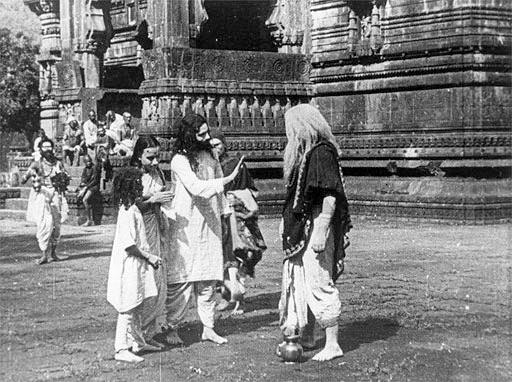
A still from "Raja Harishchandra" (1913). Photo Courtesy: Cineplot.com

A still from “Raja Harishchandra” (1913). Photo Courtesy: Cineplot.com

Phalke’s struggles, in many ways, seem to epitomize the hardships that are faced by anyone who is involved in a pioneering attempt. Check out this nugget narrated by Mokashi:

Phalke needed money to start the film and, as usual, he had nothing. To impress financiers he thought of novel tricks. He put a seed in a pot and filmed it for a couple of seconds every day over a period of 30-40 days. He made a film of that seed growing into a plant and showed it to people to impress on them the power of the new medium. There was no other way he could make people understand. Films, cinema—these are modern words. They were not at his disposal. Indians were only theatre-goers then.”

And apparently, Phalke was also a master at film promotion, much before the term was even coined:

After the movie released, the response to it was lukewarm for the first two or three days. Phalke then started introducing novel marketing techniques. He came out with funny descriptions of the film, announcing in crowded market places that it is a mile long strip of 58,000 little pictures put together. He offered prizes to ticket buyers. The audience started coming in and the movie went on to make money. He not only recovered the film’s costs, but made profits after paying his creditors. With the money, he made two more films, back to back. In one-and-a-half years, he completed three films—Raja Harishchandra (1913), Mohini Bhasmasur (1913) and Satyavan Savitri (1914).”

Mokashi also mentions the contribution of Saraswati Phalke, Dadasaheb’s wife, who shared his enthusiasm for cinema:

Even today, every first time filmmaker is a Phalke. He goes through the same difficulties—a shortage of funds, and making others believe in you to bring them on board. There is also the struggle within you, a creative struggle—will I be able to pull it off? What fascinates me most about the entire story is his wife’s contribution. We don’t know much about Saraswati Phalke, but she was a key element throughout the venture. In fact, Phalke even made a film on the making of Raja Harishchandra. I suspect that it was his wife who shot it, because in one frame of the making we can see the cameraman shooting the film. Saraswati was the only other person in the unit who knew how to wield a camera.”

He also talks about the difficulties faced by Phalke in finding woman actors and also, the bizarre issues that came along with experimenting with a new medium like cinema:

When he couldn’t convince his wife and no other woman was available, Phalke went scouting in red light areas to get a prostitute for the role. Most refused because they considered acting less reputable than their profession. One sex worker agreed and accompanied him home but a regular client of hers came and took her away. Finally, he had to go with a waiter after spotting him in a tea shop.

He asked the men who were playing women in the movie to clean, wash, cook and do all the things that a woman did. It was method acting much before the term was coined. The movie was shot between six to eight months. He built sets first and completed those portions. He then went outdoors to Wangni, on the outskirts of Mumbai, where there is a dense jungle and a river flowing—scenery important for the story. The cast, who had gone before Phalke, was arrested after the police mistook the actors for dacoits due to their costumes.”

We at TCRC salute the pioneering spirit of Dadasaheb Phalke, the man who is often referred to as the father of Indian cinema.

Also, if you haven’t watched Paresh Mokashi’s “Harishchandrachi Factory” (2009) yet, here’s a link to the trailer:

The Madras Film Industry in the 1960s: On the sets of “Thillaanaa Mohanambal” in a French documentary!

Today, we bring to you a clip from “L’inde Fantôme” (Phantom India), a documentary film made by Academy Award-winning French filmmaker Louis Malle. This is an excerpt from “Choses Vues A Madras,” which was the second episode of the documentary. Focusing on the Madras film industry in the late 1960s, the excerpt features footage shot on the sets of the 1968-released, classic Tamil film “Thillaanaa Mohanambal,” starring Sivaji Ganesan, Padmini, Balaiah, Manorama and others. Directed by AP Nagarajan and written by Kothamangalam Subbu, the film and its songs continue to be remembered even today.

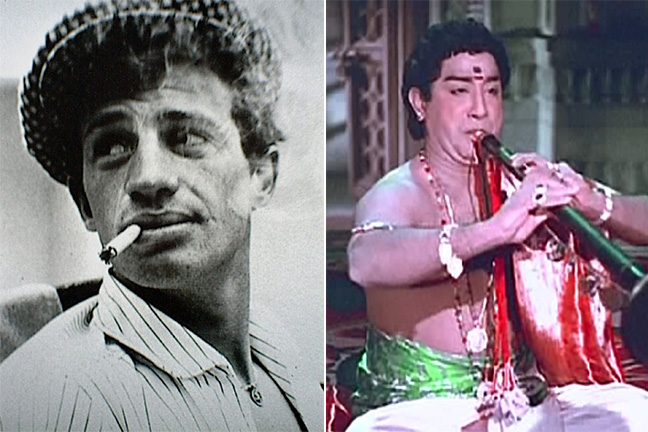
What we found most interesting was the commentary in French (you can turn on the English subtitles by clicking on the “Captions” button in the bottom bar on the YouTube video). The commentator, at one point, refers to Sivaji Ganesan as the “Indian Belmondo.” “Belmondo” here is a reference to Jean Paul Belmondo, the French actor who was a prominent face in the New Wave films that were made in France in the 1960s. He continues to be remembered for his portrayal of the character Michel Poiccard in Jean Luc Godard’s extremely influential film “Breathless” (“À bout de souffle” in French). “Breathless” was a path-breaking film that inspired many filmmakers through its brilliant use of the jump cut. So, while the comparison to Belmondo is flattering, it’s important to remember that Sivaji Ganesan had made his mark with “Parasakthi” in 1952, a good eight years before Belmondo broke out with “Breathless” (1960).

Jean Paul Belmondo in "Breathless" | Sivaji Ganesan in "Thillaanaa Mohanambal"

Jean Paul Belmondo in “Breathless”   |    Sivaji Ganesan in “Thillaanaa Mohanambal”

Do watch the clip and let us know about your thoughts on Louis Malle’s commentary and his take on Indian films. You can leave a comment or write to us at tcrc.india[at]gmail[dot]com.

The story of Lena Chettiar, the used-car dealer who turned into a film producer!

We at TCRC are always looking out for interesting trivia about yesteryear film personalities. Also, given that our search analytics told us that people were looking into the TCRC blog for information on one of Tamil cinema’s earliest superstars, actor-singer M K Thyagaraja Bhagavathar, we thought of putting together a separate post about him. We started looking for information about his 1934-released debut film “Pavalakodi.” But it was one of the producers of “Pavalakodi”, one Mr. Lena Chettiar, who ended up piquing our curiosity.

“Prabhavathi” (Tamil, 1942) was produced under the Krishna Pictures banner promoted by Lena Chettiar. Photo Courtesy: The Hindu.

Writing about the film “Prabhavathi” (Tamil, 1942) in The Hindu’s Blast From The Past column, Randor Guy profiles Lena Chettiar (click here to read the post about “Prabhavathi”):

S. M. Letchumanan Chettiar, popularly known as Lena Chettiar, was a powerful figure in the world of Tamil Cinema. A native of Chettinad, he was a ‘drama contractor’ in his early days, staging plays in various southern parts of the state by hiring freelancing actors and selling tickets for their plays. He also dealt in used cars and was the first man in this part of the world to print and circulate handbills about used cars in Tamil. Most of the Naattukottai Chettiars were wealthy, but did not know English. They found these handbills a novelty and encouraged Lena Chettiar.”

Randor Guy also reports that it was Lena Chettiar who convinced M K Thyagaraja Bhagavathar to not venture into production himself and stepped in to produce it for him:

M. K. Thyagaraja Bhagavathar’s (a top-ranking freelancing stage actor then) play with another stage actress S. D. Subbulakshmi, ‘Pavalakodi’, was a raving hit not only in the Tamil-speaking areas of South India but also in Ceylon. Bhagavathar was seriously planning to enter movies with Pavalakodi and Lena advised him against venturing into production on his own and convinced Bhagavathar to team up with him. With his rich pals, Lena produced Pavalakodi in 1934, which marked Bhagavathar’s film debut and proved to be a major hit.”

Lena Chettiar produced numerous films under various labels and eventually, started promoting the ‘Krishna Pictures’ banner in the early part of the 1940s under which he produced films in Tamil and Telugu for nearly 15 years. The last film that he produced, before the founding of Krishna Pictures, was “Krishnan Thoothu,” which was the Tamil debut of Telugu film star Kannamba. In his post about “Krishnan Thoothu,” Randor Guy mentions Lena again:

 He wielded enormous influence beyond the confines of the movie business in official and political circles. Soon after this film, he promoted his own unit, Krishna Pictures, in T. Nagar. His office on Thanikachalam Chetti Road (named after the noted Justice Party leader O.T. Chetti) was indeed a landmark of that area with its Krishna temple besides the building put up by Lena.”

Producers seldom get mentioned in serious writing about cinema. But in the early days of cinema in India, we at TCRC have noticed that often it was the producers who  moved mountains to fuel innovation and creativity. Lena Chettiar seems to be one such gentleman and we at TCRC are glad to bring back to public memory, stories of such film entrepreneurs.