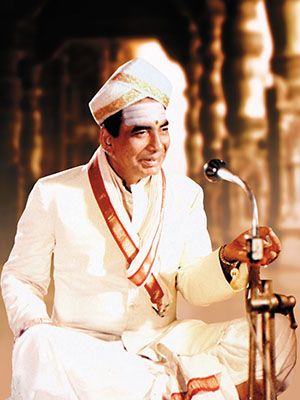
Mellisai Mannar M. S. Viswanathan

Mellisai Mannar M. S. Viswanathan is known for having incorporated various genres of world music into Indian cinema music. To say he was just a composer is an understatement. His achievements also include appearances in numerous films and television series. M. S. Viswanathan went on to act in a couple of Tamil feature films. While we all know him as a great music director, let us celebrate him in his unforgettable rare appearance as an actor in the comedy film ‘Kadala Kadala’ .

And a wonderful song that he had sung for A R Rahman for the film Sangamam along with Hariharan

Thank you MSV sir, for your great contribution to the Indian film industry! We will miss you!

Thanga Padhakkam : From stage to celluloid

By Karthik Bhatt

Like all top artistes of his era, Sivaji Ganesan, inarguably the finest actor Tamil cinema has seen, came from a stage background. Bitten by the acting bug at an early age, Sivaji Ganesan joined Yadartham Ponnuswamy Pillai’s Madurai Sri Bala Gana Sabha, a well known Boys Company of the times. It marked the beginning of a long and cherished association with Tamil theatre, which he successfully managed to sustain even after he became a top star. That he continued to remain passionate about stage is illustrated by the fact that even at the height of his career, he continued to act in stage plays, with film shootings many a time scheduled to accommodate his stage commitments.

Starting off with the Streepart (Female role) at the Sri Bala Gana Sabha, Sivaji Ganesan’s repertoire expanded to a wide range of roles, all of which stood him in good stead when he made his foray into films. In his autobiography “Enathu Suyasarithai”, he poignantly recalls the struggles associated with life in a Boys Company, where they would often be confronted by poverty and other tough circumstances.

Parasakthi (1952) propelled him to stardom, after which there was no looking back for him as a film star. His passion for stage was however undiminished and he performed for troupes such as S.V.Sahasranamam’s Seva Stage. He started Sivaji Nataka Mandram in the mid-1950s to continue his passion for stage and also to provide opportunities to many actors who were trying to make it big in films and were languishing for roles. Managing the troupe was S.A.Kannan, a stage actor who was part of the Sakthi Nadaga Sabha that had just then wound up. Sivaji Nataka Manram over the course of the next couple of decades went on to produce several hits on stage which would also replicate the success on celluloid when they were remade. Famous plays included Veerapandiya Kattabomman, Vietnam Veedu, Needhiyin Nizhal, Pagal Nila, Kaalam Kanda Kavignan and Thanga Padhakkam, the subject of this piece. In his autobiography, Sivaji Ganesan says that the play, written by J.Mahendran (later of Mullum Malarum fame) was originally being staged by Senthamarai. He watched the play at the Raja Annamalai Mandram and highly impressed by it, asked Senthamarai for the rights to stage it under the Sivaji Nataka Mandram banner and also make it into a movie. Senthamarai agreed and Sivaji Nataka Mandram inaugurated the play in 1972.

The play, which revolved around an upright police officer, Superintendent of Police (S.P) Chowdhry was directed by S.A.Kannan and had Sivaji Ganesan playing the main role. Others in the cast were Sivakami (who played his wife, the role played by K.R.Vijaya in the film) and Rajapandian, who donned the role of his son Jagannathan (Srikanth playing the role in the film). The Kalki magazine review of the play makes special mention of a sequence where Sivaji Ganesan sings and dances merrily in the birthday party of his son, hailing it as a novel attempt. Reviewing Sivaji Ganesan’s performance, it says that calling his acting a majestic portrayal would be akin to saying sugar is sweet!

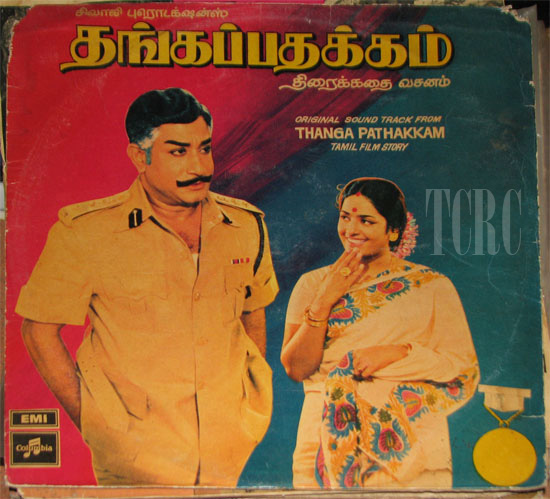
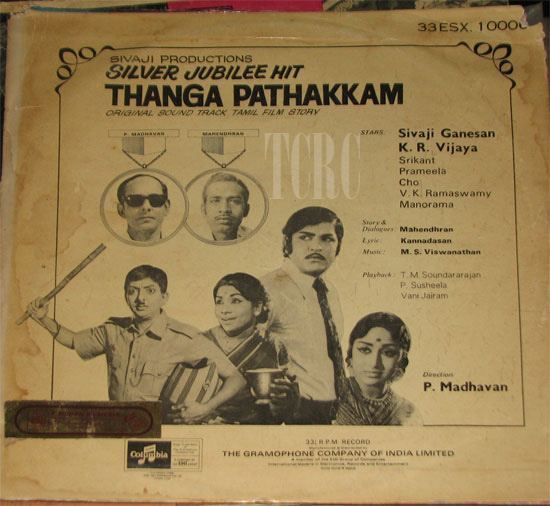
The play was made into a movie in 1974. P.Madhavan, who directed many hits (including some with Sivaji Ganesan) directed this movie, which was produced by Sivaji Ganesan’s daughter Shanti Narayanswamy for Sivaji Productions. The movie was a great success. The characterisation of the Superintendent of Police became a sort of a benchmark, with many a later movie referring to Chowdhry when mentioning a honest and upright officer! Below are the images of the LP from this film pulled out from our archive.

Thangapadakkam-1 WATERMARK Thangapadakkam-1A WATERMARK

Policekaran Magal: From stage to celluloid

By Karthik Bhatt

On 5th April 2013 TCRC shared its first post. It was the lobby card for the film Policekaran Magal. You can revisit the post here

Today as part of our ‘From Stage to Celluloid’ series we discuss more on this landmark film.

S.V.Sahasranamam was one of Tamil cinema’s most well-known character actors. Along with the likes of S.V.Ranga Rao and S.V.Subbiah, he was part of a select group of actors who were a constant presence in films between the 1950s and 1970s in the roles of a father, grandfather or elder brother.

Born in 1913, Sahasranamam joined T.K.Shanmugam’s Balashanmukhananda Sabha at an early age, giving up schooling to become an actor. His association with the troupe was a long one, lasting for more than two decades. It was an association that got him his first film opportunity, when a play of theirs, Menaka was made as a film in 1935. It was also in this troupe that he forged a lasting friendship with the legendary N.S.Krishnan.

Sahasranamam quit the Balashanmukhananda Sabha in 1936 on account of a misunderstanding with the managers. After stints as a manager with a couple of film houses, he joined N.S.Krishnan, by then a star, as a manager in his production house Ashoka Films. Film opportunities kept coming his way and he acted in a number of films through the 1940s. His passion for stage however remained undiminished. His dream of establishing his own troupe bore fruit in 1953, when he started Seva Stage.

Starting with Kangal, an adaptation of Rabindranath Tagore’s short story Vision, Seva Stage made a name for itself with its social themes and brilliant execution of the technical aspects. It was also to Sahasranamam’s credit that he managed to get noted writers such as T.Janakiraman, Ku.Alagiriswami and B.S.Ramiah to script successful and critically acclaimed plays such as Naalu Veli Nilam, President Panchatcharam, Vadivelu Vaathyaar and Policekaran Magal, which were later made into movies.

B.S.Ramiah, born in 1905 was an acclaimed journalist and writer best known in the literary circles for his association with Manikkodi, the magazine started by “Stalin” Srinivasan in 1933. He had made a name for himself as a short story writer. Sahasranamam approached Ramiah with a request to write a play for Seva Stage, thus marking the beginning of an association that would go on to produce great hits on stage.

Policekaran Magal was Ramiah’s fifth script for Seva Stage, after President Panchatcharam, Malliam Mangalam, Therotti Magan and the critically acclaimed Paanchali Sabatham . Revolving around a policeman and his family (most prominently the daughter), the play was a great success. Like other Seva Stage plays, this too did not lack in star value, with noted actors Muthuraman and V.Gopalakrishnan and actress S.N.Lakshmi playing important roles in the play. Muthuraman went on to play a role in the movie too, which was directed by C.V.Sridhar and came out in 1962. Vijayakumari played the role of the daughter in the movie, which was played on stage by Shanthini, a Seva Stage regular. J.P.Chandrababu and Manorama played the role of flower vendors, a crucial part of the plot. Sahasranamam reprised his stage role of the policeman on screen and even today, this movie is often spoken about as one of those movies which is impossible to remake thanks to the powerful portrayal by Sahasranamam.

The movie is also remembered today for its immortal melodies, most particularly Pon enben siru poo enben and Nilavukku en mel ennadi kovam.

Here are pictures of the film’s LP from our collection. The LP also carried the songs of another popular film of the time’ Sumai Thangi’.

policekaranmagal_sumaithangi Policekaranmagal_sumaithangi_back


Sabapathy: From stage to celluloid

By Karthik Bhatt

The next in our series from ‘stage to celluloid’ we discuss one of Tamil cinema’s earliest full length comedies, Sabapathy.

The film, which was released in 1941 was produced by A.V.Meiyappa Chettiar and directed by A.T.Krishnaswamy. The plot was based on Pammal Sambandha Mudaliar’s play by the same name.

In his autobiography Naadaga Medai Ninaivugal, Sambandha Mudaliar says that Sabapathy was the first farce that he wrote. The story, which revolved around a young, rich (and not so intelligent) zamindar and his foolish servant (both named Sabapathy) was first written in 1906. Sambandha Mudaliar writes that the inspiration for the servant was derived from observing the man Fridays of a few friends. In particular, he credits Narasimhan, the personal assistant of his close friend V.V.Srinivasa Iyengar, the noted lawyer for having served as the base to building the character! He also acknowledges the influence of Handy Andy, the famous book written by Samuel Lover where the character could do nothing right.

The story was written in eight parts, each of which was capable of being staged as a separate stage play. Pammal Sambandha Mudaliar himself played the role of the zamindar, while many of his troupe members donned the role of the servant. So popular was the play that it continued to be staged even after the movie had released and had become a huge success. Pammal Sambandha Mudaliar writes of an interesting incident in 1944, where he, aged 71 years at that time had to appear in the role of zamindar for a scene during a staging to raise funds for the Thondaimandala Thuluva Vellalar School on Mint Street.

The movie had T.R.Ramachandran and Kali N.Ratnam (both of them from stage backgrounds) playing the roles of the zamindar and the servant respectively. Having zeroed in on the choice of T.R.Ramachandran to play the role of zamindar, A.V.Meiyappa Chettiar brought him to Sambandha Mudaliar for his approval, which was given after a brief test of his capability to do justice to the role. Kali N.Ratnam was a well-known actor and vaadhyar who served with the Madurai Original Boys Company, earning the prefix of Kali thanks to his portrayal of the Goddess in a play about Kannagi. Amongst those who trained under him were P.U.Chinnappa and M.G.Ramachandran. The female lead was played by R.Padma (a Lux soap model!) while C.T.Rajakantham was paired opposite Kali N.Ratnam. The Kali N.Ratnam-Rajakantham partnership was a successful one and featured in several movies. C.T.Rajakantham was alive until the 1990s and even acted in the popular Marmadesam (Vidaadha Karuppu) serial.

The movie is a delight to watch even a good seven decades after its release thanks to the simple comedy and great characterisation of the actors.

Randor Guy’s article on the movie can be accessed here

Here is a popular 9 minute segment from the film.

Short film screening by Indiearth in association with TCRC

short film screening

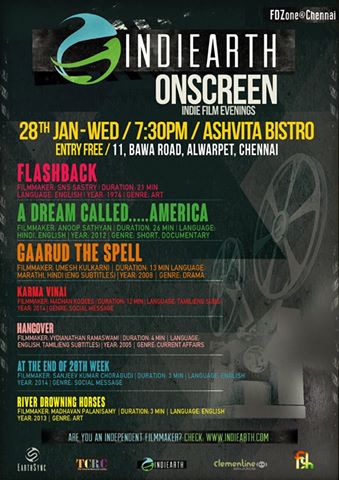
The next screening of short films by Indiearth in association with TCRC is happening at Ashvita Bistro,Chennai on the 28th of january 2015. Post screening, we will have a discussion on various styles and techniques involved in short film making with the filmmakers – Madhavan Palanisamy, Arun Mritunjay, Sanjeev Kumar, Madhan Kodees and Vydianathan Ramaswami who would be attending the screening.

ENTRY FREE!

SMS ” Short film ” with your name and email id to 9791088189.

The Short films to be screened are as follows:

1. FlashBack
Filmmaker: SNS Sastry
Duration: 21 min
Language: English
Year: 1974
Genre: Art

The film is a survey of the documentary film movement in India . We hear views of Films Division filmmakers S. Sukhdev and S N S Sastry before the Emergency and close to the end of their lives talking about documentary.

2. Gaarud The Spell
Filmmaker: Umesh Kulkarni
Duration: 13 min
Language: Marathi, Hindi (English Subtitles)
Year: 2008
Genre: Drama

The Spell gives us, in the form of a long tracking shot, a fascinating insight into what happens behind the doors of a block of tenements near the station in a small Indian town inhabited by people of differing backgrounds but all on the seamy side of life. Very briefly, we share their very personal lives. The camera takes us to the kitchens, the living rooms and even the toilets and the bedrooms of the inhabitants. The film won two national awards, one for best cinematography, and the other for best sound design. It received the best film award, the Golden Conch at MIFF, 2010.The film was also awarded the PATTON award for Best Indian Film at the 7th Kalpanirjhar International Short Fiction Film Festival, Kolkata.’Gaarud’ has been screened at more than 25 international film festivals, including the prestigious Rotterdam, and Vila de condo.

3. A Dream called……..America
Filmmaker: Anoop Sathyan
Duration: 26 min
Language: Hindi, English
Year: 2012
Genre: Short, Documentary

‘A Dream called America’ is a documentary made on Shahbaz, a 15 year old boy from Gujarat, India. He is the third among the five children of his father Aftab who makes a living by repairing cycles on a footpath. Shahbaz had studied in the US for a year on a scholarship, where he was hosted by an American couple. The one year he spent in US changed his attitude as he experienced a very comfortable and carefree life than his real home. After reaching India, he badly wants to go back and settle in US, leaving his parents in a dilemma.

Trailer & info: http://www.anoopsathyan.com/

Awards
– Best student film, Mumbai International Film Festival, India 2012
– Best documentary film, 4th International Children Film Festival – Lucknow, India 2012
– Silver award for Best student documentary, Indian Documentary Producers’ Association(IDPA) 2011
– Silver Owl for best documentary, CUT.IN Film Festival, Tata Institute of Social Sciences, Mumbai 2011

Official Selection
– Jeevika: Asia Livelihood Documentary Festival 2011 – NewDelhi, India
– Open St. Petersburg Student Film Festival ‘Beginning’ 2011 – Russia
– CHAGRIN Documentary Film Fest 2011 – USA
– OAXACA International Film Fest 2011 – Mexico
– Mumbai International Film Festival 2012 – India
– Al Jazeera International Documentary Film Fest 2012 – Qatar
– Globians DOC FEST 2012 – Germany

4. Hangover
Filmmaker: Vydianathan Ramaswami
Duration: 4 min
Language: English, Tamil (English subtitles)
Year: 2005
Genre: Current Affairs

This short film deals with the flip side of college festivals in terms of excess inflow of sponsorship revenue leaving behind a trail of unwarranted usage of plastic and other environmentally hazardous waste.

5. Karma Vinai
Filmmaker: Madhan Kodees
Duration: 12 min
Language: Tamil (English subs)
Year: 2014
Genre: Social Message

Two drunk friends meet a couple while passing through a bus stop at mid night. they drop them at bus stand, driver doesn’t care who are they as he was busy drinking while driving. when he sees both when they get down he gets disturbed.

http://www.indiearth.com/ViewTrailer.aspx?TrailerID=b10fd7dc-3d4a-40a9-9dbf-e1f5fae447f9

6. At the End of 20th Week
Filmmaker: Sanjeev Kumar Choragudi
Duration: 3 min
Language: English
Year: 2014
Genre: Social Message

‘At the End of 20th Week’ is a short film aimed at social awareness about Abortions and Female Infanticide. It portrays the pain of unborn female children. Our intention was not to get applauded or acclaimed by critics. Our intention was to take the veil of discrimination off the faces of people those who prefer sons over a daughters and who doesn’t accept life as a gift but choose to end it because it took a female form.

A beautiful young girl who is peacefully enjoying the warmth and love from an unknown person gets tortured by also another unknown person in different ways. The girl cannot escape the wrath and stays there suffering. The bed which she assumed as a safe place suddenly turns into an Inferno. The person who shared the love and warmth is no more protecting her. She dies in the end and then we identify that it’s not just another girl but she is the representation of a female fetus. And all the different methods are nothing but methods of Abortion. In the end the young girl being pulled out of the bed symbolizes the delivery method of taking a baby out of the womb. She is killed and then we see the statement “Hell begins for women in India ‘At the End of 20th Week’” It is at the end of 20th week one can identify the gender of the foetus. In most of the cases it can be easily identified at the end of 13th week which on the other hand depends on the position of the fetus. Hence the title was decided as 20th week because irrespective of the position of foetus.

7. River Drowning Horses
Filmmaker: Madhavan Palanisamy
Duration: 3 min
Language: English
Year: 2013
Genre: Art

This film blends elements of fashion and theatre to narrate a complex-relationship situation.


Happy Birthday Superstar


On this special day we would like to release a special image from our collection, a lobby card from the iconic film Baasha (1995) (Tamil)

Baasha-4
Suresh Krishna’s Baasha is an action thriller starring Rajnikanth, Nagma, and Raghuvaran. A loose adaptation of Amitabh Bahchan’s Hum, Baasha is the story of a man who becomes a mafia don and later tries to escape that life by adopting the identity of an autorickshaw driver. Needless to say, his past catches up with him. The film enjoyed a positive box office response and is considered one of Rajnikanth’s most commercially successful films. This movie won him multiple acting awards. 20 years on, Baasha’s autodriver character has been elevated to patron saint status by auto drivers in Chennai and elsewhere in Tamilnadu.


Celebrating Balu Mahendra

balumahendra

On February 13th 2014 we lost a man who has changed the language of Indian Cinema. Born Balanathan Benjamin Mahendran, Balu Mahendra started out as a cinematographer after graduating from the Film and Television Institute of India, Pune. He created a visual revolution with his unique style of cinematography. As a director, Balu Mahendra created a new wave in South Indian cinema by making films close to reality and handling them with sensitiveness that no other filmmakers could at that time. Handling the camera for every film that he directed added an element of poetry in every frame.

Here is an article by Kamal Hassan celebrating this great auteur’s life. http://www.thehindubusinessline.com/opinion/kamal-haasans-tribute-to-balu-mahendra/article5688417.ece

We, at TCRC will like to pay our tribute by highlighting the many ‘firsts’ that Balu Mahendra was associated with:

Kokila – Balu Mahendra debuts as a director. See a trailer of this path breaking film.

Mullum Malarum – Balu Mahendra handle’s the camera for yet another great film maker, Mahendran. Here is a very popular song from this film.

Pallavi Anu Pallavi – This Kannada film was Maniratnam’s debut. Balu Mahendra’s cinematography played a vital role in this film.

http://www.youtube.com/watch?v=rDX2F18-chM

Sadma – Balu Mahendra’s first Hindi film which was the remake of his own super hit Tamil film Moondram Pirai. See the heart wrenching climax of this film which is still talked about even today.

Thalaimuraigal – Released on December 20 2013, this was the last film directed by the stalwart. It was, at the same time, the first  film that he completely shot in digital and also the first time he faced the camera by playing one of the lead characters. By playing the grandfather in the film it could have also probably been the first time that the world would have seen him without his trademark cap. Here is a trailer from of the film.

Happy birthday Mr.P.C.Sreeram

pc sir

The Cinema Resource Centre would like to wish one of India’s finest cinematographers, Mr. P.C.Sreeram a very Happy Birthday. Here are some of songs that he has picturised over the years.

http://www.youtube.com/watch?v=s6PHPdYBAng

http://www.youtube.com/watch?v=csUXes0FkBc

http://www.youtube.com/watch?v=qWhWjiknKWk

http://www.youtube.com/watch?v=7Z0xFDMjj7c

http://www.youtube.com/watch?v=YHKf_HS9Puc

http://www.youtube.com/watch?v=Fme52RzRI-E

http://www.youtube.com/watch?v=0xA-oWnJAWA

RARE: Original LP cover of Kamal Hassan’s “Aboorva Sagodharargal” (Tamil, 1989)

In May 1989, Kamal Hassan’s “Aboorva Sagodharargal,” which featured the actor in the roles of a police officer, a mechanic and a dwarf clown, was released amidst much fanfare. Directed by Singeetham Srinivasa Rao and produced by Kamal Hassan himself, the film’s cast included Gouthami, Srividya, Delhi Ganesh, Jaishankar, Nassar, Nagesh, Janakaraj and many others. The film was a blockbuster hit and is said to have completed a 200-day run at the box office, a record run in Tamil cinema then (the record was broken six years later by superstar Rajnikanth’s “Baasha”). The film’s screenplay was penned by Kamal Hassan and the dialogues were written by Crazy Mohan. “Aboorva Sagodharargal” was Crazy Mohan’s debut film as dialogue writer.

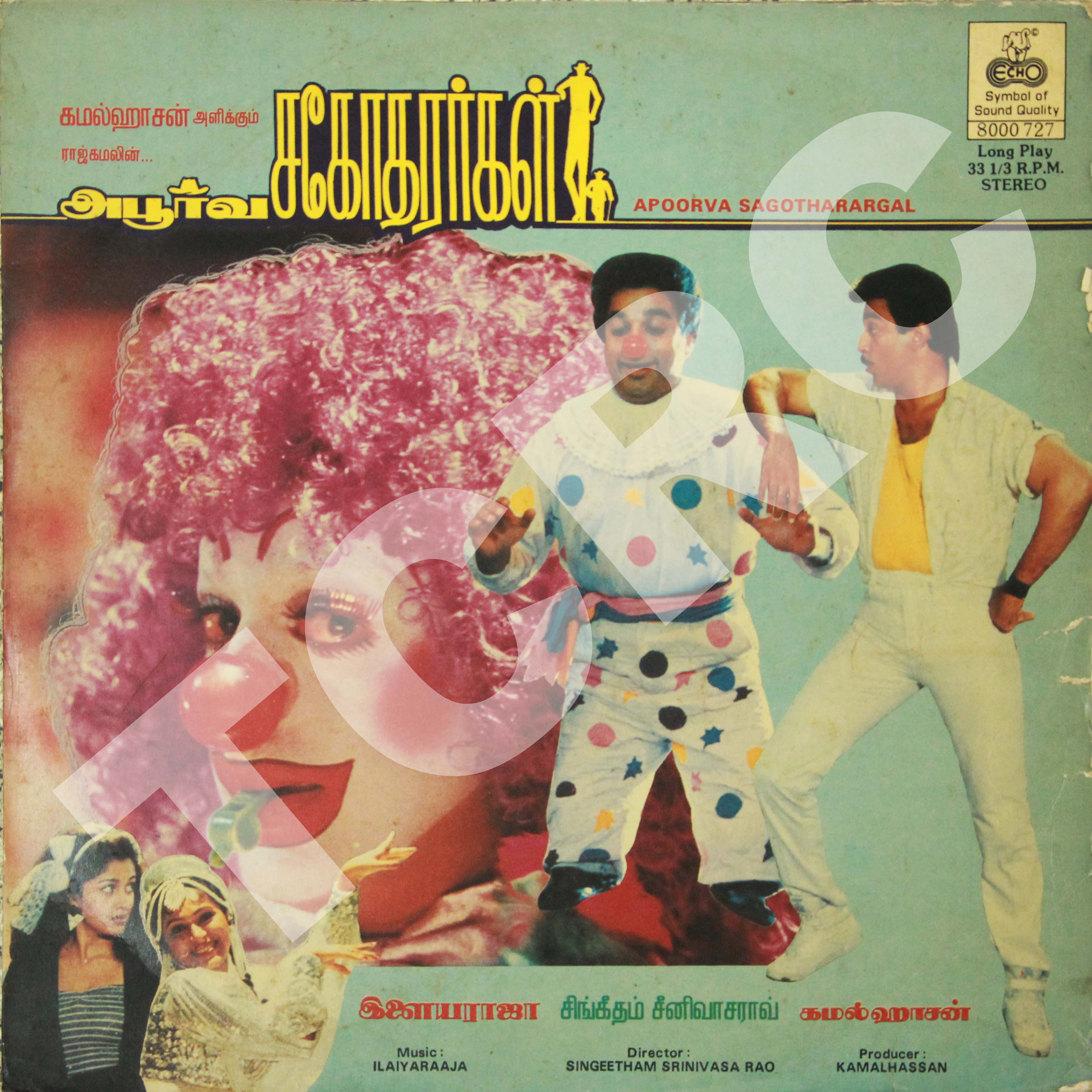
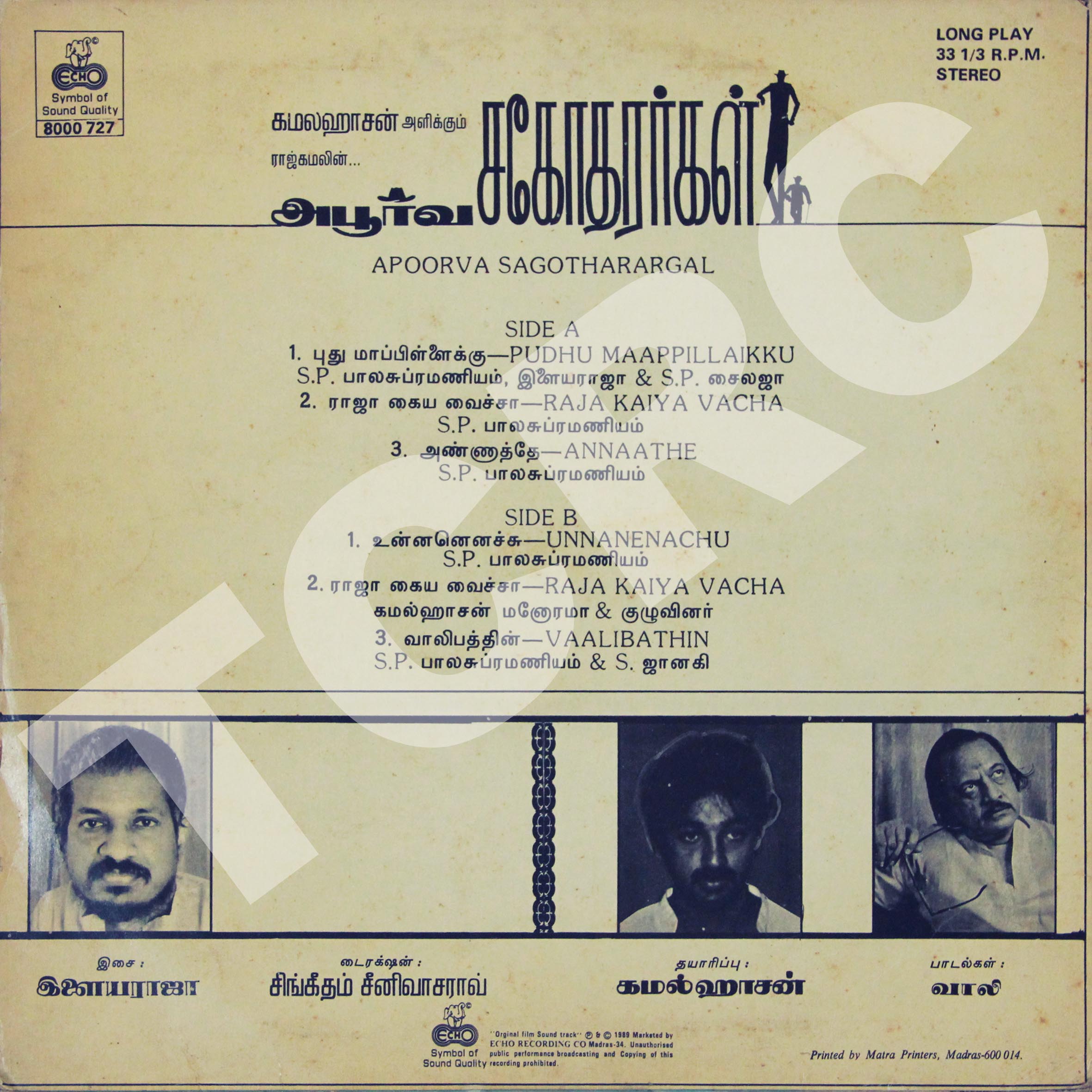
The musical score of “Aboorva Sagodharargal” was composed by Ilaiyaraaja and its songs went on to become cult classics, with tracks such as “Raaja Kaiya Vecha” receiving airplay on radio and TV channels even today. And today, we bring to you from the TCRC archives the cover of the original LP record of the film:

"Aboorva Sagodharargal" | LP record cover (front) | Tamil | 1989

“Aboorva Sagodharargal” | LP record cover (front) | Tamil | 1989

"Aboorva Sagodharargal" | LP record cover (back) | Tamil | 1989

“Aboorva Sagodharargal” | LP record cover (back) | Tamil | 1989

The film was dubbed into Telugu as “Vichithra Sodarulu” and into Hindi as “Appu Raja,” a year later. Both the dubbed versions enjoyed a successful run at the box office, with Kamal receiving unanimous praise for his portrayal of the dwarf clown Appu. In the movie, the episode where Appu falls in love with the daughter of the circus owner (the daughter played by Rupini and the father played by Mouli) is said to be a tribute to Charlie Chaplin’s “The Circus,” which was a silent film released in 1928. In “Aboorva Sagodharargal,” Appu goes through a Chaplinesque heartbreak in romance that is very similar to what transpires in “The Circus.”

The title “Aboorva Sagodharargal” itself is a hat tip to SS Vasan’s 1949-released feature film of the same name. That “Aboorva Sagodharargal” featured actors MK Radha and Bhanumathi in titular roles and was produced in Tamil, Telugu and Hindi simultaneously. Directed by Acharya and written by Kothamangalam Subbu, the old “Aboorva Sagodharargal” was an adaptation of the novella “The Corsican Brothers” by Alexander Dumas. The idea of brothers coming together to avenge the death of their father is the common thread running between both the old and the new “Aboorva Sagodharargal.”

25 Greatest Acting Performances in Indian Cinema: The Forbes List!

The Forbes India magazine recently put out a list of the 25 greatest acting performances in Indian cinema, 8 of which are performances in Telugu, Kannada, Malayalam and Tamil films.  Now, here at TCRC, we are always a little wary of lists such as these, fully aware that it’s incredibly hard to pick just 8 or 10 performances from over thousands of films made in the southern part of the country across the span of almost a century. But since this list is a part of their ‘100 Years of Indian Cinema’ set of features, we felt compelled to share this. Given below is an excerpt from the piece (click here to check out the entire list):

JV Somayajulu 
in Sankarabharanam (The Ornament of Shankara), 1980 
JV Somayajulu, an IAS officer in his 50s, plays a Carnatic musician, misunderstood for supporting the daughter of a prostitute, ignored by a society where classical music is in decline, and is being overtaken by pop music. It was a surprise hit. It opened to empty seats, gathered speed and, today, enjoys a cult status. Somayajulu played his part with such dignity and intensity that you can’t listen to any of its hugely popular songs without imagining him performing them as his sadhana.

JV Somayajulu in "Sankarabharanam" (Telugu, 1980). Photo Courtesy: Forbes India.

JV Somayajulu in “Sankarabharanam” (Telugu, 1980). Photo Courtesy: Forbes India.

“Sankarabharanam” turned out to be a cult film as far as Telugu cinema was concerned, after getting off to a slow start in the box office. Directed by K Vishwanath, the film is remembered for its music, scored by KV Mahadevan. The film was shot by cinematographer-turned-director Balu Mahendra, who later made “Moondram Pirai” with Kamal Hassan and Sridevi (“Sadma” in Hindi). The director of “Sankarabharanam,” K Vishwanath, went on to narrate yet another story revolving around an art form (classical dance) in “Saagara Sangamam” (“Salangai Oli” in Tamil). The film featured Kamal Hassan and Jayaprada in career-defining roles and like “Sankarabharanam,” it is said to be a musical success, with tunes composed by Ilaiyaraaja.