Thanga Padhakkam : From stage to celluloid

By Karthik Bhatt

Like all top artistes of his era, Sivaji Ganesan, inarguably the finest actor Tamil cinema has seen, came from a stage background. Bitten by the acting bug at an early age, Sivaji Ganesan joined Yadartham Ponnuswamy Pillai’s Madurai Sri Bala Gana Sabha, a well known Boys Company of the times. It marked the beginning of a long and cherished association with Tamil theatre, which he successfully managed to sustain even after he became a top star. That he continued to remain passionate about stage is illustrated by the fact that even at the height of his career, he continued to act in stage plays, with film shootings many a time scheduled to accommodate his stage commitments.

Starting off with the Streepart (Female role) at the Sri Bala Gana Sabha, Sivaji Ganesan’s repertoire expanded to a wide range of roles, all of which stood him in good stead when he made his foray into films. In his autobiography “Enathu Suyasarithai”, he poignantly recalls the struggles associated with life in a Boys Company, where they would often be confronted by poverty and other tough circumstances.

Parasakthi (1952) propelled him to stardom, after which there was no looking back for him as a film star. His passion for stage was however undiminished and he performed for troupes such as S.V.Sahasranamam’s Seva Stage. He started Sivaji Nataka Mandram in the mid-1950s to continue his passion for stage and also to provide opportunities to many actors who were trying to make it big in films and were languishing for roles. Managing the troupe was S.A.Kannan, a stage actor who was part of the Sakthi Nadaga Sabha that had just then wound up. Sivaji Nataka Manram over the course of the next couple of decades went on to produce several hits on stage which would also replicate the success on celluloid when they were remade. Famous plays included Veerapandiya Kattabomman, Vietnam Veedu, Needhiyin Nizhal, Pagal Nila, Kaalam Kanda Kavignan and Thanga Padhakkam, the subject of this piece. In his autobiography, Sivaji Ganesan says that the play, written by J.Mahendran (later of Mullum Malarum fame) was originally being staged by Senthamarai. He watched the play at the Raja Annamalai Mandram and highly impressed by it, asked Senthamarai for the rights to stage it under the Sivaji Nataka Mandram banner and also make it into a movie. Senthamarai agreed and Sivaji Nataka Mandram inaugurated the play in 1972.

The play, which revolved around an upright police officer, Superintendent of Police (S.P) Chowdhry was directed by S.A.Kannan and had Sivaji Ganesan playing the main role. Others in the cast were Sivakami (who played his wife, the role played by K.R.Vijaya in the film) and Rajapandian, who donned the role of his son Jagannathan (Srikanth playing the role in the film). The Kalki magazine review of the play makes special mention of a sequence where Sivaji Ganesan sings and dances merrily in the birthday party of his son, hailing it as a novel attempt. Reviewing Sivaji Ganesan’s performance, it says that calling his acting a majestic portrayal would be akin to saying sugar is sweet!

The play was made into a movie in 1974. P.Madhavan, who directed many hits (including some with Sivaji Ganesan) directed this movie, which was produced by Sivaji Ganesan’s daughter Shanti Narayanswamy for Sivaji Productions. The movie was a great success. The characterisation of the Superintendent of Police became a sort of a benchmark, with many a later movie referring to Chowdhry when mentioning a honest and upright officer! Below are the images of the LP from this film pulled out from our archive.
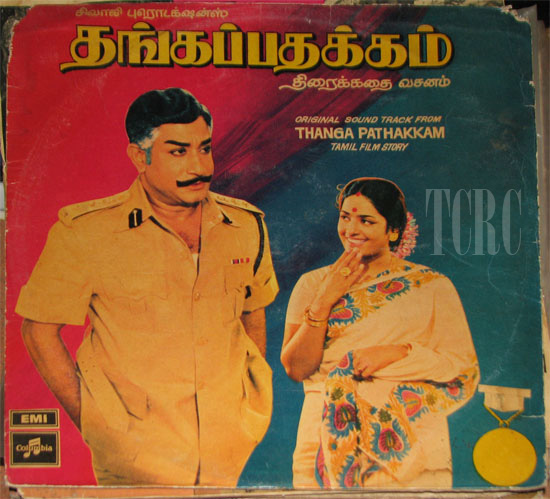
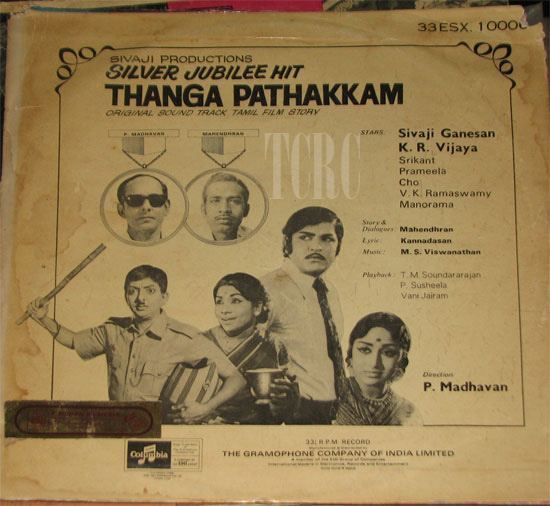
Thangapadakkam-1 WATERMARK Thangapadakkam-1A WATERMARK

Policekaran Magal: From stage to celluloid

By Karthik Bhatt

On 5th April 2013 TCRC shared its first post. It was the lobby card for the film Policekaran Magal. You can revisit the post here

Today as part of our ‘From Stage to Celluloid’ series we discuss more on this landmark film.

S.V.Sahasranamam was one of Tamil cinema’s most well-known character actors. Along with the likes of S.V.Ranga Rao and S.V.Subbiah, he was part of a select group of actors who were a constant presence in films between the 1950s and 1970s in the roles of a father, grandfather or elder brother.

Born in 1913, Sahasranamam joined T.K.Shanmugam’s Balashanmukhananda Sabha at an early age, giving up schooling to become an actor. His association with the troupe was a long one, lasting for more than two decades. It was an association that got him his first film opportunity, when a play of theirs, Menaka was made as a film in 1935. It was also in this troupe that he forged a lasting friendship with the legendary N.S.Krishnan.

Sahasranamam quit the Balashanmukhananda Sabha in 1936 on account of a misunderstanding with the managers. After stints as a manager with a couple of film houses, he joined N.S.Krishnan, by then a star, as a manager in his production house Ashoka Films. Film opportunities kept coming his way and he acted in a number of films through the 1940s. His passion for stage however remained undiminished. His dream of establishing his own troupe bore fruit in 1953, when he started Seva Stage.

Starting with Kangal, an adaptation of Rabindranath Tagore’s short story Vision, Seva Stage made a name for itself with its social themes and brilliant execution of the technical aspects. It was also to Sahasranamam’s credit that he managed to get noted writers such as T.Janakiraman, Ku.Alagiriswami and B.S.Ramiah to script successful and critically acclaimed plays such as Naalu Veli Nilam, President Panchatcharam, Vadivelu Vaathyaar and Policekaran Magal, which were later made into movies.

B.S.Ramiah, born in 1905 was an acclaimed journalist and writer best known in the literary circles for his association with Manikkodi, the magazine started by “Stalin” Srinivasan in 1933. He had made a name for himself as a short story writer. Sahasranamam approached Ramiah with a request to write a play for Seva Stage, thus marking the beginning of an association that would go on to produce great hits on stage.

Policekaran Magal was Ramiah’s fifth script for Seva Stage, after President Panchatcharam, Malliam Mangalam, Therotti Magan and the critically acclaimed Paanchali Sabatham . Revolving around a policeman and his family (most prominently the daughter), the play was a great success. Like other Seva Stage plays, this too did not lack in star value, with noted actors Muthuraman and V.Gopalakrishnan and actress S.N.Lakshmi playing important roles in the play. Muthuraman went on to play a role in the movie too, which was directed by C.V.Sridhar and came out in 1962. Vijayakumari played the role of the daughter in the movie, which was played on stage by Shanthini, a Seva Stage regular. J.P.Chandrababu and Manorama played the role of flower vendors, a crucial part of the plot. Sahasranamam reprised his stage role of the policeman on screen and even today, this movie is often spoken about as one of those movies which is impossible to remake thanks to the powerful portrayal by Sahasranamam.

The movie is also remembered today for its immortal melodies, most particularly Pon enben siru poo enben and Nilavukku en mel ennadi kovam.

Here are pictures of the film’s LP from our collection. The LP also carried the songs of another popular film of the time’ Sumai Thangi’.

policekaranmagal_sumaithangi Policekaranmagal_sumaithangi_back


2nd April ’15 ~ IndiEarth OnScreen w/ TCRC At Ashvita Bistro

Date: 2nd April 2015 (Thursday)
Time: 7:30 pm
Venue: Ashvita Bistro, Bawa Road, Alwarpet, Chennai.

ENTRY FREE and seats are on first come, first served basis.

An edition showcasing short films and film makers from the city of Chennai. IndiEarth OnScreen in association with The Cinema Resource Centre, Chennai present a collection of short films depicting the flavour and essence of Chennai and it’s people. Features a mix of documentary and fiction, the shorts portray definitive and hidden nuances of the populace as a whole that put together the fabric of the city.

The evening will also feature a conversation with the filmmakers as well a Q&A with the audience hosted by IndiEarth.

Film 1:
Chennai Gaana
Vydianathan Ramaswami
18 min/ Color/ 2012/ Tamil (English Subs)
Music,
Trailer: http://www.indiearth.com/ViewTrailer.aspx?TrailerID=11832bad-5f4f-4964-8e51-a25d881adeb2

Gaana songs are a sub-culture of Chennai urban culture.

Gaana in simple words is another name for Tamil Rap song (s), which is getting transformed into a viable commodity by entering the market and undergoing a process of sanitization. It comes across at issues like Politics, urban poverty, caste, violence and sex.

Gaana songs came into existence as part of the urban culture and it has its roots in the slums of Chennai. The Gaana as a popular cultural form is distinct in structure, rhyming verses while talking about the loves and lives of the slum people.

Gaana comes from a mixture of different Tamil dialects and other languages the Dalits, fisher folk of Chennai encounter.

Gaana undoubtedly gives a cultural identity to Subaltern masses in the fringes of the urban spaces. Gaana singers do subtly make music whose effect is to challenge and undermine the consequences of poverty and marginalization.

A Chennai Gaana song sung by Late Power House Pandi about “Human Life and Living” juxtaposed through a montage of Chennai centric visuals illustrating “Slice of Chennai”

Film:2
Raja Magal
Filmmaker: Manikandan
13 min/ Color/ 2014/ Tamil (English Subs)
Short, Drama

Trailer: http://www.indiearth.com/ViewTrailer.aspx?TrailerID=c105cb76-d8ca-4f03-bcc1-17234a684448

Often, we find that certain moments from our past are etched deeply within our memory. They are brought to life sometimes by certain harmless innocuous happenings such – a name, a picture or a song. This short film is about such an event, where a name triggers a memory that resides deep within the protagonist. This memory of his spurned love, Janani, enriched by her blissful dance to a classic film song, taunts him. There is a sudden stir in the protagonist to relive the moments, by playing the classic song that was of paramount importance to him and the memory. What happens next is an unexpected coincidence.

Film 3:
Children of the Republic
Filmmaker: Ramakrishna Dhanasekaran
18 min/ Color/ 2013/ Tamil (English subs)
Social Message

Trailer: http://www.indiearth.com/ViewTrailer.aspx?TrailerID=c69625c7-0b3f-41cd-84ef-312b05c70bf8

Santhosh Kumar, a 5th class student of a government school in Chennai, spends time collecting empty bottles for money and huffing correction fluid for recreation. His naïve encounters in the real world only reveal him to be ignorant and in need of help.

Children of the Republic is a series that provides a glimpse of the dark and dangerous path some of our youngsters have stumbled onto.

Film 4:
Meelparvai
Filmmaker: Vijay Jayapal
22min/ Color/ 2014/ Tamil (English subs)
Short, Drama

Trailer: http://www.indiearth.com/ViewTrailer.aspx?TrailerID=73bf9da4-c9e9-4f4b-8cca-ed72385e0de5

Meelpaarvai is a romantic drama about love, relationships and retrospection. “Meelpaarvai” is a Tamil word meaning “Retrospect”.

Karthik and Divya are ex-lovers, who haven’t met in the last three years. One fine day, Karthik receives a surprise call from Divya, who is now married, to meet her at the same coffee shop where they last met three years back.

Film:5
Helmet Thirudargal
Parthy KL
20 min/ Color/ 2014/ Tamil (English Subs)
Comedy, Social Message

Trailer: http://www.indiearth.com/ViewTrailer.aspx?TrailerID=80de8029-2922-452b-8012-44a2414e0c02

Helmet thirudargal is a short film on Helmet awareness. The awareness delivered through comedy genre.

Film 6:
Madras is Beautiful
Balaji Maheshwar
4 min/ Color/ 2014
Music video

Trailer: http://www.indiearth.com/ViewTrailer.aspx?TrailerID=3437622e-d668-4ab3-9234-8e6d1140cba6

This film is to appreciate the beauty in day to day life that goes unnoticed due to the fast paced lifestyle of our generation.Life in Madras is beautiful.Embrace It.


About TCRC

The Cinema Resource Centre (TCRC) is a not-for-profit public archive of Indian cinema designed to enable research on the audio-visual cultural artifacts produced by Indian films, especially those made in the regional languages of South India.

We seek to promote film culture, from a historical, educational, and artistic perspective.

At present, The Cinema Resource Centre (TCRC) makes available for public viewing over:
– 8,000 movie posters
– 5,000 ‘lobby cards’ (used for promotion of films in movie halls)
– 3,000 song books (booklets containing lyrics of the movie’s songs and also, some information about the production)
– 300 long-playing (LP) records
– 700 pieces of literature on cinema (old newspaper & magazine clippings, books)
– 25,000 photographs (shot during production of films)

The artifacts pertain to various Indian films that have been released over the last 80 years. They have been sourced painstakingly from collectors, films producers, technicians, artistes and fans.

We’re a small team and our passion for cinema is the only thing that sustains us..

IEOS 2nd April Ashivta Poster WEB


Sabapathy: From stage to celluloid

By Karthik Bhatt

The next in our series from ‘stage to celluloid’ we discuss one of Tamil cinema’s earliest full length comedies, Sabapathy.

The film, which was released in 1941 was produced by A.V.Meiyappa Chettiar and directed by A.T.Krishnaswamy. The plot was based on Pammal Sambandha Mudaliar’s play by the same name.

In his autobiography Naadaga Medai Ninaivugal, Sambandha Mudaliar says that Sabapathy was the first farce that he wrote. The story, which revolved around a young, rich (and not so intelligent) zamindar and his foolish servant (both named Sabapathy) was first written in 1906. Sambandha Mudaliar writes that the inspiration for the servant was derived from observing the man Fridays of a few friends. In particular, he credits Narasimhan, the personal assistant of his close friend V.V.Srinivasa Iyengar, the noted lawyer for having served as the base to building the character! He also acknowledges the influence of Handy Andy, the famous book written by Samuel Lover where the character could do nothing right.

The story was written in eight parts, each of which was capable of being staged as a separate stage play. Pammal Sambandha Mudaliar himself played the role of the zamindar, while many of his troupe members donned the role of the servant. So popular was the play that it continued to be staged even after the movie had released and had become a huge success. Pammal Sambandha Mudaliar writes of an interesting incident in 1944, where he, aged 71 years at that time had to appear in the role of zamindar for a scene during a staging to raise funds for the Thondaimandala Thuluva Vellalar School on Mint Street.

The movie had T.R.Ramachandran and Kali N.Ratnam (both of them from stage backgrounds) playing the roles of the zamindar and the servant respectively. Having zeroed in on the choice of T.R.Ramachandran to play the role of zamindar, A.V.Meiyappa Chettiar brought him to Sambandha Mudaliar for his approval, which was given after a brief test of his capability to do justice to the role. Kali N.Ratnam was a well-known actor and vaadhyar who served with the Madurai Original Boys Company, earning the prefix of Kali thanks to his portrayal of the Goddess in a play about Kannagi. Amongst those who trained under him were P.U.Chinnappa and M.G.Ramachandran. The female lead was played by R.Padma (a Lux soap model!) while C.T.Rajakantham was paired opposite Kali N.Ratnam. The Kali N.Ratnam-Rajakantham partnership was a successful one and featured in several movies. C.T.Rajakantham was alive until the 1990s and even acted in the popular Marmadesam (Vidaadha Karuppu) serial.

The movie is a delight to watch even a good seven decades after its release thanks to the simple comedy and great characterisation of the actors.

Randor Guy’s article on the movie can be accessed here

Here is a popular 9 minute segment from the film.

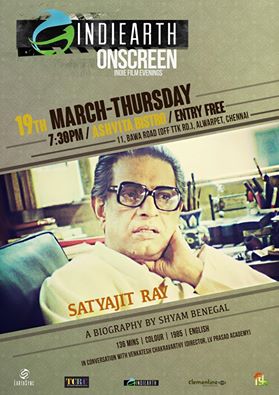
‘Satyajit Ray’ by Shyam Benegal – 19th Mar. ~ IndiEarth OnScreen & TCRC

Date: 19th March 2015 (Thurs)

Time: 7:30 pm
Venue: Ashvita Bistro, Bawa Road (off TTK Rd.), Alwarpet, Chennai.
Entry Free

Satyajit Ray
Filmmaker: Shyam Benegal
136 min/ Color/ 1985 / English

A biographical on Satyajit Ray, one of India’s most significant film makers, who also attained international acclaim through his cinematographic creations, narrated through Shyam Benegal’s lens.

In Conversation with Venkatesh Chakravarthy (Director, LV Prasad Academy)

**
ARE YOU AN INDEPENDENT FILMMAKER? GET SCREENING OPPORTUNITIES>>>
Be a Part of IndiEarth OnScreen:
Submit your film for further screening opportunities on www.IndiEarth.com& get in touch with us at support@indiearth.com.

About TCRC

The Cinema Resource Centre (TCRC) is a not-for-profit public archive of Indian cinema designed to enable research on the audio-visual cultural artifacts produced by Indian films, especially those made in the regional languages of South India.

We seek to promote film culture, from a historical, educational, and artistic perspective.

At present, The Cinema Resource Centre (TCRC) makes available for public viewing over:
– 8,000 movie posters
– 5,000 ‘lobby cards’ (used for promotion of films in movie halls)
– 3,000 song books (booklets containing lyrics of the movie’s songs and also, some information about the production)
– 300 long-playing (LP) records
– 700 pieces of literature on cinema (old newspaper & magazine clippings, books)
– 25,000 photographs (shot during production of films)

The artifacts pertain to various Indian films that have been released over the last 80 years. They have been sourced painstakingly from collectors, films producers, technicians, artistes and fans.

We’re a small team and our passion for cinema is the only thing that sustains us.

11050314_802357586514529_7152715142625329464_n

Manohara: From stage to celluloid

By Karthik Bhatt

Tamil theatre was unarguably the biggest breeding ground for Tamil cinema, whose origin and development encouraged the easy migration and transition of actors, technicians, authors and themes from theater. It was a relationship which began in the early days of cinema and lasted right upto the 1980s. Some of the most memorable films in our industry have been remakes or adaptations of stage plays. The Tamil theater background of our greatest actors is well documented. Equally worthy of documentation is the contribution of various playwrights whose subjects were remade as films that were both critically acclaimed and commercially successful. Foremost amongst them in this regard was Pammal Sambandha Mudaliar.

Born in 1873, Sambandha Mudaliar authored nearly a hundred works comprising of plays, short stories, books on religion and of course, his extremely informative autobiography. Rightfully known as the father of Tamil theater, ten of his plays were remade as films. Undoubtedly the biggest hits amongst them were Manohara and Sabapathy. This post is about the former.

Manoharan, as the play was titled was Sambandha Mudaliar’s 6th play. In his memoirs “Naadaga Medai Ninaivugal”, he says that idea for the story was born when he attended a religious discourse on the life of Dhruva. The scene where Dhruva is grief-stricken on seeing the humiliation his mother suffers at the hands of his father’s second wife, Suruchi struck a chord with him and he decided to write a play with this scene as its fulcrum. Thus was born Manoharan, with the character of the second wife being replaced by that of a mistress. Sambandha Mudaliar played the title role of Manoharan.

The play was inaugurated on the 14th of September 1895 at the Victoria Public Hall. Sambandha Mudaliar says that though the collections on the occasion amounted to only Rs.200, it was well appreciated by those present. The songs were composed by the legendary Sankaradas Swamigal. The climax of the play was the famous “Sangili Scene” (as it came to be popularly known amongst the public), where the hero broke free from the chains with which he was tied to the pillars. Sambandha Mudaliar writes that almost inevitably after every performance, he would collapse from the exertion caused by the scene.

The play was a resounding success. Sambandha Mudaliar says that the play was staged a record 859 times (upto the year 1932) by various troupes with his permission and probably an equal number of times without his permission. Many actors who would go on to become leading stars in cinema donned various roles in the play, notable amongst them being “Nadippisai Pulavar” K.R.Ramaswami and R.S.Lakshminarasimhan, who took on the screen name Manohar after he became famous playing the role in a college performance. Interestingly, Sivaji Ganesan played the role of the queen in K.R.Ramaswamy’s play! It was also published as a book for the first time in 1907, with subsequent reprints being made even upto the 1980s.

The play was made into a movie twice. The first one, which was made in Bombay in 1936 and had Sambandha Mudaliar playing the role of the king Purushothaman sank without a trace. The second one however, made in 1954 is much remembered even today, thanks to the brilliant performance of Sivaji Ganesan. The dialogues of the original play were virtually rewritten by Mu.Karunanidhi.

Film historian Randor Guy gives us more details on the film here .

TCRC has in its vast collection the Long Play story set record of the 1954 version of the film

Manohara-Story-Set-1 Manohara-Story-Set-1A


Here is the iconic court room scene from the film showcasing the powerful performance by Sivaji Ganesan.


Short film screening by Indiearth in association with TCRC

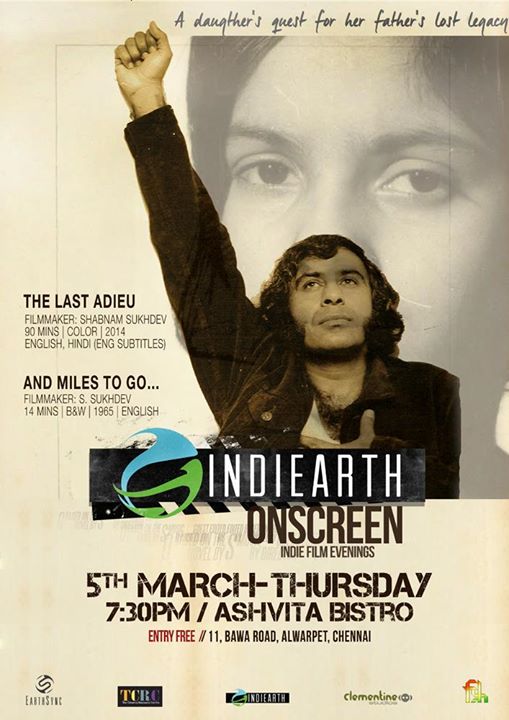
As a part of our cinema retrospect series on landmark films and filmmakers, this edition of IndiEarth OnScreen in association with The Cinema Resource Centre (TCRC) will highlight one of the most complex and prolific documentary filmmakers of the ‘60s – S Sukhdev.

Date: 5th March 2015 (Thurs)
Venue: Ashvita Bistro, Bawa Road (off TTK Rd.), Alwarpet, Chennai.
Entry Free

Conversations and audience interaction after the screening to follow.

Film 1:
AND MILES TO GO…
S. Sukhdev
14 min/ B&W / 1965 / English

A scathing view on the inequalities of our young nation; Sukhdev, working within the state run Films Division went on to make a film that was far removed from propaganda.

Film 2:
The Last Adieu
Shabnam Sukhdev
90 min/ Color /2014/ English, Hindi (English subtitles)

Awards: National Film Award for Best Historical Reconstruction/Compilation Film, more
Genres: Biographical film, Historical fiction

The film is a personal quest of a filmmaker daughter to unravel the past and make a connection with her filmmaker father, S. Sukhdev, who died suddenly at the age of 46, leaving behind a huge body of work and an unresolved relationship with his daughter.

While he was an accomplished filmmaker in the public eye, his family had another story to tell. With the help of archival audio recordings, old photographs and Sukhdev’s films, Shabnam endeavours to construct a picture of her father as she struggles to love and respect him for who he was.

The film is an important record of a phase in documentary history that inspired and paved the way for the new wave in non-fiction narratives, and pays homage to S. Sukhdev, an important filmmaker who revolutionized Documentary filmmaking in India in the mid 60’s, right through the 70’s.

Trailer: https://www.youtube.com/watch?v=9IgoTwzmYYI

Producer — Films Division
Direction — Shabnam Sukhdev
Editing — Jabeen Merchant
Sound Design and Sound Mixing — Mohandas VP
Camera — Ashwin Shukla

http://www.livemint.com/Leisure/BZB0OKaBz7jIVuOcK9gbbI/Documentary–Home-and-the-world.html
11030393_795908743826080_3629659086392679415_o
Submit your film for further screening opportunities on www.IndiEarth.com& get in touch with us at support@indiearth.com / Call: 9176610467.
***

This week’s screening

10624635_602478549896654_2077785320442471829_n


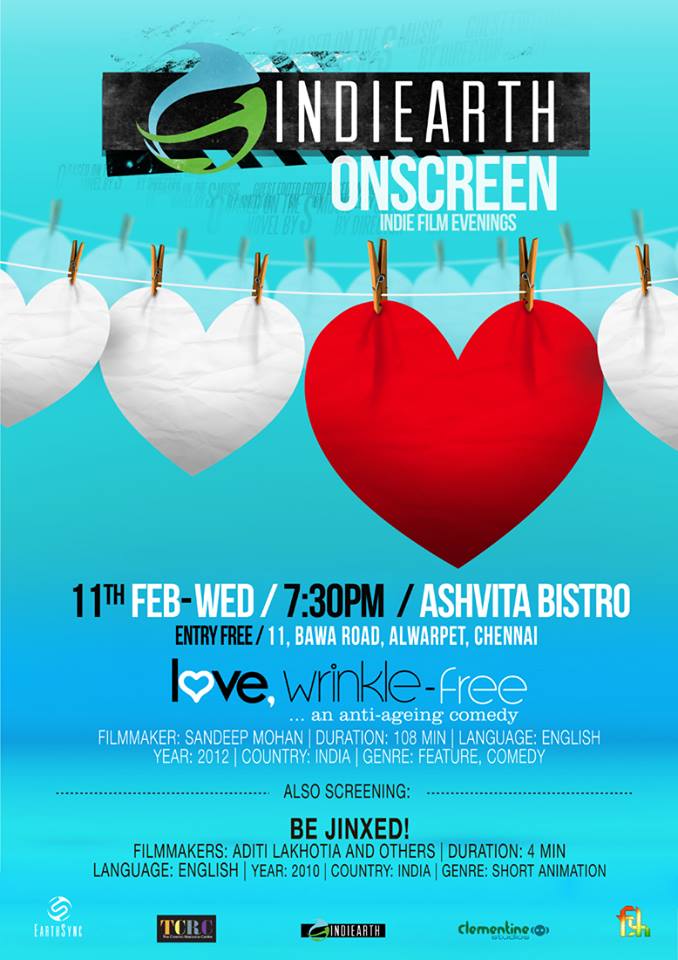
Date: 11th February, 2015 – Wednesday

Venue: Ashvita Bistro
Time: 7:30PM
Address: 11 Bawa Road, Alwarpet, Chennai
ENTRY FREE
SMS ” Short film ” with your name and email id to 9791088189.

Be Jinxed!
Filmmakers: Aditi Lakhotia and others
Duration: 4 min
Language: English
Year: 2010
Country: India
Genre: Short Animation

This is a 3D animated short film made about a frog named Timmie who wakes up inside a Science Lab only to realize that he is about to be dissected by a determined biology student named Minnie. Timmie tries to escape his fate with Minnie in hot pursuit causing a series of chaotic event in the laboratory.

Love, Wrinkle-Free
Filmmaker: Sandeep Mohan
Duration: 108 min
Language: English
Year: 2012
Country: India
Genre: Feature, Comedy

Set in Goa, “Love, Wrinkle-Free” is a story about Savio, a 38 year old senior area sales manager who works in an innerwear company. Savio’s mundane life is thrown out of gear with the unplanned pregnancy of his 46 year old religious wife Annie. complicating matters further is how their adopted teenage daughter Ruth (with asian/north east indian features), reacts to this pregnancy, and a chance meeting Savio has with a sensual traveling photographer Natalie, who wants him to do something “unique” for her.

At its heart, “Love, Wrinkle-Free” is an off-beat, light-hearted story about love going beyond cosmetic barriers – a universal theme that finds resonance across the world.

Trailer & More Info: http://www.indiearth.com/ViewTrailer.aspx?TrailerID=1c971996-b76e-471e-8694-77e165fc1512

Filmmaker Sandeep Mohan wil be available for post screening Q&A and open house discussion.


Short film screening by Indiearth in association with TCRC

short film screening

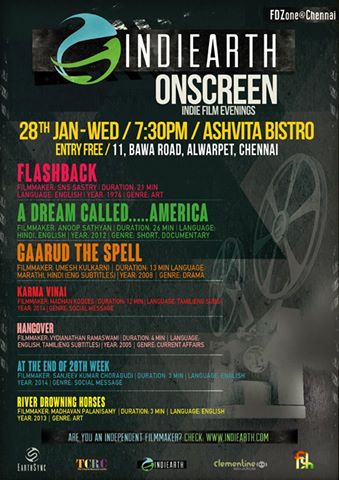
The next screening of short films by Indiearth in association with TCRC is happening at Ashvita Bistro,Chennai on the 28th of january 2015. Post screening, we will have a discussion on various styles and techniques involved in short film making with the filmmakers – Madhavan Palanisamy, Arun Mritunjay, Sanjeev Kumar, Madhan Kodees and Vydianathan Ramaswami who would be attending the screening.

ENTRY FREE!

SMS ” Short film ” with your name and email id to 9791088189.

The Short films to be screened are as follows:

1. FlashBack
Filmmaker: SNS Sastry
Duration: 21 min
Language: English
Year: 1974
Genre: Art

The film is a survey of the documentary film movement in India . We hear views of Films Division filmmakers S. Sukhdev and S N S Sastry before the Emergency and close to the end of their lives talking about documentary.

2. Gaarud The Spell
Filmmaker: Umesh Kulkarni
Duration: 13 min
Language: Marathi, Hindi (English Subtitles)
Year: 2008
Genre: Drama

The Spell gives us, in the form of a long tracking shot, a fascinating insight into what happens behind the doors of a block of tenements near the station in a small Indian town inhabited by people of differing backgrounds but all on the seamy side of life. Very briefly, we share their very personal lives. The camera takes us to the kitchens, the living rooms and even the toilets and the bedrooms of the inhabitants. The film won two national awards, one for best cinematography, and the other for best sound design. It received the best film award, the Golden Conch at MIFF, 2010.The film was also awarded the PATTON award for Best Indian Film at the 7th Kalpanirjhar International Short Fiction Film Festival, Kolkata.’Gaarud’ has been screened at more than 25 international film festivals, including the prestigious Rotterdam, and Vila de condo.

3. A Dream called……..America
Filmmaker: Anoop Sathyan
Duration: 26 min
Language: Hindi, English
Year: 2012
Genre: Short, Documentary

‘A Dream called America’ is a documentary made on Shahbaz, a 15 year old boy from Gujarat, India. He is the third among the five children of his father Aftab who makes a living by repairing cycles on a footpath. Shahbaz had studied in the US for a year on a scholarship, where he was hosted by an American couple. The one year he spent in US changed his attitude as he experienced a very comfortable and carefree life than his real home. After reaching India, he badly wants to go back and settle in US, leaving his parents in a dilemma.

Trailer & info: http://www.anoopsathyan.com/

Awards
– Best student film, Mumbai International Film Festival, India 2012
– Best documentary film, 4th International Children Film Festival – Lucknow, India 2012
– Silver award for Best student documentary, Indian Documentary Producers’ Association(IDPA) 2011
– Silver Owl for best documentary, CUT.IN Film Festival, Tata Institute of Social Sciences, Mumbai 2011

Official Selection
– Jeevika: Asia Livelihood Documentary Festival 2011 – NewDelhi, India
– Open St. Petersburg Student Film Festival ‘Beginning’ 2011 – Russia
– CHAGRIN Documentary Film Fest 2011 – USA
– OAXACA International Film Fest 2011 – Mexico
– Mumbai International Film Festival 2012 – India
– Al Jazeera International Documentary Film Fest 2012 – Qatar
– Globians DOC FEST 2012 – Germany

4. Hangover
Filmmaker: Vydianathan Ramaswami
Duration: 4 min
Language: English, Tamil (English subtitles)
Year: 2005
Genre: Current Affairs

This short film deals with the flip side of college festivals in terms of excess inflow of sponsorship revenue leaving behind a trail of unwarranted usage of plastic and other environmentally hazardous waste.

5. Karma Vinai
Filmmaker: Madhan Kodees
Duration: 12 min
Language: Tamil (English subs)
Year: 2014
Genre: Social Message

Two drunk friends meet a couple while passing through a bus stop at mid night. they drop them at bus stand, driver doesn’t care who are they as he was busy drinking while driving. when he sees both when they get down he gets disturbed.

http://www.indiearth.com/ViewTrailer.aspx?TrailerID=b10fd7dc-3d4a-40a9-9dbf-e1f5fae447f9

6. At the End of 20th Week
Filmmaker: Sanjeev Kumar Choragudi
Duration: 3 min
Language: English
Year: 2014
Genre: Social Message

‘At the End of 20th Week’ is a short film aimed at social awareness about Abortions and Female Infanticide. It portrays the pain of unborn female children. Our intention was not to get applauded or acclaimed by critics. Our intention was to take the veil of discrimination off the faces of people those who prefer sons over a daughters and who doesn’t accept life as a gift but choose to end it because it took a female form.

A beautiful young girl who is peacefully enjoying the warmth and love from an unknown person gets tortured by also another unknown person in different ways. The girl cannot escape the wrath and stays there suffering. The bed which she assumed as a safe place suddenly turns into an Inferno. The person who shared the love and warmth is no more protecting her. She dies in the end and then we identify that it’s not just another girl but she is the representation of a female fetus. And all the different methods are nothing but methods of Abortion. In the end the young girl being pulled out of the bed symbolizes the delivery method of taking a baby out of the womb. She is killed and then we see the statement “Hell begins for women in India ‘At the End of 20th Week’” It is at the end of 20th week one can identify the gender of the foetus. In most of the cases it can be easily identified at the end of 13th week which on the other hand depends on the position of the fetus. Hence the title was decided as 20th week because irrespective of the position of foetus.

7. River Drowning Horses
Filmmaker: Madhavan Palanisamy
Duration: 3 min
Language: English
Year: 2013
Genre: Art

This film blends elements of fashion and theatre to narrate a complex-relationship situation.


Indie Film Screenings by Indiearth in association with TCRC in Chennai

Indiearth


Indiearth and TCRC brings an Evening of Short Films:
A collection of freshly picked award winning films from the Films Division that speak of the various interesting nuances of short film making and documentary cinema; generating profound interest in captive audiences who are either new or seasoned non-mainstream film buffs.

Also included are 2 latest shorts by upcoming filmmakers of today. The screening will be followed up by a discussion led by IndiEarth on “Why short films and documentaries are important; to be made and screened to audiences”.

THROUGH A LENS STARKLY
Kuldeep Sinha
Genre: Arts, Cinema
Year: 1992
Duration: 33 minutes
Language: English

During the 100 years of cinema in India, the documentary films have acheived a tremendous growth and Film Division has played a major role in the movement of documentary films in India. The film details the systematic growth of documentary filmmaking.

YES WE MAKE THEM SHORT
Baba Mazgavkar
Genre: Mass Communication Media, Cinema
Year: 1990
Duration: 13 minutes
Language: English

A film emphasising the importance of short films which generallyare not seen by the general audience. Short films can also beinterestingly made. It is through short films that cinema has undergone various innovations and experiments.

INDIA THROUGH THE LOOKING GLASS
Siddharth Kak
Genre: Arts, Cinema
Year: 1990
Duration: 33 minutes
Language: English

Here is a history of the Indian documentary film – from thecoming of cinema to India at the turn of the century to its present development. Excerpts of numerous documentaries areincluded. This is was the opening film at the Bombay International Film Festival

ALFIYA
Satyarth Shaurya Singh
Genre: Shorts, Social Awareness
Year: 2014
Duration: 15 minutes
Language: English, Hindi (English Subtitles)

This is a film that explores a single day in the life of it’s protagonist, Alfiya. The film follows an indefinite progression: an oscillation between the social world and the inner life. Alfiya, a young girl in her twenties, grapples with blurred lines of perception which as likely stem from a ‘ delusional disorder’, or a phobia, to an unshakable dream state.

SILENT NIGHT
Rajdip Ray
Genre: Short, Social Awareness
Year: 2014
Duration: 3 minutes
Language: English

Christmas is the season of joy and giving. But amidst all the happiness and brightly coloured lights are the hidden pangs faced by more than 11 million street children in the largest democracy of the world. Silent Night takes the viewer on a trip around the streets of Calcutta, with one such child, on Christmas eve.