FIlmy Ripples- Inspired plagiarism in early music

By P V Gopalakrishnan

Music in a movie has so many sectionalized areas such as composing, arranging, conducting, re-recording etc. which are all attended to by different dedicated professionals in Hollywood. Whereas, largely, it is a one-man show, in the context of our movies where it is the responsibility of one individual, called “Music Director”, who is usually a brand name by himself, though he might have umpteen musicians specialized in some aspect or other, ably supporting him informally!

Often the Music Directors have strong lieutenants who are well versed in trained classical music to assist them, such as the late Pugazhenthi (of late K.V.Mahadevan).

We have, in the present days, a huge flock of Music Directors with their own creative talents. In stark contrast to this there were relatively few Music Directors in the past. However, those times, most of them were very strong in classical base, particularly in Carnatic Music. People like, Papanasam Sivan, C.R.Subburaman, G.Ramanathan, T.R.Pappa, S.M.Subbiah Naidu, Sudarsanam, M.D.Parthasarathi, Emani Sankara Sastri, Rajeswara Rao, Master Venu, S.V.Venkatraman and many more stood tall amongst the film music makers. Most of them have spent long internships with senior music directors of their times, worked alongside with them under their supervision and had learnt the ropes. They gave us outstanding music, which have withstood the efflux of time! In this context of comparison, the current music scenario seems a large departure.

There have been Tamil films with countless number of songs per movie. But you also had the AVM produced, S.Balachandar directed, thriller movie “Andha NaaL” devoid of any songs whatsoever, but with only background score.

Even in those days, with abundantly talented Music Directors around, there were films, which openly plagiarized western tunes or Hindi film music. These could have been plainly due to compulsion from the Producers or Directors. Or even introducing a new genre to cine goers as a marketing tool. After all, mimicking is a form of compliment to the original!

For instance, the AVM film ‘Oar Iravu’ (1951) had a hit song rendered by MLV, “Ayya Sami” under the baton of Music Director Sudarsanam. This song was based on the Hindi song “Gore Gore” from the film ‘Samadhi’, which was in turn based on the Latin American song “Chico Chico”, from the film “Cuban Pete”!

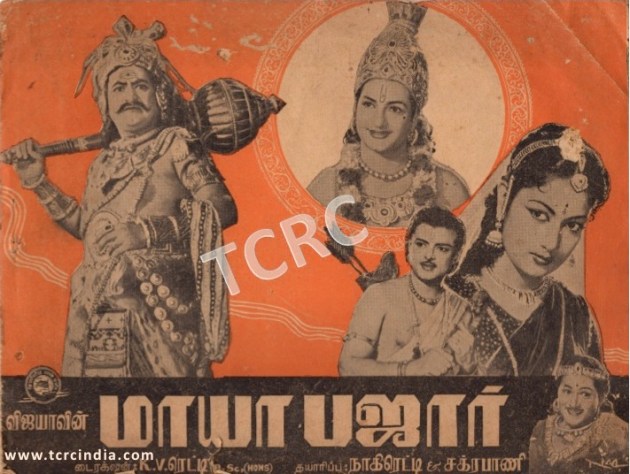
‘Kalyana Samayal Sadam’song from “Maya Bazaar” was inspired by the laugh tracks of the song “Laughing Samba”.

Maya Bazaar

Song Book of Maya Bazaar PC: From the archives of TCRC

I have read somewhere that some moviemakers in that era handed down a bunch of Western/Hindi film records to the prospective Music Director and advised them to adopt or at least adapt the tunes.

If a Hindi film was dubbed in Tamil, then there was the need to keep the orchestration & tune of original Hindi song, to be sung in Tamil by a local play back artiste. There were many Hindi films dubbed in Tamil where senior Tamil playback artistes were used to sing.

For instance, Vikki (G.Krishnaveni), wife of A.M.Raja, who had a long innings lasting over four decades & rendering thousands of songs in Telugu, Tamil, Telugu, Kannada, Malayalam, Hindi, and Sinhalese too, had sung in Raj Kapoor’s dubbed versions of  “Aah” in Telugu and Tamil. “Raja ke aayegi bharaat” (Shankar-Jaikishen) became “Kalyana oorvalam varum”.

Other than such dubbed versions, we have umpteen carbon copies of Hindi tunes.

Modern Theatres produced ‘Digambara Samiyar’ (1950) (Music: S.M.Subbiah Naidu – G.Ramanathan) had two popular songs based entirely on Hindi tunes. The run away hit song, ‘Oosi pattase vedikkaiyaka’ was lifted from the Hindi song “ Oh…dilwale” and “parudappa parudappa’ was a straight lift from Hindi ‘Laralappa laralappa’ from “ek thi ladki”.

In  ‘Avan Amaran’ (1958), Music Director T.M.Ibrahim set tune to the song sung by Sirgazhi & A.P.Komala, “Kalana minjathayya”, which was a carbon copy of from a popular Hindi tune “Ramayya Vastavayya” from Raj Kapoor’s Shri.420.

In fact one more song “Vaan mathi nee arivay” in the same film was also carbon copy of “Jaye to Jaye kahaan” rendered by Talat mehmood for Devanand in film Taxi Driver.

Another Tamil number sung by Jikki in the music of G.Ramanathan from ‘Komathiyin kadhalan’ (1955), produced by T.R.Ramachandran,“anaganai nikartha azhagan”, which was a straight lift of the very popular Hindi song of Music Director C.Ramchandra’s composition “dekh tere sansar kitna badal gaya Insaan” from the movie “Nastik” (1954).

G.Ramanathan was otherwise a very respected Music Director of repute, for his very popularly melodic carnatic based tunes.

Our highlighting such outright adoption of the then existing Hindi tunes is not to put down the concerned Music Director. This is simply to highlight a timeframe, in the anthology of Tamil film music, when such plagiarism was sometime routinely in vogue. If the Producer & Director insisted on copying an already popular tune those poor Music Directors never had a way out!

“Konjum Purave” by MLV was a clone of ‘Thandi Hawaain’ by Lata Mangeshkar, set to music by the legend S.D.Burman in the film ‘Naujawan’ (1951). The very same tune was lifted in Tamil film “Thai Ullam” (1952) as “Konjuum Purave”. Nevertheless the Tamil version became a huge hit, owing to the lovely tune as well as the silky voice of MLV. I remember having heard this song, as a child, being played all over in Madras, in the fifties. The music score was duo V.Nagaiah & Ramachandra Rao. Coming to the song, the “Konjum Purave” opens with the First violinst to the slow humming of MLV to the backdrop of vibrafone, but quickly transforms into a quick-beated foot tapper with its Dholak percussion . The intermittent BGM brings back the first Violinist’s melancholic strains before MLV goes on to her fast pace. Whereas S.D.Burman’s BGM arrangement is uniquely different, with Hawain Guitar for interludes in place of the Tamil version’s Violin. The young Lataji’s voice is more delicate than that of MLV.

M.S.Rajeswari rendered “Enni Enni Parkum Manam Inbam Kondaduthae”, composed by R. Sudarsanam. The identical tune was used in the song “Chup Chup Khade Ho Tho” sung by Lata under the baton of the duo Husnlal-Bhagatram, in the Hindi Film Badi Behen released in the same year. While Vazhkai was remade in Hindi only in 1951 as Bahaar, in which Vyjayanthimala made her debut Hindi films, it is not clear as to which version of the tune was the original.

Another interesting info: The Jewish Music Research Centre, Israel has published a CD containing the rare Jewish songs in Malayalam language representing the Jewish tradition that was in Kochi from where a lot of Malayali Jews migrated to Israel. One of the Malayalam songs in such CD “Enni enni tirttu dinam”  a Zionist song celebrating the Israeli independence from British, has been set to the tune of “Enni enni parkkum manam”.

Much later, Music Director Vedha was known in using popular Hindi tunes in his songs. His song “Oho ethanai azhagu irubathu vayathinile’ from Athey Kangal reminded you of ‘Pedal Pushers’ by Ventures.  Occasionally you could see even MSV using tunes from overseas in his songs. “Anubavam pudumai’ in Kathalikka Neramillai was based on Italian melody “Besame Mucho”. Puthiya Paravai’s ‘Partha gnabagam illaiyo’ reminded the American tune ”Sway with me”.

Even R.D.Burman’s ‘ Mil Gaya’ was a total lift from ABBA’s  “Mama Mia”. Shankar-Ganesh’s ‘Megame Megame’ too was a replay of the tune from a Ghazal by Jagjit Singh.

The list could be long.

For change there was also reverse copying, the popular American Hip Hop Band, “Black eyed Peas” took portions of Ilayaraja’s  “Unakkum enakkum anandam” by S.Janaki from ‘Sri Raghavendra’ and mixed it with one of their songs.

There have been Tamil film songs, which were kept as they were with little or no changes when the original Tamil movies were remade in Hindi. The instances are “Ilaya Nila” of Ilayaraja from Payanangal Mudivathillai was largely the same in Kalakar in the music of Kalyanji Anandji. “Muthu kulikka vaareegala” of MSV from “Anubhavi Raja Anubhavi” was retained by R.D.Burman in “Dho Phool”.

Adapting good musical notes from unknown cultures and blending it to our own music genres is after all is a creative service, I would personally opine. The outright lifting also perhaps served the same in times when Tamil films were not quite ‘connected’ with other languages and cultures, though within the country.

Ultimately, all songs have to be within the parameters of the seven musical notes, “Sa Re Ga Ma Pa Da Ni”!


Filmy Ripples:Nadaswaram in old Tamil films

By P V Gopalakrishnan

Nadaswaram played significant roles in some limited Tamil Films.

The nadhaswaram legend T. N. Rajarathinam Pillai, a major icon of those times, played an interlude in the movie Rajamukthi (1948), (Hero MKT & Heroine N. Janaki, later MGR’s wife). MGR, then a small time actor himself, was in a support role in this film. The film, made after the prison term of MKT, was shot in Prabhat Studios, Pune as MKT wanted to be away from the film circuit of Madras, in the aftermath of his release from prison. As such most of the technicians were Maharashtrians for this film. However, Rajamukthi, which was come back attempt for his film career, terribly bombed, witnessing MKT’s slide. (By the by, this film was the debut movie for M.L.Vasanthakumari as a playback artiste.)

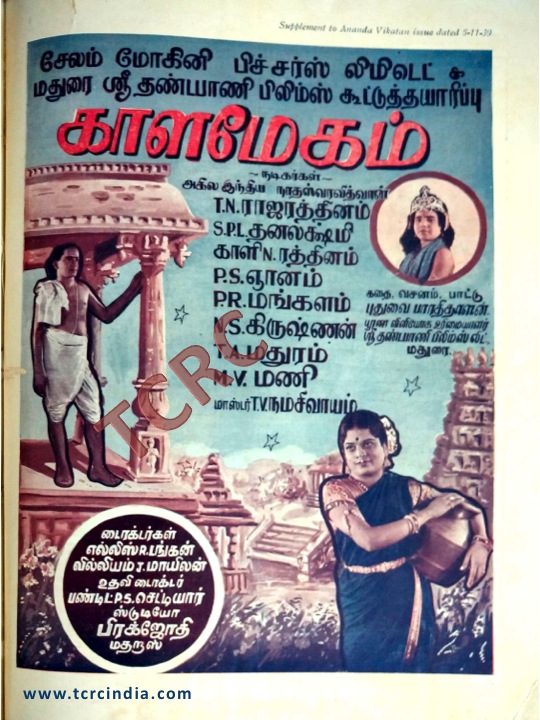
Talking of T.N.Rajarathinam Pillai, he himself acted as a Nadhaswaram player in a wedding sequence in the film Miss Malini (1936), paying Todi & rendering a song in Rithigaula. In “Kalamegham” (1940), written by Bharathi Dasan & directed by Ellis Dungan, he acted as a Nadhaswaram playing Hero, singing many songs.

Kala Megham

An ad of the film Kalamegham in Ananda Vikatan Deepavali Malar 1939 PC: From the archives of TCRC

Another leading Nadaswaram vidwan, Namagiripettai Krishnan played off screen, while the credit titles ran on the screen in the movie ‘Town Bus’ (1955) and not the usual film orchestra. It was in the beautiful Raga ‘Mohanam’.

Who can forget the iconic song, “Singara velane deva”, in the combo of S. Janaki’s voice & the Nadaswaram rendition of Karukurichi Arunachalam, another doyen of Nadaswaram world? It would be strange to learn that the full Nadaswaram tune, in AAbheri raga, by Karukuruchi Arunachalam was recorded at Madras for use in the film. On later thought the Director M.V.Raman decided to have also a song sequence using the already recorded Nadhaswaram tune. Then, the high-pitched S. Janaki was commissioned to sing by the Music Director S.M.Subbiah Naidu on the lyrics written to suit the tune. Janak’s vocals were recorded at Raman Studios, Bombay. In those days it was marvel that Sound Recordist Jeeva could manually inter-spread Janaki’s each line of singing to be succeeded by each line of the Nadhaswaram. Bravo on that!

Another song that copiously used Nadhaswaram in a film song was “ Vaaray en thozhi vaarayo” in the film “Pasamalar” by MSV-TKR, for a wedding sequence. It was an amazing blend of Nadaswaram with violins & mandolin in that number. Following this, wherever relevant the Music Directors have used Nadaswaram, such as ‘Oli mayamana ehtir kalam’ in ‘Pachai Vilakku’ (MSV-TKR) and ‘ Nadaswara osaiyile devan vandhu padugiran” in ‘Poovum Pottum’ (Govardhanam).

Pachai Vilakku(1).jpg

Song Book of the film Pachai Vilakku PC: From the archives of TCRC

However, when we talk of Nadaswaram with reference to Tamil films, perhaps, the immediate recall reference could be the iconic movie “Thillana Mohanambal”, a romantic story of a Nadaswaram Maestro Sikkil Shanmukhasundaram with a danseuse Mohana, written by Kothamangalam Subbu. The film is full of Nadaswaram music played off screen by the popular Nadaswaram duo M. P. N. Sethuraman and M. P. N. Ponnusamy from Madurai. In this film Sivaji Ganesan has no songs requiring play back support, as all his musical renderings were on the Nadaswaram, played by the duo.

Thillana Moganambal

The LP cover of Thillana Mohanambal PC: From the archives of TCRC

Director A.P.Nagarajan who had the opportunity of listening to MPN Bros, at a wedding in Karaikudi suggested them to Sivaji. Soon, the duo was in Chennai for their rehearsals at Music Director K.V.Mahadevan’s studio.

As per the MPN Bros, Sivaji Ganesan listened to them, as they rehearsed for the film, lying on Kannadasan’s lap and earned liberal appreciation from all before Director A.P.Nagarajan confirmed their selection for the film.

Asst.Music Director Pugazhenthi decorated the “Nagumomu” composition of Thyagaraja, a master piece in the film, with incredible sangathis. Impressed by their performance of Muthiah Bhagavathar composed English Notes at the 42nd birthday celebrations of Sivaji Ganesan, APN included that piece too in the film. The MPN Bros recalled that the scintillating ‘Nalandhana’ song took about nine takes.

The body language & acting of Sivaji Ganesan to the playing of Nadaswaram synced so well that nobody believed he was not playing it for real. In fact, when a Russian delegation met Sivaji Ganesan sequel to the film’s release, it was incredible for them to believe that he was only acting and not actually playing!

When the movie was released in 1968 in Madurai, the home town of MPN Bros, the brothers, the seventh generation players in their family, were literally lifted by the crowd for bringing immortal fame to the Temple City.

MPN Bros since played for major VIP functions & every invitation card used to specially feature their names as star attraction. Since Thillana Mohanambal the duo performed in only the film ‘Kovil Pura.’

After that M.P.N. Sethuraman passed away & in a gory accident. M.P.N.Ponnuswamy lost his jaw, besides his wife’s life.


Filmy Ripples : Film Directors of nascent stages of Tamil Screen

By P.V. Gopalakrishnan

A film’s narration is in the hands of its Director, besides its Editor & Cinematographer. While a Director’s role in filmmaking is second to none, he has to have teamwork with other functionaries.  The Directors are the professionals who see every sequence shot through the eyes of the ultimate cine goer. They are like the captains  of a ship and pilots of an aircraft.

These days, there is so much talent in the industry that we often witness the avtar of a new talent in film direction.

But think of the times when Cinema itself was in nascent stage & the Directors had the risk of experimenting with a pristine audience. In such a stage there were some outstanding Film Directors in Tamil Cinema who contributed to Tamil Cinema from its silent era, about whom we will talk here. We have excluded here the legend Ellis.R.Dungan, as we had covered in details about him earlier.

Sunder Rao Nadkarni

Sundar Rao Nadkarni, a Konkani from Mangalore, was an actor from Silent Film Era & later became an all rounder as editor, cinematographer, director and producer. He lived his formative years in Bombay which enabled him to delve deep into Marathi theatre and cinema. Thereon, Nadkarni moved to Coimbatore and finally Madras, where he settled down permanently. Inspired by the success of Sabapathy when AVM wanted to launch another comedy, he noted Nadkarni who went on to direct the Tamil Mega Hit film of AVM, En Manaivi (1942).

Following this success, Nadkarni also made other successful Tamil films. But his greatest hit was M.K.Thyagaraja Bhagavathar starred Haridas (1944), which set a record by becoming the first Tamil film to run for 110 weeks at the Broadway theatre in Madras.

Haridas

An ad for Haridas in Kalki Deepavali Malar 1943 PC: From the archives of TCRC

He directed all the top Tamil actors too during his active years, such as T. R. Rajakumari in Haridas (1944), Narsimha Bharathi in Krishna Vijayam (1950), and MGR and Savitri in Mahadevi (1957). (Nadkarni was the co-producer of ‘Mahadevi’).

Raja Sandow

unnamed

Raja Sandow PC: Unknown

K. Raja ‘Sandow’ (original name: P.K.Nagalingam) was one of the legendary film-makers right from the silent movie era. Besides, he was also a successful actor, producer and director.

According to Randor Guy, it was a sports enthusiast millionaire from Bombay, Omar Sobhani who took P.K.Nagalingam, for his athletic abilities, to Bombay, where he later met Director Patankar who gave him a break in ‘Baktha Bhodhana’ (1922), purely owing to his physique & good looks. Thus he started his film career. In fact, ‘Sandow’ in his name was appended for his physique, after the Hollywood strongman Eugen Sandow.

Between 1922 & 1943 Raja Sandow ruled the roost in silent  (such as ‘Veer Bhemsen’ (1923) & ‘The Telephone Girl’ (1926)) as well as talkie films in Tamil & Hindi. Later he took to film direction and even had scripted for talkies. The ‘Reformist’ Sandow brought many reforms to Tamil cinema & spearheaded making social themed movies with messages. He was also initially handling the Directorial part of the celebrated MKT movie, “Sivakavi” but was replaced by Sriramulu Naidu. A pioneer in the first generation of Indian film making, he also used to act in Tamil & Hindi till his sudden demise at his 48 in1943.

Y.V.Rao

2003082201400401

Y.V Rao PC: Unknown

Yaragudipati Varada Rao (born 1903) aka Y.V.Rao was a man of many parts that he was a filmmaker, actor and a film director. He was a visionary in his professional thinking & was a pioneer in making films in various Southern languages besides Hindi, right from silent movie era, when he started as an actor in silent films. Then he shifted to Madras in the 1920s & was cast as hero in many silent films like “Garuda Garva Bhangam”, “Gajendra Moksham” , and “Rose of Rajasthan”. Moving on, Y.V. Rao started his directorial debut with silent films, such as ‘Pandava Nirvana’ (1930), ‘Pandava Agnathavaas’ (1930) and ‘Hari Maya’ (1932).

Rao was at the pinnacle when he directed Tamil film, ‘Chintamani’ (1937) with MKT as its hero. The film created box-office records and proved to be a turning point in the annals of Tamil cinema and also in the life and career of Thyagaraja Bhagavathar.

Y.V.Rao married Actress Kumari Rukmini, through which they had a daughter, who would later come to be recognized as Actress Lakshmi.

Acharya

G. Raghavachari was a successful Madras High Court lawyer who was also active in the early Tamil Cinema writing and directing, without identifying himself for his work, as in those times cinema was a taboo in many minds, leaving Raghavachari to be anonymous in the movies he worked, including the popular film ‘Rishyasringar’ directed by him.

It was in 1943 at the insistence of movie mogul S. S. Vasan his name appeared as “Acharya” in the credit titles in Gemini’s ‘Mangamma Sabatham’.

During his days he was the most knowledgeable in South Indian Cinema and was involved in productions such as ‘Chandralekha’ (1948) & ‘Apoorva Sahotharargal’ (1949). As per Randor Guy, it was Raghavachari who directed the famous drum dance sequence in Chandralekha, using multiple cameras to film the sequence, though he walked out of the film in mid way.

T.R. Sundaram

T._R._Sundaram

T.R.Sundaram PC: Unknown

T.R.Sundaram (born 1907) was from a wealthy family & was a graduate from Leeds University. He was married to a Britisher, Gladys while in UK.
Sundaram entered Tamil films in the early 1930s & was involved in film production in partnership. Later he promoted his own company “Modern Theatres” in Salem. He became a successful studio owner & directed “Sati Ahalya’ (1937). Some of the films made by Modern Theatres included ‘Arundathi’ (1943), ‘ Sulochana’ (1947), ‘Utthama Puthiran’ (1940), Manonmani’ (1942), ‘Aayiram Thalaivangi Apoorva Chintamani’ (1947), ‘Adithan Kanavu’ (1948), ‘Digambara Samiyar’ (1950), ‘Manthiri Kumari’ (1950), ‘Ponmudi’ (1950), ‘Valayaapathi’ (1952), ‘Sarvadhikari’ (1951), ‘Alibabavum Narpathu Thirudargalum’ (1956), and ‘Pasa Valai’ (1956). T.R.Sundaram was a great & strict disciplinarian at work.

Manonmani

An ad of Manonmani in Ananda Vikatan Deepavali Malar 1942 PC: From the archives of TCRC

TRS gave breaks to many like M Karunanidhi & Kannadasan who became legends.Almost all the top stars have acted for Sundaram except the legend M. K. Thyagaraja Bhagavathar. Even the American filmmaker Ellis R. Dungan worked for him, directing ‘Manthiri Kumari,’ and ‘Ponmudi.’

Modern Theatres, one of the most successful film entities, has produced nearly two hundred movies in various languages. Out of this studio came out the first Malayalam movie, ‘Balan’. Besides, the first Tamil film in Gevacolor, ‘Alibabavum Narpathu Thirudargalum’ was also from Modern Theatres.

T.R. Sundaram who passed away in 1963.

K.Subramanyam

Subrahmanyam, a lawyer by profession, decided to go into movie making and founded in 1937 the Motion Pictures Producer Combines Studio where later Gemini Studios stood. He was a founding veteran of Tamil Film Industry & one of the founders of Nadigar Sangam in 1952.

He started his film career working on silent films directed by Raja Sandow. He started Meenakshi Cinetone, debuting his Directorial career with film Pavalakkodi, in which M. K. Thyagaraja Bhagavathar too debuted as an actor.

His remarkable movie was Balayogini, dealing with many social issues of the times. In 1938, he made Sevasadanam, advocating  woman’s empowerment, Bhakta Cheta, on the subject of untouchability and  “Mana Samrakshanam’, a war effort film. His best-known work was Kalki Krishnamurthy written nationalistic film Thyagaboomi, which got banned by the British government, for its explicit National flavor.

As to his personal life, he first married Meenakshi and later Actress S.D.Subbulakshmi. Through these two wed locks, he had children such as S. V. Ramanan, Dr Padma Subramanyam & Abaswaram Ramji, amongst others. His grandson S.Raghuram became a legendary dance choreographer in Indian film industry.

When Subramanyam’s studio was gutted in a major fire, the property came up for auction through a court order. At this juncture, Subrahmanyam persuaded S.S.Vasan to bid for it and enter film production. This is how Vasan’s Gemini Studios came into being.

Sriramulu Naidu

Sriramulu Naidu (born 1910 at Trichy) was another illustrious figure in the development of South Indian cinema. He was a great film personality who promoted as many as three motion picture studios in Coimbatore. In his younger days he was managing his railway retired father’s  bakery in Coimbatore. It was the early thirties when Tamil films were made only in far off Calcutta, Bombay or Kolhapur as till around 1934 the South did not have facilities for movie making. When Premier Cinetone Studio opened in Coimbatore, Sreeramulu Naidu joined the Studio & got trained in several aspects of film msking. Later he co founded the famed Central Studios in Coimbatore, where ‘Tukaram’ was made in Tamil 1938, in which the famous Carnatic Musician Musiri Subramanya Iyer debuted I Cinema. In 1941 Sreeramulu Naidu at Central Studios made ‘Aryamala’. In this movie, Naidu introduced M.S.Sarojini as the heroine. (Later he married her too). In this film Naidu learnt he Art of film making from the other capable co-technicians. When a Madras-based Narayana Iyengar promoted Pakshiraja Films at Coimbatore, Sreeramulu Naidu joined him as his agent and eventually became its Partner. But he quit that and founded the legendary Pakshiraja Studios at Coimbatore, where once Kandhan Studios stood.

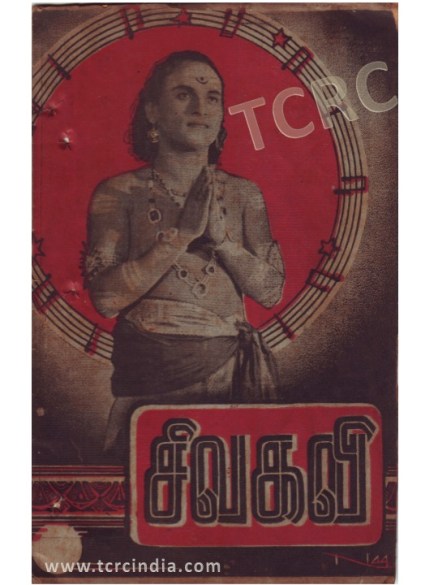
Naidu’s second film ‘Sivakavi’ (1943) with MKT in the lead was also a grand success. Raja Sandow initially directed this film but since he fell out with Naidu, the latter took over its direction.

SIvakavi

Song book of Sivakavi. PC: From the archives of TCRC

The other noted films under his direction included Pavalakodi, Kalyaniyin kanavan, Kanchana, Malaikallan & Maragatham ‘Malaikallan’ (1954) was made in various languages including Hindi. In Tamil version the pair was MGR- Bhanumathi & in Hindi the pair was Dilip Kumar-Meena Kumari.

If there was a Hall of Fame for the Film Industry in India, like it is in Hollywood, all the above illustrious as well as industrious men would have surely found their coveted places therein. The current Tamil Film Industry owe a lot to these relentless pioneers.


Filmy Ripples : Dancing Queens of Tamil Screen (Part 2)

By P V Gopalakrishnan

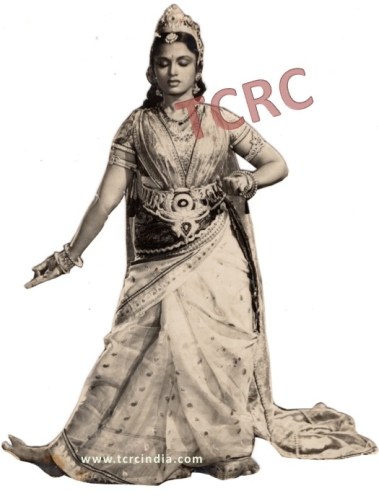
Vyjayanthimala

Vyjayanthimala, born  1936, got a break in an AVM’s Tamil movie, Vazhkai, when she was just fifteen. Director M. V. Raman, spotted the young Vyjayanthi in one of her Bharathanatyam recitals at Gokhale Hall, Madras & recommended to AVM. The movie was a great success and also was remade in Hindi as Bahaar (1951). She acted in a few more Tamil movies like Then Nilavu before moving on to a highly successful career in Hindi movies.

Here is her graceful dance sequence with the popular number “Nanda gopalanodu naan aaduvene” in the film ‘Vazhkkai”. The singer was MLV.


Travancore Sisters:

Travancore Sisters

The Travancore sisters in Ananda Vikatan 1966 PC: From the archives of TCRC

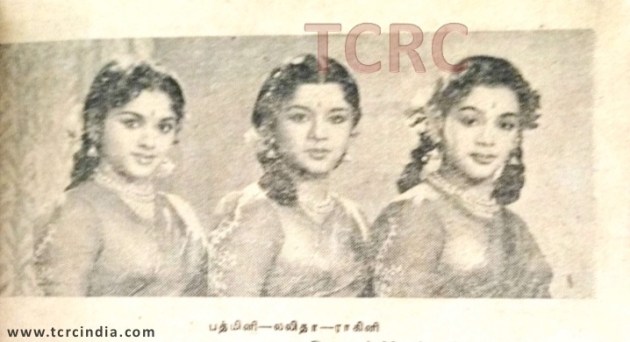
Several noted actors in the past were dancers and had performed on screen. The three sisters ‘Lalitha-Padmini-Ragini’ from Kerala came and ruled the Tamil industry in the forties, popularly known as “Travancore Sisters”.

Born to Thankappan Pillai & Saraswathiyamma in a large Nair family from Thiruvananthapuram, they took to arts at a very early age. Lalitha and Padmini began their training from Kathakali exponent Guru Gopinath.

When the family migrated to Madras they continued their dance training under the great Nattuvanar and Dance Director for films Vuzhavoor Ramaiah Pillai who groomed them to perfection.

The sisters debuted in the film ‘Kannika’ (1947) as dancers in Shiva-Sakthi dance, choreographed by Bharathanatyam Guru Vazhuvoor Ramaiah Pillai. This was the maiden movie produced by Sriramulu Naidu of Pakshiraja Studios, Coimbatore.

The sisters had an active performing career, both as classical dancers and as dancers and actors in South Indian cinema and Hindi cinema as well.

The highlight of “Vanjikottai Valiban” (1958) was the scintillating ‘dance duel’ between Padmini and Vyjayanthimala, which had come to be regarded as one of the best dance sequences in Indian cinema. Bharatanatyam Guru, Dandayudhapani Pillai, choreographed this.

Sai – Subbulakshmi Duo

The dancing duo sisters, Sai & Subbulakshmi were very popular with their brisk movements & performance like a spinning ‘Top’ in early Tamil  & Hindi films. This was in quick departure from the earlier dance formats, which were rather slow.

Sai – Subbulakshmi are said to be the off springs of P.A.Periyanayaki , a well-known play back singer of early Tamil films. This duo dancers were very well sought after & mesmerized the cine goers with their captivating dance numbers. Dancing in perfect harmony, the sisters seem to merge effortlessly with the song and the situation and it is easy to see why they were such a draw and came to perform not just in Tamil films but in a series of Hindi films too. They were trained under Muthuswamy Pillai and had tutelage in Kathak from well-established dance masters. They interpreted their dance compositions effortlessly their moves were very fluid. Sai of the duo was also the daughter in law of Actress R. Padma, (the beautiful heroine of “Sabhapathi’ & the then Lux Soap model ) and V.S. Raghavan  (Sound Engineer of AVM).

Here is a visual of the Sai-Subbulakshmi duo’s swift dance from the film ‘Malaikannan’.


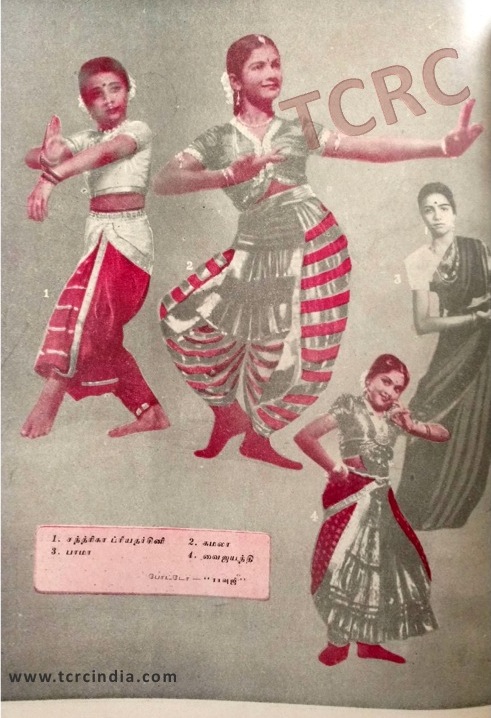
Kumari Kamala

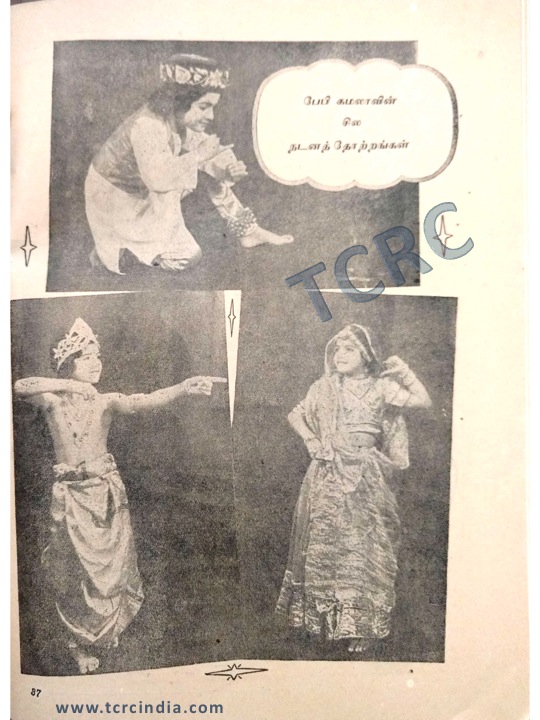
‘Kumari’ Kamala, as she is generally known even today, is a noted Bharatnatyam dancer and actress of yesteryears. Born in 1934 in a family of artists, where her sisters, Radha and Vasanthi were also dancers, she learnt Kathak from famous Lachhu Maharaj at a tender age. The Tamil film director A.N. Kalyanasundaram Iyer happened to watch her doing a dance concert and debuted her in ‘Valibar Sangam’ (1938) and later Ramanama Mahimai (1939), when she was a baby of four years then. So she was initially known as Baby Kamala. She also appeared as a child artist in Hindi films like Kismet and Ram Rajya in 1943. In Chennai she learnt Bharatnatyam from Muthukumara Pillai and Vazhavoor Ramiah Pillai. She appeared in Tamil movie, Jagathalaprathapan (1944) where she performed the Snake Dance. In her next film Sri Valli (1945), she played double role. Her film Nam Iruvar, based on Bharatnatyam theme made a great impact on audience. In 1953, Kamala performed during her coronation festivities of Queen Elizabeth II.

She has acted in more than 100 films belonging to Tamil, Hindi, Telugu and Kannada

She is the recipient of Padma Bhushan, Kalaimamani & Kendra Sahitya Academy award.Here is a popular dance number ‘Theeratha vilayattu pillai’ from the AVM film “Vedhala Ulagam”.


Waheeda Rahman

The wellknown Hindi’s heroine of yesteryears, Waheeda Rehman, was in fact originally from South, as her family lived in Chengalpattu near Madras. She and her sister learnt Bharatnatyam  under Guru Trichunder Meenakshi Sundaram Pillai in Chennai and Guru Jayalaxmi Alva, later in Bombay.

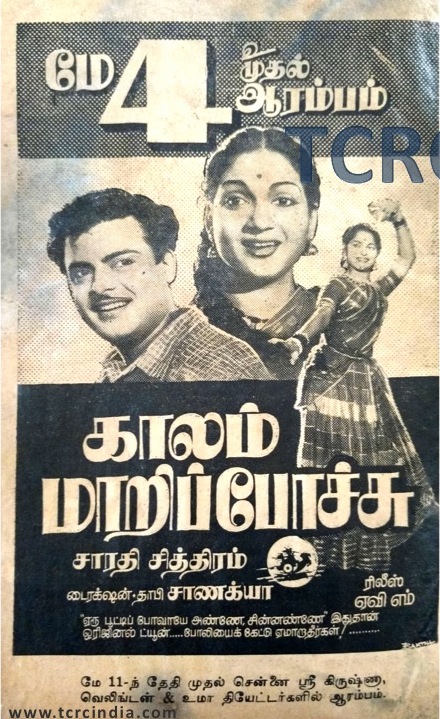
Kaalam Maari Pochu

An ad for the film ‘Kaalam MaaRi Pochu in the magazine Pesum Padam PC; From the archives of TCRC

She appeared as a dancer in movies like “Kaalam MaaRi Pochu” (1956), Alibabavum naaRpathu thirudargaLum” (1956). Here is the famous dance sequence of Waheeda in the former film.

Waheeda was proficient in Bharathanatyam. Guru Dutt, who cast her in the Hindi film ‘C.I.D’, spotted her. Then she went on to appear in many of his films. Her pairing with Dev Ananad was  very popular.

Rajasulochana

Rajasulochana, born 1934, was a classical dancer and film actress who debuted in Kannada film ‘Gunasagari’ in 1953, since which she acted in more than 250 movies belonging to different languages.

She learnt classical dance forms from various Gurus such as Lalithamma, K. N. Dhandayuthapani Pillai, Vempati Chinna Satyam, Krishnakumar, Vishnu Vysarkar, and Kalamandalam Madhavan. Rajasulochana founded her own Dance School, ‘Pushpanjali Nritya Kala Kendram’ in 1961 at Chennai.

Here is a dance sequence featuring her in the popular song “Vasantha mullai pole vandhu” from the film. ‘Sarangdhara’.


Down the time line, there were more trained & accomplished classical dancers who were also actors in Tamil Cinema such as E.V.Saroja, Jayalalitha, and VennirAadai Nirmala.

Tamil Cinema continues to feature dances to date, but of different genres to suit the modern tastes of cine goers. However, Dance as an Art Form, no doubt, continues to be patronized by the Films.


Filmy Ripples: Dancing Queens of Tamil Screen (Part 1)

By P V Gopalakrishnan

Dance and Tamil cinema have had a long association. And when you talk of early period Tamil movies mostly the dances were in classical Bharatanatyam format, choreographed by veteran gurus such as Vazhuvoor Ramaiah Pillai and the like.

About a hundred years ago, the dance was performed only by professional dancers either belonging to Devadasi tribes or Royal Courts. Even it was considered a taboo for women from family backgrounds to learn or perform dances. As such the same was not in the domain of commoner. It was the cinema, which brought dance forms to the public at large, through the movies. Leave alone the Films, today, in stark contrast, the dance forms are hugely popular with the public with no such past inhibitions.

Our films have had very many talented, graceful & beautiful dancing stars. It was an added advantage, for the female artistes, if they could dance well. Even otherwise, the not -so-good heroines at dancing too did dance, thanks to the choreographers who taught them to make a semblance of the dance, per se!

Kamala&Vyjayanthi mala

Kamal and Vyjantimala in Ananda Vikatan Deepavali Malar 1945 PC: From the archives of TCRC

In this write up we are covering some of the popular dancing stars of Tamil films in its early period.

In the bygone era of cinema, the dances were in slow pace giving more importance to mudras & abhinaya than brisk body movements, as in tune with the rest of the movie’s ingredients. You will agree, the following visuals would stand by my observations!

Hemamalini Arni

Here is a dance sequence by Hemamalini Arni, (in her thirteen, then) to the classical song ’Nadanam aadinaar” from the film “Kannika” (1947). In the music composition of Papanasam Sivan. Hemamalini Arni, who had tutelage in Bharatanatyam under Vazhuvoor Ramaiah Pillai, also had sung her own vocals in this song “Natanam Adinar”. Hemamalini Arni was gifted a Standard Car by Sreeramuly Naidu for her role in ‘Kannika’. Director M.V.Raman offered her a role in one of his films when she was seventeen, which she refused. It is said, Hindi Film’s ‘Dream Girl’ Hemamalini was named so by her mother, who was a family friend of Hemamalini Arni, in sheer inspiration of Hemamalini Arni,’s first name. Hemamalini Arni is settled in Hyderabad, running her own Dance School for Bharathanatyam.

M.S.Sarojini

In the same film “Kannika’ there was a song-dance sequence with Actor M.S.Sarojini dancing to the hit song of that time,  “Yaaro vandhu en kan pothinaar”, written & composed by Papanasam Sivan. The voices were of M.S.Sarojini & S.S.Mani (nephew of Papanasam Sivan). When the noted Guru Muthukumara Pillai was in Coimbatore in mid forties teaching dances to actors at a drama company, he trained Director Sriramulu Naidu’s actress wife M.S.Saroja for her lead role in the film ‘Kannika’ & Pillai himself too made a cameo appearance in the film. Muthukumara Pillai, who had trained legends like Rukmini Devi Arundale, Mrinalini Sarabhai and Kamala Laxman, belonged to the oldest generation of nattuvanars whose hereditary artistic dance practice was rediscovered in the twentieth century as the dance form Bharatanatyam.

T.R.Rajakumari

TR Rajakumari2

A photo of T R Rajakumari PC : From the archives of TCRC

The run away hit “Sivakavi” (1943), produced by Sreeramulu Naidu, featured M.K.Thygaraja Bhagavathar & the ravishing T.R.Rajakumari. the latter played the role of a Court Dancer who loved the Poet Hero. The song & dance sequence, “Kavalaiyai theerpathu” earned its place in the galaxy of immortal movie melodies of South India. T.R.Rajakumari was considered the Dream Girl of Tamil Films in the forties.

Here again, you might observe the dancing very laid back with its  slow pace, which characterized the films of early films.

Vasudhara Devi

Vasundara Devi (1917-1988), the mother of Vyjayanthimala, was a dancer in her own right as she starred & danced in notable films such as “Rishyasringar” and ‘Mangamma Sabatham”  (1943). 

Though she was a trained in Bharathanatyam dancer, the Director, Acharya of Mangamma Sabatham had used some of the hit songs Bollywood’s Carmen Miranda in the music of Rajeswara Rao in the film for this seductive song & dance sequence of Vasundhara Devi, as can be seen in this video.

Kumari Rukmini

Both the mother ‘Kumari Rukmini’ & grand mother ‘Nungambakkam Janaki’ of the talented actress Lakshmi of the 70’s cinema, were dancing stars in the early years of Tamil films.

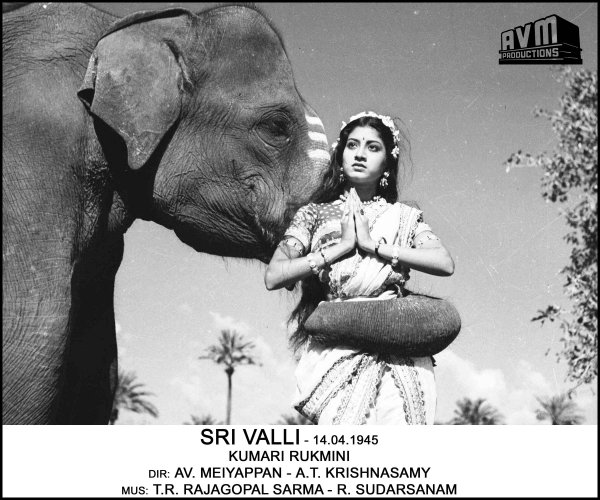
“Kumari Rukmini” debuted as a heroine in AVM’s Sri Valli (1945). As per Randor Guy, AVM originally wanted to cast Vasundhara Devi as heroine but since she interfered with the choice of Heros, he replaced his choice with Rukmini with a fresh talent, T.R.Mahalingam, as her hero.

Here is the song & dance sequence in the song ‘Sinthai arinthu vaadi’ from Sri Valli.

                                                                                                                               ( to be continued)

From Book to Celluloid : Valli Thirumanam

By Sugeeth Krishnamoorthy

Introduction: Of thousands of mythological stories passed on to us today by our ancestors, possibly no other story could have a more direct and closer bearing to us now than the story of Lord Muruga—who is the Native God of the ancient Tamil people. Valli Thirumanam tells the story of how Valli, a tribal girl, came to be Lord Murugan’s second wife. This story has been passed on orally through storytelling and staged plays, long before the print medium arrived. Even today, Valli Thirumanam continues to be one of the most popular plays in rural India, although, like most contemporary stages of its nature, they unfortunately smack of vulgarity,  rendering the ‘Bhakthi’ rather ineffective. Though, only a century ago, rural stage drama was an effective means for disseminating ‘Bhakthi’ propaganda and reaching out to the masses. it has sadly declined now.

Screenshot 2017-04-20 21.27.39.png

Valli Thirumanam by Shankardas Swamigal PC: unknown

Given its huge reach and its evolution over time, the story of Valli Thirumanam has undergone some minor changes here and there, the central theme—the challenges faced by Lord Muruga during his courtship of Valli—have been universally retained.

The play was also published in the literary form as well, and article reviews one such adaptation by Pammal Sammandha Mudaliar, for reference[1]. This play was published under the title ‘Valli Manam’ in the late 1930s. The second edition of this book was published in the year 1940. [2]

Story Synopsis : Nambirajan the tribal chief, fails to send Valli, his beautiful duaghter,  tend to the millet crops. The customary practice of the tribe is to send girls of marriageable age to look after and keep vigil on the crop, a portion of whose harvest is to be offered to Lord Subramanyam. The failure of tribal chief to carry out this duty is believed (by the Priest) to anger the Lord, which causes all crop to fail subsequently. Nambirajan, realising his folly, orders Valli, to leave for the forest immediately, taking her friend along. Valli requests Nambirajan to send the youngest of her elder brothers, ‘Kutti Anna’,along as well and the chief agrees. Kutti Anna, as we infer from the play, is possibly not of sound mind, and the playwright has modified this character’s dialogues[3] to infuse humour in the play.

During her sojourn, Lord Murugan appears in Valli’s dream and becomes the object of her affections. Firm in her love for him, she refuses to entertain other suitors. Lord Naradar who has come to earth, chances to hear a sweet voice and is surprised to discover that it belongs to a lovely girl albeit from the tribal community.[4] On enquiring he comes to know that Valli was born of noble birth to a deer that abandoned her in a tangle of creepers[5] immediately after birth. Nambirajan, who already had seven sons found her amidst the bushes and adoped her. In the past, Lord Murugan had helped Naradar, and so, as a token of gratitude, Naradar decides to offer Valli as a bride to the Lord as Guru Dakshina. When he reveals his plans to Valli, he is shocked at her downright refusal and at her claims of having fallen in love with a man who appeared in her dreams. Naradar vows to get Valli married to Murugan. Knowing that Murugan, already married to Deivanai (also proposed by him) would be alarmed at this second proposal, Narada goes armed with the plea that he has already taken a vow or sabatham and that it must be seen through. He prevails upon  Murugan to help him complete his sabatham, even if that means taking Valli against her own will.

To do so, Murugan then takes the avatar of a tribal hunter, who tries to woo Valli in the forest. When she doesn’t relent, he becomes a magic tree, and still later a lecherous old man whose every advance and proposal of marriage is rebuffed. Valli remains set in her adorations. praying to her Lord during every tribulation to protect her.

In the face of this failure, Lord Murugan seeks the blessing of his brother Vinayagar, hoping that this may help him achieve success. Assuming the guise of the ‘old man’ again, he invokes his brother who appears in the form of a wild rampaging elephant in the forests where Valli tends to her crop. Chased by the elephant, she calls out in fear to the Old Man. He promises to help on the condition that she marries him, to which she agrees, in desperation. Happy at having succeeded in his mission, he calls off the elephant (his brother), which vanishes.

When he seeks the reward of marriage, Valli, who has come out of her fear-crazed state,  refuses again. Defeated yet again, but not willing to give up yet, he goes against the rules of the game and recalls his brother in the form of the elephant, asking him to trouble her.

Vexed and helpless, Valli calls out to Lord Murugan for protection. Murugan, who can no longer ignore the earnest pleas of the unswervingly loyal Valli, makes the elephant, the ‘old man’ and the tree disappear and appears in their place, promising to take her away and marry her.

When Valli is chased by the Wild Elephant, she agrees to marry, and Murugan sends back the Elephant. She later refuses to marry him. This cannot happen, since Valli has given her word and promises could not be broken in Hindu mythology. So, here lies the catch.

When chased by the Wild Elephant, Valli says this out of fear – ‘Okay, I will marry’ ( She does not specify who to the ‘Old Man’, she only said that ‘she will marry’, and in her heart, she promises to marry only Lord Murugan). The happy old man sends back the elephant.

Later, when the Old man seeks her hand in marriage, she now says, I said ‘Okay, I will marry’ but did not say ‘Okay, I will marry you’.

So, technically, Valli has not broken her promise to the old man. It was the old man, who was fooled

When Valli seeks forgiveness for insulting the ‘hunter’ and the ‘old man’, he forgives her and sends her home. But he is not yet done with his trickery.

Taking another disguise, he goes to her father, the Tribal Chief, and warns of the schemes of a thief to kidnap his daughter. The Chief dispatches his sons to keep vigil. However, Murugan manages to steal into the house unnoticed (by the sleeping brothers) and takes off with Valli to Kazhagu Malai, setting the king and the brothers on a chase. Eventually, Murugan reveals himself to the family.

The family seeks his forgiveness, but Murugan refuses. He says that he is now the ‘son-in-law’ of the family and cannot forgive them, but will still be magnanimous enough of give them his blessings. Valli and Murugan are then married and live happily ever after.

Analysis : The story gives us elements of understanding of our own history. At some point in time, may be thousands of years ago, our ancestors were migrants. They were tribals and the concrete jungles in which we live today, were once agricultural lands and forests. In the play, we understand large forest lands are slowly being transformed into agricultural lands where ‘Thinai’ (millets) are grown. We surmise that lands were part of the forests as characters in the play mention the sight of wild animals like tigers, bears and wild elephants.[6]

The drama also reinforces the long accepted practice of polygamy. The happenings in this drama beg the questions: How could Lord Murugan, who was already married, accept another woman in his life? Why should Valli waive her rights to conjugal exclusivity, and share them with Deivanai? In the play, there is little attention given to Deivanai, and her reaction to this arrangement is only to be assumed as being favourable (as suggested by the fact that they all live together).[7] Naradar is not free of blame either, letting his ego overcome the fact that Lord Murugan was already married to a bride brought by him

The other aspect that is very clearly visible throughout the drama is the ‘male dominated society’ of its time. Murugan, Naradar, Vinayagar[8] are al male chauvinists at some level, and the women are accepting and submissive.

For instance, Valli seeks forgiveness to Lord Murugan, for shouting at his various avatars (the hunter, the tree and the old man), and Murugan graciously agrees to forgive her. But common sense says that it was in fact Murugan’s fault in the mater, and Valli was entirely innocent as she had no idea that it was her Lord Murugan taunting her. Logically, shouldn’t Murugan have sought Valli’s forgiveness?

This leads to the other interesting question. Why then, did Lord Murugan have to take various avatars to conquer Valli, and more importantly, taunt and frustrate her at various points? When he knew that Valli desired him, all that he needed to do was to go to her in his original form. Obviously, if that was so simple, there would be no story to begin with, so the author offers an explanation, which appears logical on the face of it:

Valli desires to marry Lord Murugan and tells Lord Naradar that she would marry only the man of her dreams. Now Murugan has to fulfill this wish of Valli. But Naradar, on being insulted by Valli’s outright rejection of his proposed (but undisclosed) suitor, vows to avenge his defeat. Without knowing who was actually inside Valli’s heart, he swore that Valli would end up marrying Lord Murugan and no one else. So, he goes to Lord Murugan and tells him that there is someone else in Valli’s heart, but he should conquer and marry her, come what may.[9] So, Lord Murugan, in order to appease both his devotees, has to play a balancing act wherein he has to take on various guises to taunt Valli (to humour Narada), but finally appears as himself (the only guise Valli recognises) to ask for Valli’s hand in marriage. He thereby fulfills the wishes of both Valli and Naradar making it a win-win situation for them.

Scientific Approach Analysis : “Valli Thirumanam’ can also be explained through a more scientific approach. By the standards of her time, Valli was definitely a ‘hot headed’ and  independent woman, who insisted on choosing her own life partner. It was natural therefore that the ablest of the opposite sex would fight it out and the winner would be the one chosen to produce through marriage the finest (healthiest) offspring. So, there is the need for an alpha-male in this context. Here, Lord Murugan plays that role.

The alpha-male ( Lord Murugan) must seduce and subdue ‘unyielding, stubborn, and egoistical’ female ( Valli) and win her over, all the while demonstrating his superior prowess through song, lyricality, poetics and histrionics, and heroism to convey his (physiological and reproductive) superiority as a suitor

Film Versions : Valli Thirumanam has been adapted many times to the film format. The iconic R.Natraja Mudaliar made the play a silent film in the early 1920s. It was made into a ‘Talkie’ in the year 1933. It was made as a film in the 60s, as well, but for this analysis, we chose the film ‘Sri Valli’ made by A.V. Meiyappan in the year 1945. Although the film bears a slightly different name, the core elements of the film are the same.
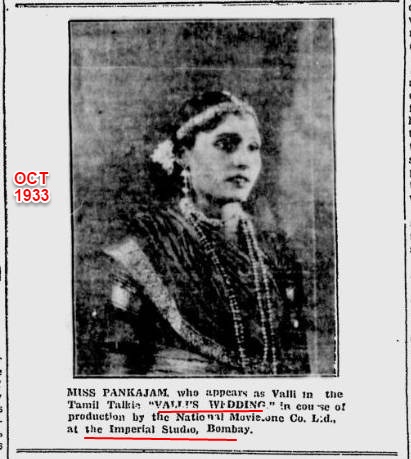
Image.jpg

Valli Thirumanam (1933) an ad from The Indian Express archives

T.R. Mahalingam plays the lead role of Lord Muruga, while the role of Valli is played by Kumari Rukmini[10]. The film’s script retains basic elements of the legendary script.

In the film, the hunting party of the tribal chief finds an abandoned baby girl. The chief picks up the girl and adopts her. The girl grows up into a charming maiden, who is subsequently sent to the Thinaipunam[11] —to tend to the chief’s crop —along with her friend and her youngest, elder brother ‘Kutti Anna’ ( also called ‘Killi’ in the film version.) This role was essayed by the legendary comedy actor T.R. Ramachandran, whose clever emoting and body language, suited the role ( of a man of stunted emotional and intellectual development) to a T.

The aspects of Lord Naradar meeting Valli, the subsequent challenges, Lord Murugan’s avatars as the hunter, the  magic tree and the lecherous old man have more or less been retained in the corresponding scenes of the film version. The film provides additional weightage to the scene where Valliis been chased by the wild elephant—a classic AVM company marketing strategy. There are minor changes to the script. For example, in the scenes where the Chief sees Valli with another man, feels ashamed and puts her in prison; where Lord Murugan rescues her, slays his pursuers (using his divine powers), and then revives them upon Valli’s earnest appeals; and where the chief then humbly requests Lord Murugan to accept his daughter in marriage, which Lord Murugan does.

The movie ends with the marriage of Murugan to Valli  and a still frame of Murugan with Valli and Deivanai, on either side.

Additional Commercial Elements in Film :

  1. Songs and Aesthetics: A film made on this scale should naturally have additional filler elements, unlike a stage play. The songs rendered by the lead pairs were great hits. In fact, the ‘Meiyyadha maan’ song is very popular even today. [12] The ‘Mayile Thoothu Sellaiyo’ song is also quite pleasant to hear. The scenes with the Thinaipunam set in a large tract of forest land is convincing and aesthetically pleasing as the studio sets have been designed to simulate large swathes of open land, with accents such as birds, like the peacock, which elevates it even further. Fortunately for us, a good print of this film has survived, the viewing of which will surely help us appreciate the film better.
  2. Comedy Track: In the original play, ‘Kutti Annan’ has no romantic interest, but in the film version, there is an attempt to create a love interest for him, in the form of Valli’s friend who is part of her entourage. Also part of this story line are the almost invariable comedy couple fixtures of T.R. Mathuram and N.S. Krishnan. Subamma (T.R.Mathuram) plays the role of a sanskaari woman who lives in wait for her athai paiyan[13], despite knowing that he is in love with Valli. Later, he realises his folly and with the help of Lord Muruga, he marries Subamma.
  3. Bharathanatyam: The late ‘30s saw a political and cultural movement strongly in favour of reviving Bharatanatyam[14]. Baby Kamala[15] had come to become the symbol of this revival in film. So, Bharatanatyam was used in many films, mainly as an additional commercial element, even if it had no logical bearing to the original script of the film. In this film, Kamala plays the role of the younger Valli, who performs Bharatanatyam to a song in the film,[16] although how a girl born and bred in a tribal community with no exposure to the art could do so, obviously defies logic.

Valli’s characterisation in the film: Consistent with that in the play, Valli’s portrayal is that of an  egoistic, dominant and an arrogant female in the film. In fact, she even calls the Vedan (Hunter) ‘da’ in retaliation when he called her ‘di’. Valli’s nature is accentuated by using Subamma’s polar opposite character as a foil. Subamma is very submissive, and the suggestive lyrics that she sings out also tells us about her, when she calls out to her Machaan (N.S.Krishnan) and tells him “I will even behave like a prostitute ( if need be) and enhance your pleasure”[17]. So possibly, the question being posed in the perspective of a male (chauvinist) of the time could have been, “if Subamma could be like this, why should Valli be like that?”, thereby adding more weight to Valli’s character in the film.

The film presents a great opportunity for us to understand various facets of life, not only of our own past, but of early Tamil cinema, of society and its thinchief. Since, the copyright of the film has possibly expired, the film can be seen on public access websites like YouTube. [18]

REFERENCES:

[1] Another version of ‘Valli Thirumanam’ available on the Internet has been penned by the legendary playwright— Sankaradas Swamigal. This version, along with the original song couplets which were played on stage, can be downloaded from the Tamil Heritage Foundation website: http://www.tamilheritage.org/old/text/ebook/ebook.html

[2] The book is available for free download on the ‘Internet Archive’, as the copyright of the book has likelu expired.

[3] While all the characters speak in Literature based Tamil, Kutti Anna speaks in Local Madras Bashai. “Annathai’ instead of ‘Anna’ for example. The character has now been replaced on stage by a dedicated buffoon.

[4] Elements of Racism – Naradar cannot believe that a girl from the Tribal community look so divine and have such a sweet voice.

[5] Valli Kodi (creeper)

– Hence, she was named Valli.

[6] Valli was once chased by a wild elephant, and ever since was in fear of wild elephants. Lord Murugan uses the knowledge of her fear to his advantage while seeking her marriage.

[7] Through an equivalent form of ‘divorce’ or otherwise.

[8] Who agrees to come in the form of a wild elephant and frighten Valli.

[9] Again, another example of male chauvinism— Naradar felt that upholding his vow of marrying Valli to Murugan, to preserve his ego, was more important than Valli’s desire to marry someone of her own choice.

[10] Actress Lakshmi’s mother.

[11] Forest Lands, where Thinai ( Millet) was grown.

[12] This song has even been satirised in local TV Programs that offer stand-up comedy.

[13] First Maternal cousin— It is customary for maternal cousins to marry amongst themselves in Tamilnadu.

[14] The political movement was launched against Devadasi women, who had allegedly added erotic elements to a traditionally pure dance form and polluted it. The advocates of the Anti-Nautch movement wanted to bring the Devadasi girls to mainstream society and purify and restore the dance as a symbol of culture and Bhakti. This has been described in the ‘Sevasadanam’ article.

[15] Baby Kamala was a child prodigy and her Bharatanatyam skills were used extensively.

[16] The older Valli ( Kumari Rukmini) also performs Bharathanatyam in this film.

[17] The phrase Daasiyai Pol Nadandhu Inbam Kooduven in the song ‘Amman Maganai Nee Aati Vekira’ is a typical male chauvinistic song.

[18]Film Viewing Link—https://www.youtube.com/watch?v=5oCVp7BDvkM

Filmy Ripples : Exotic Child Stars of bygone era (Part 2)

By P V Gopalakrishnan

M.N.Rajam

M.N.Rajam, born 1940, started as a stage actor when she was hardly seven years and debuted into Film with ‘Nalla Thambi” (1949) in the role of an orphan girl. This movie was written by C.N.Annadurai, produced by N.S.Krishnan & directed by the duo Krishnan-Panju. And before her fifteen years of age she had acted as a minor in as many as fifteen films, some of which were Pavalakodi, En Thangai, Ratha Kanneer, Kanavane Kan Kanda deivam, Mangayar Thillakam, Needhipathi & Town Bus. Since then she had acted with many leading stars of Tamil screen.

Rajam got married to the Playback Singer A.L.Raghavan in 1960. They have a happy family with their children & grandchildren well qualified abroad.

 ‘Baby’ Sachu

Kumari Saraswathi aka Sachu (born 1948) was another notable child star of early Tamil Cinemas. ‘Maadi’ Lakshmi & Bay Saraswathi were dancing duo in the fifties, the former being Sachu’s elder sister, with her “Maadi’ title referring to their upstairs residence opposite to P.S.High School in Mylapore.

Sachu debuted in the film ‘Rani’ (1953), at her five, by director A C Sami.  Sachu acted as the junior Bhanumathi in this film. Her next movie was “Sorga Vaasal”. Then more notable films such as Maya Bazaar, Avvaiyar, Shyamala followed where she acted along with many legends. In Avvaiyar she was the baby Avvai. The chubby-faced Sachu went on to fill the vacuum left by Baby Saroja.

Baby Sachu_Avvayar

Baby Sachu in Avaiyar PC: From the archives of TCRC

Her first film as heroine was “Veera Thirumagan” (1961) with Anandan, the father of Disco Shanthi. This movie, produced under AVM Banner, was directed by A.C.Trilokchandar, MSV-TKR scored music for this film & the duet ‘Roja malare Rajakumari’ from the film is evergreen to date.

Sachu had since acted in more than 500 films in five different languages and a few television serials. Her role pairing with the legend Nagesh in Sridhar directed ‘Kathalikka Neramillai’ was superb. After this, she did several comedienne roles along with major comedians such as Suruli Rajan, `Thengai’ Srinivasan, Cho, Thangavelu, M.R.R.Vasu and M.R.Radha in many films from 1964 to 1989. The late 1970s and 1980s saw her playing supporting roles in films Kamal & Rajani too. She moved on to the small screen in the 2000s and has starred in many serials & stage plays.

K.Balaje

The late Actor-Producer Balaje too entered films as a child star in Gemini’s Avvaiyar, donning the role of Lord Muruga. Balaje’s love for acting was right from his school days. In fact, Gemini Vasan identified him at one of his school dramas, before casting him in Avvaiyar.

1.jpg

Balaje as Murugan in Avaiyar PC: unknown

K.Balaje, in his early life, also worked as Production Manager with Narasu Studio (owned by Narasu’s Coffee people) at Guindy, where he became acquainted with Gemini Ganesan, Savitri and Sivaji Ganesan. He also ran ‘Balaji Nadaga Mandram’, which served as a launch pad for many veterans including Nagesh. He founded Sujatha Cine Arts & Sujatha Recording Studio. He was well known for remaking blockbuster movies from Hindi. Balaji, whose daughter is married to Malayalam Super Star Mohanlal, passed away in 2009.

Sukumari

The late Sukumari was a veteran actor with great track record both In Tamil & Malayalam screen.  But she debuted as a child star at her ten in the AVM produced Tamil film ‘Oar Iravu’  (1951) as a dancer in a cameo role in the initial part of the song ‘Vasantha Mullaiyum malligaiyum’ in the music of R.Sudarsanam, as featured in the video below.

Sukumari was a cousin of Lalitha, Padmini & Ragini, popularly known as Travancore Sisters. She again appeared in ta dance sequence much later in the film “Pasa Malar’ in the song “Vaaray en thozhi varayo” as an youngster.  She also used to act in Cho’s plays in the sixties. Her very many stellar roles in Malayalam screen are ever memorable.

A versatile actor, she acted the with big names of the industry, including Mamooty, Mohanlal, Rajinikanth, Kamal Haasan, MGR, Sivaji Ganesan, Nageswara Rao & Prem Nazir.

Wife of famous film director-producer late Bhimsingh, Sukumari received numerous accolades, including Kalaimamani Award, the Kerala State Award on four occasions, Padmashri & the National Award for the best supporting actress in 2011.

One can easily equate her to the late Thespian Manorama of Tamil screen. Sukumari succumbed to third degree burns in 2013.

E.V.Saroja

The dancing star E.V.Saroja debuted, as MGR’s kid sister, in the Film ‘En Thangai’ (1951), which was later remade in Hindi as ‘Choti Bahen’ by L.V.Prasad.

images

An image from the film “En Thangai”

Further her performance in the films ‘Gulebakavali’, ‘Veera Thirumagan’ & ‘Madurai Veeran’ were notable ones. In all, she had a track record of acting in some forty films & dancing in about a hundred films. She learnt Bharathanatyam under the famous Guru Vazhuvoor Ramaiah Pillai. She also choreographed dances. She was married to popular film producer and director T V Ramanna. E.V.Saroja passed away in 2006 at her seventy.

Daisy Irani

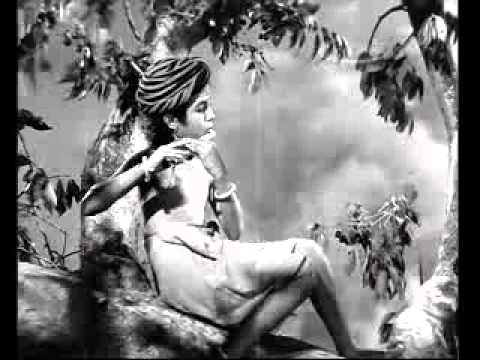
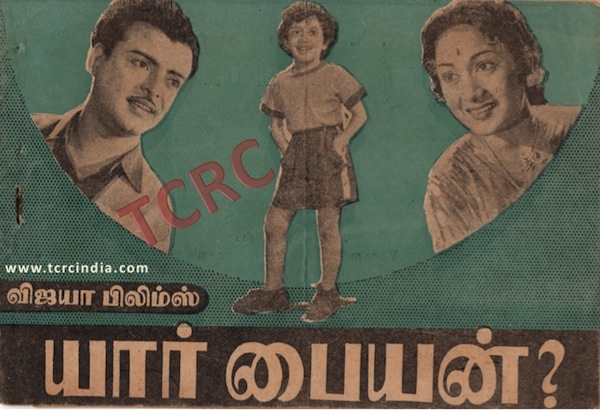
Daisy Irani, a Parsi girl child from Bombay film Industry was imported into Kodambakkam to play a crucial child role as a cute & smart boy in the Tamil Film “Yaar Paiyyan” (1957), screen-played by Sridhar, based from a well-known Bengali story, ‘Sekelar’. Daisy Irani, along with Gemini Ganesan & Savithri, contributed to the success of this film and Daisy Irani instantly became the darling child artiste of Tamil Cinema goers. “Yaar Paiyyan” was directed by noted filmmaker T.R. Raghunath, in the music score of S. Dakshinamurthi.

Yaar Payyan

Song Book of Yaar Paiyan PC: From the archives of TCRC

However, Daisy did not act in any other Tamil film as she got very busy with her Hindi Films at Bombay. In ‘Yaar Paiyan’ she had plum role along side even veteran Comedian N.S.Krishnan.

Born in a Parsi family of five children, as the little girl of just two-and-a-half years, Daisy Irani made her debut in a Movie as a male child. When Director Bipin Gupta was on the look out for a small boy to act in his movie, he spotted Daisy playing in her brother’s clothes and he mis­took her for a boy. Nevertheless it was a boy’s role. Much against the wishes of her conservative Parsi father who ran a Irani Café in Bombay, she was signed for her debut movie, duly fuelled by her mother. Then others like Satyen Bose & B.R. Chopra came forward and she became a hot property. As a ‘boy’ child star! Her first re­lease was the film Taksal.

After she had played a boy in films, they never let her become a girl, in Hindi films. She played a child artist role in movies like Hum Panchi Ek Dal Ke (National Award winner), Musafir, Sahara, Bandish, Ek Hi Raasta, Naya Daur, Jagte raho, Hum Panchhi Ek Dal Ke, Jailor, Qaidi No 911 and Do Ustad in the 1950s. She co-starred with great stars like Ashok Kumar, Balraj Sahni, Meena Kumari, Madhubala, Lalita Pawar and Nirupa Roy. Daisy became very busy doing three shifts of shooting. Travelling in plush cars to shoot she used to fall asleep, standing in the cars owing to fatigue.

Daisy Irani in an interview to Mumbai Mirror in 2012 recounted that she & her sister Honey Irani, having been thrusted into films, had no childhood, no education, as they couldn’t go to school. By the time they grew aware of their predicament, their childhood was gone. They made a lot of money, but got none of it, as their mother blew it all up. During her career as a child star, she said, the production staff used to physically abuse her by hitting & pinching if there was a need to cry in any sequence.

As Daisy Irani grew up the offers for cinema rolls as a child star stopped coming. Then she started doing stage shows.  By this time the movie. ‘Bachpan’ produced by her mother flopped incurring heavy in debts. The family lost their seven cars one by one.

At the insistence of her mother she acted as a heroine in Gujarati and Punjabi movies when she was hardly 14 years. However, to get a break in Hindi films was very hard, as she was known for her roles as a child star.

Then she fell in love with Director K.K.Shukla and got married to him. Following that she started her own successful Acting School in 1990.  Films such as Aakhen, Katti Patang, Talash, Arzoo are some of her works before she quit film scene.

Daisy’s sister, Honey Irani long gave up Cinema for marriage to Javed Akhtar. Daisy is the maternal aunt of famous film personalities such as Farah Khan, Sajid Khan, Zoya Akhtar and Farhan Akhtar.

….. and so, the legacy of Child Actors continues in our films.


Filmy Ripples : Exotic Child Stars of bygone era (Part 1)

By P V Gopalakrishnan

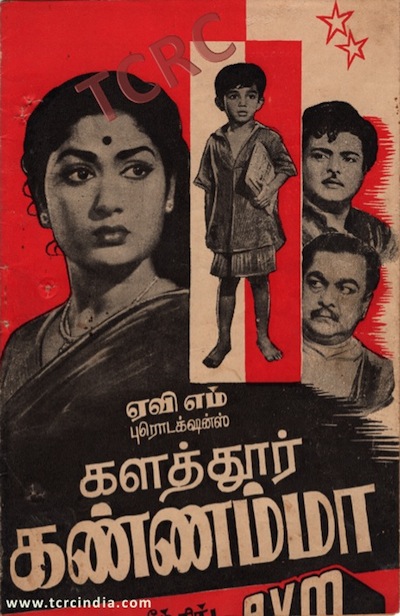
Child Artistes are not new to us as cine goers. Many mainstream Tamil film actors, such as Kamal Haasan, Meena, Sridevi, Shalini, Kushboo, Simbu, Hansika, and more debuted as child artistes. Besides, there are even more who were celebrities as children, but eventually moved away into oblivion. In our current context here, we will be looking at some of the ‘exotic’ child artistes who may not be even well known today but who, nevertheless, ruled the roost in the early ‘period’ films during the good old Black & White Talkie era.

Kalathur Kannamma.jpg

‘Kalathur Kannamma’ was the debut for Kamal Hassan as a child actor PC: From the archives of TCRC

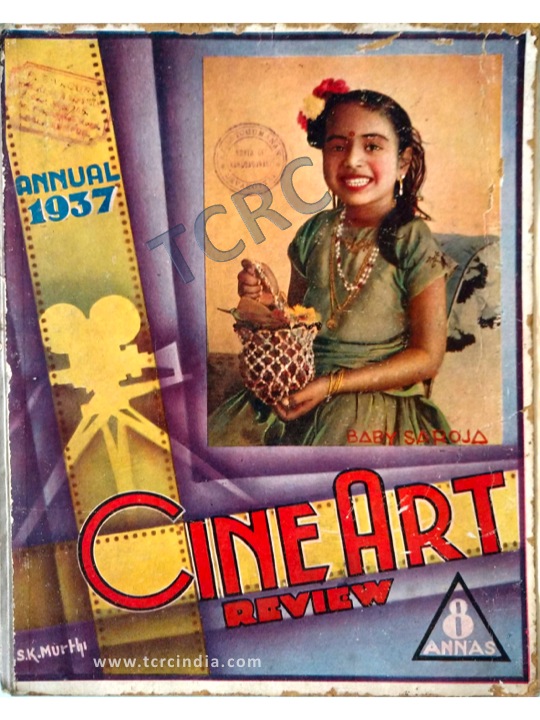
Baby Saroja – An Icon of 1937

Tamil Cinema’s first ever child star was “Baby Saroja”, who debuted as a six year old in “Bala Yogini” (1937), directed by K.Subramanyam who also was her uncle. Baby Saroja was the daughter of K.Viswanathan (then owner of Chithra Talkies) who was the sibling of Director K.Subramanyam. Baby Saroja became an instant craze amongst the moviegoers, as it was the first time they were seeing a child actor in films.  She was then compared to the Hollywood’s child star, Shirley Temple. In ‘Balayogini’, Baby Saroja rendered a lullaby “Kanne Pappa”. This little super star also did a Bharatha Natyam number to a Tamil version of ‘Krishna Née Begane Baro,’ written by Papanasam Sivan. Such classical dance was a first on the screen in those times, which she learnt from Gowri Ammal, the last Devadasi of the Kapaleeswara temple, Mylapore.

Baby Saroja1

‘Baby’ Saroja on the cover of Cine Art Review 1937  PC: From the archives of TCRC

Baby Saroja3

‘Baby’ Saroja featured in Ananda Vikatan Deepavali Malar 1937  PC: From the archives of TCRC

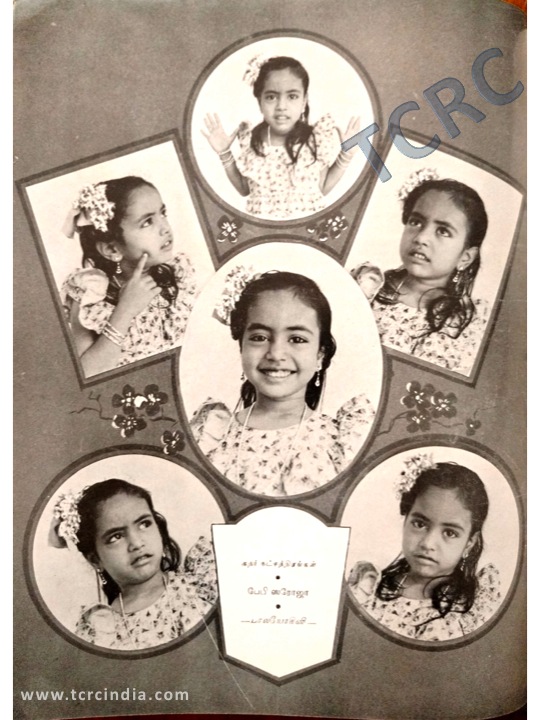
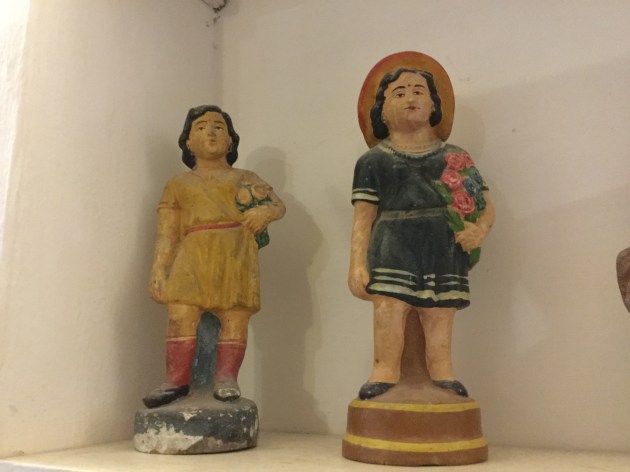
As she took the movie audiences by storm, Baby Saroja was a household name, not only in Madras but also even amongst the Tamil speaking community of far off Singapore, Malaya & Ceylon. Many named their female newborns as ’Saroja’, after this kid wonder of talkies. Japan-printed colour picture cards of Baby Saroja were distributed among her fans. Commercial establishments used her picture & name on their products such as Soaps, Matchboxes etc (of course with no endorsement fee given to the child). There were even ‘Navarathri Kolu’ dolls named after Baby Saroja, some of which, I understand, can still be found with the antique dealers of Chettinad. Baby Saroja became so synonymous with Tamil folklore of those times, that Lakshmi Viswanathan (a cousin of ‘Baby Saroja’) wrote in her Article “Shirley Temple of India” in The Hindu dated 10th July 2013, that Tamil soldiers who were joining the army during World War II, apparently sang a song, “Baby Saroja, Naan warukku poren Née kavalai padade” (meaning: Baby Saroja I am going to War but you do not worry), taking leave of Baby Saroja.

img_1266

‘Baby’ Saroja Navratri golu dolls. PC: Sriram Venkatakrishnan

Baby Saroja further acted in two more movies, “ Thyaga Bhoomi” & “Kamadhenu” which were very popular. In the film ‘Kamadhenu’ (1941), Saroja’s Mother & Father too acted in lead roles. After that Baby Saroja hung her boots & did not act in more movies, but not without leaving an indelible mark on Tamil Screen of yester years. Indian cinema has seen many child stars. But none attracted the sobriquet: Shirley Temple of India,  “Baby Saroja’, now in her eighties, lives in Chennai as Saroja Ramamrutham.

‘Kumari’ Rukmini

Rukmini, daughter of Dancer ‘Nungambakkam’ Janaki (who did roles in films such as Seetha Vanavasam, & Lavangi) and mother of Actress Lakshmi, debuted as a child star at her very young age in the film “Harischandra” (1935), as young Lohidasan. This, in fact, was an accidental debut, in the sense, Nungambakkam Janaki, who also had a role in Harischandra, was staying in a hotel room at Calcutta adjacent to where T.P.Rajalakshmi, the film’s heroine, was put up for the shoot.  As the producers of the film were still on the look out for a child actor to feature as Lohidasan, T. P. Rajalakshmi suggested baby Rukmini for the role, which was accepted by Rukmini’s mother. And, thus, “Baby’ Rukmini entered films in a male role as a child actor!

Following that, Rukmini acted as a child star in in Hindi Film ‘Jalaja’ too alongside the veteran, T.P.Rajalakshmi. Later both Nungambakkam Janaki as well as her daughter Rukmini together featured in the movie ‘Baghya Leela”.

Director K.Subramanyam cast her in Balayogini (1937) where she got noticed better.

It was in AVM film, “Sri Valli” (1945), she became a heroine & the credit titles named her as “Kumari” Rukmini”. In this film, both T.R.Mahalingam & Rukmini sang in own voices. However, after the release of the film on feedback from various sources, AVM decided to remove the sound track of Rukmini from the songs she had rendered & had playback singer P.A.Periya Nayaki sing for her.

B2ZIXBOIgAAnDox

PC: Unknown

Rukmini got married at her seventeen to Director Y.V.Rao, while the shoot of ‘Lavangi’ was in progress. through which they had a daughter, who became Actress Lakshmi. Later, the couple separated.

Later, between 1961 & 1975 Rukmini appeared in various Tamil such as Kappal ottiya Tamizhan, Idayathil Nee, Karnan, Vennira Aadai, Kandu konden Kandu konden movies in small roles.

Rukmini passed away in 2007.

S.Varalakshmi

Do you remember the song “singara kanne un thaen oorum” from the Block Buster Veera Pandiya Katta Bomman? Yes, the sweet voice belonged to S.Varalakshmi, the singing star. She too started her career as child artist in Balayogini (1937), when she was nine years old. She also acted in Seva Sadanam (1938) along with M.S.Subbulakshmi, followed by a role in Parasuraman (1940) opposite T.R.Mahalingam. But her major role was in Modern Theatre’s box office hit ‘Aayiram Thalai Vaangi Apoorva Chinthamani’ (1947).

In all, Ms. Varalakshmi acted in nearly four hundred films and worked with all the leading stars of Tamil and Telugu cinema, including M.G. Ramachandran, Sivaji Ganesan, Gemini Ganesan, Kamal Haasan and Rajinikanth.  She also won critical acclaim as a talented singer, having started singing at her seven and has sung for over a hundred songs in various films.

She married film producer A.L.Srinivasan, the brother of Kannadasan. S.Varalakshmi breathed her last in 2009 at her 84.

T.R.Mahalingam

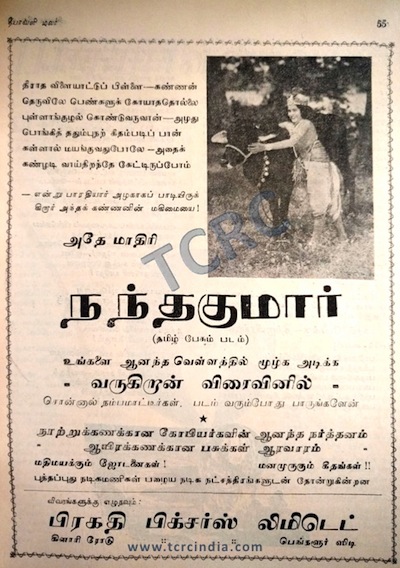
T.R.Mahalingam (TRM) started very young as a child in Theatre with his acting & singing, his self-professed role model being S.G.Kittappa. TRM was a Star in Special Dramas of those days & had been playing the role of a young Lord Krishna. When AVM planned the movie “Nandakumar’ they cast the fourteen year old T.R.Mahalingam for the very same role of a young Krishna. Thus Mahalingam debuted into Movies with AVM’s production ‘Nandakumar’ (1937).

TR Mahalingam

An ad for Nandakumar from Ananda Vikatan Deepavali Malar 1937 PC: From the archives of TCRC

Moving on, he acted in several films, which, however, did not do well. It was only with AVM’s ‘Sri Valli’ (1945) he got into fame, again. It was in this film that he sang his all-time famous high-pitched number ‘Kaayaadha Kaanagathe Nindrulaavum’ with an amazing artistry that is envied to this day. The film, which celebrated Golden Jubilee in many theatres, made T.R.M, a super star.

He successively acted in two more Mega Hit movies of AVM, released immediately after Indian Independence, namely, ‘Naam Iruvar’ (1947) & ‘Vedhala Ulagam’  (1948). In the former TRM captivated cine goers by his immaculate rendering of the patriotic songs of Mahakavi  Subramanya Bharathi. In fact, on a visit to the cinema hall in Madurai where Naam Iruvar was running, his dancing fans physically carried him. In “Vedhala Ulagam’ too there were Bharathi songs in the stellar voice of T.R.M. Mega hit film  ‘Gnana Soundari’ (1948) produced by Citadel Films followed next. Closely following the success of Gnana Soundari, Citadel produced ‘Idhaya Geetham‘ (1950) with TRM & T.R.Rajakumari, but the film did not do well. (To digress a bit, Citadel Studios was then located in Kilpauk, in the same place the RBI quarters stand today, on Poonamalli High Road, close to Ega Theatre.)

Then TRM produced & acted a string of movies himself such as Mohanasundaram, Chinnadurai, Machcha Rekhai, Theruppaadakan and Villaiyaattu Bommai.  While acting in ‘Mohanasundaram’ with S.Varalakshmi as his heroine he had a crush on her, but it did not materialize further. This totally crippled T.R.M financially & he was totally abandoned by those around him. But Kannadasan cast him in his own movie “Malaiyitta Mangai’ which gave TRM a respite in life. But this too was short lived. Soon TRM found himself out of place as the era of singer-actors became extinct. The new era cinema started looking different with new breed of actors & singers. TRM refused to accept this change but was still adamant about the tradition of actors singing their songs. He sporadically got roles in films like Thiruvilayaadal (1965), Agathiyar (1971), Thiruneelakhandar (1972) and Rajaraja Chozhan (1973) .His song ‘Isaithamizh Nee Seida’ in ‘Thiruvilaiyadal is a well remembered one.

Thus he went into oblivion & returned to his native, returning to Stage Plays. TRM passed away in 1978 at his 58. But even to date his enchanted voice is remembered fondly by many.

‘Kumari’ Kamala

“Kumari” Kamala, born in 1934 in a family of artists, debuted in the film ‘Valibar Sangam’ (1938) and later in ‘Ramanama Mahimai ‘(1939) as Baby Kamala, while she was only four years old. She also appeared as a child artist in Hindi films like ‘Kismet’ and ‘Ram Rajya’ in 1943. Those days this young danseuse was very popular in the movies.

Baby Kamala

‘Baby’ Kamal featured in Kalki Deepavali Malar 1942 PC: From the archives of TCRC

Kamala is a noted Bharatnatyam dancer, though she later learnt Kathak & Hindustani music. She had acted in more than a hundred films in Tamil, Hindi, Telugu and Kannada. Kumari. She appeared in Jagathalaprathapan (1944) performing the ‘Pambu’ Dance. In her next film, ‘Sri Valli’ (1945), she played a double role. Her film ‘Nam Iruvar’, based on Bharatnatyam theme, made a great impact on audience. In 1953, Kamala performed during her coronation festivities of Queen Elizabeth II.

She was briefly married to cartoonist R. K. Laxman. In 1980, Kamala moved to New York permanently where she started a dance school, “Shri Bharatha Kamalalaya” in Long Island.

                                                                                                                                  (To be continued)


From Book to Celluloid : Thaneer Thaneer

By Sugeeth Krishnamoorthy

The late 1800s saw a cultural renaissance in what is Tamil Nadu today. Several art forms, including traditional dances and performing arts  like Sathir, Poi Kaal Kuthirai, Thol Paavai Koothu, Bommalatam, and so on, saw a revival, that was not just culturally driven but also strongly driven by the nationalistic movement. Legends like U.V. Swaminatha Iyer discovered and published literature that sought to explain the culture, history and life of the ancient Tamils.

The origins of modern theatre began in the second half of the 19th century. Its success can largely be attributed to two doyens: Sankaradas Swamigal and Pammal Sammanda Mudaliar. These two dramatists strongly defined theatre, as it would be, in the years to come.

While most of early theatre was based on puranic themes, several of the plays Mudaliar was involved in writing had modern themes adapted or inspired from English plays or based on contemporary social commentary. Several of Mudaliar’s works like ‘Sabapathy’, ‘Manohara’, ‘NallaThangal’, ‘Yayati’ and ‘Dasi Penn’ were adapted to film formats. There were also nationalist’ plays attempted to be made into film, like Inbasagaran[1], based on Kovai Ayyamuthu’s stage play of the same name. The early actors of the Tamil talkies were also sourced from stage[2], as they had the ability to sing and thereby influence the audience through their melodious voice, although the initial acting during the first decade of Tamil cinema, was, at times, very rough and crude. The oldest surviving film today, is Pavalakkodi[3], which D.V.Balakrishnan, says was a filmed version of a stage drama.

‘Free India’ was reeling under immense poverty. This became a hot-bed for intellectuals and writers, who inspired by communist principles sought expression through literature and film. Subsequently, several films in the 60s, 70s and early 80s were made that were based on interlinking themes of unemployment, poverty and communist ideology.

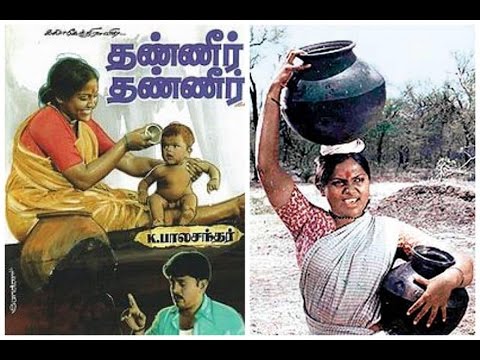
Thanneer….. Thanneer is one such story. This story, penned by Komal Swaminathan,resulted from a discussion among a group of intellectuals in the late 70s, on what could possibly become a defining ‘Tamil stage drama’ in a global arena[4]. Interestingly, the writer rated this work as his best. The play, is based on the characters who live in a remote village, and their daily struggle to fetch water— a basic commodity, that eludes them.

It is their trials and tribulations that form the story. Using water as a metaphor, Swaminathan has woven a tale about the social injustices faced by marginalized sections of society. The writer challenges these inequities by asking, for instance, why villagers are allowed a ration of only 1kg of sugar, whereas urbanites are permitted 5kgs. More over, being denied the basic necessities of life existence like Water, The writer also, at various points in the story, points out how the ‘communist party’ targeted these groups, winning their allegiance through their overt challenges of authority using tools such as ‘unions’ and ‘boycotts’. The author also makes references, sarcastically at times, to the impending “River Integration” schemes’ and the presence of Seemai Karuvelam marams’ surrounding the village. For a state that has no natural river springs and that is dependent on three rivers from neighbouring states, these issues are only too relevant even today.

Another aspect that the writer brings in vote-bank politics. This divisive strategy used by politicians is as if not more relevant today as it was then. The writer speaks of the plight of these groups of people, exploited by politicians and left high and dry after they come to power.

When Vellaisamy, a nomad with a murky past, comes across this tiny village and its people reeling from  drought, he tells the villagers, “If the State and the Administration will not help you, then you must take things into your own hands.”   He leads the villagers and is yet one among them, helping them launch a campaign to regain their rightful claim to that vital fluid, water. And when all seems lost, he provides the villagers, hope and the courage, to do the unthinkable—build a canal; break the hills and divert the water towards the village[5]. When the villagers attempt to do this, the State opposes, puts an end to an undertaking that will alleviate the suffering of the villagers, instead declaring it unlawful. What follows is the climax of this play.

Although the play seems most obviously influenced communist ideals, it is easy to see past it objectively to the dominant and apolitical issue of human rights violation. It makes one wonder what crime the poor villages committed to be denied, even the most basic necessities? The author concludes, adopting a communist stance that if these things continued to happen, social revolution will be inevitable.

hqdefault

K.Balachander, made this play into a movie with the same name -— “Thanneer…Thanneer’. Keeping the basic structure of the play intact, Balachander has made a few changes that have added value to the film. In stark contrast to other Kollywood directors of his time, K. Balachander was known to give a lot of importance and ‘central’ roles to his female leads. In this story, there is only one female character, Sevanthi. Balachander has altered her role significantly, to make her the mother of a new born, who is spending her early motherhood at the place of her birth. This enables Sevanthi[6] to be in the village ‘Athipatti’, the place where the story takes place, and thereby play a central role in the film.

At various points in the original play, one can observe a generational difference in thinking between the older men, who prefer being subservient to their boss and the younger rebellious group, lead by Goval. By introducing a female character, Sevulli, at the ‘cheri’, and creating a love interest for Goval, K.B has also tried to raise issues about caste-based geographical segregation, which was and is quite common in rural India. By making Sevulli, a victim of paralysis, Goval’s love interest ,K.B brings the issue of ‘poisoned flouride well’,  beside the cheri[7]into focus in a powerful way. Unlike in the movie, Swaminathan’s play does not dwell too much on this part of the story.

There are two other important characters in this film. Being the most educated person in the village, Vaidhyanathan, the school teacher represents the ‘experience of age’ and yet at the same time, has the power to command respect amongst the hasty youth. Originally a nomad, Vellaisamy, a run away convict, finds the village ‘Athipatti’ as his new home. He becomes one of the dynamic leaders of the village and offers solutions and plays a major role in the attempts of the villagers to bring water to them. His presence in the village grows to  a point where the villagers on coming to know of his past, offer to protect him rather than hand him to the police, inspite of a bounty on Vellaisamy’s head. Balachander has retained the essential elements of both these characters, right across the film.

Aligning with the theme of the film, K.B also introduces several dramatic elements that add more value to the story, as film is a visual medium. There are certain scenes—such as the one where the poosari tricks Sevanthi into fetching a pot of water, threatening to otherwise curse her; the man who opposes the village’s rules and enters the polling booth to drink as much water as he can; , the conversation between Sevanthi and the engineer who asks for water for his Jeep; and the one where the Nayakar in his thirst laps up the soda he brings with him in his vehicle—that are apt examples of the use of such elements to elevate the film.

Another invaluable aspect of this film is the music. Without wasting footage, several dialogues in the film, which were cut out at the editor’s table were, used in the title track, as audio fillers. There is also the clever use of silence to convey climactic emotion — such as when the rain clouds betray the expectant village-folk ( with the camera panning on Sevanthi), when the womenfolk with their mud pots block the passage of the politician, and when a battalion of police face-off against the shocked village-folk at the site where the mountain is to be broken. The film makes good use of natural sounds like baby-cries, breaking of wood and wooden pots, among others. The short folk songs, which were there in the original play itself, keep with the tone and mood of the film.

The end climax sees a couple of major changes. In the play, the teacher ‘Vaidhyanathan’ continues to take classes for the children in the evening, but in the film version, he volunteers to go to jail claiming he was responsible for hiding Vellaisamy. Another surprising element is that, in the climax, Sevanthi removes her thaali’ and throws it at her husband Alagiri, who threatens her. She tells him to put it around his neck, along with the several medals that he is going to receive after arresting Vellaisamy. This scene would have invariably added more value to the ‘characterization’ of Sevanthi. It would have added weight to K.B’s portrayal of ‘the independent woman’, but alas this scene was omitted.

The death of Vellaisamy is tragic, yet poetic. The man who started things with a ‘hiccup’ and went on to attempt to save the village, thanks to Sevvanthi’s act of kindness, did not get any water when he was chased by the police and died of thirst. Goval, who was shown to have a rebellious streak,joined similar groups. And in an unresolved pre-climax, several people leave the village while those that chose to live behind, lived in hope.

The film ends with a montage shots:government officials engaged in water conservation programmes’ and ‘River integration’ discussions;. Nayakar going to the village and pleading with his caste members (the same ones who boycotted him earlier) for votes and. Sevanthi laughing to his face; and finally a paddy field covered with flags of political parties.

The writer of the play must have had tremendous foresight and politico-social insight if the dominant themes of the film continue to be relevant 35 years later. The film “Thanneer…Thanneer” does the play justice by staying true to its content and spirit while adapting it to the medium and the ethos in an evocative and sensitive manner. The movie is sure to leave you with a lump in your throat!

Watch the screening of this film at Ashvita Bistro on the 17th April at 7.30pm

Notes:

[1] Inbasagaran’ was made into a film, as well. Unfortunately, it met with a tragic fire accident just before release. The reels were lost and the film was never released. The film was produced by Mahalakshmi Studios, a film production company.

[2] Successful actors like M.K.Thiyagaraja Bhagavathar, S.D.Subbulakshmi, N.S.Krishnan, S.V.Sahasranamam all came from the stage.

[3] Pavalakkodi (1934) and Sathi Sulochana(1934) are the oldest surviving Tamil Films. Both of them have been preserved at the N.F.A.I

[4] Komal Swaminathan’s own words : ‘Thaneer.. Thaneer’ – Vanathi Pathipagam.

[5]Such an event has happened for real in our History. The Mulla Periyar dam was built to divert water from Upper Kerala to Lower South Tamilnadu, a century ago. Less than a tenth of the water has been diverted, yet this water which reaches Tamilnadu takes care of the drinking and irrigation needs of 6 districts in Tamilnadu. The Dam was built by a British man, John Penny Cuik, who is revered in Theni District.

[6]In the original play, Sevanthi is married off to a policeman, Alagiri and leaves the village after marriage. She returns for Aadi, and plays a prominent role in the climax. She does not have any children in the play.

[7]The play tells us that the people of Athipatti did not use the water of the cheri, because the well was poisoned. Alternatively, we may speculate that they refused to do so, also because of caste- based differences. However, there is a scene in which Goval and his friend, drink water from this ‘fluoride well’ due to unbearable thirst, as no water sources existed in the vicinity.


Major Chandrakanth : From Stage to Celluloid

By Karthik Bhatt

Major Chandrakanth

Song book of Major Chandrakanth PC: From the archives of TCRC

‘Major’ Sundarrajan was one of Tamil cinema’s most well-known character actors.  His dialogue delivery which mixed English and Tamil phrases was sophisticated and unique and rather unsurprisingly, he was the first choice when it came to portraying characters such as a rich father. For someone with no connection to the armed forces whatsoever (he was employed with the Telephones Department), his identity as ‘Major’ Sundarrajan was came about thanks to Major Chandrakanth, the successful stage play and movie.

Tamil cinema over the years has seen many directors who can be considered trendsetters. One of the biggest names in the list is that of Dadasaheb Phalke awardee, late Kailasam Balachander. Born in Nannilam in 1930, Balachander developed a keen interest in Tamil theatre at a young age and as a boy used to write, act and direct small skits in his village. He moved to Madras around 1949-50 after graduating from the Annamalai University and a brief stint as a teacher and joined the Accountant General’s office. It was around this time that the amateur theatre movement, which would see its heydays in the 1960s and 1970s had started to take roots, with the likes of United Amateur Artistes, Triplicane Fine Arts Club, Mylapore Fine Arts and Indian National Artistes (run by VS Raghavan) regularly performing to packed audiences. Added to this were the recreation clubs of the various Government and private sector offices. The Accountant General’s office had an active recreation club and soon K Balachander started becoming part of the theatre circuit, writing and acting plays.

‘Major’ Chandrakanth was born in the Accountant General’s office. A new Accountant General from Bengal had taken charge in Madras and a function had been organised to welcome him. The mantle of writing a play to be staged on the occasion fell on K Balachander, who decided that it had to be in English to ensure that the Accountant General understood the play. The story, titled “Courage of Conviction” revolved around a blind Major. K Balachander played the role of the protagonist and received great appreciation for his authentic portrayal of a blind man’s mannerisms.

K Balachander decided to expand the play into a full length script for Ragini Recreations, the troupe that had been formed by his friend PR Govindarajan (later Kalakendra Govindarajan) in 1958. By this time he had developed close friendships with people such as S.Raman (later more famously known as ‘Nair’ Raman), Harikrishnan, ISR and Venky. They were an integral part of the plays staged by the troupe. Over the next few years, the troupe would attract the likes of Nagesh, Major Sundarrajan and Sowcar Janaki, making it one of the most formidable ones on the amateur theatre circuit.

The story of ‘Major’ Chandrakanth dealt with an honest and morally upright blind army officer who gives asylum to a murderer on the run from the police for having killed a person in a fit of rage. The victim had been his sister’s lover, who had cheated her on promise of marriage leading to her suicide unable to bear the shame. On the case to find the murderer is the Major’s elder son, a police officer. It then comes to light that the person who had been murdered was the Major’s younger son and that both the Major and the murderer were unaware of each other’s identity for a long time. The story ended with the officer arresting the murderer and the Major for having harboured a criminal.

The role of the Major was played by Sundarrajan, who was then performing small roles with the Triplicane Fine Arts, while that of the elder son was played by Venky. Govindarajan donned the role of the younger son. Interestingly, the character of the sister was an invisible one with only references to her being made onstage and was developed into a full length role only in the movie, while the brother’s character was played by Gokulnath. The play was a stupendous success and before long, it had been adapted into a movie. The adaptation was in Hindi, the movie Oonche Log. Produced by M/s Chitrakala Films and directed by Phani Majumdar, it won the Second Prize in the Hindi movies category at the 13th National Film Awards for the year 1965. It was Feroz Khan’s first major hit, where he held his own against veterans such as Ashok Kumar (who played the Major) and Raaj Kumar. The Tamil version of the movie was produced by AVM Productions and came out the following year. Directed by K Balachander himself, the movie was a stupendous hit.

The play led to two other christenings. Venky, who was then employed in the American Consulate was named Srikanth after the character by K Balachander. He would go on to feature in several other plays and movies by Balachander and become a popular actor in the 1960s and 1970s. A decade or so later, Balachander gave the name of the younger son’s character to a person who today is the country’s biggest superstar, Rajinikanth.