I DIRECTORS: THE CAPTAINS — MASTERS AND COMMANDERS WITH AN IMPACT TO LAST THE AGES
2. The 1930s— Part 12(2)
(2)T.R. Raghunath
While last episode we talked about Raja Chandrasekhar this episode is about his younger brother T.R. Raghunath alias Thimatchipuram Rajagopal Raghunath whowas born on 16 July 1912.
Few of the films that T.R. Raghunath worked as a film maker/Technician during 1930 to early 1940:
1935: GNANASOUNDARI (Assistant Director)
1936: DHARA SASANGAM (Sound Recordist)
1936: KIZHATTU MAAPPILLAI (Short Film)(Director)
1939: JOTHI (Director)
1942: Thamizhariyum Perumal
Raghunath graduated from Madras University but moved to his better interest, Film making. He started his film career as a sound recordist later went on to become a director. He worked under his elder brother initially before moving on to do films independently.
He worked as an Assistant director in Gnanasoundari and as a sound recordist in Dharasasangam. Both were directed by the pioneer A. Narayanan, often referred as the Father of south Indian Film business who started the south India’s first talkie studio Srinivasa Cinetone
Raghunath directed independently for first time through a short film Kizhattu Maappillai. Kizhattu Maappillai was shown along with Usha Kalyanam directed by another forgotten revolutionary film maker K. Subramanian who introduced many talents to the Tamil Film Industry
An advertisement of MURUGAN TALKIE FILM COMPANY mentioning KIZHATTU MAAPPILLAI
From the magazine ANANDA VIKATAN DEEPAVALI MALAR 1939
PC: From the archives of TCRC
In 1939 he directed the film Jothi also titled Sri Jyothi Ramalinga Swamigal. The film was about the life of saint Ramalinga Swamigal of Vadalur. Script was written by Pammal Sambandam Mudaliar, he along with Shankardas Swamigal pioneered the early years of Tamil theatre. His elder brother Raja Chandrasekhar supervised the film making and guided in the screenplay process as well.
Madurai Mariyappa Swamigal wrote the lyrics and scored music for songs. The songs became popular and were released in Odeon records owned by another pioneer, A.V. Meyyappan. The film went on to become one of the major hits of those days and ran in cinema halls for 18 weeks.
He made the film based on the Sanskrit poet Kalidas, Thamizh Ariyum Perumal. Story Screenplay and dialogues were written by Elangovan. Produced by RM. Ramanathan Chettiar, at Newtone Studios in which he was an investor. The film had M.G. Ramachandran alias MGR in the lead role who went on to become one of the biggest stars of those times and later Chief Minister of Tamil Nadu. M. R. Santhanalakshmi as female lead played dual role in the film.
An advertisement of THAMIZH ARIYUM PERUMAL
From the magazine KALKI DEEPAVALI MALAR 1942
PC: From the archives of TCRC
Thamizh Ariyum Perumal had 22 songs. All were written by Udumalai Narayana Kavi. The music was credited in the name of Saraswathi Stores owned by A.V. Meyyappan. The film was distributed by Thyagaraja Films Limited owned by M.K. Thyagaraja Bhagavathar. Inspite of having lot of positive factors the film failed at box office.
T.R. Raghunath had a wonderful career directing more than 30 films with most of them being successful. After directing MGR in minor roles during 1940s he directed him again as a leading star in Raja Desingu and Vikramadithan. He was later appointed as President of Madras division of FDI (Film Division of India)
[To be continued] We’ll be back next week with more hidden treasure from the history of Tamil cinema. Stay tuned!
About the Author:
V.V. Prasad is a Electronics and Communication Engineer based from Chennai. He is currently involved in the role of a Researcher and Archivist in THE CINEMA RESCOURCE CENTRE. He takes care of the non film materials like Photographs, Magazines, Lobby Cards, Song books etc of the archives. Cataloguing them and digitizing them are part of his current work. His interests and passion lie on the research of Cinema particularly South Indian Cinema.
It isn’t uncommon, especially in Indian Cinema, to see other forms of art, like music, modified to supplement film. When initially dance performances, short plays, and boxing matches were added in between to make films more attractive, these turned into modern dance numbers and fight sequences incorporated into the story as films evolved. Traditional art forms were altered with changing media and the advent of new forms of media in the early 20th century, first with silent films and later with talkies. Performance mediums like music and dance now had the opportunity to be displayed to a larger audience, and films had the chance to use existing art forms to aid their storytelling. Taking music and film’s evolution together, they formed a new genre of film songs and later opened up playback singing, which involves recording audio tracks of one person singing and substituting it for the actor’s voice, as a new profession.
Sound first came to Tamil cinema as the four-reeler(the length of a film was indicated by the number of reels long it was), which consisted of sequences of semi-classical songs and dances. With sound came music, and Papanasam Sivan is said to be the maestro who made film music popular in South India in the 1930s.
Working Still from the Film Naveena Sarangadhara Featuring S.D.Subbulakshmi Naveena Sarngadhara was directed by K.Subramaniam had the songs composed by Papanasam Sivan PC: From the archives of TCRC
The songs in most of the early talkies were songs adapted from drama companies for film, which brought singers to the cinema rather than actors who couldn’t sing. Since early film musicians were drawn from the stage, stage performers clearly brought an influence, but most classical compositions had to adapt for the screen. To make films socially acceptable to the upper classes, they looked for a change through the use of Carnatic music to make it a more “respectable” medium. Since the advent of talkies, the world of cinema was seen as vulgar to the extent that barely anyone wanted to be associated with the industry. Sambur Vadagarai Subbaiah Bhagavathar was the first from the classical music scene to enter cinema along with Mahajapuram Viswanatha Iyer in Nandanur in the 30s. However, the film didn’t do well despite having two Carnatic music personalities when the negative caught fire and the filmmakers were accused by an insurer of sabotage. The star-singing era stretched from the 1930s into the 40s, when actors had to be able to sing as well as act, and the songs were recorded with an overhead mic while orchestras played behind the mic; at the same time, the ‘Tamizh Isai’ movement was born which contended that musicians from Tamil Nadu were only to sing in Tamil and not Telugu. The movement had ties to the Dravidian Self-Respect movement as well.
Working Still from the Film KAMBAR (also called KALVIYIN VETTRI) A film that S. V. S. Bhagavathar acted and sung in PC: From the archives of TCRC
During the 1940s, cinema-centred music culture was created from the emergence of film songs. The songs were shorter and had influences from multiple music genres, and only the features of a raga that made it identifiable as such were maintained. For a while, since Tamil talkies were made in studios in Calcutta, the influence of Western music that had seeped into Calcutta started affecting Tamil and Telugu films as well. The resulting South Indian film songs were a blend of traditional Carnatic and Hindustani music, Folk music, and Western pop. With music being mass-produced in South India for films and making it more accessible, the new genre of film music threatened traditional hierarchies. It marginalised the standing of Carnatic music and musical drama that had so far maintained a position at the top of the “hierarchy” of music in society.
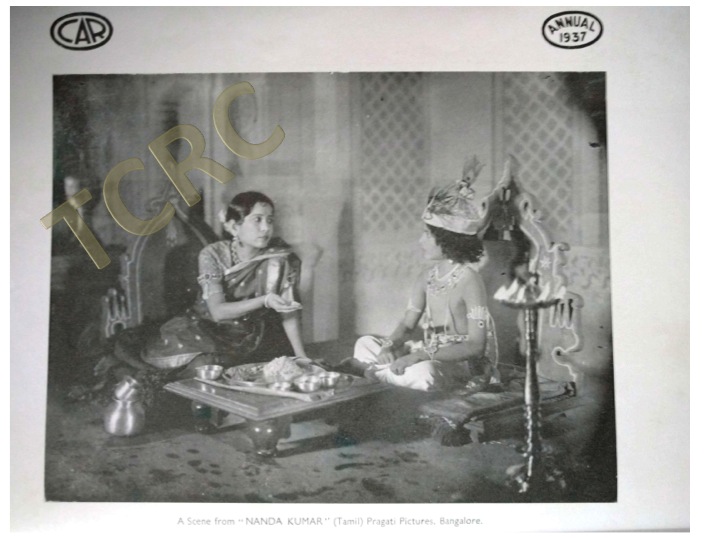
Working Still from the Film Nandhakumar, Featuring T.P. RAJALAKSHMI and T.R.Mahalingam from the magazine Cine Art Review 1937
A.V. Meyyappan, who was accredited to introducing playback singing, has also been attributed to bringing about dubbing in different languages and shooting on-location. Playback singing in South India started with Meyyappan’s decision to replace the voice of the actress who played Devaki voice in Nanda Kumar, which he found lacking, with Lalitha Venkataraman’s voice. By the end of the 1940s, playback singing had become common. Playback singers have been given considerable importance and recognition in Indian Films considering the contrasting amount of discourse in Hollywood from the fact that Christopher Plummer’s original vocals were cut from ‘The Sound of Music’ to more recently (in the 21st Century) when Zac Efron’s vocals in ‘High School Musical’ were replaced. Indian Playback singing has widely been given its due, and playback singers are openly credited for their work. With new technology in music production, some producers are using tech instead of the “traditional” method of recording and producing music and though this has received some backlash, as change usually does, it opened up film music to incorporate new genres and attract new audiences. Despite this use of technology, traditional methods are still an irreplaceable part of South Indian film music seeing that they are still used in conjunction by highly-regarded Music Directors like A.R. Rahman, Ilayaraja, and Santhosh Narayanan. To this day, playback continues to be prevalent in South Indian Film Industries, with singers like K.S. Chithra, K.J. Yesudas, S.P. Balasubramanyam, S. Janaki, and countless others, the sheer number of which should indicate the importance of this profession in South Indian Cinema. However, there has been a new trend of actors doing their vocals more recently with actors like Dhanush, Kamal Haasan, Shruti Haasan, and Nithya Menen.
About the Author: Sarayu Sankriti Kaushik:
Sarayu is an undergraduate student currently interning at TCRC. Having always been interested in all forms of art, she is currently pursuing a B.A. degree in Literature and Arts.
Film as a medium had an influence on the public on a scale that no other performance-based medium had, especially in terms of informing and influencing the public on social reform and politics. In addition, cinema in India has always catered to the masses, becoming a key factor in propaganda. Though initially silent films in South India didn’t participate in political activism, small references and undertones of political situations were present in films even as something as small as an imprisoned protagonist wearing a Gandhi cap in a scene. Over time, the topics covered in films have been influenced by the social and political situation of the time and place that they were made in. The influence wasn’t just direct in terms of the settings of the film drawing from reality, but also subtly through the effect on trade and travel, affecting what filmmakers were exposed to and therefore affecting the aesthetics and opinions that the films carried.
At the beginning of World War 1, most funds went towards funding war efforts and the British army, so the financing for films ran low, in addition, though there was a demand for Indian mythological films in the West, orders for prints couldn’t be met due to the impact of the war on trade between India as a British colony and Britain and the import of raw films. Apart from the war, the Spanish flu had taken a large toll on the Indian population considering a third of the Spanish Flu deaths worldwide in 1918 and 1919 were in India alone. Filmmakers in India were not entirely deterred though, with Dadasaheb Phalke releasing 23 films between 1913 and 1918 by initially mortgaging his insurance policies and later getting several loans, and even travelling to England during the war to screen some of his films there. The first studio in Madras, the India Film Company, was established in 1916 and the first Tamil silent film, ‘Keechaka Vadham’ was released amid the First World War.
After World War 1, Indian filmmakers’ attraction to German cinema led to several of them travelling to train at the UFA Studios, resulting in an adoption of the aesthetics and the type of content covered. At the level of marketing films on the other hand, in retaliation to US films being offered at lower prices, Britain had enforced the ‘Cinematograph Films Act’, having found their productions lacking in comparison to the US studio’s marketing tactics, making it a legal obligation to show a minimum quota of British films for 10 years from 1928. Since British films were any films made by British companies or British-controlled companies (made by studios in the British Empire authored by a British subject), Indian Films benefitted. Despite their rivalry in the market, what both Hollywood and British films had in common were their propaganda films. Especially Imperial propaganda films portrayed India as a primitive society and an “oriental fantasy” while pushing the idea of white supremacy and of the British as rulers. But this wasn’t without backlash and causing agitation, with the National Congress calling for the boycott of ‘Gunga Dun’, an American film, in provinces where it hadn’t already been banned before release. This led to Britain’s official advisory to Hollywood and British filmmakers to avoid several topics that would incite backlash. Drama artists brought political activism to cinema produced by Indian filmmakers as well with the arrival of talkies. ‘Kalidas’, the first Tamil talkie, though a mythological film, had a calling for civil disobedience and a song praising Gandhi. Political films soon became a key part of propaganda when they started moving away from using mythological allegories and became “politically conscious”.
Working Still from the Film KALIDAS, Featuring T.P. RAJALAKSHMI and VENKATESAN
PC: From the archives of TCRC
As all forms of art do, film drew from reality, and with films focussing on more current issues, they moved away from becoming more overtly political. The Japanese invasion of Burma and the Indian exodus from Burma was one such event, influencing films like ‘Maana Samrakshanam’ and, ‘Burma Rani’ (which was banned after independence for its negative portrayal of the Japanese and Burmese). With World War 2’s start, the British went as far as to mandate the use of the War as a setting, ensuring every studio produced one film highlighting the efforts of the British for every three films they made. “War films became the flavour of the day,” says P.V. Gopalakrishnan in his ‘Nitrate Saga’. The British government discouraged local film production to promote “Empire films” (movies made in England) ultimately to promote the commercial interests of British Film Companies.
An advertisement of BURMA RANI
From the magazine PESUM PADAM PONGAL MALAR 1945
PC: From the archives of TCRC
After the British government recognised the role of films in political propaganda and with tensions rising in the country, they attempted to tighten censorship, particularly around communist ideas, labour, Hindu-Muslim relations, and other such socio-political issues in an attempt to quell any spread of nationalist ideology. This led to extremely non-controversial entertainment and escapist cinema. From 1942 to 1943, with people fleeing from Madras City due to fear of Japanese invasion. Gemini Studios and The Film Chamber temporarily moved out of the city after the Japanese bombing of Madras in October 1943. Production of films took a significant hit, but never stopped, using the reality of life in the South during the war as topics in films. With Independence from British colonisation, the topic of films shifted to patriotism and freedom. The effect of Partition on South Indian film wasn’t direct since unlike North India, the exodus from India didn’t include filmmakers and actors from this industry. However, with the migration of Muslims who owned large parcels of land in Kodambakkam, South Indian filmmakers acquired the land and turned the area into a hub for filmmaking in South India, and still houses many Tamil film studios to this day.
About the Author: Sarayu Sankriti Kaushik: Sarayu is an undergraduate student currently interning at TCRC. Having always been interested in all forms of art, she is currently pursuing a B.A. degree in Literature and Arts.
Cinema is easily one of the most fascinating and compelling of all human endeavours – both in the realm of storytelling and otherwise. The history of world cinema, can be said to have truly begun with the Silent Era – way back, late in the 19thcentury. The first Tamil Talkie, KALIDAS, changed the face of Tamil cinema and Indian film in 1931.
In this series, we bring to you the fascinating stories of the people behind and in front of the screen – people who were originally responsible for taking the Tamil film industry to dizzying heights.
We begin with the captains of these majestic ships: directors.
I. Directors: The Captains – Masters and Commanders With An Impact To Last The Ages
Although we intend to discuss film directors of a different era altogether – and the profound impact their work had on the development of Tamil cinema – we cannot speak of this industry without invoking the name of Shankardas Swamigal, the Father of Tamil Theatre. He and Pammal Sambhanda Mudaliar are considered the true pioneers of Tamil theatre. He was instrumental in shaping the careers of stalwarts of the craft, such as Nawab T.S. Rajamanickam, M.R. Radha, S.V. Venkatraman, K.B. Sundarambal, S.G. Kittappa and K. Sarangapani.
I. THE SILENT ERA
NATARAJA MUDALIAR
Nataraja Mudaliar began his career as a businessman trading in bicycles, and later, in the import of American cars. Greatly inspired by the first feature film to ever be released in India, Dadadsaheb Phalke’s RAJA HARISCHANDRA, which was released in 1913, he decided it was the world of filmmaking that was his true calling.
After reaching out to a close friend, Pammal Sambhanda Mudaliar, one of the foremost pioneers of theatre in Tamil, he decided to tell the story of Draupadi and Keechaka from one of the greatest epics of India, the Mahabharata. The first feature film of his career was released in 1917, and was called KICHAKA VADHAM. It holds the honour of being the first South Indian silent film ever made and released in India.
And thus was born the first ever production company in Southern India: The Indian Film Company. He donned many helms for the film; he was producer, cameraman, editor, as well as the director for the film. He went on to make many more films, often rooted in the rich heritage of Hindu mythology: DRAUPADI VASTRAPURANAM, LAVA KUSA, RUKMINI SATHYABAMA and MAYIL RAVANA.
However, as they say, all good things must come to an end, and so was the case with his time in cinema. After the devastating loss of his son and a catastrophic fire accident in his studio – which was already taking heavy losses – he went back to his trade of automobiles.
Despite this difficult end, he rightfully earned the moniker of being the Father of Tamil cinema, and was ultimately responsible for sowing the seeds that led to the fertile growth of the industry’s future.
RAGHUPATHY SURYA PRAKASH
Raghupathy Surya Prakash, also known as R.S. Prakash, was one of the most prolific directors of silent films in Southern India. He also directed the first Telugu feature film, BHISHMA PRATINGNA, in 1921, which was produced by his father, Raghupathy Venkaiah Naidu, who was responsible for the construction of the first movie theatre in Chennai, Gaiety Talkies. He was also the man behind the first film studio in Chennai, Glass Studio, which was believed to run from Vepperi to Sangam Cinemas, now in Kilpauk. The film company was named as Star of the East Films, and BHISHMA PRATINGA was produced under this company.
The formidable father-son duo went on to make many silent films for both Tamil and Telugu audiences in the 1920s and early 1930s, which was when the revolutionary shift from silent films to talkies finally took place.
2. The 1930s
1) H.M. REDDY
H. M. Reddy is India’s first multilingual film director. In his film, KALIDAS, he featured and utilised dialogue in both Telugu and Tamil. The film went on to earn the shining distinction of the first film in India to have sound in more than one language, as well as being the first Talkie in both the Tamil and Telugu film industries. Reddy, who assisted Ardeshir Irani in the production and direction of the first Indian talkie film, ALAM-ARA, was deeply inspired by his experience and decided that he must make a talkie film with sound in the South as well. Thus, KALIDAS was conceived. L.V. Prasad, the founder of the famous Prasad Studios, who also played a small role in ALAM-ARA, became an integral part of the cast of KALIDAS as a comical priest as well.
Working Still from the Film KALIDAS, Featuring T.P. RAJALAKSHMI and VENKATESAN
PC: From the archives of TCRC
H. M. Reddy went on to produce and direct many more films – BHAKTHA PRAHALDA, GRUHALAKSHMI and TENALIRAMAKRISHNA– primarily in the Telugu language.
He later directed a Tamil Movie MATHRU BHOOMI in 1939. One of the doyens of Tamil music, Papanasam Sivan, composed the music and wrote songs for the film. Kumidhini was the vocalist for many of the songs, which went on to become great hits of their time. The film’s theme was primarily dealing with the struggle for India’s freedom. However, the British Raj’s ironclad censorship would have made the release of such a film impossible.
To sidestep this problem, he set the story at an entirely different time in history: the invasion of North West India by Alexander the Great. Despite this careful measure, the film did feature songs that were sympathetic to the freedom movement and echoed its sentiments; consequently, the film faced rumours of an impending ban.
MATHRU BHOOMI was made on a budget of two lakh Indian rupees – an enormous budget in that era – and was the most expensive movie of its time.
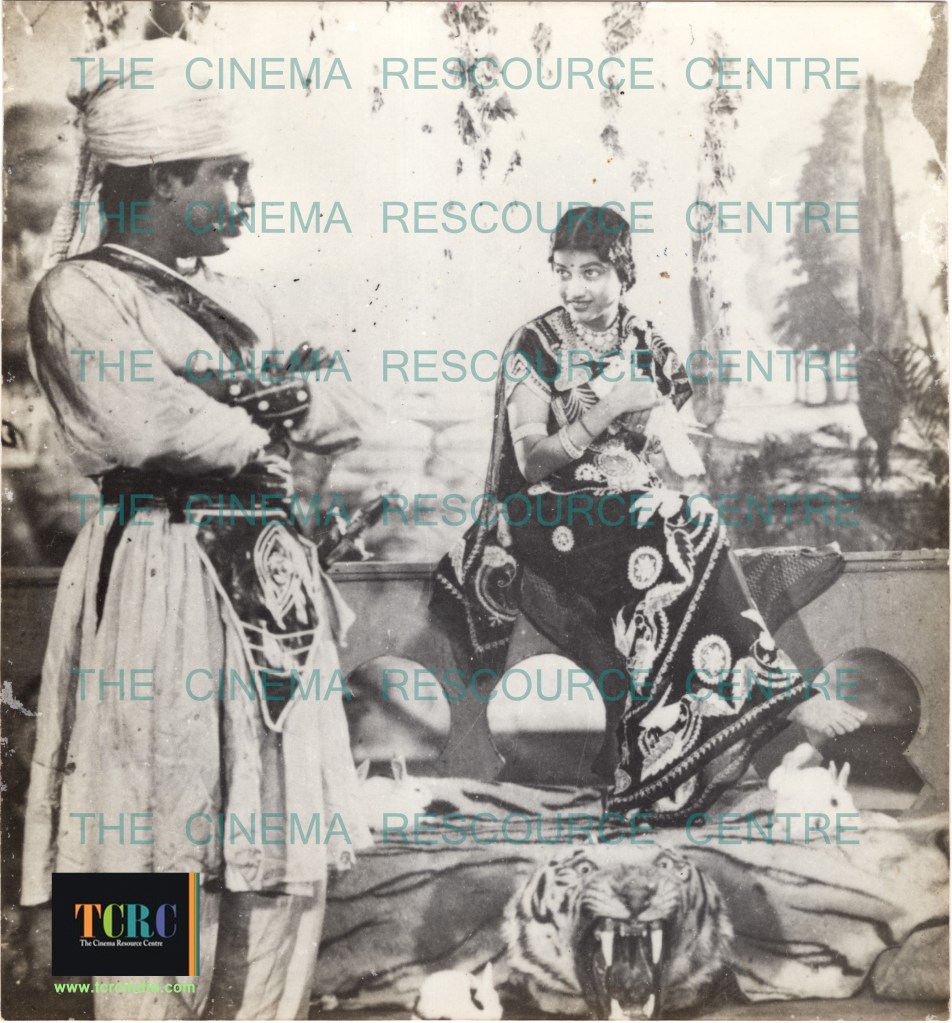
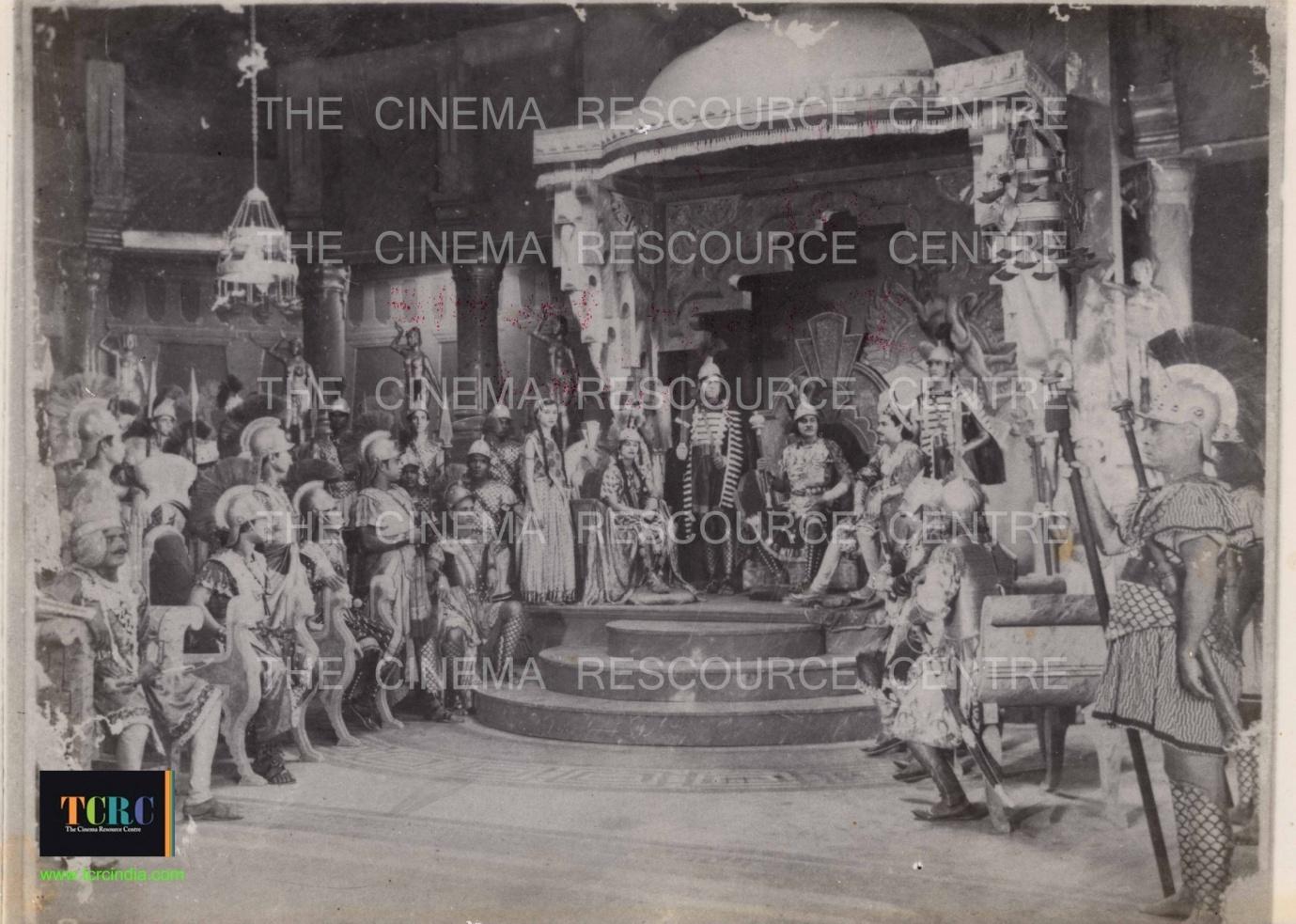
Working Still from the Film MATHRU BHOOMI
PC: From the archives of TCRC
[To be continued] We’ll be back next week with more hidden treasure from the history of Tamil cinema. Stay tuned!
About the Author:
V.V. Prasad is a Electronics and Communication Engineer based from Chennai. He is currently involved in the role of a Researcher and Archivist in THE CINEMA RESCOURCE CENTRE. He takes care of the non film materials like Photographs, Magazines, Lobby Cards, Song books etc of the archives. Cataloguing them and digitizing them are part of his current work. His interests and passion lie on the research of Cinema particularly South Indian Cinema.
If you have found yourself listening to old Tamil film music and felt like you attain absolute ecstasy from the mosaic of sounds that the blend of various musical instruments produced, pleasing your eardrums, we know exactly how you felt!
From traditional Indian instruments to the exotic instruments from various parts of the globe, the music composers of Tamil screen composed their lilting music. In fact, by virtue of music composers like A. R. Rahman having become a global player, such globalization in music has brought some very exotic musical instruments such as Balalaika, Cajon, Harpejji etc to our door step.
The track record of Tamil film music goes much beyond the music directors & playback artistes who literally lived them. The immaculate talents of extremely talented musicians, who never were known to the listeners at large, deserved the credit of the lively compositions we cherish even to-date. The fruits of their creativity is an ever lasting a gift to the current & future generations of music-lovers.
In order that we appreciate those highly talented music makers of the Tamil screen, we must know about the various musical instruments they used in their breezy compositions, under the direction of music directors.
Here in this Article, we will have a ringside view of the various musical cine-orchestral music instruments along with links to videos and songs wherein these were used, particularly in Tamil films till the early seventies. However, we will eschew Accordion since we have already devoted a special Article on that.
Univox organ:
In old Tamil films the organs used to produce musical notes similar to the mighty church organs. Since then the organs have gone through a long history of evolving & development resulting in today’s one-man orchestra provided by the modern electronic keyboards.
Listen to ‘Ennai alum Mary matha’ by P.Leela from Missiyamma (1955), in the composition of veteran S. Rajeswara Rao, where the beginning music is of the organ.
Bagpipes:
These are wind instruments using enclosed reeds, fed from a ‘bag’, which acts as the reservoir of air. The player keeps pumping air orally into the ‘bag’ as he plays. So, the difference between any wind instrument & bagpipe is that unlike the other wind instruments which are blown into with air directly from the player’s lungs, bagpipes receive air first into its bag from where it goes to the pipes. Though Bagpipe is predominantly seen as a Scottish instrument, bagpipes have been played for over a millennium throughout other large parts of the West.
I have not come across a bagpipe being used in any Tamil film songs. Though someone said, it has been used by K.V.Mahadevan in the song ‘Thottu vida thottuvida thodarum’, on a careful listening, I find, the bits resembling Bagpipes are in fact produced by the Organ of those times known as Univox.
As far as my information goes, Bagpipes were used only in the Raj Kapoor film Sangam (Music by Shankar Jaikishen) in the song ‘Bol Radha Bol Sangam’.
Banjo:
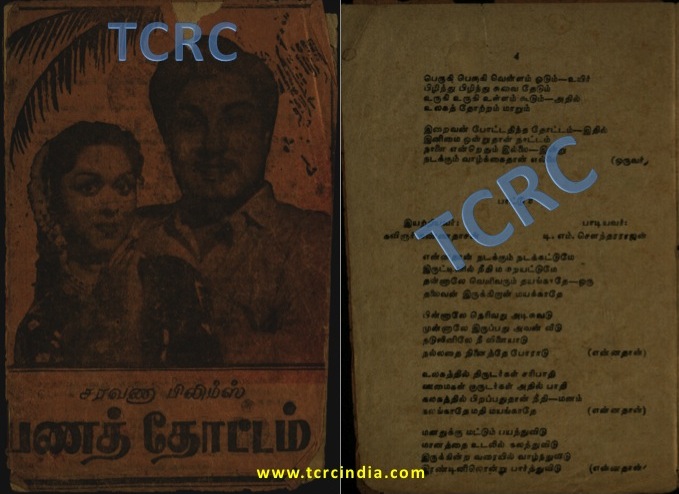
A plucked stringed instrument, which originated in Africa & got adopted in the country music of USA. Banjo had not been very widely used in Tamil film music but there are specific songs where this has been used. For instance, MSV-TKR had used Banjo in few of their compositions & the one we have here for citing is ‘Ennathan nadakkum nadakkattume’, from ‘Pana Thottam’ (1963), where the string instrument you hear is a Banjo.
Song book of Pana Thottam with the page containing the song ENNATHAN NADAKKUM NADAKATTUME PC: From the archives of TCRC
Bongos:
These are Afro-Cuban percussion instruments consisting of a pair of small, open bottomed drums of different sizes & played by fingers & palm.
Indian films till the sixties used this percussion instrument very frequently in the compositions. In fact instruments such as Accordion, Bongos & Mandolin ruled the roost In Tamil film compositions prior to seventies but became slowly extinct as there was a paradigm shift to the music genre & compositions. MSV-TKR had used Bongos in very many memorable songs. Ganesh (of Shankar-Ganesh Duo) who was a formidable member of MSV’s orchestra played Bongos.
Some of the songs using Bongos for percussion that deeply rooted in my mind include ‘Ullam enbathu aamai’, ‘Pesuvathu kiliya’, ‘Poga poga theriyum’ & ‘Silai eduthan oru sinna ponnukku’.
Here is ‘Pesuvathu kiliya’ from Deiva Thai, composed by MSV-TKR with the Bongo beats.
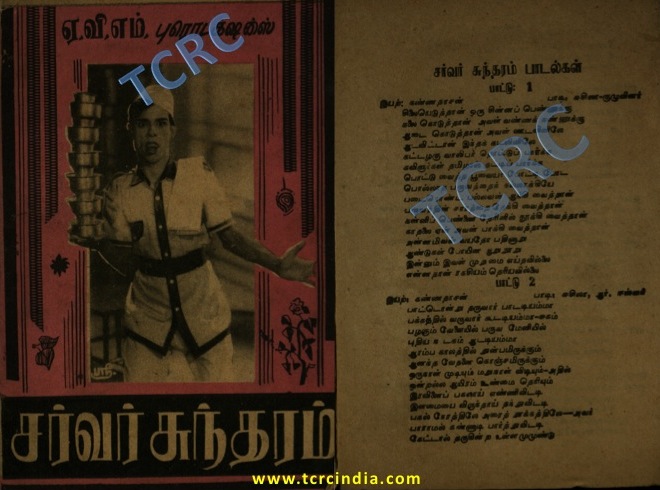
In ‘Silai eduthan oru china pennukku’ (Server Sundaram) too you get to hear percussion beats of Bongos.
Song book of Server Sundaram with the page containing the song SILAI EDUTHAN ORU CHINNA PENNUKKU PC: From the archives of TCRC
Castanets:
These are rhythmic percussion instrument comprising of a pair of concave shells joined on one edge by a string, originating from Turkey. O.P.Nayyar had used it often in his compositions. It is a hand held instrument used to produce clicks for rhythmic accents or a ripping or rattling sound consisting of a rapid series of clicks.
Here is a Tamil composition by MSV-TKR in the song ‘Pillaikku thanthai oruvan’ from ‘ Parthal Pasi Theerum’ (1962)., where you can hear the rhythmic wooden clap sounds produced by Castanets.
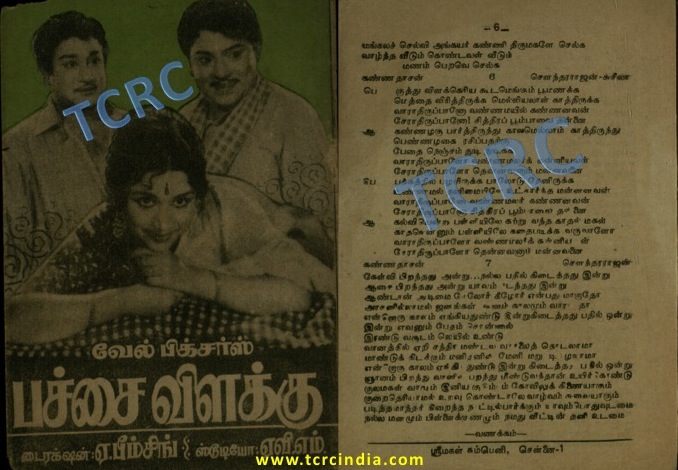
You can spot castanets in few other Tamil songs too such as ‘Kelvi piranthathu anru’ (Pachai Vilakku), the music director being MSV-TKR.
Song book of Pachai vilakku with the page containing the song KELVI PIRANTHATHU ANDRU PC: From the archives of TCRC
Cello:
It is a four stringed bass instrument originated from Italy in 17th century, looking like a giant violin (held while playing against the seated cellist and traditionally played with a horsehair bow), has been used routinely in many Tamil Film Songs. However, due to its ‘Bass’ tone structure it has a low tonal registry & may not be heard separately unless played singly in the songs.
In ‘Silar sirippar silar azhuvar’ song from ‘Pava Mannippu’ (1960), composed ny MSV-TKR you can hear Cello.
In ‘Enge nimmadhi’ song (‘Puthiya Paravai’ – 1963) too, one can distinctly hear Cello in the opening music just prior to the vocal of TMS.
Guitar:
A typically six stringed instrument with European roots with a multitude of incarnations from acoustic to electric, has featured commonly in many film songs.
Tamil Cinema has had amazing Guitarists such as Dhanraj Master, Philip, Ilayaraja, Chandrasekhar, Gangai Amaran & R.Visweswaran. Of these, the last named late Visweswaran (husband of danseuse Chithra Visweswaran) was a close friend & college-mate of this writer. Visweswaran himself was an expert Guitarist who could play Flamenco genre music & had played for R.D.Burman.
Veteran Guitarist Philip debuted in the M.K.Radha starred Gemini produced film “Apoorva Sahodarargal’ (1949), introduced by the legendary Music Director S. Rajeswara Rao. Since that Philip had played for K.V. Mahadevan, Viswanathan – Ramamurthy, Sathyam and V. Kumar. Hindi music directors from Bombay such as Hemant Kumar, Madan Mohan, Chitragupta and Ravi wanted Philips to migrate to Mumbai. Philip, an autodidact, now in his eighties, was considered a genius. His guitar pieces were predominant in many Tamil film hits including ‘Aha mella nada mella nada (Pudiya paravai), ‘Vannakili sonna mozhi’ (Deiva Thai), ‘Malar enra mugam onru’ (Kathalikka neramillai), “Aval paranthu ponale’ (Paar magale paar), ‘Avalukkenna Azhagiya mugam’ (Server Sundaram), ‘Anubhavam pudumai’ (Kathalikka neramillai), ‘Aada varalaam’’ (Karuppu Panam).
In an Article by V. Balasubramanian titled “Harmony with strings” in The Hindu dated 27.4.2014, the author wrote “MSV during his heydays was a hard taskmaster who would leave no stone unturned till he gets what he wanted. During a particular recording, that started at 7 a.m, the work went on till next day morning. Philips pleaded with MSV to let him go but in vain. Finally, when it was pack up, Philips had to rush directly from the recording studio to the church where his wedding was to take place.“ This writer has had the opportunity of meeting this genius along with R.Visweswaran in early sixties.
“Ilaiya nila pozhigirathu” (Payanangal Mudivathillai) composed by Ilayaraja & rendered by SPB has ample guitar bits, played by Guitarist Chandrasekhar. As per an Interview by SPB, Ilayaraja had well over twenty retakes to get the Guitarist play those difficult Flamenco Notes to his full satisfaction. The results were obvious in the song!
We will continue discussing more of the exotic musical instruments used in our films in our next posting.
In the early times when classical music was by far the stronghold in cinema, the orchestras, which were mostly owned in-house by Production Houses, comprised, mostly, traditional Indian musical instruments, including Harmonium & Jalatharangam.
Listen to this song by K.B.Sundarambal from the cult classic film ‘Avvaiyar’ (1953), in which Jalatharangam features along with violins.
Another old song where the BGM, which included Harmonium is minimalistic was from the film “En Manaivi” (1942), featuring Nellore Natesam.
Some of Western & African instruments were also in used in the Tamil movies produced prior to fifties, such as Clarinets, Trumpets, Violins, Piano et al.
Here is an old hit from Vazhkai, in which you could hear Clarinet dominantly in the BGM.
In fact, till much later, Clarinet solos featured in many Tamil film hits, like the song ‘Inbam Pongum Vennila’ from Veera Pandiya Kattabomman, composed by the legend G.Ramanathan. You can hear clarinet in this song in the opening music itself after Sitar, Violins & Univox, in that order.
The Magnum Opus production, “Chandralekha” (1948) by Gemini Vasan had its soundtrack composed by S.Rajeswara Rao with R. Vaidyanathan and B. Das Gupta collaborating with M.D.Parthasarathy on the background score. In an old interview with ‘The Hindu’, Rajeswara Rao had recalled that it took him over a year to compose the music for the film, with much of the time being taken for the drum dance sequence. He stated that the music for the mammoth Drum Dance sequence they had used Trumpets, piano, many Double Bass violins and drums from Africa, Egypt, and Persia acquired from a visiting African war troupe. Cooling Rajiah played the Accordion & Piano in the gypsy song in the same film.
A still of Ranjan from the Film Chandralekha directed by S.S. Vasan. PC: From the Archives of TCRC
In the Post Independence era, the Tamil movies started seeing changes in terms of story subjects, the way dialogues were delivered & even the music compositions, in tune with the overall metamorphosis that was witness to the change of air, all around.
The music directors were ever ready to bring in new music instruments into film music.
Though Tamil Cinema, despite being the big brother of other Southern Regional Filmmakers, traditionally followed trends in Hindi film industry.
The sensational Rajkapoor film ‘Awara” (1951) had Musical notes that was thought to be Accordion notes, which distinguished the song “Awara Hoon” by Music Directors Shankar-Jaikishen duo, inspired by an old Turkish tune.
However, there is a theory that the notes were, in fact, not Accordion at all but was played on Harmonium by one Vistasp Balsara, who passed away in 2005. He claimed, in an interview to Calcutta Doordarshan, to have played such Harmonium pieces also in other classics such as “Yaad Kiya Dil Ne” (Patita, 1953) and “Aye Mere Dil Kahin Aur Chal” (Daag, 1952).
But Accordion has come to stay by then as an important cine instrument in Hindi. Here is another breezy number from another Rajkapoor starrer, ‘Dastan’, where notable Accordion notes by the player Goody Servai decorate the song composed by Naushad.
There were other noted Accordionists in Hindi Film Industry such as Kersi Lord (Roop tera mastana in Aradhana), Sumit Mitra (Har Dil jo pyar karega in Sangam) Enoch Daniels (Beqrar karke hame from Bess saal Baad). Of these we have to specially mention about Late Kersi Lord, who was a multi instrumentalist & who immortalized some of the Hindi film hits with his contribution. He was honoured with Dadasaheb Phalke Award in 2010, as a cine musician. He was the one who played the bells like sounding ‘Glockenspiel’ instrument in the famed song ‘Main Zindagi Ka Sath Nibhata Chala Gaya’ composed by Jayadev in ‘Hum Dono’.
The accordion thus became an oft-used instrument in Hindi cinema under legendary Music directors such as C Ramchandra, Naushad, Shankar-Jaikishan, Salil Chowdhury and S D Burman as they made it a part of their compositions.
It was in Pava Mannippu (1961) that MSV-TKR featured Accordion in ‘Athan….En athan’ composition & the Accordionist was our own Mangalamurthy.
Accordionist Mangalamurthy was this writer’s craft teacher in the high school, in the late fifties, but owing to his parallel music career he was hardly seen in the school and was on long leave.
MSV had used Accordionist Mangalamurthy in many of his compositions. Some of the songs where Accordion has predominantly featured are “Avalukkenna” (server Sundaram), “Ulagam piranthathu enakkaga” (Paasam), ‘Kannirandum mella mella’ (Andavan Kattalai), Ponaal pogattum poda (Palum Pazhamum), “Netryvarai nee yaro” (Vazhkkai Padagu), “Unga ponnana kaigal” (Kathalikka Neramillai), “Poranthalum ambilaiyaa” (Policekaran Magal), “Kan pona pokkile” (Panam Padaithavan), “Iyarkkai ennum ilaiya kanni” (Shanthi Nilayam), “Varavu ettana” (Bhama Vijayam), “Naalai intha neram parthu” (Uyarntha Manithan).
In the following video of Avalukenna song, Mangalamurthy features himself playing accordion, along with his other legendary co musicians, such as Philip (Guitarist) & Raju (Mandolin/Santoor/ Yodelling).
The accordion’s origin is said to be from Berlin & this heavy instrument, worn on the player’s chest, weighs about 7 kgs.
A R Rahman gave Accordion a home coming again & his accordion could be heard throughout the film Guru & even in his Tamil composition ‘Nenjukkulle’ from the film ‘Kadal’.
You cannot accept or even imagine Indian Films without songs. Whether it is a romantic duet or a parody number or song with some philosophy engrained in it or even an off screen rendering in the backdrop of a visual, songs have thrived,to the enchantment of the movie goer. There are instances where the songs have outlived the memory of a film in which they featured. In contrast, western films had limited number of musicals like My Fair Lady, Fiddler on the Roof, South Pacific where songs featured, as they were based on Broadway Musicals.
In the bygone days, the music came from those fragile vinyl records as they revolved under that magical pin! The success of Indian Cinemas’ music was amplified by the music companies such as HMV, Odeon, Columbia that published music, then. Out of these HMV fascinated me the most as a child, with its dog peering into the phonograph player, with inscriptions “His Master’s Voice”. In later adult years, I learnt that this logo was based on a painting by Francis Barraud, a Liverpudlian painter, with the same caption. Francis painted his late brother’s pet dog Nipper, as Nipper would run over to the phonograph and listen intently to the voice of his late master. In India, HMV became RPG when bought out by RP.Goenka Group and later came to be known as ‘Sa Re Ga Ma’.
In my childhood in the village, around late forties, I used to sprint to one of the neighbouring houses where a ‘thatha’ lived, to see & listen to his gramophone, as he played ‘oridam thannile’ song. Here is the video of the very song from the 1949 fim ‘Velaikkari’, sung by P.Leela & V.N.Janaki (wife of MGR) in the music of C.R.Subburaman & S.M.Subbiah Naidu.
In the initial days of Talkie Cinemas, it was a prerequisite that the main artistes had singing ability. Personalities such as M.K.Thyagaraja Bhagavathar, S.G.Kittappa, P.U.Chinnappa, Honnappa Bhagavathar, K.B.Sundarambal, M.S.Subbulakshmi, G.N.B, T.R.Rajakumari , T.R.Mahalingam, N.C.Vasanthakokilam were all singing stars. Most of them could travel to high altitude octave levels with ease. They had to be mostly loud in rendering as was the need of the recording technology available.
Somewhere, the play back artistes, who lent the actors their ghost voices, took avtar as a professional tribe in cinemas. That has a background too.
When AVM was making ‘Nandakumar’ he found a song rendered by the actress playing Krishna’s mother, Devaki was far from satisfactory. So he got an innovative spark of replacing the sound track of the song recorded by the actress with an external voice and shooting the song with the actress lips ‘sync’ing. And he got cracking with that idea which finally worked. AVM commissioned a then prominent Carnatic musician of Bombay, Lalitha Venkataraman, to render the song. It worked, as the song was re-shot with the actress moving her lips to Lalitha Venkatraman’s singing. This is the origin of the playback system in Tamil cinema. Necessity, sure, is the mother of invention! It was a major breakthrough in those times, which practice is continuing with great tradition & aplomb even into these days of state of the art sound engineering.
A still from a scene in the film Nandakumar published in the 1937 issue of Cine Art Review Magazine. PC: From the archives of TCRC
The current generation or even the immediately preceding one might not have had the opportunity of listening to the old Tamil film songs of fifties & prior, leave alone knowing the names of playback singers of those times? This writer has catalogued nearly seventy Tamil Film play back singers (some of them actors too) of sixties and the prior period extending back to thirties. These names, alphabetically, are: A.G.Ratnamala, A.L.Raghavan, A.M.Raja, A.P.Komala, A.S.Mahadevan, Balamurali Krishna, C.R.Subbaraman, C.S.Jayaraman, Chandrababu, D.K.Pattammal, G.N.Balasubramanyam, Gajalakshmi, Ganasaraswathi, Ghantasala, Hemant Kumar, Honnappa Bhagavathar, Jamunarani, Jesudas, Jikki, K.A.Chokkalinga Bhagavathar, K.B.Sundarambal, K.R.Ramasami, K.Rani, K.V.Janaki, K.Vijaya, Kanaka, Kothamangalam Seenu, L.R.Easwari, M.H.Hussain, M.L.Vasanthakumari, M.M.Dandapani Desikar, M.R.Santhanalakshmi, M.S.Rajeswari, N.S.Krishnan, Nagerkoil Mahadevan, P.A.Periyanayaki, P.B.Srinivas, P.Bhanumathi, P.Leela, P.Suseela, P.U.Chinnappa, Pazhani Baghirathi, R.Balasaraswathi Devi, Radha Jayalakshmi, Raghunath Panigrahi, S.C.Krishnan, S.M.Subbiah Naidu, S.Varalakshmi, Sarangapani, Sirkazhi Govindarajan, Srinivasan, Sulamangalam Jayalakshmi, Sulamangalam Rajalakshmi, Sundari Bhai,T.A.Madhuram, T.A.Mothi, T.M.Soundararajan, T.R.Mahalingam, T.R.Rajakumari, T.R.Ramachandran, T.S.Bagaavathi, T.V Ratnam, Thavamani Devi, Thyagaraja Bhagavathar, Tiruchi Loganathan, U.R.Jeevarathinam, Udutha Sarojini, V.J.Varma, Vasundara Devi, V.N.Sundaram, V.Nagaiah, V.T.Rajagopalan, V.V.Sadagopan. Huff….even reading this long enumeration of singers of yesteryears makes one pant!
Here is another popular song, in the lighter vein, “Oosi pattase” from the film ‘Digambara Samiyar’. (1950), in the voices of Gajalakshmi & V.T.Rajagopalan. The tune of this duet, between a young girl and her grandfather, was inspired by a popular Hindi tune ‘O…..dilwalo!’. The music directors G.Ramanathan & S.M.Subbiah Naidu.
From the early talkie Tamil films and up till the fifties the film songs followed the classical Carnatic genre and there are gems among such compositions. Those days many senior music directors were employees of big Studios which owned orchestras.
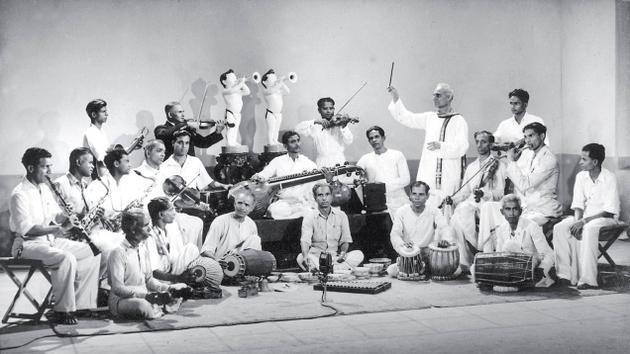
Music Director MD Parthasarathi with his orchestra at Gemini Studios. PC: unknown
AVM’s orchestra was known as Saraswathi Stores Orchestra. Even though these orchestras had many Western instruments like Trumpets, Clarinets & French Horns, besides typical desi instruments like Jaltharangam, Veena, Morsing, Hormonium, they all played Carnatic tunes. To say it all, in those days even the Madras Corporation had a Band consisting of Western Instruments playing songs like Chakkani Raja or Nagumo! There was also a famous private Brass Band in the old Madras known as Nadhamuni Bros. Band, which was, out and out, a Carnatic music band. This shows how strong the classical music had influence on general public.
It was only at the advent of MSV-TKR in the early fifties the cine music assumed a light music genre, which is why they were called Mellisai Mannargal. In fact, MSV-TKR duo stepped into main stream music direction when C.R.Subburaman died abruptly leaving unfinished music assignments. The era of MSV-TKR heralded a new chapter in Tamil film music. It was also the induction of musical instruments like Accordion, Dilruba, Bongos, Grand Piano, Spanish Guitar, Mandolin and the like into orchestration. They experimented with numerous genre of music. You could spot jazz, blues, samba, rock, cha cha cha and what not in some of their compositions. Their music never drowned the lyrics. Together they created magic through the voices of living legends for decades well into seventies. You need a dedicated write up to discuss their music.
In the early days they used the lyrics of celebrated personalities like Bharathiyar , Gopalakrishna Bharathi, Thayumanavar et al. Then there were composers of the tall order of Papanasam Sivan, Bharathi Dasan, Kalki Krishnamurthy. There were other well known lyricists such as Udumalai Narayana Kavi, Aroordas, Maruthakasi, Kamatchi sundaram, Thanjai Ramaiahdas, Pattukottai Kalyanasundaram much before the later lyricists such as Kannadasan & Vaali.
Papanasam Sivan wrote many beautiful songs for films which are greatly remembered & revered. Mostly these were set to Carnatic tunes. Some of these, like ‘Maa Ramanan’ which was a cinema song, has come to be sung on Carnatic Stages even today. Papanasam Sivan’s Carnatic compositions were largely popularised by D.K.Pattammal & D.K.Jayaraman. Another interesting thing about Papanasam Sivan is, neither his name was Sivan nor was he from Papanasam. He was, in fact, born Polagam Ramaiah. His ‘mudra’ name in his compositions was ‘Ramadas’. He spent a lot of time in Papanasam, thereby adopting the “Papanasam” tag. Also, it was a tradition to address men of respect as Sivan in those days, this explains the suffix to his name. It is also said that there was lot of influence of Mahavaidyanatha Sivan, during his tenure at Trivandrum, on his compositions, thereby making Sivan as his second part of the name.
AVM used many songs of Mahakavi Subramanya Bharathi in their films such as Naam Iruvar, Vethala Ulagam, Ore Iravu, Vazhkai. The rights to Bharathiyar’s works were held by a gramaphone company owned by Surajmal & Sons which bought the rights for Six Hundred Rupees. Later AVM bought the rights from them for Ten Grand. It was at the instance of Omandur Ramasamy Reddy , who was the then Chief Minister of Madras Presidency between 1947 & 1949, AVM relinquished their rights.
Bharathidasan’s ‘Thunbam nergaiyil’ written by Bharathi Dasan as expression addressed to a child was used in AVM’s ‘Oar Iravu’ (1951) in the voices of M.S.Rajeswari & V.J.Varma and filmed in a situation of romance between lovers, played by Lalitha & Nageswara Rao
I have seen from the Kodambakkam High Road side, the mammoth sets put up within Gemini Studios, about the same place where today Park Hotel stands, for ‘Bhama Vijayam’. It was a two-story ‘building’ where the story unfolded. Similarly I have seen, from outside, a large Big Top of a Circus being put up in AVM for ‘Parakkum Paavai’.
All these studios were virtual dreamlands where the celluloid industry made its ware. There was an element of fascination & grandeur about them. The studios were products of necessity as films could be made only in controlled & capsuled spaces, where only production was technically possible. In the black-and-white era of those days when the film ran at slow speed requiring abundant light, the Director and Cinematographer had to exercise extraordinary judgment & vivid imagination.
A busy film studio was a beehive of activities as technicians, set property guys, lighting equipment handlers all moving about in feverish activity, even as the artistes applied grease to their face in preparation for their day’s shoot in humble green rooms, there being no private Caravans owned by any big star then.
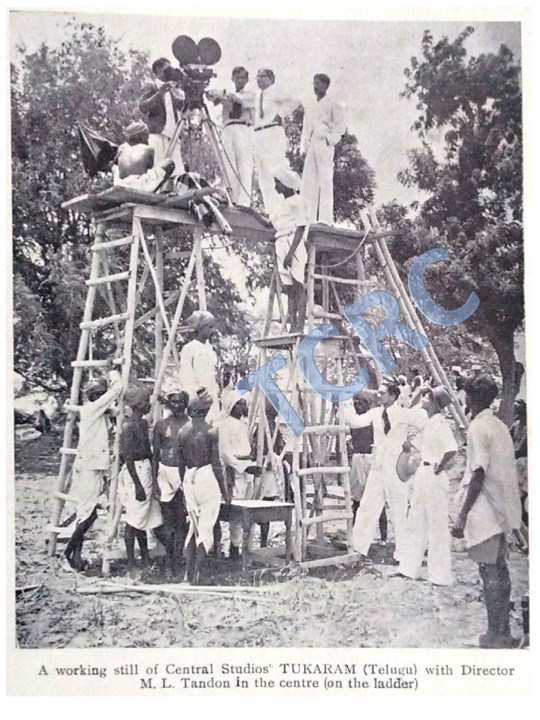
Image from Cine Art Review Magazine 1937. PC: From the archives of TCRC
In the humble recording theatres in these studios, dating back to pre-stereo era, many a musician huddled up in small recording rooms, amidst running power & audio cables, to produce the ever charming film music that we adore to date. Veteran Music Directors such as Emani Sankara Sastry, Parthasarathy, C.R.Subburaman, S.M.Subbiah Naidu, T.G.Lingappa, Sudarshanam, G.Ramanathan, T.R.Pappa, S.V.Venkataraman, S.Rajeswara Rao, Parur Sundaram Iyer, K.V.Mahadevan, MSV-TKR, S.Dakshinamurthy & Pandurangan swayed their baton in these Studios in collaboration with legendary lyricists like Papanasam Sivan, Kothamangalam Subbu, Thanjai Ramaiahdas, and Ku.Ma.Balasubramanyam.
While recording ‘Engey Nimmathi’ song for Puthiya Paravai, MSV-TKR team had to accommodate the large number of spill over musicians on to the outside lawns. In this song the Music Directors used huge musical ensemble comprising instruments such as Harp, Violins, Cello, Bass, Vibrofone, Bongos, Kettle Drums, Flutes, Castanet, Trumpets, Tuba, Trombone, Clarinet & Mandolin.
The early films of Black & White era too had brief spells of outdoor shoots. But sets were more predominant as a rule owing to limitations.
Gradually the trend was increasingly towards outdoor shoots, away from the confines of the mighty studios, as evidenced by Kathalikka Neramillai (1964). Most of the outdoor locales of this iconic wholesome comedy were shot at Azhiyar Reservoir Dam, some sixty five kilo meters away from Coimbatore, located in the picturesque foothills of Valparai, in the Anamalai Hills of the Western Ghats.
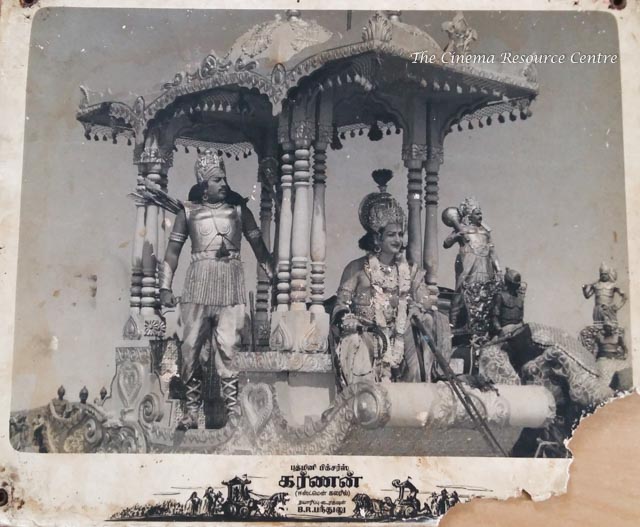
Similarly, Karnan was notably the first Tamil film to be shot extensively in locales at Jaipur & Kurukshetra. The Art Director Ganga of Karnan got huge chariots made in Chennai and shipped them to Kurukshetra, where the war sequences were filmed in out door. With Central Government’s permission, real cavalry and infantry men from the Indian Army were deployed in the battles scenes at Kurukshetra.
A lobby card from the film Karnan featuring the chariot PC: From the archives of TCRC
The cameras have since become smarter and often airborne on drones. The Information Era has changed the very way films are made. Today, most of these mighty shooting spots called Studios have disappeared one by one, as Technology has made a paradigm shift in film making, which tendered those mammoth sized studios redundant. The sophisticated equipment and availability of alternative resources enable film makers to shoot at any place of their choice. Thus the brick ‘n’ mortar studios of huge sizes lost their popularity.
In contrast, today the films are made about everywhere, ranging from the rural hamlets to urban slums, from deserts to highways, from cricket pitches to Pizzeria.
Several film studios in Chennai have downed their shutters and their vast areas have turned over to real-estate development. Many got transformed into hospitals, hotels, multiplexes, colleges, wedding halls and the like.
Similarly, the Bombay’s landmark studios such as RK, Mehboob, Filmistan & Famous too have lost their sheen.
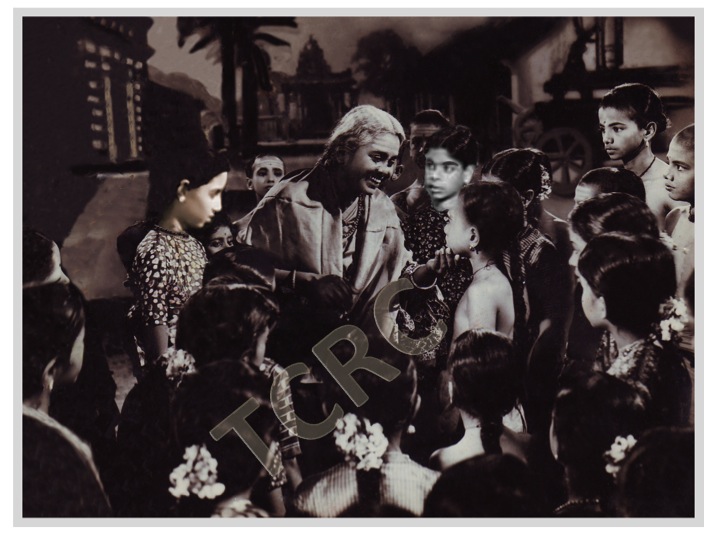
In fact, by 1970s that filmmakers slowly ventured out of the studios of Kodambakkam, to shoot in outdoors and actual locales, abandoning the sets. The bougainvillea creepers, the ceiling dropped pigeons, ornate fountains of the make-believe sets were gone, with ‘as-a-matter-of-fact’ outdoor shoots setting in. A huge tribe of set making carpenters, painters, decorators, prop suppliers were all gone with the sets. These were the very people who feasted cine-goers with the celebrated visuals of the black & white era with their enormous sets. They made us relish the clever make over to the mythology and historical subjects of films. Who could forget the sets of Chandralekha or Avvaiyar? Even much later, the sets of Veera Pandiya Kattabomman, Karnan and the like provided us the much of visual enchantment.
A photograph from the film Avvaiyar. PC: From the archives of TCRC
The Gemini twins, in their ‘langoti’s, blowing the bugle at the corner entrance of erstwhile Gemini Studios still haunt us, by their sheer absence there anymore.
Once in my high school vacation, a guy in our friend circle motivated us for a trip to the far away AVM studio to witness a film shoot, on the pretext one of his relatives worked there. Our long bus trip to Puliyur and beyond made a bunch of us cross a lot of fields and Aubergine cultivated lands (you know, Kodambakkam Kathirikkai was very popular in those days), till we reached our dream destination. But our starry eyed expectations were soon blown off by the studio sentry who, forthwith, denied entry to our small group of school kids.
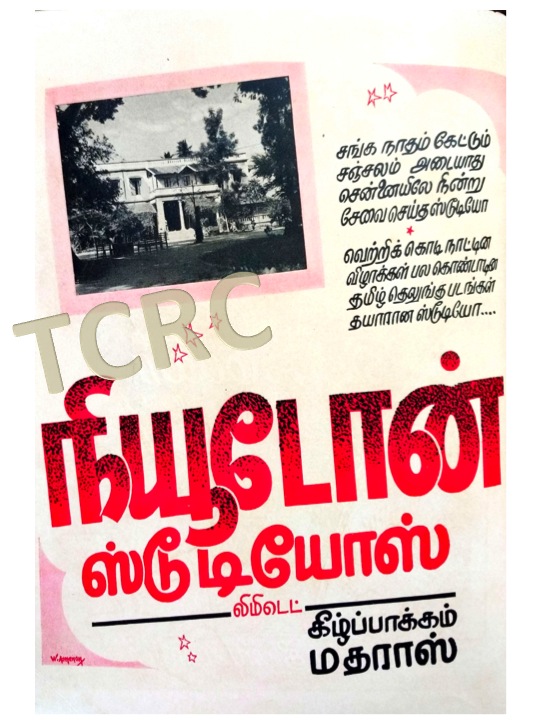
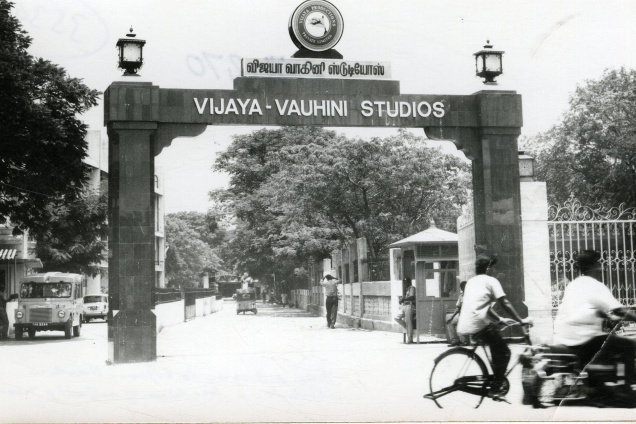
Today, the word ‘Kollywood’, coined after Bollywood, would refer the whole hub encompassing Vadapalani to Kodambakkam to Saligramam, the nerve center of Tamil film industry & TV. It is in this topography, the mighty film studios such as AVM & Vijaya Vahini once clustered & grew with vast facilities for film production. They had innumerable shooting floors, with Vijaya Vahini having as many as thirteen. Of course we had also, by exception, film studios spilled over to other areas of Madras too, such as the mighty Gemini in Mount Road, Venus in Alwarpet, Meenakshi Cinetone turned Neptune turned Satya in Adyar and Newtone, Citadel in Purasawakkam.
An Ad for Newtone Studios in Kalki Deepavali Malar 1942 PC: From the archives of TCRC
Those days, before the advent of Kodambakkam over bridge in 1965, there was a rickety railway level crossing at busy Kodambakkam, choking with heavy traffic. The gate closed with every suburban service passing. The ever hungry star gazers hanged about this level crossing to catch a glimpse of their favourite stars, lurking inside their car, waiting for the gate to open.
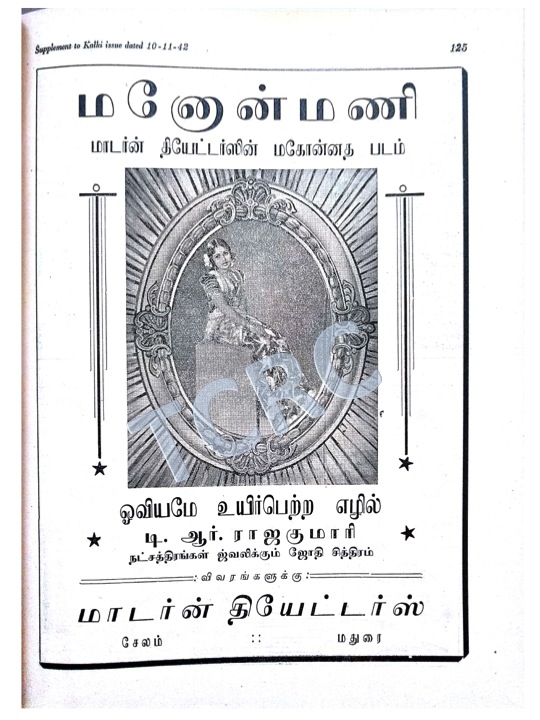
Besides Madras, there were also few well-known studios in other cities; Mr. T.R.Sundaram’s Modern Theatres Studio at Salem, Sreeramulu Naidu’s Pakshiraja Studios, Neptune Studios & Central Studios, all in Coimbatore.
An Ad for brought out by Modern Theatres for the film Manonmani in Kalki Deepavali Malar 1942 PC: From the archives of TCRC
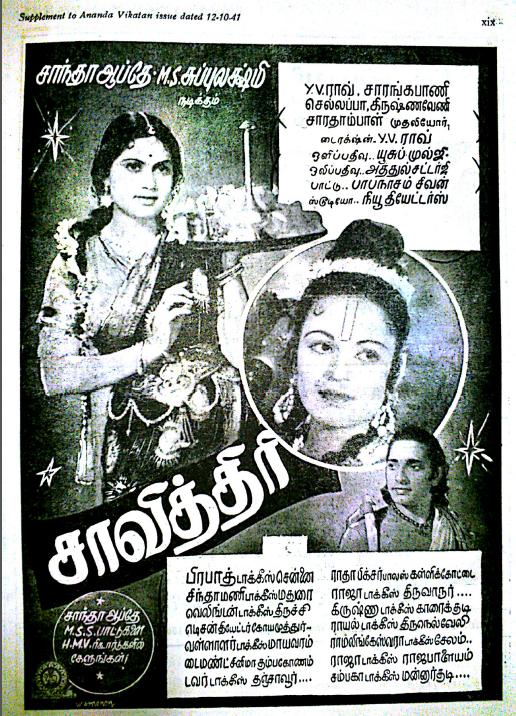
Prior to production of films in Madras State, some films were produced in Calcutta & Pune. M.S. Subbulakshmi starred Savithri (1941), which had as many as eighteen songs penned by Papanasam Sivan, was produced in New Theatres Studio of Calcutta.
An Ad for the film Savitri in Ananda Vikatan Deepavali Malar 1941 PC: From the archives of TCRC
As per the Film Historian Randor Guy, the Madras Electric Supply Corporation (MESC) had built a powerhouse in Kodambakkam area during the World War II times, but without many takers for the energy. The film studios were enthused to set up shops here. Kodambakkam soon saw several studios coming up such as AVM, Vijaya, Rohini, Bharani, Vikram, Paramount (later called Majestic), Golden, Vasu, and Karpagam.
Much before AVM Productions was launched, Sri Valli (1945), directed by A.V.Meyyappan himself along with A.T.Krishnaswamy, was made by AVM under the banner of Pragathi Studios. This movie catapulted A.V.Meiyappan to fame.
AVM Studios was first located at Karaikudi, before shifting to Kodambakkam. The Karaikudi studio was made of thatched roof structures and stood at Devakottai Rastha. ’Nam Iruvar’, released before Indian Independence & which became a thundering success, was made in Karaikudi based AVM studios. This super hit film extensively portrayed the hopes and aspirations of a nation on the brink of independence. Only after this did AVM move his studio from Karaikudi to Kodambakkam.
AVM Studios, in its grand annals, have had many a landmark event associated with Tamil Film Industry.
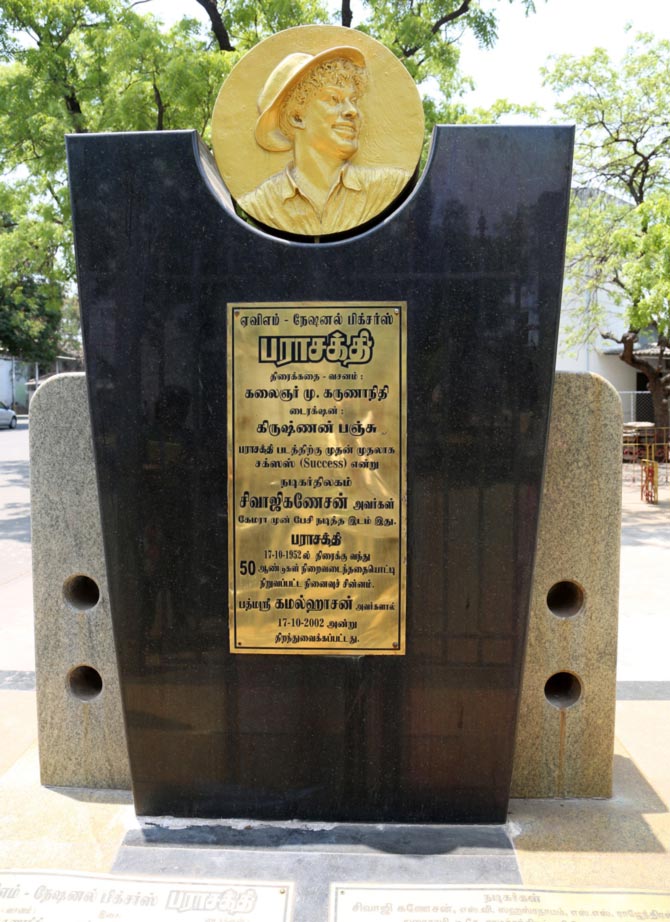
National Pictures and AVM Productions jointly produced the debut film of Sivaji Ganesan ‘Parasakthi’, though it did not begin well for Sivaji Ganesan, who was on a princely monthly remuneration of Two Hundred Fifty Rupees for the film. In fact, at one stage, Meiyappan, dissatisfied with Ganesan’s “thin” body frame wanted him replaced. But, ironically, time wanted to prove this very Ganesan as an Institution by himself. So, AVM’s partner in the project, Perumal, insisted that Ganesan be retained. But the initial scenes involved many retakes with Ganesan. Rest was history, with the world acknowledging him as Nadigar Thilakam.
A plaque commemorating the 50th year of Parasakthi at AVM studios at the very spot Sivaji Ganesan said his first dialogue ‘Success’ . PC: http://www.rediff.com
AVM’s “Vazhkai” (1949) was the first film to be shot at the new AVM Studio at Chennai. The film starred T.R. Ramachandran and Vyjayanthimala, which was the latter’s debut movie in Tamil when she was a teenager. When M. V. Raman, who wrote ‘Vazhkai’, spotted Vyjayanthimala performing a Bharata Natyam concert at Gokhale Hall in Madras, he was impressed by her talent & beauty and recommended her to the boss Meiyappan.
V. Venkatraman (SVV) was ‘found’ by A.V.Meyyappa Chettiar as a man in distress at Cubbon Park, Bangalore & gave him the break in “Nanda Kumar” as Music Director. SVV became a major name in music scene & scored soul-stirring music for over two hundred films in various languages. Even MSV & TKR worked for him at some point in time.
C.N.Annadurai is said to have written the three hundred pages of screen play for the film “Oar Iravu” in a single night camping at AVM studios, for a whopping sum (at those times) of Rupees Ten Thousand!
It was only at AVM Studios the living legend S.Janaki gave her audition in 1957 before Music Directors Sudarashanam & Govardhanam.
Vijaya Studios made “Maya Bazaar” (1957) which was critically acclaimed and considered as one of the enduring classics of Indian Cinema. It was touted as a landmark achievement in Indian film’s cinematography, art direction and visual effects with the technology available at the time.
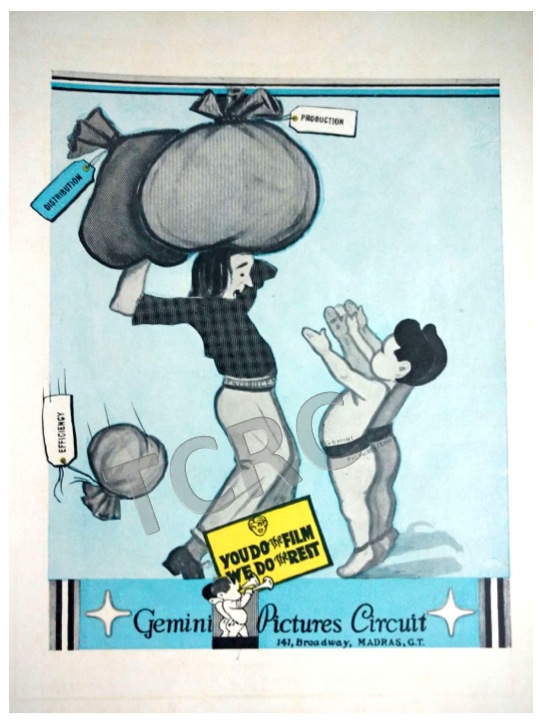
Gemini Studios, owned by Movie Moghul S.S.Vasan, had a history. The Veteran Film Director K. Subrahmanyam (Father of Denseuse Padma Subramanyam) who made some iconic movies including ‘Thyaga Bhoomi’ (1938) was having a Studio at the same premises since 1937. But owing to a major inferno the property was totally burnt down. In 1941, S.S.Vasan bought out the premises in a distress sale & built his own studio & named it Gemini Studios. It is said that Vasan, who was a fan of horse racing, named the studio after one of his favourite horses. Gemini Studios produced some of the iconic movies such as Nandanar, Mangamma Sabatham, Miss Malini, Chandralekha, Avvaiyar, Vanjikottai Valiban to name a few.
An ad for Gemini Pictures Circuit with its distinct logo (the company that bought over the studio from Subramanyam and renamed it Gemini Studios). Published in Anada Vikatan Deepavali Malar 1939. PC: From the archives of TCRC
The movies always began after ‘The News Reel’ of the Information & Broadcasting Ministry of the government.
Whenever a song sequence came in the movie the audience fled out to have a soda or smoke or to relieve themselves!
In the very few theatres that were air conditioned in those days, after the first reel was screened, the operator used to quietly switch off the a/c. In those times the word consumerism was unknown and none batted an eyelid at such practice!
On the metal backs of the seats you would find creative engravings by the ‘learned’ audience. In some seats the sponge was found scooped out by some disgruntled theatre goers. The washrooms had a mixed stink of phenyl and human fluids while their walls bore unsharable graffitis.
But the audience inside these halls, with high ceilings sporting sporadic ceiling fans, lived the movies with their favourite chocolate faced Heroes and buxom Heroines.
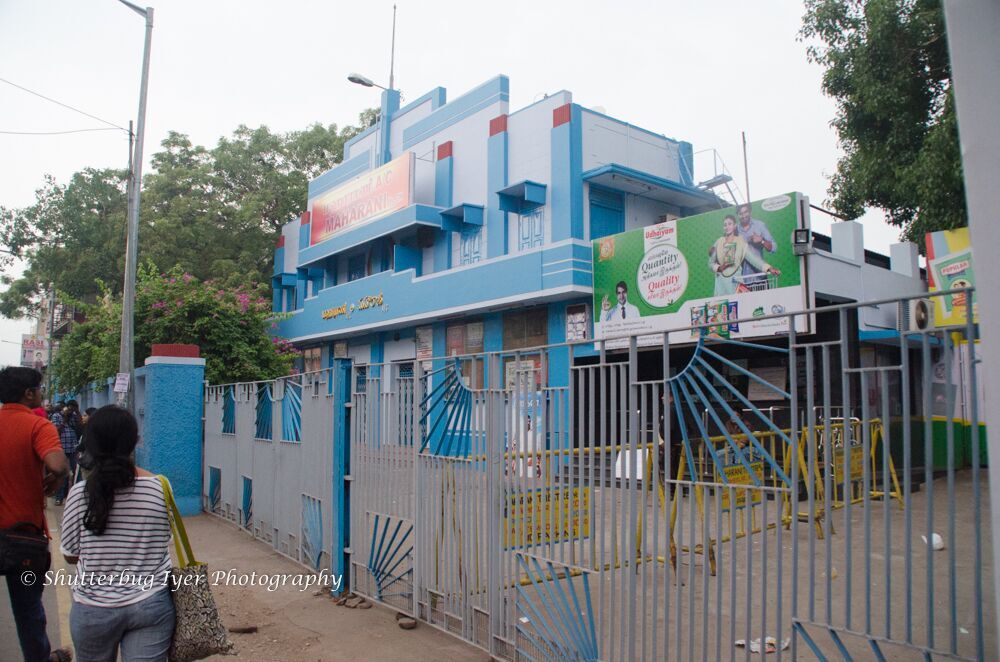
When Srinivasa Kalyanam was released in Maharani Theatre, in the front foyer a Tirupathi Balaji was installed. On the release of Marma Manithan, cycle rikshaw men were dressed like that character a la style Mr.X, as they distributed fliers about the movie.
Maharani still standing. PC: V.Harihara Subramanian, Feb 2017
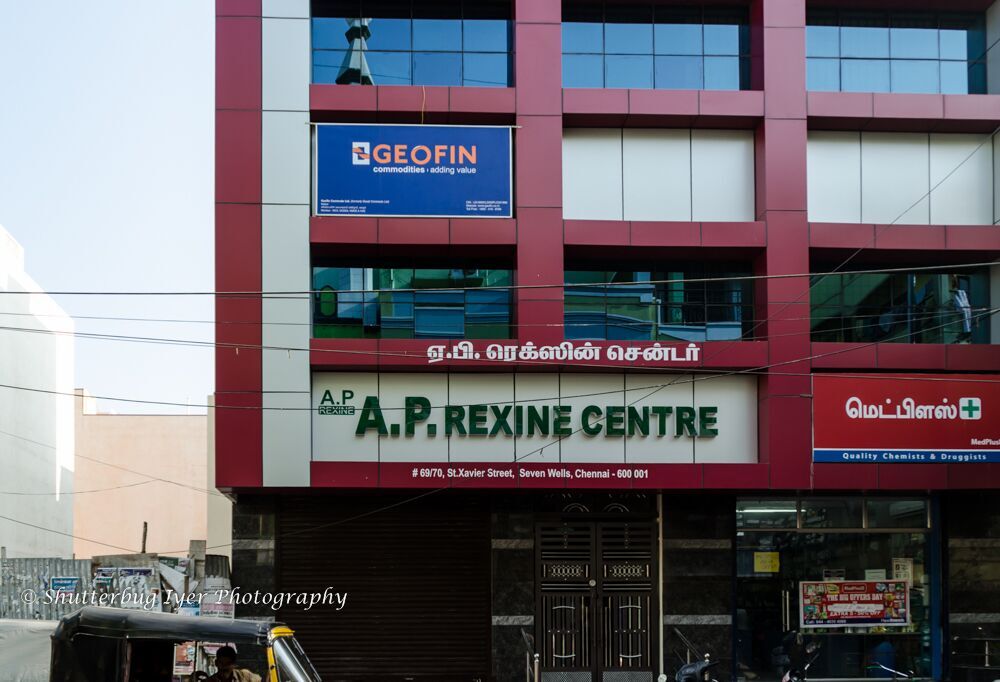
One of the oldest theatres of Madras was Murugan Talkies. It was originally started in 1910 by one Murugesa Mudaliyar as Majestic Theatre where Tamil Plays happened.
This was later converted to a cinema hall. In 1931, Majestic’s name was changed to “Kinema Central” , where the first Indian talkie film “Alam Ara” was screened, with People coming by road and rail, packing food, to watch the first talkie. This theatre also saw the screening of the first “Tamil-Telugu” Talkie ‘Kalidasa’. Classics like Meera, Shakunthala , Avvaiyaar , Uththama Puthiran, Sathi Leelavathi , Thyagabhoomi, Ambikapathy , Thiruneelakantar, Ashokkumar ran at Kinema Central.The theatre’s name was changed as Murugan Talkies in 1942.This iconic cinema hall was pulled down a couple of years ago, after 80 years.
An unimpressive shopping complex stands in the place of Murugan Talkies. PC: V.Harihara Subramanian
Then the new air-conditioned cinemas such as Safire & Anand came right on Mount Road.
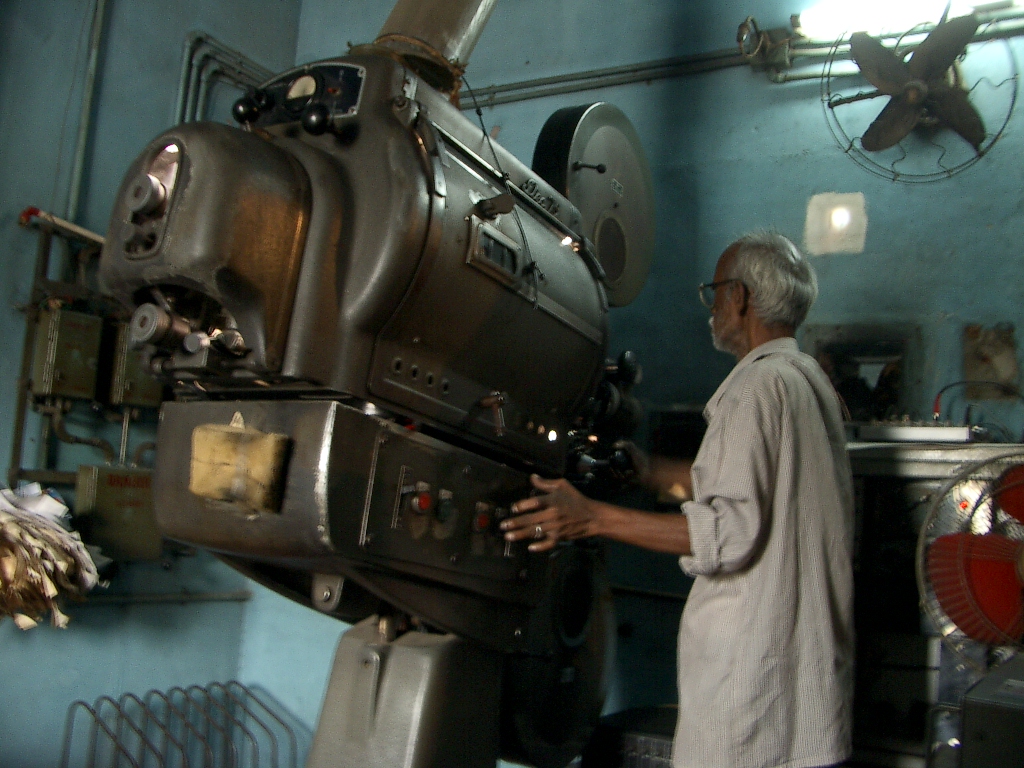
Safire was a pioneer featuring multiscreen complex. It had screens named Safire, Emerald & Blue Diamond. Its Blue Diamond cinema ran continuous shows, where one could buy a ticket and enter the theatre in the middle of a screening and continue to stay as long as one wanted, as the movie was screened non stop, back to back. Safire complex opened with the iconic 70MM movie ‘Cleopatra’, followed by Battle of the Bulge, Mutiny on the Bounty, South Pacific – all in mammoth 70MM. The Safire Complex also had the first ever Disco of Madras, named Nine Gems. It even had a restaurant serving Rajasthani culinary. When ever I pass by, these days, the bush grown compound where once Safire complex stood proudly on the Mount Road, I feel both melancholic & nostalgic.The Anand Theatre owned by an influential Congressman Umapathi had its mammoth electric screen raise before each movie projection started, revealing the silver screen, to the accompaniment of Spanish Gypsy tune, which, by the by, also inspired MSV to compose ‘Thulluvatho Ilamai’.
The projectionist with his projector at the erstwhile Anand theatre. PC: Sruti Harihara Subramanian
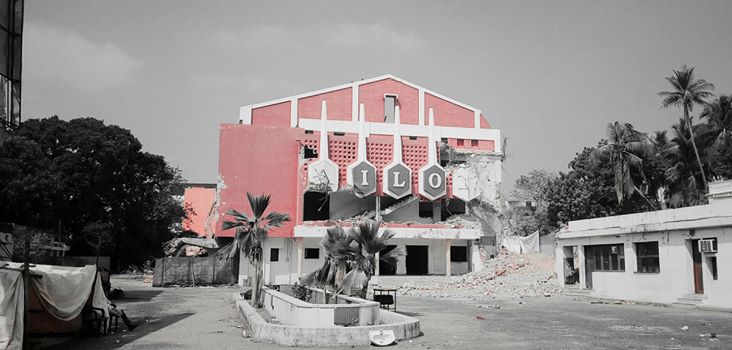
Then came the Pilot Theatre in late sixties at Royapettah, started by Mr. Sanjeevi of Pilot Pen Company, with Cine Rama technology.
Pilot theatre in the process of being demolished on Feb 9th 2017 PC: Srinivasa Ramanujam
This is the anthology to the current generation of cinema halls, which are cartelised screens in corporate run set-ups, such as PVR & Inox, with plush seatings, comfy air-conditioning with snacks served at your seat, if you had pre booked them.
PVR which spearheaded multiplexes across India was a JV by the Indian film distributor Priya Exhibitors and Australian Media company Village Roadshow, from which first letters P-V-R, their multiplexes are known now.
Movies are an experience, indeed, whether in sixties or now.





 The Cinema Resource Centre (TCRC)